Введение
You’re about to sign a contract with a pneumatic supplier who claims ISO 9001 certification. Their certificate looks legitimate, their prices are competitive, and they’re promising fast delivery. Six months later, quality issues emerge, and you discover their “certification” was from an unaccredited body—essentially worthless. Now you’re stuck with unreliable components, disrupted production, and a damaged relationship with your own clients. This nightmare scenario happens more often than you’d think. 😨
Проверка сертификации поставщика требует проверки подлинности сертификата ISO по базам данных аккредитованных регистраторов, подтверждения соответствия области сертификации требованиям к вашей продукции, изучения дат аудитов и записей о надзоре, запроса сопроводительной документации, например, отчетов об аудитах, а также понимания того, какие стандарты ISO (9001, 14001, 45001) актуальны для производителей пневматики.
I remember talking with David, a sourcing director at a packaging machinery company in Wisconsin. He’d been working with a “certified” pneumatic supplier for eight months when a major customer audit revealed the supplier’s ISO certificate was expired. The fallout cost his company a $2M contract. After that painful lesson, he implemented the verification framework I’m about to share with you—and he’s never been caught off-guard again.
Оглавление
- What ISO Standards Are Most Important for Pneumatic Manufacturers?
- How Do You Verify the Authenticity of ISO Certificates?
- What Should You Look for in Certification Scope and Exclusions?
- How Can You Assess a Supplier’s Ongoing Compliance Beyond the Certificate?
What ISO Standards Are Most Important for Pneumatic Manufacturers?
Not all ISO standards are created equal—knowing which ones matter helps you evaluate suppliers effectively. 🎯
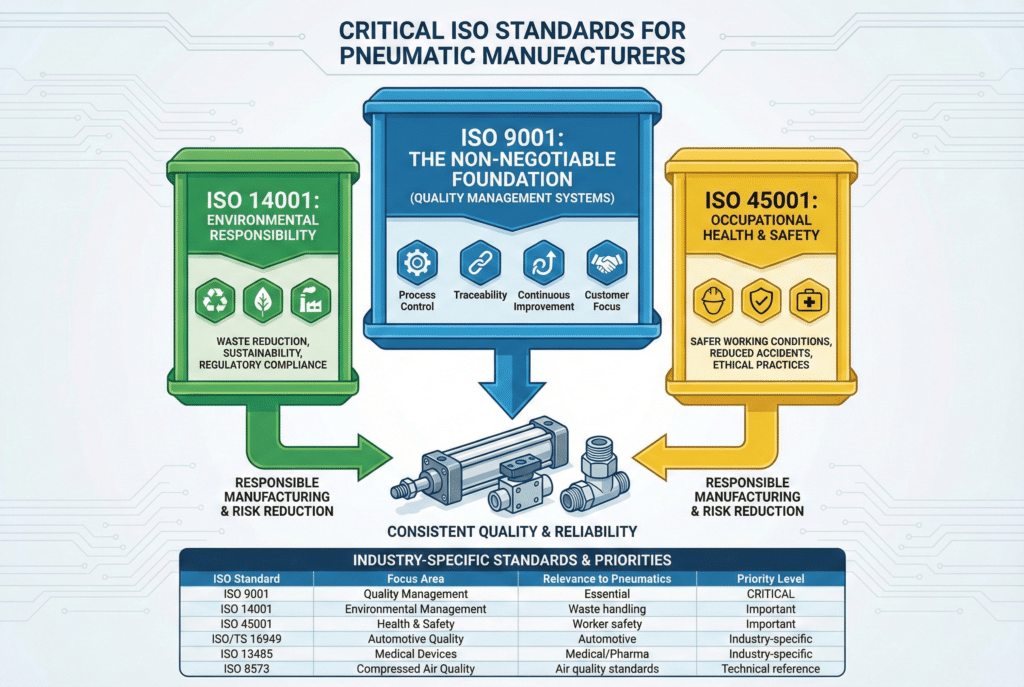
The most critical ISO standards for pneumatic manufacturers are ISO 9001 (quality management systems), ISO 14001 (environmental management), and ISO 45001 (occupational health and safety). For pneumatic components specifically, ISO 9001 certification is essential, while ISO 14001 and ISO 45001 demonstrate commitment to responsible manufacturing practices that reduce supply chain risks.
ISO 9001: The Non-Negotiable Foundation
ISO 90011 is the global standard for quality management systems (QMS). For pneumatic manufacturers, this certification means:
Управление процессом: Documented procedures for design, production, testing, and delivery ensure consistent quality across every batch of rodless cylinders, fittings, or valves.
Прослеживаемость2: Raw materials are tracked through production to finished goods, enabling rapid response if quality issues emerge.
Непрерывное совершенствование: Regular management reviews and corrective action processes drive ongoing quality enhancement.
Customer focus: Systematic approaches to understanding and meeting customer requirements.
At Bepto Pneumatics, our ISO 9001 certification isn’t just a plaque on the wall—it’s embedded in everything we do, from incoming material inspection to final pressure testing before shipment. 💪
ISO 14001: Environmental Responsibility
While not always mandatory, ISO 140013 certification signals a supplier’s commitment to environmental management:
- Proper handling and disposal of manufacturing waste
- Energy efficiency initiatives
- Compliance with environmental regulations
- Reduced risk of environmental incidents that could disrupt your supply chain
For companies with corporate sustainability goals or customers requiring environmental compliance, this certification is increasingly important.
ISO 45001: Workplace Safety Standards
ISO 45001 (which replaced OHSAS 18001) focuses on occupational health and safety management:
- Safer working conditions reduce accidents and production disruptions
- Lower worker injury rates correlate with better quality control
- Demonstrates ethical manufacturing practices
Industry-Specific Standards Worth Knowing
| ISO Standard | Focus Area | Relevance to Pneumatics | Priority Level |
|---|---|---|---|
| ISO 9001 | Quality Management | Essential for all manufacturers | Критический |
| ISO 14001 | Environmental Management | Waste handling, sustainability | Важно |
| ISO 45001 | Health & Safety | Worker safety, ethical practices | Важно |
| ISO/TS 16949 | Automotive Quality | Required for automotive suppliers | Industry-specific |
| ISO 13485 | Медицинские приборы | Required for medical/pharma applications | Industry-specific |
| ISO 85734 | Compressed Air Quality | Air quality standards for systems | Technical reference |
How Do You Verify the Authenticity of ISO Certificates?
A certificate is only as good as its authenticity—and fake certificates are surprisingly common. 🔍
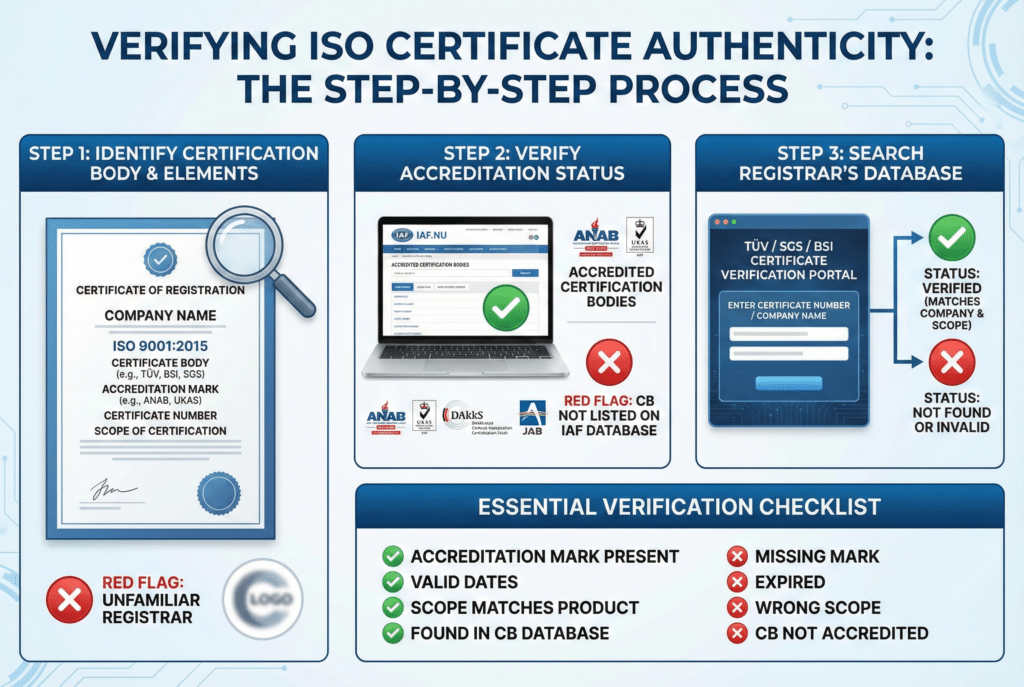
Verify ISO certificate authenticity by checking the certification body’s accreditation status with IAF (International Accreditation Forum)5 members, searching the registrar’s public database for the supplier’s listing, confirming certificate numbers and validity dates, checking for proper accreditation marks (ANAB, UKAS, etc.), and requesting recent surveillance audit reports to confirm ongoing compliance.
The Accreditation Body Verification Process
Here’s your step-by-step verification checklist:
Step 1: Identify the Certification Body
Look at the ISO certificate. The certification body (also called registrar or certification authority) should be clearly identified—examples include TÜV, BSI, SGS, DNV, Bureau Veritas, or others.
Красный флаг: If the certification body name is unfamiliar or difficult to verify online, proceed with extreme caution.
Step 2: Verify Accreditation Status
The certification body itself must be accredited by a recognized national accreditation body. Check for accreditation marks on the certificate:
- ANAB (ANSI National Accreditation Board) – USA
- UKAS (United Kingdom Accreditation Service) – UK
- DAkkS (Deutsche Akkreditierungsstelle) – Germany
- CNAS (China National Accreditation Service) – China
- JAB (Japan Accreditation Board) – Japan
Visit the IAF website (iaf.nu) and search their database of accredited certification bodies. If the supplier’s certification body isn’t listed, the certificate is likely worthless.
Step 3: Search the Registrar’s Database
Most legitimate certification bodies maintain public databases of certified companies. For example:
- TÜV: Search their online certificate database
- SGS: Use their certificate verification portal
- BSI: Check their client directory
Enter the supplier’s company name or certificate number. If they don’t appear, contact the certification body directly.
Real-World Verification Example
Let me share how I helped Linda, a procurement specialist at a material handling equipment company in North Carolina, avoid a costly mistake. She was evaluating a new pneumatic cylinder supplier from Asia who provided an impressive-looking ISO 9001 certificate.
Following my verification process, she discovered:
- The certification body was accredited (good sign ✓)
- The certificate number was valid (good sign ✓)
- BUT the scope of certification covered “metal fabrication”—not pneumatic components (red flag! 🚩)
The supplier was technically certified, but not for the products they were selling her. She walked away and eventually partnered with Bepto Pneumatics, where our ISO 9001 scope explicitly covers “design, manufacture, and supply of pneumatic cylinders and components.”
What to Look for on a Legitimate Certificate
A genuine ISO certificate should include:
- Company legal name and address
- Certification body name and logo
- Accreditation body mark (ANAB, UKAS, etc.)
- Standard and version (e.g., “ISO 9001:2015”)
- Certificate number (unique identifier)
- Issue date and expiry date (typically 3-year validity)
- Scope of certification (specific activities covered)
- Signature of authorized representative
Missing any of these elements? Ask questions. 🤔
What Should You Look for in Certification Scope and Exclusions?
The scope statement is where the rubber meets the road—it defines exactly what the certification covers.
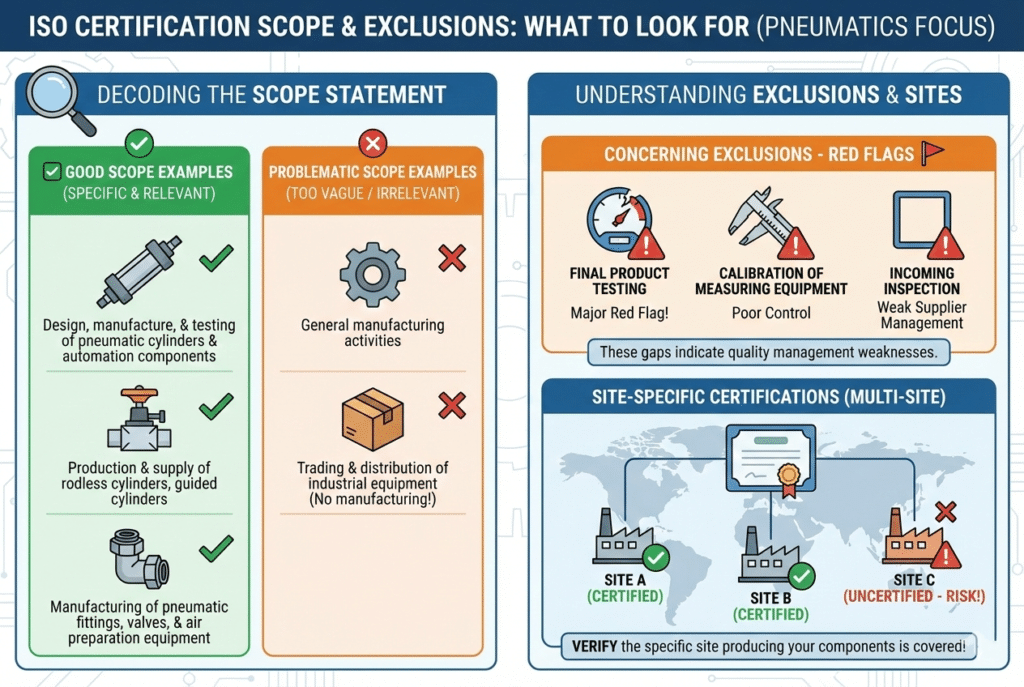
Certificate scope should explicitly include the pneumatic products you’re purchasing (e.g., “design and manufacture of pneumatic cylinders, valves, and fittings”) rather than generic manufacturing activities. Watch for exclusions that might exempt critical processes like design, testing, or calibration—these gaps can indicate quality management weaknesses in areas that directly impact product reliability.
Decoding Scope Statements
The scope statement appears on every ISO certificate and defines what activities are covered. Here’s what to look for:
Good Scope Examples (Specific and Relevant)
✅ “Design, manufacture, and testing of pneumatic cylinders and automation components”
✅ “Production and supply of rodless cylinders, guided cylinders, and pneumatic actuators”
✅ “Manufacturing of pneumatic fittings, valves, and air preparation equipment”
Problematic Scope Examples (Too Vague or Irrelevant)
❌ “General manufacturing activities”
❌ “Metal products and components”
❌ “Trading and distribution of industrial equipment” (no manufacturing!)
Understanding Exclusions
ISO 9001 allows certain exclusions under Clause 7 (Support) and Clause 8 (Operations), but these should be minimal and justified:
Acceptable exclusions:
- Design (if the company only manufactures to customer specifications)
- Certain testing methods not applicable to their products
Concerning exclusions:
- Calibration of measuring equipment (suggests poor measurement control)
- Incoming inspection (suggests weak supplier management)
- Final product testing (major red flag! 🚩)
Site-Specific Certifications
If your supplier has multiple manufacturing facilities, verify that the specific site producing your components is covered:
Multi-site certificates: Cover multiple locations under one certificate (look for site addresses listed)
Single-site certificates: Cover only one facility (confirm it’s the right one)
I once worked with Thomas, an engineering manager at an automotive supplier in Michigan, who assumed his pneumatic valve supplier’s ISO certification covered all their facilities. When quality issues emerged, he discovered the problematic valves came from an uncertified satellite facility. Always verify the production location! 📍
How Can You Assess a Supplier’s Ongoing Compliance Beyond the Certificate?
A certificate is a snapshot in time—ongoing compliance requires continuous verification. 🔄
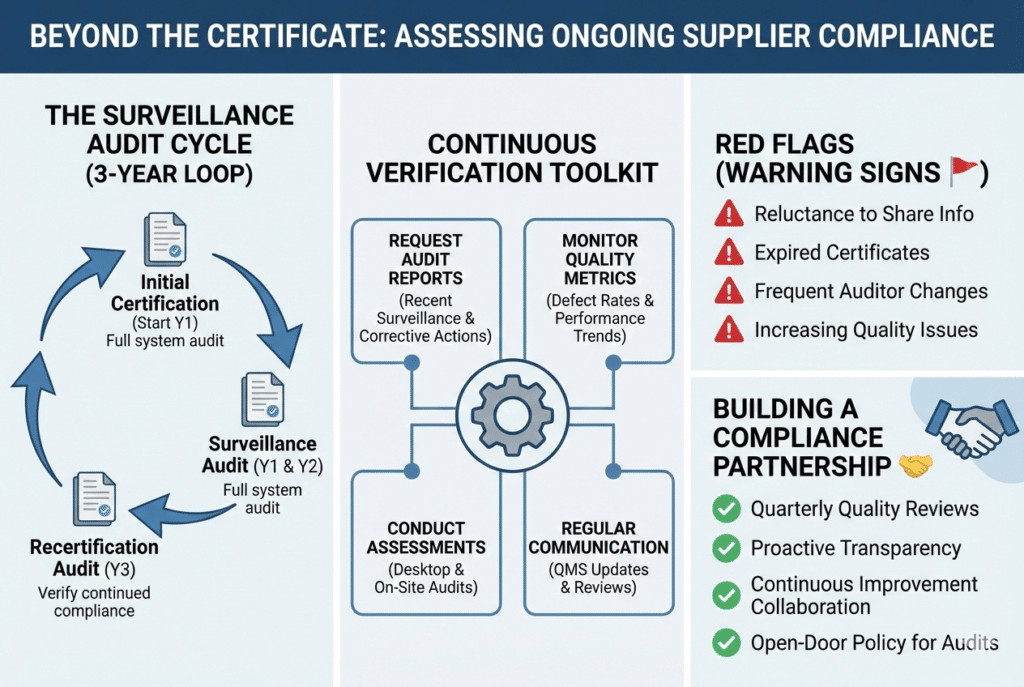
Assess ongoing compliance by requesting recent surveillance audit reports (conducted annually), reviewing corrective action records from audits, checking certificate validity dates and renewal status, conducting periodic supplier audits or assessments, monitoring quality metrics and performance trends, and establishing regular communication about quality management system updates.
The Surveillance Audit Cycle
ISO certification isn’t “one and done”—it requires ongoing maintenance:
| Audit Type | Частота | Назначение | What to Request |
|---|---|---|---|
| Initial Certification | Once (3-year cycle start) | Full system audit | Complete audit report |
| Surveillance Audit | Annually (Years 1 & 2) | Убедитесь в постоянном соблюдении требований | Surveillance audit summary |
| Recertification Audit | Every 3 years | Full system re-evaluation | Recertification audit report |
Key point: A certificate issued in 2022 should have surveillance audits in 2023 and 2024, then recertification in 2025. If your supplier can’t provide evidence of these audits, their certification may be suspended or withdrawn.
Requesting Audit Documentation
Professional suppliers should be willing to share (at minimum):
Audit summary reports: High-level findings without proprietary details
Non-conformance records: Issues identified and how they were resolved
Certificate status: Confirmation from certification body that certificate is current
At Bepto Pneumatics, we proactively share our audit summaries with key partners. Transparency builds trust. 🤝
Conducting Your Own Supplier Assessments
Don’t rely solely on third-party audits—conduct your own periodic assessments:
Desktop Assessment (Annual)
- Review updated certificates and audit reports
- Analyze quality metrics (defect rates, on-time delivery, etc.)
- Check for any regulatory issues or recalls
- Review customer complaint handling
On-Site Assessment (Every 2-3 Years)
For strategic suppliers, consider on-site visits to evaluate:
- Production process controls
- Оборудование для тестирования и контроля
- Calibration programs
- Document control systems
- Employee training records
- Corrective action effectiveness
Building a Compliance Partnership
The best supplier relationships go beyond transactional certificate checking. Here’s how we work with our strategic partners at Bepto Pneumatics:
Quarterly quality reviews: We share performance data, discuss trends, and collaborate on improvements.
Proactive communication: If we identify any quality system issues during our internal audits, we notify affected customers immediately—before they discover problems.
Continuous improvement projects: We invite key customers to participate in our improvement initiatives, ensuring our QMS evolves to meet their changing needs.
Open-door policy: Want to visit our facility and review our quality systems? We welcome it. Serious B2B partnerships are built on transparency, not secrecy. 💼
Red Flags That Indicate Compliance Issues
Watch for these warning signs that suggest certification may not reflect reality:
🚩 Reluctance to share audit information: “It’s confidential” is a cop-out for legitimate business partners
🚩 Expired or soon-to-expire certificates: Without evidence of renewal in progress
🚩 Frequent changes in certification bodies: May indicate they’re “shopping” for easier auditors
🚩 Increasing quality issues: Despite maintaining certification
🚩 Poor document control: Outdated procedures, missing records, inconsistent documentation
🚩 Resistance to customer audits: Quality suppliers welcome verification
Заключение
ISO certification verification isn’t about being suspicious—it’s about being smart and protecting your business through due diligence, ongoing monitoring, and partnerships with suppliers who view certification as a commitment, not just a marketing tool. 🎯
FAQs About ISO Standards for Pneumatic Manufacturers
Является ли сертификация ISO 9001 обязательной для поставщиков пневматики?
Хотя в большинстве регионов сертификация ISO 9001 не является обязательной по закону, она является отраслевым стандартом для профессиональных производителей пневматики и часто обязательна для поставщиков в автомобильную, аэрокосмическую, медицинскую и другие регулируемые отрасли. Even if your industry doesn’t require it, ISO 9001 certification provides assurance of consistent quality management practices. At Bepto Pneumatics, we maintain ISO 9001 certification because it’s the right way to do business—it keeps us disciplined, accountable, and focused on continuous improvement.
Как определить, что сертификат ISO поддельный?
Verify the certification body is accredited by checking IAF member databases, search the registrar’s public certificate directory for the supplier’s listing, confirm the certificate number and dates are valid, and look for proper accreditation marks from recognized bodies like ANAB or UKAS. В поддельных сертификатах часто встречаются орфографические ошибки, незнакомые органы по сертификации или отсутствуют знаки аккредитации. Если вы сомневаетесь, свяжитесь с органом по сертификации напрямую - они могут подтвердить подлинность в течение нескольких минут.
What’s the difference between ISO 9001:2008 and ISO 9001:2015?
ISO 9001:2015 - это текущая версия, отличающаяся риск-ориентированным мышлением, более активным участием руководства и улучшенным процессным подходом по сравнению с версией 2008 года, которая была снята с производства в 2018 году. Any supplier still showing ISO 9001:2008 certification has an expired certificate—they should have transitioned by September 2018. This is a major red flag indicating they either let their certification lapse or haven’t kept up with current standards. 🚩
Нужно ли мне требовать ISO 14001 и ISO 45001 в дополнение к ISO 9001?
ISO 9001 необходим для обеспечения качества; ISO 14001 и ISO 45001 - ценные дополнения, демонстрирующие приверженность принципам охраны окружающей среды и безопасности, но они могут не иметь решающего значения, если этого не требует ваша отрасль или корпоративная политика. Обычно я рекомендую отдавать приоритет проверке ISO 9001, а сертификаты по экологии и безопасности рассматривать как второстепенные факторы. При этом поставщики, имеющие все три сертификата, как правило, демонстрируют более зрелые системы управления и более низкие риски в цепочке поставок.
Как компания Bepto Pneumatics демонстрирует постоянное соответствие требованиям ISO?
Мы ежеквартально проводим внутренние аудиты, ежегодно проходим надзорные аудиты в аккредитованном органе по сертификации, ведем полную документацию по прослеживаемости, обмениваемся резюме аудитов со стратегическими партнерами и приветствуем проведение аудитов наших предприятий и систем качества со стороны клиентов. Our ISO 9001:2015 certification (scope: design, manufacture, and supply of pneumatic cylinders and components) is publicly verifiable, and we’re happy to provide our latest audit reports to serious business partners. Quality isn’t just what we promise—it’s what we prove every day. Give me a call, and I’ll walk you through our quality management system personally. 📞
-
Gain a comprehensive understanding of the ISO 9001 requirements for establishing a robust quality management system. ↩
-
Discover how manufacturing traceability systems ensure product quality and safety throughout the entire supply chain. ↩
-
Explore how the ISO 14001 framework helps organizations improve their environmental performance and resource efficiency. ↩
-
Refer to the ISO 8573 standards to understand the specific purity classes and contamination levels for compressed air. ↩
-
Learn about the role of the International Accreditation Forum in ensuring the global validity of accredited certifications. ↩