

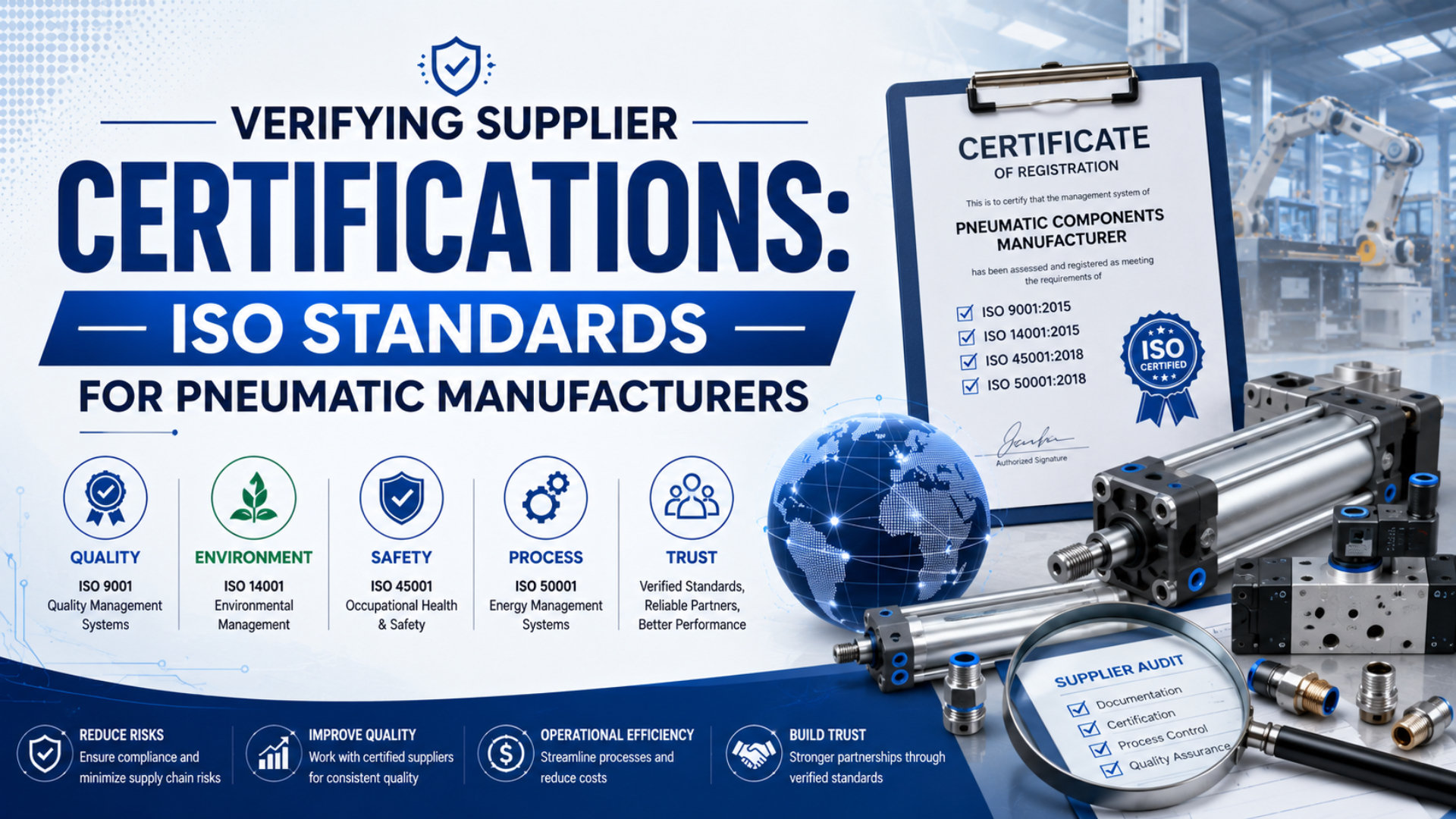
Verify a pneumatic supplier’s ISO certificate by matching six items: the legal entity, manufacturing site, standard and edition, certificate status, accredited certification chain, and certification scope. Then verify the actual product separately. A valid ISO 9001 certificate supports confidence in a supplier’s quality management system, but it doesn’t certify the cylinder, valve, fitting, or shipment named in your purchase order.
That distinction changes the approval process. The certificate is one evidence layer. Manufacturing controls, inspection records, functional tests, change control, and lot release records are others. If they don’t connect to the quoted product and factory, the certificate can’t close the gap.
Key Takeaways
- ISO itself issues no certificates; independent certification bodies do.
- Use six recorded checks for identity, site, status, accreditation, scope, and evidence.
- ISO 9001 certification applies to a management system, not the pneumatic product.
- ISO 19011:2026 is the current management-system audit guideline.
The most useful procurement model is a two-chain test. The first chain proves who certified which management system at which site. The second proves that the offered product was built, inspected, tested, and released under controlled requirements. Supplier approval is incomplete until both chains meet.
What Does an ISO 9001 Certificate Actually Prove?
ISO and IAF guidance draws one hard boundary: ISO 9001 certification applies to the quality management system within the stated certification scope, not to each product. It does not guarantee 100% product conformity or prove that a pneumatic cylinder meets another ISO specification (ISO and IAF, 2016).
ISO develops standards but does not audit organizations or issue ISO certificates. An independent certification body performs the management-system audit. An accreditation body can then confirm that the certification body is competent for the relevant certification activity. ISO describes accreditation as an added layer of confidence, not a compulsory feature of every certification arrangement (ISO, accessed 2026).
This gives buyers three different claims to keep separate:
| Claim | What it can support | What it does not prove |
|---|---|---|
| Certified to ISO 9001 | The QMS within the defined scope was assessed by a certification body | The cylinder itself is ISO 9001 certified |
| Accredited certification | An accreditation body recognized the certification body’s competence for the relevant activity | Every shipment is conforming |
| Product conformity evidence | The offered configuration met specified dimensions, materials, inspections, and tests | The supplier’s whole QMS is certified |
Does a valid certificate mean the supplier’s processes deserve no further review? No. It means the management system passed a third-party assessment within a stated boundary. Purchasing still has to decide whether that boundary covers the correct legal entity, production site, product family, and activities. Accredited certification is certification delivered by a body whose competence for the relevant activity has been recognized by an accreditation body. ISO 9001 certification is generally voluntary, although a customer, tender, regulator, or sector scheme can make it a contractual condition. Write the condition into the supplier-approval procedure, apply it consistently to comparable suppliers, and avoid calling ISO 9001 universally mandatory. Name who checks the record and where the approval evidence is stored.
The current published edition remains ISO 9001:2015 together with Amendment 1:2024. ISO expects the sixth edition in September 2026 and states that certified organizations will receive a transition period. A supplier displaying a valid 2015-edition certificate in July 2026 should not be rejected merely because the next edition is approaching (ISO, 2015; ISO, 2026).
Which ISO Standards Matter for a Pneumatic Supplier?
As of July 2026, the applicable editions in this supplier screen include ISO 9001:2015 with Amendment 1:2024, ISO 14001:2026, ISO 45001:2018, and ISO 19011:2026. Each addresses a different management or audit question; none replaces product-specific acceptance evidence (ISO, ISO, ISO, 2026).
Start with the requirement you actually need to control. Quality, environmental performance, occupational safety, audit practice, product dimensions, and compressed-air purity are different subjects. A supplier may legitimately use several standards, but one certificate should not be presented as proof of all of them.
| Standard or scheme | What it addresses | How a pneumatic buyer should use it |
|---|---|---|
| ISO 9001:2015 plus Amd 1:2024 | Quality management system | Verify entity, site, scope, status, certification body, and accreditation |
| ISO 14001:2026 | Environmental management system | Require when environmental controls or customer policy make it relevant |
| ISO 45001:2018 plus Amd 1:2024 | Occupational health and safety management system | Use for OH&S requirements, not as a proxy for cylinder quality |
| ISO 19011:2026 | Guidelines for auditing management systems | Structure internal and supplier audit programs; it does not create a certification |
| IATF 16949:2016 | Automotive-sector QMS requirements used with ISO 9001 | Apply only when the automotive supply chain and customer-specific requirements call for it |
| ISO 15552:2018 | Basic, mounting, and accessory dimensions for defined pneumatic cylinders | Verify dimensional interchangeability separately from QMS certification |
| ISO 8573-1:2010 | Compressed-air purity classes for particles, water, and oil | Specify air quality at the required point; it is not a manufacturer certification |
The old ISO/TS 16949 reference should not appear in a current checklist. IATF states that IATF 16949:2016 cancelled and replaced ISO/TS 16949:2009, with old certificates invalid after September 2018 (IATF, accessed 2026). ISO 8573 also needs precise wording: ISO 8573-1:2010, not “ISO 85734,” classifies compressed-air particles, water, and oil. The ISO 8573-1 air quality guide covers point-of-use verification. Product standards answer another question. ISO 15552 supports defined dimensional interfaces, but its label does not establish seal materials, cushioning behavior, sensor compatibility, leakage, service life, or application performance. Use the ISO 15552 interchangeability checklist to control those features. This separation prevents a QMS certificate from becoming a shortcut for environmental, automotive, air-quality, or dimensional claims that need independent evidence.
How Do You Authenticate an ISO Certificate?
ISO’s certification guidance identifies two primary verification routes: use IAF CertSearch, or contact the certification body, accreditation body, or ISO directly. A defensible supplier check expands that into six recorded checks so purchasing can reproduce the result later (ISO, accessed 2026).
1. Match the legal entity
Compare the certified organization name with the legal entity on the quotation, contract, invoice, and supplier master record. Record any relationship between a trading company, parent company, and factory. Similar brand names are not evidence that the contracting entity is covered.
2. Match the manufacturing site
Check every address or site schedule attached to the certificate. The listed headquarters may not be the facility machining tubes, assembling cylinders, or performing final tests. If several sites share a certificate, identify which activities are covered at the actual production location.
3. Check the standard, edition, number, and status
Record the full standard reference, certificate number, issue date, expiry date, and current status. Use the certification body’s directory or certificate-verification portal. A PDF copy is static; the issuer’s current record is stronger evidence of active, suspended, withdrawn, or expired status.
4. Identify the certification body
Confirm the organization that issued the certificate. Do not treat the ISO logo as an issuer mark. ISO states that it does not issue certificates and does not permit its logo to be used in connection with certification (ISO, accessed 2026).
5. Verify the accreditation chain
Confirm the accreditation body and whether the certification body is accredited for the relevant management-system activity. Global Accreditation Cooperation Incorporated became fully operational on January 1, 2026 and assumed the former international roles of IAF and ILAC (Global ACI, 2026).
IAF CertSearch remains a practical certificate lookup. Search by the certified entity name or certificate number, then compare the standard, status, certified locations, certification body, and accreditation body. A missing result is a trigger for follow-up, not automatic proof of fraud. CertSearch notes that a valid certificate may be absent because data has not been added or the entity is confidential; contact the issuer or accreditation body to resolve the gap (IAF CertSearch, accessed 2026).
6. Read the certification scope
The scope should describe the relevant products, services, and main activities without implying product certification. Phrases such as “manufacture of pneumatic cylinders and automation components” are more relevant than “trading of industrial products” when the supplier claims to be the manufacturer. The wording still has to be matched to the site schedule and real process route.
How Should You Read Certification Scope and Applicability?
The ISO 9001:2015 edition replaced the former exclusion concept with applicability. The organization may claim conformity only when requirements judged not applicable do not affect its ability or responsibility to deliver conforming products and services (ISO 9001 Auditing Practices Group, 2020).
The scope of ISO 9001, the organization’s QMS scope, the certification scope, and the scope of one audit are related but different. The certificate normally communicates the covered activities, products or services, organization, and physical locations. One audit visit can sample only part of that QMS while the certification program covers the full cycle.
Read the certificate scope with five questions:
- Which products and services are named? Confirm the quoted cylinder, valve, actuator, or component family fits the wording.
- Which activities are covered? Distinguish design, manufacture, assembly, testing, distribution, and servicing.
- Which sites perform those activities? Match the production address and any attached site schedule.
- Which processes are outsourced? Outsourcing does not transfer responsibility for conformity. Check how the supplier approves and controls the external provider.
- Which requirements are not applicable? Ask for the documented justification when it affects design responsibility or other controls relevant to your order.
Certification scope is the statement communicating the certified activities, products or services, organization, and covered locations. It is not a list of every inspection step. Avoid claims that calibration, incoming inspection, or final testing must appear as separate lines on the certificate. The QMS must control the processes and resources needed to meet product requirements, but the exact inspection and test plan comes from product, customer, statutory, and risk requirements. Design responsibility deserves special attention. A supplier manufacturing only to a buyer-controlled drawing may justify that some design and development requirements are not applicable. A supplier selecting seals, tolerances, materials, cushioning, or structural dimensions is making design decisions. Assign those responsibilities explicitly. Record this boundary in the supplier approval file.
Would the same certificate automatically cover a satellite assembly plant or a new subcontractor? No. Recheck the site schedule, scope, and external-provider controls whenever the production route changes. The factory capability audit guide shows how to follow one order through the actual route.
What Evidence Is Needed Beyond the Certificate?
ISO and IAF state that accredited ISO 9001 certification does not guarantee 100% product conformity and does not certify the product itself. Supplier approval therefore needs a second evidence chain tied to the offered cylinder, its manufacturing route, and the released lot (ISO and IAF, 2016).
Use an evidence ladder instead of asking whether a supplier is “ISO certified.” Product conformity evidence means records showing that a defined product met defined requirements under stated conditions. Each higher level answers a question the level below cannot answer.
Product definition
Freeze the supplier part number, buyer drawing revision, bill of materials where applicable, product standard, options, markings, packaging, and approved deviations. A catalog family name is not a controlled configuration. For an ISO 15552 cylinder order, use the ISO 15552 procurement checklist to capture application and interface requirements.
Manufacturing process
Ask for the process flow that makes the offered configuration. Identify critical and outsourced operations such as tube finishing, piston-rod finishing, coating, seal supply, machining, assembly, leakage testing, and packaging. Confirm who approves process changes and how the effective lot is identified.
Measurement and calibration
Review the inspection plan, decisive measurement equipment, current calibration status, method, acceptance limit, and reaction to an out-of-tolerance result. A calibration certificate alone does not show that the correct gage or method was used on the product.
Inspection and functional testing
Define which characteristics are checked, sample frequency, test conditions, acceptance limits, record format, and release authority. Leakage, stroke operation, cushioning, sensor function, dimensions, and surface requirements may need separate evidence. The required tests depend on the purchased configuration and its application.
Traceability and containment
Set the degree of traceability required by risk, contract, and regulation. The record may connect the shipped lot or serial number to material or component batches, process history, inspection results, deviations, and release. Full raw-material-to-serial traceability is not automatically required for every ISO 9001-certified product.
Corrective action and change control
Review how the supplier contains a nonconforming lot, identifies affected shipments, determines cause, verifies corrective action, and prevents unapproved substitution. Ask for examples with confidential commercial information removed. Product or process changes should state the affected part, reason, validation evidence, approval requirement, and first effective lot.
Risk-Based Supplier Audit Depth
ISO 19011 reached its fourth edition in May 2026 and now provides the current guidance for managing audit programs, conducting management-system audits, and evaluating auditor competence. It supports internal, supplier, and certification audits, but it does not prescribe one universal audit interval for every supplier (ISO 19011, 2026).
Set audit depth from consequence and uncertainty, not a fixed calendar slogan. A catalog accessory for a noncritical machine and a custom cylinder controlling a suspended load should not receive the same evidence plan.
| Supplier risk condition | Appropriate review | Escalation trigger |
|---|---|---|
| Low consequence, standard catalog item, proven history | Certificate verification plus specification and order review | Status change, recurring defect, or site change |
| Moderate consequence, configured product, new supplier | Desktop process review plus sample and first-lot evidence | Missing records, failed qualification, or unclear outsourced process |
| High consequence, custom or safety-relevant duty | Cross-functional on-site or remote process audit plus witnessed qualification | Unapproved change, major nonconformity, failed containment, or production transfer |
A desktop review can cover certificate status, legal identity, site, scope, process flow, quality plan, sample evidence, and corrective-action records. An on-site audit becomes more useful when records conflict, manufacturing capability is uncertain, critical processes are difficult to verify remotely, or the potential failure consequence is high.
Do not demand the complete third-party certification audit report as if every buyer is entitled to it. The report may contain confidential information outside your order. Ask for the certificate status, most recent audit date, general conclusion, relevant nonconformity status, and evidence that applicable findings were closed. If the supplier declines, evaluate whether alternative evidence closes your risk rather than declaring the certificate invalid.
Reverification should be event-driven as well as periodic. Trigger it after a certificate status alert, expiry or transition milestone, legal-entity change, factory move, process transfer, certification-body change, major quality escape, repeated corrective-action failure, or unapproved material substitution.
Supplier Approval Decision
A practical approval file should contain six closed gates: identity, certificate status, accreditation, scope, process evidence, and product or order evidence. This structure applies ISO’s distinction between certification and accreditation while preventing a valid management-system certificate from being treated as a product certificate (ISO, accessed 2026).
Use knockout conditions before price and lead-time scoring:
- Stop if the contracting entity and factory relationship cannot be established.
- Stop if the certificate number, issuer, status, or applicable site cannot be verified.
- Stop if the scope does not cover the relevant activity and the supplier presents it as manufacturing certification.
- Pause if the product definition, decisive inspection, functional test, or change-control evidence is missing.
- Limit approval to the exact site, product family, configuration, and conditions supported by the evidence.
The approval record should name the approved scope, reviewers, open conditions, evidence locations, and next review trigger. It should distinguish certificate monitoring from product acceptance. The first keeps the credential current. The second decides whether a component or lot meets the purchase requirements.
For broader onboarding, connect this decision to the private-label manufacturer qualification framework. Certificate verification is one gate inside that larger commercial and technical approval process.
Supplier Certification FAQs
Five questions cause most certificate-screening errors: whether certification is mandatory, whether it covers the product, what a missing database result means, which audit information is reasonable to request, and when to verify again. The answers follow ISO’s current certification guidance and 2026 audit framework (ISO, ISO 19011, 2026).
Is ISO 9001 certification mandatory for a pneumatic manufacturer?
Not universally. ISO states that organizations can implement ISO 9001 without certification. A customer, tender, regulator, or sector scheme can still require certification contractually. Define whether accredited certification is mandatory in the supplier procedure, then state the acceptable standard edition, scope, sites, certification status, and transition rules.
Does ISO 9001 certify the pneumatic cylinder itself?
No. ISO 9001 certification assesses the organization’s quality management system within the certification scope. ISO and IAF state that it does not certify the product or guarantee 100% conformity. Approve the cylinder through controlled drawings, material requirements, inspections, functional tests, application checks, and order-specific release evidence.
What should I do if a certificate is missing from IAF CertSearch?
Treat the missing result as an unresolved check, not immediate proof of fraud. Confirm the spelling, legal entity, certificate number, and site. Then contact the certification body or accreditation body. IAF CertSearch notes that some valid records may be absent, not yet uploaded, or restricted as confidential.
Must a supplier provide its complete certification audit report?
No universal rule gives every buyer the complete third-party report. It may contain confidential information unrelated to your order. Request current certificate status, the latest audit date, a relevant findings summary, and closure evidence. If those are unavailable, use a targeted supplier audit and product records to close the specific risk.
When should supplier certification be verified again?
Check at onboarding and before approval expires under your supplier-control procedure. Recheck after certificate expiry, suspension, withdrawal, standard transition, legal-entity change, factory move, process transfer, certification-body change, major quality escape, repeated corrective-action failure, or any event that could disconnect the certificate from the product’s real manufacturing route.
Sources and technical references
The sources below are current standards-body, accreditation, and scheme-owner references. Retrieval dates are included so later reviewers can recheck editions and organizational changes.
- ISO, Certification, certification and verification; retrieved 2026-07-26.
- ISO 9001:2015, current edition and amendment; retrieved 2026-07-26.
- ISO 9001 edition 6 status, publication and transition; retrieved 2026-07-26.
- ISO and IAF, Expected Outcomes, product-claim boundary; retrieved 2026-07-26.
- ISO 9001 Scope and Applicability, scope and applicability; retrieved 2026-07-26.
- ISO/IEC 17021-1:2015, certification-body requirements; retrieved 2026-07-26.
- Global ACI, international accreditation role; retrieved 2026-07-26.
- IAF CertSearch verification guide, lookup fields and missing records; retrieved 2026-07-26.
- ISO 14001:2026, environmental management systems; retrieved 2026-07-26.
- ISO 45001:2018, occupational health and safety; retrieved 2026-07-26.
- ISO 19011:2026, audit guidelines; retrieved 2026-07-26.
- IATF 16949:2016, replacement of ISO/TS 16949; retrieved 2026-07-26.
- ISO 8573-1:2010, compressed-air purity classes; retrieved 2026-07-26.
- ISO 15552:2018, pneumatic cylinder dimensions; retrieved 2026-07-26.