

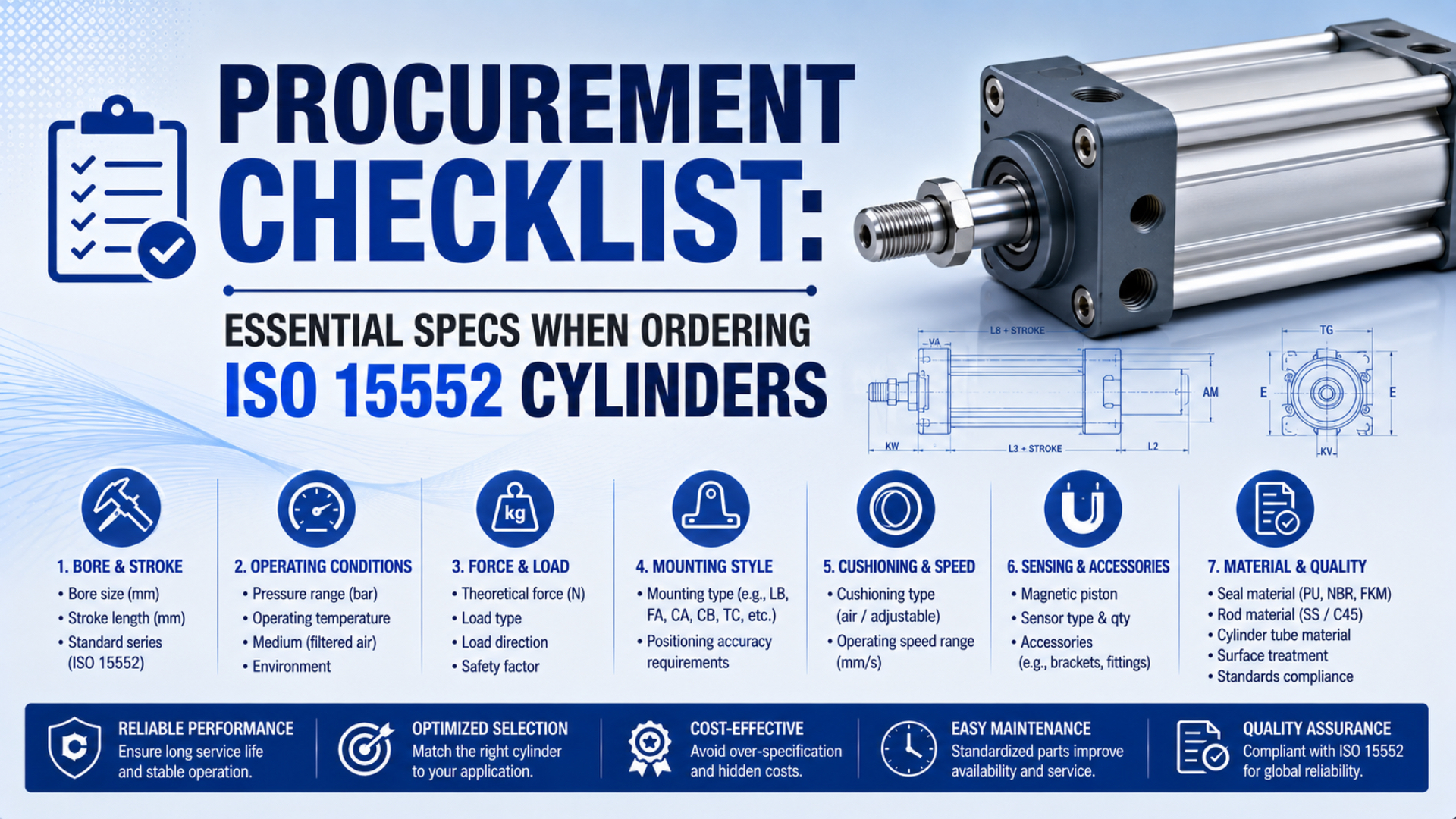
This ISO 15552 cylinder procurement checklist identifies the application duty, exact cylinder configuration, installation interfaces, operating environment, required supplier evidence, and acceptance criteria. “ISO 15552, 63 mm bore, 200 mm stroke” is a useful start, but it isn’t a complete order description.
ISO 15552 defines a dimensional platform for interchangeability. It doesn’t standardize every supplier’s port option, stroke offering, rod end, cushioning method, sensor, seal package, corrosion treatment, or functional rating. Purchasing must therefore control the requirement and the offered part number as two separate records.
Key Takeaways
- ISO 15552 covers 32-320 mm bores at a maximum rated pressure of 10 bar.
- The RFQ must separate application requirements from supplier-configured options.
- Approve the exact drawing, order code, evidence package, and acceptance criteria before release.
In this checklist
- What Does ISO 15552 Define for Procurement?
- Application Data the Buyer Must Provide
- How Should the Cylinder Configuration Be Written into the RFQ?
- Which Environmental and Safety Requirements Need Evidence?
- What Should the Supplier Return with the Quotation?
- Normalize Quotations Before Choosing a Supplier
- What Belongs in the Purchase Order and Order Acknowledgment?
- ISO 15552 Cylinder Procurement FAQs
What Does ISO 15552 Define for Procurement?
ISO 15552:2018 covers detachable-mount pneumatic cylinders from 32 to 320 mm bore at a maximum rated pressure of 1,000 kPa, or 10 bar. The 18-page standard establishes metric basic, mounting, and accessory dimensions needed for interchangeability (ISO 15552:2018, confirmed 2025).
The standard applies to single-rod and double-rod cylinders, with or without provision for magnetic sensors. That scope lets a buyer name the dimensional family and the required standard edition. It doesn’t mean that every compliant catalog offers all 11 nominal bore sizes, every stroke, or identical options.
Use three requirement owners:
Requirement ownership is the assignment of each specification field to the standard, the configured supplier product, or the machine application. It prevents a dimension controlled by ISO 15552 from being confused with a performance value or catalog option controlled elsewhere.
| Requirement owner | Controls | Procurement evidence |
|---|---|---|
| ISO 15552 | Applicable basic, mounting, and accessory dimensions | Standard edition plus supplier declaration |
| Supplier configuration | Orderable bore and stroke, ports, rod end, cushioning, sensing, seals, materials, and accessories | Exact part code, option-specific drawing, and technical data |
| Machine application | Force, travel, timing, load, orientation, environment, safety behavior, and acceptance limits | Approved requirement sheet and test plan |
This ownership split makes an RFQ auditable. Each field has an identified source, and a supplier can respond with a value, document, or exception. A blank field is visible. A vague statement such as “standard ISO cylinder” is not.
For replacement work, continue with the separate ISO 15552 cylinder interchangeability checklist. That process compares the installed unit, proposed replacement, first article, and approved release record. This procurement checklist instead focuses on building a complete new-order requirement.
Application Data the Buyer Must Provide
ISO 4414:2010 addresses significant pneumatic-system hazards across design, construction, installation, adjustment, operation, maintenance, cleaning, energy efficiency, and environment. Those eight lifecycle concerns explain why a cylinder RFQ needs the intended motion and operating context, not only nominal dimensions (ISO 4414:2010).
Start with the job the cylinder must perform:
| Application input | Minimum entry | Why the supplier needs it |
|---|---|---|
| Motion | Extend, retract, clamp, lift, index, tension, or another defined action | Establishes the load case and failure consequences |
| Required travel | Working travel in mm, including the controlled start and end points | Determines ordered stroke without an arbitrary allowance |
| Load | Mass, required process force, direction, and variation | Supports bore, rod, mounting, and cushion review |
| Timing | Target extend time, retract time, dwell, and cycles per minute | Connects the cylinder to valve, tubing, and flow requirements |
| Orientation | Horizontal, vertical rod up, vertical rod down, or angle | Changes gravity, alignment, drainage, and holding behavior |
| Guiding | External guide, linkage geometry, permitted side load, and moments | Prevents the piston rod from being treated as a load-bearing guide |
| Supply | Pressure measured during motion, available flow, and air-quality specification | Defines the operating point rather than a static regulator setting |
| Failure state | Required behavior after pressure or electrical power is lost | Separates motion production from safety or load-holding functions |
Do not add a generic 10 or 20 mm “safety margin” to the stroke. Measure the machine travel, account for adjustable stops and mounting geometry, then choose an orderable stroke that preserves the required end positions. Excess stroke can enlarge the installed envelope and create an unwanted impact zone.
Theoretical force is only one input. Use the Cylinder Force Calculator to record bore, rod diameter, working pressure, friction allowance, and design factor, then state the required usable force in the RFQ. The supplier must still check its configured cylinder rating and the real dynamic pressure.
If the target motion is fast, attach the mass, speed, and stroke-time requirement instead of asking for a “high-speed cylinder.” The high-speed cylinder specification checklist explains how valve flow, tubing, deceleration, impact energy, and sensor response become part of the same motion requirement.
How Should the Cylinder Configuration Be Written into the RFQ?
SMC’s current CP96 catalog lists seven bores from 32 to 125 mm, ports from G1/8 to G1/2, and bore-dependent piston speeds up to 700 or 1,000 mm/s. Those are CP96 configuration data, not universal ISO 15552 values (SMC CP96, 2025).
Create one line item per unique configuration. Record “supplier to propose” only where alternatives are genuinely acceptable.
Identity and dimensional fields
- ISO 15552 edition and requested conformance statement
- action: double-acting single rod, double rod, or another explicitly approved arrangement
- bore and stroke
- required retracted and extended envelope, with datum references
- piston rod end: thread system, size, pitch, gender, usable length, shoulder, and mating accessory
- nonstandard rod extension, rod material, coating, or protection feature
- quantity and project revision
A bore and stroke do not define the installed length. Ask for the exact configured drawing at the ordered stroke. Generic family outlines can omit special rod ends, cushion adjusters, sensor brackets, or accessory stacks.
The piston rod end thread specification guide provides a drawing-ready callout. Use it when a clevis, rod eye, coupling, or machine part already exists.
Mounting and alignment fields
- front, rear, foot, clevis, trunnion, or other mounting arrangement
- applicable standard mounting designation and supplier order code
- accessory part numbers, pin diameters, widths, and retained hardware
- cylinder centerline, load pivot geometry, and permitted angular movement
- installation clearances for ports, sensors, cushion screws, and maintenance tools
Don’t assume manufacturer sales codes are ISO designations. Parker and SMC use different order-code structures for comparable mounting arrangements. Put the physical mounting requirement and supplier code in separate columns.
Meaningful transverse load or moment belongs on an external guide, guided cylinder, or engineered linkage. A larger cylinder body does not turn a standard piston rod into a linear guide. For applications with uncertain alignment, specify the linkage and allowable movement instead of choosing an accessory from its name alone.
Pneumatic interface and functional options
- port thread designation, nominal size, seal method, location, and orientation
- cushioning type at each end and required adjustment access
- moving mass, approach speed, and end-of-stroke energy for cushion review
- piston magnet requirement
- sensor technology, voltage, output, cable or connector, quantity, and mounting hardware
- stroke adjustment, rod lock, bellows, scraper, tandem, or other special option
Festo’s current DSBC data lists elastic, adjustable pneumatic, and self-adjusting pneumatic cushioning, plus male and female rod-end options and strokes up to 2,800 mm in selected variants (Festo DSBC, 2026). That variety is precisely why “standard cushioning” and “standard rod thread” are insufficient RFQ entries.
Use the cylinder cushioning guide to define the deceleration problem. For sensing, specify the electrical interface using the reed switch and Hall effect sensor guide.
Which Environmental and Safety Requirements Need Evidence?
ISO 8573-1 classifies compressed-air purity against three principal contaminant groups: particles, water, and oil. A procurement specification should state the required class at the cylinder inlet or another defined measurement point instead of using “clean, dry air” as an acceptance criterion (ISO 8573-1:2010).
Record the normal and worst credible conditions:
- minimum, normal, and maximum ambient and media temperature
- indoor, outdoor, washdown, dust, chips, welding spatter, salt, or chemical exposure
- exact chemicals and cleaning agents, including concentration and contact duration
- required compressed-air purity and whether lubricated operation is permitted
- duty in cycles per minute, hours per shift, planned service life, and dwell conditions
- corrosion, material, lubricant, cleanroom, or food-contact requirements
- hazardous-area classification, zone, gas or dust group, and temperature class where applicable
- required machinery safety function and behavior after loss or restoration of energy
Do not ask for “FDA,” “ATEX,” “IP67,” or “cleanroom” as an isolated label. Name the applicable regulation or standard, the product boundary, the required certificate or test report, and the issuing entity. The cylinder, sensor, connector, cable, fitting, and installed machine can have different compliance responsibilities.
For clean environments, specify the particle, lubricant, exhaust, surface, and material constraints using the cleanroom cylinder qualification guide. A standard ISO profile cylinder is not automatically a cleanroom-qualified assembly.
Environmental adjectives should be translated into evidence fields. “Washdown” becomes chemical exposure, temperature, pressure, duration, ingress requirement, materials, and test evidence. “High cycle” becomes motion frequency, load, speed, service target, maintenance interval, and a defined failure threshold. Suppliers can evaluate those entries; they cannot verify an adjective.
Safety-related load holding also deserves its own circuit requirement. Trapping air in a cylinder is not automatically a safe mechanical hold because leakage, hose failure, valve behavior, compressibility, and external load remain. Define the risk-reduction function at machine level under the applicable safety process.
What Should the Supplier Return with the Quotation?
ISO 10099:2001 is a four-page standard covering final functional examination and acceptance criteria for double-acting, single-rod pneumatic cylinders. It does not replace an application-specific test plan, but it shows that dimensional conformance and final functional acceptance are separate evidence sets (ISO 10099, confirmed 2023).
Require a structured compliance response rather than a price-only quotation:
| Supplier return | Acceptable evidence | Clarify or reject when |
|---|---|---|
| Exact manufacturer and part number | Complete code with every prefix and suffix decoded | The quote names only a product family |
| ISO statement | Applicable standard and edition | “ISO type” or “equivalent” is unexplained |
| Configured drawing | Bore, stroke, mounting, installed lengths, rod end, ports, sensors, and accessories | The drawing is generic or uses a different stroke |
| Technical data | Pressure, temperature, speed, cushioning, media, materials, and option limits | Values come from another variant |
| Application response | Accepted values or explicit exceptions against every RFQ field | Silence is treated as agreement |
| Compliance documents | Named declarations, certificates, or reports tied to the offered configuration | A logo or marketing claim replaces evidence |
| Inspection proposal | Defined dimensional and functional checks | “Standard inspection” has no criteria |
| Commercial data | Unit price, quantity break, lead time basis, validity, warranty, Incoterm, and exclusions | Lead time or scope is conditional but unstated |
| Change control | Drawing revision and notification commitment | Manufacturing or design changes can occur without notice |
Request neutral 3D CAD only when the machine layout needs it. The controlled 2D drawing remains essential because it carries dimensions, tolerances, notes, and revision status. A model without a drawing can show geometry while leaving acceptance limits undefined.
If the supplier proposes an alternative, require a marked deviation list. “No deviations” should be an explicit response, not an inference from a returned quotation.
Normalize Quotations Before Choosing a Supplier
Parker’s current P1F technical catalog covers ISO 15552 cylinders from 32 to 125 mm bore and includes multiple material, cushioning, mounting, sensor, and accessory choices. Comparing only unit price can therefore compare unlike configurations even inside one ISO family (Parker P1F, 2026).
Bid normalization is the comparison of each supplier against the same controlled requirement, scope, evidence, and exception fields. Build a bid tab with one row per requirement and one column per supplier:
- requested value and document revision
- offered value
- evidence reference and page
- compliant, deviation, or not answered
- technical owner
- commercial effect
- resolution and approval date
Normalize accessories, sensors, connectors, mounting hardware, freight, inspection, documentation, and commissioning scope. A low cylinder price can exclude the hardware needed to make the line item usable.
Treat unanswered fields as unresolved risk, not assumed compliance. This makes quote comparison asymmetric in the right way: a documented deviation can be engineered and priced, while an empty cell cannot be evaluated. Procurement should not erase technical exceptions to make bids look comparable.
Use a short technical clarification cycle before final commercial negotiation. Freeze the accepted manufacturer, part number, drawing revision, and deviation register together. If the purchase is a cross-supplier replacement, use the deeper interchangeability verification process before approving the alternate.
What Belongs in the Purchase Order and Order Acknowledgment?
ISO 15552:2018 was confirmed current in 2025, but a standard reference alone still leaves supplier options unresolved. The purchase order should therefore identify the exact configured part, approved drawing revision, RFQ revision, accepted deviations, document deliverables, and inspection terms as controlled order requirements (ISO 15552).
Place these items on the purchase order or its controlled attachment:
- Manufacturer and complete part number.
- Quantity and delivery schedule.
- ISO 15552 edition and any required supplier statement.
- Approved drawing number, revision, and stroke.
- Mounting and rod-end accessories with separate part numbers.
- Sensor, cable, connector, and mounting hardware details.
- Environmental, material, lubricant, and compliance requirements.
- Inspection, certificate, traceability, packaging, and labeling requirements.
- Approved deviations and precedence between documents.
- Change-notification and substitution restrictions.
Then compare the supplier’s order acknowledgment line by line. Acknowledgment is the final opportunity to catch a changed suffix, omitted accessory, substituted sensor, revised lead-time assumption, or undocumented exception before manufacture.
Copyable RFQ and PO checklist
APPLICATION
Motion/function:
Required travel:
Load/process force and direction:
Extend/retract time:
Cycles per minute and operating hours:
Orientation and external guiding:
Pressure during motion and available flow:
Required behavior after loss of energy:

CYLINDER CONFIGURATION
Standard and edition: ISO 15552:2018
Action:
Bore:
Stroke:
Mounting and accessories:
Rod-end thread and mating hardware:
Port thread, size, location, and orientation:
Cushioning at each end:
Piston magnet and sensor package:
Special rod, seal, material, or protection options:

ENVIRONMENT AND COMPLIANCE
Temperature:
Air purity and lubrication:
Dust, water, chemicals, corrosion, or outdoor exposure:
Applicable regulation/standard and required evidence:

SUPPLIER RETURN
Complete part-code breakdown:
Configured drawing and revision:
Option-specific technical data:
Compliance matrix and deviations:
Inspection and acceptance proposal:
Price, lead time basis, warranty, Incoterm, and exclusions:
Change-notification commitment:

PURCHASE RELEASE
Approved manufacturer and part number:
Approved drawing revision:
Accepted deviation register:
Required certificates and inspection records:
First-article requirement:
Substitution prohibited without written approval: Yes / No
The checklist is intentionally configuration-neutral. Fill it from the machine requirement, then let each supplier map its own order code to the same controlled fields.
ISO 15552 Cylinder Procurement FAQs
ISO 15552 spans 32-320 mm bores and a 10 bar maximum rated series, yet its purpose is dimensional interchangeability rather than complete product configuration. These five procurement questions address the gaps that remain after the standard is named (ISO 15552:2018, confirmed 2025).
Is bore and stroke enough to order an ISO 15552 cylinder?
No. Bore and stroke identify two core dimensions, but the order still needs action, mounting, rod end, port, cushioning, sensing, environment, pressure, timing, accessories, and acceptance evidence. Ask the supplier to return a fully decoded part number and an option-specific drawing before the order is released.
Does ISO 15552 make different suppliers automatically interchangeable?
No. ISO 15552 establishes basic, mounting, and accessory dimensions needed for interchangeability. It does not make every supplier’s port option, rod end, cushion, sensor, material, stroke range, or functional rating identical. Cross-supplier replacement requires drawing comparison, configuration review, and application testing.
Should the buyer specify the port thread or let the supplier choose?
Specify the required port designation, size, sealing method, location, orientation, and fitting clearance when the machine interface is controlled. If alternatives are acceptable, state that explicitly and require the supplier to identify the offered port. Never infer the port solely from bore size or regional convention.
What drawing should be approved before the purchase order is released?
Approve the configured drawing for the exact manufacturer part number, ordered stroke, mounting, rod end, port arrangement, sensor hardware, cushioning option, and accessories. A generic catalog outline is insufficient when options change installed dimensions or access. Record the drawing number and revision on the purchase order.
When should a first article be required?
Require a first article when the supplier, manufacturing site, design, material, special option, critical interface, or application risk is new. Define dimensional and functional acceptance criteria before ordering. The first article should be traceable to the offered part number, drawing revision, inspection record, and machine trial result.
Sources and technical references
- ISO 15552:2018, Pneumatic fluid power - Cylinders with detachable mountings, current edition confirmed in 2025. Retrieved 2026-07-26.
- ISO 4414:2010, Pneumatic fluid power - General rules and safety requirements, current published edition. Retrieved 2026-07-26.
- ISO 8573-1:2010, Compressed air - Contaminants and purity classes, published edition marked for revision. Retrieved 2026-07-26.
- ISO 10099:2001, Pneumatic cylinders - Final examination and acceptance criteria, confirmed in 2023. Retrieved 2026-07-26.
- SMC CP96 ISO 15552 Cylinders, configuration and technical data. Retrieved 2026-07-26.
- Festo DSBC Standards-Based Cylinders, 2026 technical data. Retrieved 2026-07-26.
- Parker P1F ISO 15552 Cylinders, current technical catalog. Retrieved 2026-07-26.