

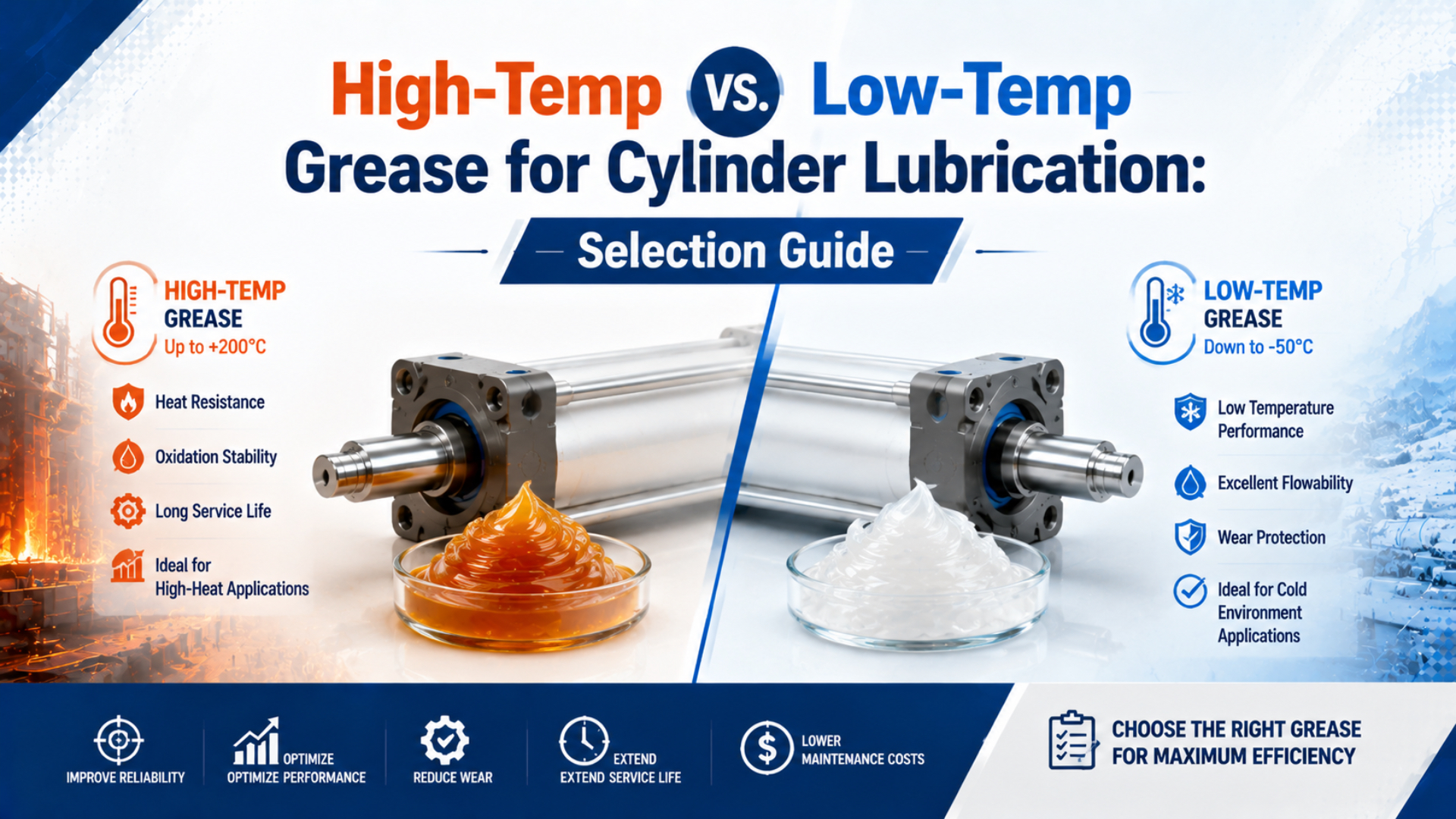
Choose high- or low-temperature cylinder grease only after confirming the exact cylinder model, measured component temperatures, installed seal materials, and the lubricant manufacturer’s approved range. A broad label such as “silicone,” “PAO,” or “lithium complex” cannot qualify a finished grease for a pneumatic cylinder.
Start with the cylinder manufacturer’s lubrication instructions. Many cylinders are factory greased for life or prohibit downstream oil mist. Changing the grease can alter seal volume, hardness, friction, oil release, and migration. If no approved alternative exists, treat a grease change as a component qualification, not ordinary maintenance.
Key Takeaways
- Festo lists model-specific options from -40°C to +150°C, not one universal grease range.
- Measure cold start, stable body temperature, transient peak, and thermal cycling.
- Dropping point is not maximum service temperature.
- Test the exact grease, seal compound, and residual lubricant before release.
What Actually Separates Low- and High-Temperature Cylinder Grease?
Festo lists ordinary cylinder variants to about -20°C, special cold variants to -40°C, and selected hot variants to +120°C or +150°C. Those limits belong to defined cylinder, seal, and grease combinations. They do not create universal temperature bands for every PAO, silicone, PFPE, lithium, or polyurea grease (Festo, accessed 2026).
Low-temperature cylinder grease is a manufacturer-approved lubricant that preserves acceptable starting resistance, running friction, oil release, and sealing behavior at the qualified cold condition. High-temperature cylinder grease is an approved lubricant that retains the required film and physical stability through the qualified continuous and transient heat exposure.
Neither definition can be reduced to base-oil family. Two products using the same broad chemistry can differ in base-oil viscosity, thickener concentration, additives, consistency, oil separation, evaporation, seal response, and contamination controls. Buy the finished product specification, not a chemistry label.
The cylinder configuration matters just as much. Festo’s hot variants combine special grease with heat-resistant seals. SMC similarly describes a high-temperature guide-cylinder option in which both the seal material and grease change, with a published range from -10°C to +150°C (SMC, accessed 2026). The grease alone does not convert a standard cylinder into that option.
For the wider assembly review, use the high-temperature pneumatic-cylinder guide and the sub-zero cylinder design guide. Sensors, magnets, wipers, tubing, guides, and mounting can fail inside a temperature range that the lubricant survives.
A useful purchasing question is not “Which grease works at -40°C?” It is “Which grease and seal combination is approved for this cylinder after a -40°C cold soak, and what acceptance evidence must the assembled axis pass?” The second question preserves the engineering boundary.
Which Temperature Must You Specify?
Parker lists -10°C to +80°C for one permanently greased OSP-P clean-room cylinder family, while Festo publishes different limits for its cold and hot options. This spread shows why room temperature cannot substitute for measured cylinder-body, gland, carriage, and transient exposure data (Parker, accessed 2026).
Record four conditions:
- Minimum cold-start temperature. Measure after the longest realistic shutdown, before motion warms the assembly.
- Stable production temperature. Record the body near the piston and rod seals after the machine reaches repeatable duty.
- Peak transient temperature. Capture oven opening, hot washdown, defrost, steam, part transfer, or radiant-heat events.
- Thermal cycling. Record how quickly and how often the component moves between cold and hot states.
Ambient air is only one exposure. A cylinder near an oven can receive radiant heat while the surrounding air remains moderate. A freezer axis can start below the daytime room reading. Hot water can heat the gland and wash lubricant away without raising the whole room temperature.
Measure the point that limits the configuration. Useful locations include the rod gland, barrel beside the active piston path, end cap, rodless carriage, guide block, and sensor bracket. State instrument type, surface preparation, emissivity setting for infrared measurements, sampling interval, machine state, and uncertainty.
Also record compressed-air dew point. Cold metal can form ice from moisture carried by the supply or entering around the rod. The ISO air-quality guide explains particle, water, and oil classes, but air-quality compliance still does not approve a grease.
In our experience, grease selection improves when the maintenance record includes one cold-start trace and one fully warmed trace. Those two records expose whether resistance is dominated by initial viscosity, seal stiffness, thermal growth, contamination, or an air-path problem that a lubricant change will not fix.
Low-Temperature Selection: Use Torque Data, Not Pour Point
ASTM D1478 evaluates starting and running torque below -18°C and notes test temperatures from -73°C to -18°C for different grease specifications. It was developed around slow-speed ball bearings, and ASTM says suitability for other applications must be determined individually. A D1478 result is therefore screening evidence, not cylinder approval (ASTM D1478, 2020).
Low-temperature selection should answer three separate questions:
- Does the base oil remain fluid enough for the grease to release lubricant?
- Does the finished grease create acceptable starting and running resistance?
- Do the seals, guides, wipers, and grease work together after cold soak?
Pour point describes a property of the base fluid under its specified method. It does not measure piston-seal breakaway, oil release from the finished grease, or cylinder leakage. Likewise, NLGI consistency grade describes grease consistency under a standard penetration test; it is not a direct cold-start rating.
Ask the grease supplier for low-temperature torque or other application-relevant data at the specified temperature. Then ask the cylinder manufacturer how that evidence maps to the selected model. A softer grease is not automatically better: migration, leakage, oil separation, seal response, and retention still matter.
For the installed test, cold-soak the complete cylinder and connected components for a defined time. Record the first movement separately from subsequent cycles. Measure supply pressure at the cylinder port, piston or carriage movement, full-stroke time, leakage, and any stick-slip. The minimum operating-pressure guide helps separate breakaway demand from an undersized air path.
Do not use a low-temperature grease to compensate for the wrong seal option. Festo notes that seal elasticity falls in cold service and identifies special cold variants rather than a lubricant-only change. The seal temperature-selection guide covers the elastomer side of that decision.
High-Temperature Selection: Drop Point Is Not a Service Limit
NLGI identifies dropping point and consistency as 2 key grease properties, but its glossary warns that dropping point should not determine the upper operating temperature. The result shows when material separates under a laboratory method. It does not establish oxidation life, evaporation, seal compatibility, film retention, or pneumatic-cylinder service life (NLGI glossary, accessed 2026).
High-temperature selection needs a finished-product operating limit supported by the grease supplier and accepted by the cylinder manufacturer. Request evidence for:
| Evidence | What it helps establish | What it does not prove alone |
|---|---|---|
| Recommended continuous and short-term temperature | Supplier’s use boundary for the finished product | Compatibility with the selected cylinder |
| Oxidation or high-temperature life data | Resistance to chemical degradation under the stated test | Installed relubrication interval |
| Evaporation and oil-separation data | Likelihood of base-oil loss under the stated method | Seal-film retention during motion |
| Dropping point | One physical transition under a defined laboratory method | Maximum cylinder operating temperature |
| Seal-compatibility data | Relative volume and hardness response for tested elastomers | Dynamic sealing life in the assembled cylinder |
Heat affects more than lubricant. It changes seal modulus, clearances, guide alignment, tubing, sensors, and any magnetic target. SMC’s -10°C to +150°C option changes both grease and seals and says to operate without a pneumatic-system lubricator. Copying its grease chemistry into another cylinder would not copy the validated design.
The inspection plan should look for rising friction, leakage, migrated oil, hardened deposits, discoloration, rod or bore wear, and position-dependent drag. These observations are evidence to investigate. They are not proof that oxidation caused the fault. The grease-aging guide separates oxidation, physical change, contamination, and lubricant migration.
How Do Grease and Seal Compatibility Change the Decision?
ASTM D4289 measures elastomer volume and hardness change after 70 hours, commonly at 100°C or 150°C. The standard says those changes do not duplicate service behavior and recommends application-specific correlation, especially for severe flexing or extreme temperature. Use it to screen the exact grease and elastomer, not to approve every seal sharing a generic name (ASTM D4289, 2024).
NBR, FKM, EPDM, polyurethane, silicone rubber, and PTFE-based seals are families, not single formulations. Cure system, fillers, plasticizers, hardness, fabric reinforcement, energizers, and finished geometry can change lubricant response. A chart that says “silicone grease works with all elastomers” is not an acceptance document.
For a proposed grease, obtain:
- Exact product name, revision, and batch traceability.
- Exact base oil, thickener, and relevant additive information available from the supplier.
- Compatibility data for the selected seal compound, not merely “NBR” or “FKM.”
- Test temperature, duration, volume change, hardness change, and acceptance limits.
- Cylinder-manufacturer approval or an agreed qualification plan.
After coupon screening, test the assembled cylinder. Dynamic seals flex, wipe, heat, and redistribute lubricant. A static immersion coupon cannot reproduce surface finish, side load, pressure cycling, short strokes, dwell, or contamination. The air-lubrication and seal-material guide explains why airline oil creates another compatibility boundary.
Compatibility has two layers: material compatibility and functional compatibility. A seal can remain inside acceptable volume and hardness limits yet still create too much breakaway friction, poor oil retention, or unacceptable leakage in the real groove. Release the pair only after both layers pass.
Why Should You Avoid Mixing Greases?
ASTM D6185 evaluates binary grease mixtures at 50:50, 10:90, and 90:10 ratios because one ratio can pass while another fails. It also states that compatibility cannot be predicted with certainty from composition or thickener type. Mixing can cause softening, hardening, oil separation, or performance loss (ASTM D6185, 2024).
Changing from standard grease to a hot or cold product can leave residual lubricant inside the bore, seal grooves, rod gland, carriage, grease port, and guide. Wiping an exposed rod does not remove that inventory. Adding the new product may create an untested mixture precisely where the dynamic seal needs a stable film.
Follow the cylinder and grease manufacturers’ changeover procedure. It may require:
- Complete disassembly by qualified personnel.
- Removal of the old grease with an approved cleaning method.
- Inspection or replacement of seals and wear parts.
- Controlled application quantity at named surfaces.
- Full-stroke cycling to distribute the film.
- Recommissioning under the qualified temperature and load.
Do not improvise solvent cleaning. A solvent can attack seals, remove lubricant from hidden interfaces, leave residue, or create an unsafe maintenance condition. ISO 4414 requires hazards and stored pneumatic energy to be controlled during machinery-system work (ISO 4414, accessed 2026).
Some factory-lubricated cylinders should not be relubricated in service. Parker describes permanent grease lubrication for the referenced OSP-P clean-room family, while SMC’s high-temperature option says not to use a pneumatic-system lubricator. The pre-lube and break-in guide provides more context on initial lubricant distribution.
Build a Model-Specific Grease Approval Sheet
Parker recommends lubrication every 500 km for one P1Z rodless-cylinder family and shorter intervals under higher temperature, heavy contamination, or grease-dissolving exposure. That model-specific instruction is stronger evidence than a universal calendar rule such as “halve every hot-service interval” (Parker P1Z instructions, accessed 2026).
Create one approval sheet for each cylinder configuration:
| Approval field | Required entry |
|---|---|
| Cylinder identity | manufacturer, complete model, revision, bore, stroke, seal option |
| Existing lubricant | factory grease or approved service grease, application quantity, date |
| Air-lubrication rule | dry non-lube, continuous oil mist, prohibited, or model-specific |
| Temperature exposure | cold start, stable body, transient peak, cycling frequency |
| Mechanical duty | load, speed, stroke usage, dwell, orientation, side load, cycles |
| Environment | water, washdown, cleaner, particles, process vapor, food zone |
| Candidate grease | exact trade name, revision, supplier limits, batch |
| Compatibility evidence | exact seal compound, test method, temperature, duration, limits |
| Changeover method | cleaning, residual grease control, seal replacement, quantity |
| Release test | pressure, stroke time, leakage, motion, inspection, sample size |
Avoid generic material tables in purchasing specifications. Instead, require the supplier to mark each entry as documented, tested, not applicable, or unresolved. An unresolved field is visible risk. A guessed “universal compatibility” cell hides it.
Specify relubrication only when the manufacturer provides a service point and procedure. Base the interval on the model manual, accumulated travel or cycles, environment, and condition evidence. If grease condition is the concern, link the approval sheet to the grease-aging diagnostic guide rather than replacing grease on appearance alone.
How Do You Commission a Cylinder at Temperature?
ISO 19973-3 reports pneumatic-cylinder reliability in cycles or accumulated kilometres and uses defined test conditions and failure thresholds. A grease qualification does not need to reproduce that full reliability standard, but it should copy the discipline: state the duty, measurement boundary, sample, acceptance limits, and first-failure rule (ISO 19973-3, confirmed 2021).
Run a staged release:
- Room-temperature baseline: record port pressure, breakaway, running pressure, stroke time, leakage, and sensor operation.
- Cold or hot conditioning: hold the complete test boundary until the specified component temperatures stabilize.
- First-cycle capture: record startup separately because it can differ from warmed repetitive motion.
- Duty-cycle run: reproduce load, speed, dwell, stroke use, cushioning, orientation, and air quality.
- Inspection: check grease migration, deposits, seal lips, rod or bore marks, guide drag, and leakage.
- Repeatability: test enough cycles and samples to support the stated release decision.
Set numeric acceptance limits before the test. Suitable metrics include maximum breakaway pressure, permitted stroke-time change, external leakage, pressure decay under a defined hold, full-stroke completion, sensor repeatability, and post-test seal dimensions. Do not decide after seeing the result.
Compare cold first cycle with cold running cycles, and hot stabilized cycles with the room-temperature baseline. If pressure rises but the load and grease are unchanged, inspect seal stiffness, alignment, tubing, valve flow, and exhaust restriction before blaming the lubricant.
The approval should state its limits. A pass for one bore, seal option, temperature profile, and grease batch does not automatically release every cylinder size or neighboring product. Document which variables can change without retest.
What Changes for Food and Washdown Applications?
NSF distinguishes H1 lubricants for incidental food contact from H2 lubricants for locations with no food contact, while ISO 21469 adds hygiene requirements for formulation, manufacture, and use. These registrations apply to the lubricant product. They do not certify the cylinder assembly, cleanability, leakage control, or washdown durability (NSF, accessed 2026).
For a food-area cylinder, add these checks:
- Verify the exact finished grease in the NSF registry; an approved ingredient does not register the final grease.
- Identify whether incidental food contact is possible and where leaked grease could travel.
- Confirm that cleaning chemicals, hot water, steam, and pressure do not wash lubricant into the process.
- Check cylinder cleanability, corrosion resistance, wipers, crevices, mounting, exhaust, and air quality.
- Use only the minimum lubricant quantity required by the approved procedure.
Food grade does not mean washout resistant, low temperature, high temperature, universally seal compatible, or suitable for oxygen service. Each claim needs separate evidence. A high-temperature H1 grease may still be wrong for the cylinder’s seals or cleaning chemistry.
Hot washdown also creates a temperature cycle. Record water temperature, duration, spray direction, chemical concentration, component temperature, and the cooling period before restart. A grease that survives dry oven heat may behave differently after repeated water and cleaner exposure.
Cylinder Grease Selection FAQs
These 5 answers apply the same evidence hierarchy used by Festo, NLGI, ASTM, Parker, and NSF: exact cylinder documentation first, exact grease and seal data second, and installed-condition verification last. Generic temperature, chemistry, and NLGI tables can screen candidates, but they cannot release a pneumatic cylinder for production.
Can one wide-temperature grease cover both cold and hot cylinders?
Only when the exact grease is approved for each cylinder, seal option, temperature profile, and exposure. A broad supplier range does not prove acceptable cold-start friction, hot oil retention, seal response, or residual-grease compatibility. Keep separate approval sheets even when both machines ultimately use the same product.
Is grease dropping point the maximum cylinder temperature?
No. NLGI states that dropping point should not determine upper operating temperature. It measures one laboratory transition, not oxidation life, evaporation, oil separation, seal compatibility, or dynamic film retention. Use the grease supplier’s finished-product limit, cylinder-manufacturer approval, and an installed hot-condition test.
Does ASTM D1478 prove a grease will work in a cold pneumatic cylinder?
No. ASTM D1478 measures starting and running torque in a slow-speed ball bearing below -18°C. ASTM says suitability for other mechanisms, loads, speeds, and temperatures must be determined individually. Use the result to compare candidates, then cold-soak and test the complete cylinder under representative duty.
Can I mix high-temperature grease with the factory grease?
Do not mix them without explicit compatibility evidence and an approved changeover procedure. ASTM D6185 shows that even greases with similar thickener types can be incompatible and that different blend ratios can behave differently. Residual factory grease remains in seal grooves and internal surfaces after a simple external wipe.
Does NSF H1 grease make a pneumatic cylinder food safe?
No. H1 registration concerns a lubricant intended for potential incidental food contact. It does not certify the assembled cylinder, cleanability, corrosion resistance, air quality, leakage control, washdown survival, or compatibility with the installed seals. Verify the finished lubricant and complete a machine-specific hygiene risk assessment.
Sources and technical references
- Festo: Pneumatic Cylinders and Extreme Temperatures, cold and hot model options, special seals, and special grease. Accessed 2026-07-27.
- SMC MGP High-Temperature Option, model-specific seal and grease change with -10°C to +150°C range. Accessed 2026-07-27.
- Parker OSP-P Maintenance Instructions, permanent grease lubrication and model temperature range. Accessed 2026-07-27.
- Parker P1Z Operating Instructions, model-specific lubrication method and interval. Accessed 2026-07-27.
- NLGI Technical FAQs, grease construction, consistency, dropping point, and seal compatibility. Accessed 2026-07-27.
- NLGI Grease Glossary, dropping-point limitation and grease terminology. Accessed 2026-07-27.
- ASTM D1478-20, low-temperature torque of ball-bearing grease and application limitations.
- ASTM D4289-24, elastomer volume and hardness compatibility screening.
- ASTM D6185-24, evaluation of binary grease mixtures.
- ISO 19973-3:2015, pneumatic-cylinder reliability test and reporting framework.
- NSF Food-Grade Lubricants and ISO 21469, H1 and hygiene-certification scope.