

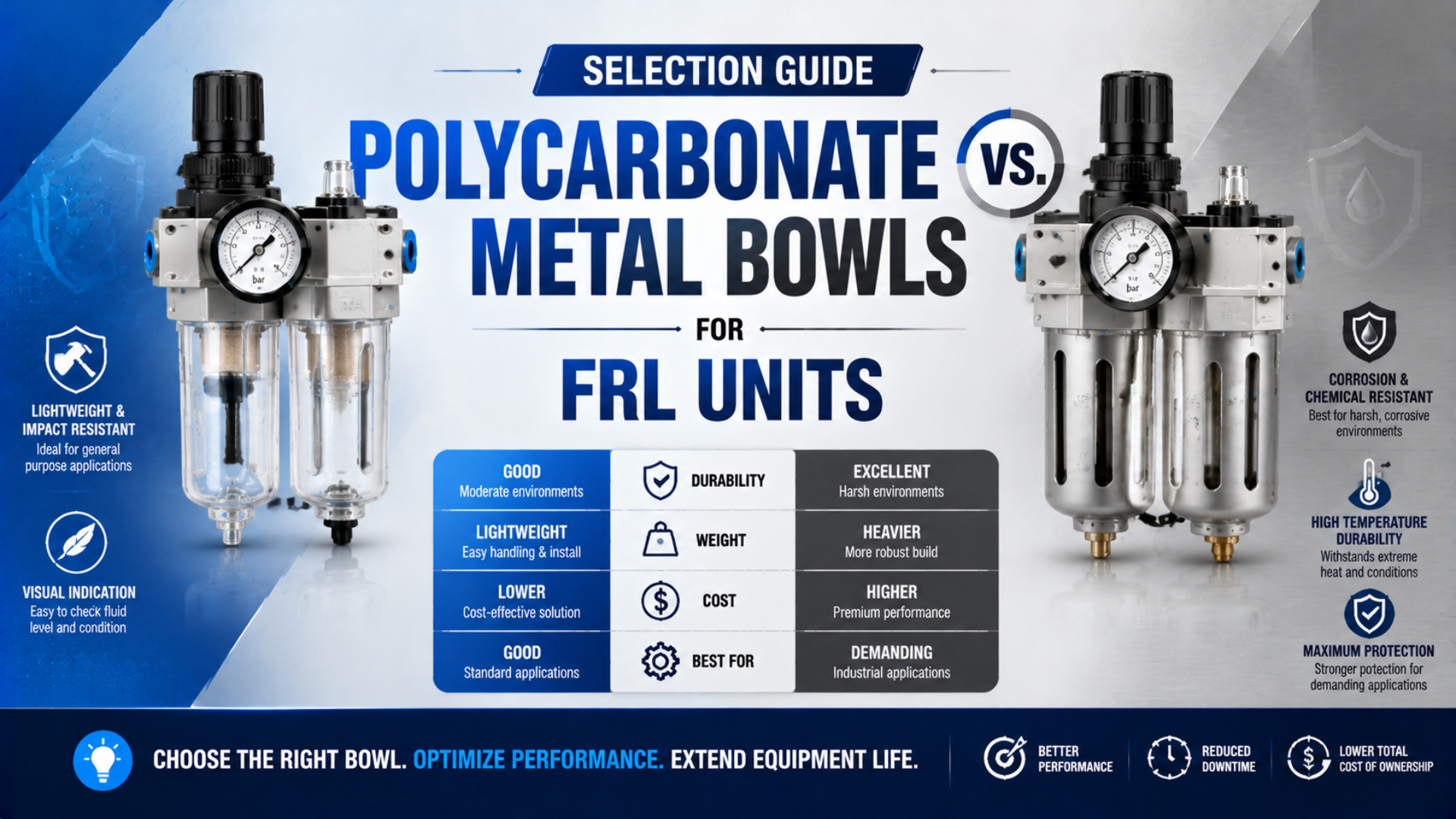
The choice of polycarbonate vs. metal bowls for FRL units starts with the exact series data, pressure and temperature envelope, internal and external chemical exposure, impact and UV risk, washdown conditions, and the need to see the liquid level. The material name alone is not a safe specification because the guard, sight gauge, seals, drain, and retaining mechanism also define the assembly’s limits.
A clear bowl can make inspection fast. A metal bowl can improve resistance to impact and some operating environments. Neither is universally superior, and neither label proves compatibility with every solvent, lubricant, acid, cleaning chemical, or outdoor condition.
Key Takeaways
- Pressure and temperature limits belong to an exact FRL series and bowl configuration, not to a material category.
- A metal body may still contain a polymer sight gauge, elastomer seals, or a plastic drain.
- Chemical compatibility must cover condensate and compressor lubricant inside the bowl as well as cleaners, fumes, and UV outside it.
- A bowl conversion is valid only when the manufacturer identifies the complete replacement kit for the exact model.
This guide concentrates on bowl-material selection. Use the FRL sizing guide for peak-flow and pressure-drop calculations, and the modular versus standalone FRL guide for system architecture.
Select the Complete Bowl Assembly, Not Just the Body Material
An FRL bowl assembly is the complete pressure-containing and serviceable group: bowl body, guard, sight feature, seals, drain, retaining interface, and any coating. Parker’s engineering guidance separates polycarbonate-bowl precautions from metal-bowl precautions, while its product data show that a metal bowl may still use a nylon sight gauge, nitrile seals, and a polymer drain (Parker Engineering Data, 2026; Parker 05E data, 2026).
That means an aluminum or zinc bowl body does not make every wetted or exposed part metallic. The narrow level window may remain the most chemically sensitive component. The drain seal may set the fluid-compatibility limit. The retaining threads or bayonet may determine whether a nominally similar replacement can be installed safely.
In application reviews, I treat an unidentified sight gauge, seal, or drain as an unresolved compatibility risk. It is not a minor detail to fill in after the bowl body has been selected.
When requesting a quotation, specify the exact FRL manufacturer, series, port size, bowl-kit number if known, drain type, and current guard. “Metal bowl for a 1/2-inch filter” is not enough information to establish fit or rating.
When Is a Polycarbonate Bowl the Better Choice?
A polycarbonate bowl is often the practical choice when visual inspection matters and the exact manufacturer’s pressure, temperature, chemical, impact, and environmental limits are satisfied. Operators can see condensate, lubricant level, discoloration, and some contamination without relying on a small sight window or opening a depressurized assembly.
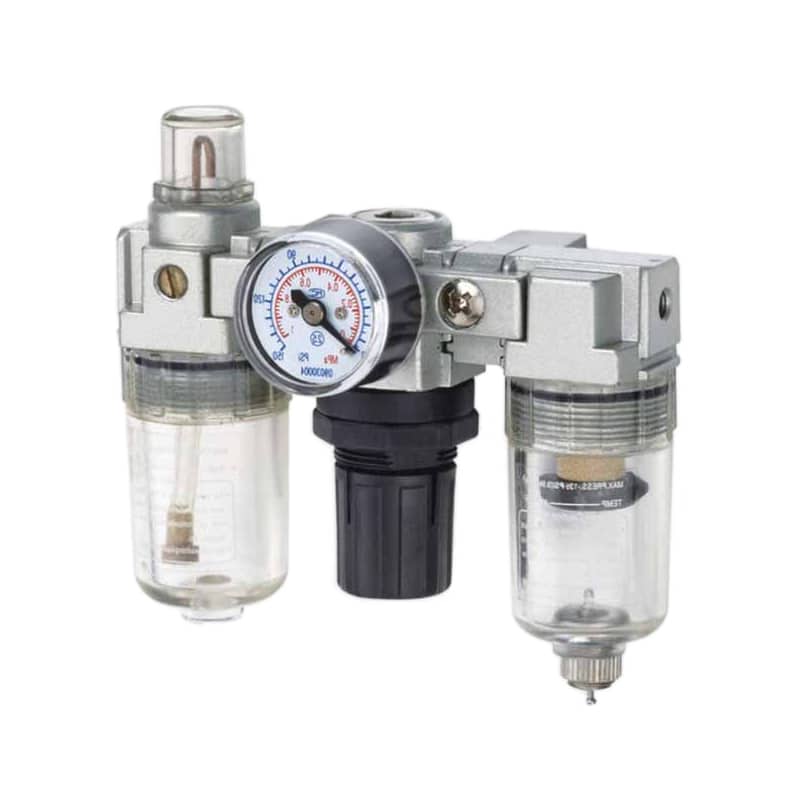
Visibility can make a maintenance route faster, but it does not replace an inspection standard. The team still needs a defined maximum liquid level, drain-function check, and response when the bowl becomes cloudy, crazed, scratched, distorted, or difficult to inspect.
Polycarbonate is not a synonym for “low pressure.” For example, one Festo service-unit product lists a Makrolon bowl with a metal guard for 1 to 16 bar and -10 to 60°C. Those values belong to that specific product, not to all polycarbonate bowls (Festo LFR-1/4-D-MINI-KC, 2026).
A protected clear bowl can therefore be appropriate when:
- the approved product data cover the real inlet pressure and ambient/fluid temperature;
- internal condensate and compressor lubricant are compatible with the bowl, seals, and drain;
- external cleaners, fumes, oils, and process chemicals have been assessed;
- the specified guard is fitted and undamaged;
- sunlight, impact, abrasive debris, and washdown do not exceed the product’s environmental limits;
- direct liquid-level visibility has a defined maintenance value.
Do not remove a factory guard to improve visibility. Select a configuration designed to provide both inspection access and protection.
Which Chemicals and Environments Threaten Polycarbonate?
Parker warns that polycarbonate bowls and sight domes should not be used with chlorinated hydrocarbons, ketones, esters, certain alcohols, or incompatible fire-resistant compressor fluids, and should be protected from direct sunlight, impact, and temperatures outside their rating. It also recommends cleaning them only with mild soap and water (Parker Engineering Data, 2026).
That guidance is more useful than a fixed “solvent exclusion radius.” Exposure depends on chemical identity, concentration, temperature, contact time, stress in the molded part, ventilation, splash pattern, and whether the substance reaches the bowl as liquid or vapor. A universal two-meter rule cannot account for those variables.
Assess two exposure paths:
| Exposure path | Examples to identify | Parts that may be affected |
|---|---|---|
| Internal | condensate, compressor lubricant, pipe treatment residue, cleaning carryover | bowl, sight dome, seals, drain, element end caps |
| External | degreasers, paint solvents, washdown chemicals, cutting fluids, UV, process fumes | bowl, guard, sight window, retaining interface, labels |
Stress cracking may not appear immediately after first contact. Record the exact safety-data-sheet product name and concentration instead of writing “solvent present” on the application form. Send that information to the FRL manufacturer for a written compatibility decision.
If the chemical changes, repeat the review. A bowl accepted for one water-based cleaner is not automatically compatible with a new degreaser used during weekend sanitation.
What Does a Metal Bowl Improve, and What Limits Remain?
A metal bowl can improve impact resistance, reduce direct UV exposure to the bowl body, and extend the pressure or temperature envelope in some product series. However, Parker also states that its metal bowls are not recommended for strong acids or bases, or for salt-laden atmospheres, so “metal” is not a universal chemical-resistance rating (Parker Engineering Data, 2026).
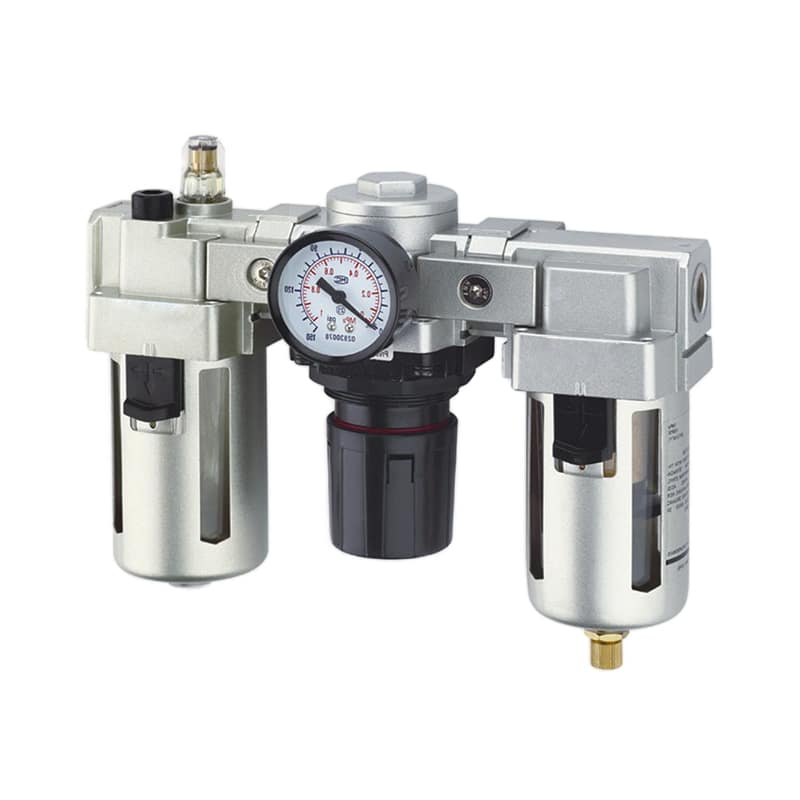
The exact alloy and finish matter. Die-cast zinc, die-cast aluminum, stainless steel, and coated metal do not share one corrosion envelope. If stainless steel is required, specify the grade and verify the remaining materials. The 304 versus 316 stainless guide explains why an alloy designation must be matched to the actual chloride and chemical conditions.
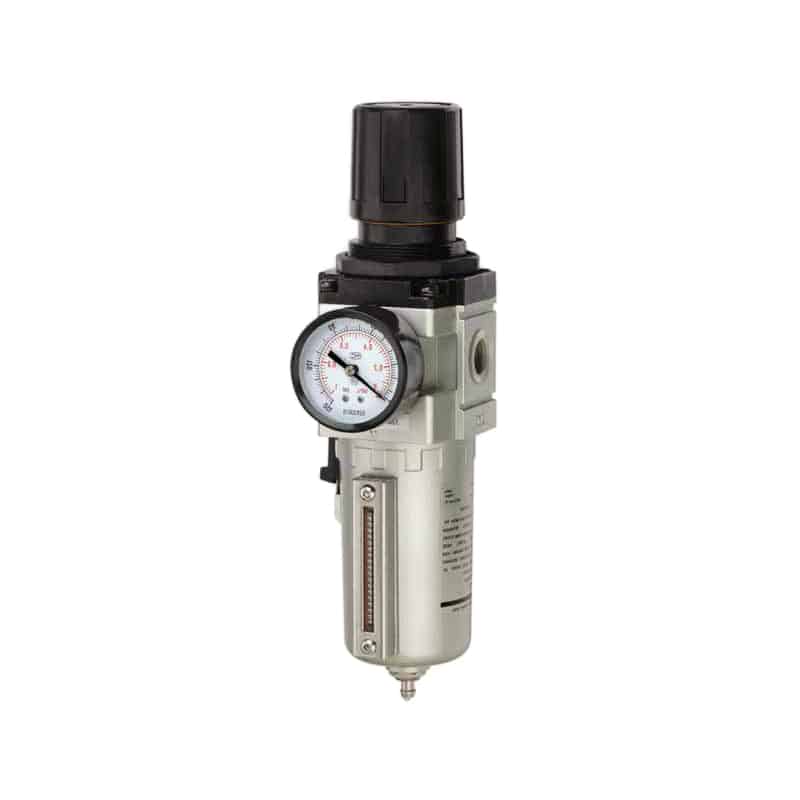
A sight-equipped metal bowl is also a mixed-material assembly. Parker’s 05E example lists a zinc bowl, nylon sight gauge, nitrile seals, and plastic drains. In that configuration, the sight gauge or drain may remain the limiting part even though the main shell is metal (Parker 05E data, 2026).
Metal construction alone does not establish food, pharmaceutical, cleanroom, or washdown compliance. Those claims require application-specific evidence covering surface finish, coatings, lubricants, seals, drains, cleanability, particle generation, and applicable regulatory or customer standards.
Why Are Pressure and Temperature Limits Model-Specific?
Pressure and temperature ratings are model-specific because bowl geometry, retaining design, guard, sight feature, drain, seals, and tested configuration vary by series. Parker’s own catalog gives different limits for different families, demonstrating why one universal cutoff for every polycarbonate or metal FRL bowl is technically unsound (Parker complete FRL catalog, 2026).
The following numbers are examples, not general design limits:
| Manufacturer series example | Polycarbonate configuration | Metal configuration | Selection lesson |
|---|---|---|---|
| Parker P31 particulate filter | 10 bar maximum; -10 to 52°C | 17 bar maximum; -10 to 65.5°C | one series shows a higher metal-bowl envelope |
| Parker 05E filter | 10.3 bar maximum; 0 to 52°C | 17.2 bar maximum; 0 to 80°C | another series has different temperature limits |
| SMC AW10 filter regulator | polycarbonate standard; metal optional | same published unit maximum of 1.0 MPa and -5 to 60°C | a material option does not always change the unit rating |
The SMC AW10 data are from SMC’s product documentation and apply only to that configuration (SMC AC series data, 2026).
Check both maximum pressure and operating pressure range. Also check ambient and fluid temperature separately if the datasheet provides both. Account for the highest credible regulator inlet pressure, blocked-in pressure, compressor control band, cold start, radiant heat, and cleaning temperature.
Do not carry a rating from a filter to a visually similar lubricator. Confirm the complete part number and all suffixes, because drains, bowls, and options can change the approved envelope.
How Do Guarding, UV, Impact, and Washdown Change the Choice?
Mechanical and environmental exposure can make the guard and installation location as important as the bowl body. Parker recommends metal bowl guards for all applications, while Festo’s MS service-unit range offers polycarbonate bowls with bowl guards and metal-bowl options, showing that guarding and bowl material are separate configuration decisions (Parker Engineering Data, 2026; Festo MS filters, 2026).
Ask where the FRL will actually be mounted:
- Can a dropped tool, part, forklift load, or broken belt strike it?
- Is it exposed to direct sun or UV-producing equipment?
- Will grinding debris or weld spatter reach the bowl or sight feature?
- Is the area washed down, and at what pressure, temperature, and chemistry?
- Can vibration loosen the bowl, drain, or retaining feature?
- Is the assembly behind a panel that prevents routine level inspection?
A machine enclosure can reduce impact risk but trap heat or chemical vapor. An outdoor cover can reduce UV and rain exposure but make drain checks harder. Evaluate the assembled installation, not an isolated bowl on a catalog page.
When washdown is required, request the complete unit’s environmental and material data. A corrosion-resistant bowl body does not prove that the drain, gauge, adjustment knob, fasteners, mounting kit, or interface seals tolerate the same process.
Can You Replace a Polycarbonate Bowl With a Metal Bowl?
Only replace one bowl material with another when the manufacturer identifies a compatible complete kit for the exact FRL model and the converted assembly retains the required ratings and certifications. Similar diameter, thread size, or visual appearance does not prove interchangeability between brands, series, production generations, or drain options.
Verify all of the following before ordering:
- Manufacturer and complete FRL part number, including suffixes.
- Approved bowl-kit part number and supported unit revision.
- Bowl seal material and whether a new seal is included.
- Drain type, thread, orientation, and minimum operating behavior.
- Guard, sight gauge, and retaining mechanism supplied with the kit.
- Pressure and temperature rating after conversion.
- Chemical and environmental compatibility of every replacement part.
- Installation torque, latch position, leak test, and commissioning instructions.
- Effect on agency approvals, warranty, and site validation.
Never adapt an unlisted bowl by machining, adding thread sealant to a retaining interface, or combining a body from one series with a drain from another. A pressure-containing bowl sits over stored pneumatic energy.
Before service, isolate the unit and follow the site’s hazardous-energy procedure. ISO 4414 covers the design, installation, operation, maintenance, and safety requirements of pneumatic systems, while OSHA 29 CFR 1910.147 includes pneumatic energy within hazardous-energy control for covered servicing work (ISO 4414, 2010; OSHA 1910.147, 2026).
How Should You Build a Defensible Bowl-Material Decision?
A defensible decision starts with the exact component data and then works through internal chemistry, external environment, operating envelope, physical hazards, inspection needs, and replacement evidence. If one input is unknown, mark it as an open item rather than filling the gap with a rule of thumb.
Use a simple decision record:
| Decision input | Required evidence | Acceptance statement |
|---|---|---|
| Exact identity | nameplate photo and full part number | selected kit is listed for this unit |
| Pressure and temperature | manufacturer datasheet for exact option | all credible conditions remain inside rating |
| Internal chemistry | compressor-fluid data, condensate analysis if needed | every wetted part is compatible |
| External chemistry | cleaner SDS, concentration, method, contact time | exposed assembly is approved |
| Physical environment | installation photos and risk assessment | guard and location control impact/UV risk |
| Inspection | maintenance method and alarm/action limit | liquid level and bowl condition can be checked |
| Commissioning | installation instructions and test record | leak, drain, regulator, and visibility checks pass |
Festo describes its MS filter regulators as using die-cast aluminum housings with optional metal or polycarbonate bowls and multiple drain systems. This is a useful reminder to capture the entire option set rather than specifying only the visible cup (Festo MS filter regulators, 2026).
What Should the RFQ and Acceptance Checklist Include?
A useful RFQ lets the supplier identify the exact bowl assembly and state its limits in writing. It should separate facts from preferences: “must tolerate cleaner X at 3% and 45°C” is an application requirement, while “prefer clear bowl” is a visibility preference that may be changed if it conflicts with safety or compatibility.
Provide:
- complete FRL part number, module type, port size, and revision;
- maximum and minimum inlet pressure, not only regulator setpoint;
- fluid and ambient temperature range, including cleaning and shutdown;
- compressor lubricant and any fire-resistant fluid used upstream;
- expected condensate contaminants;
- external chemical names, concentrations, and exposure methods;
- UV, impact, vibration, washdown, and corrosion conditions;
- required drain function and discharge connection;
- required visual inspection or electronic level indication;
- regulatory, customer, cleanroom, or food-zone requirements;
- requested bowl kit, seals, guard, drain, and spare quantity.
On receipt, compare the packing list and part markings with the approved quotation. Inspect the sight feature, seal, drain, guard, and retaining interface. Install under the manufacturer’s instructions, then record isolation restoration, leak test, drain operation, regulator response, and inspection access.
Drain choice can change both maintenance behavior and the bowl kit. The manual versus semi-automatic drain guide covers that decision. If the process needs oil-aerosol removal rather than only bulk-liquid separation, use the coalescing-filter guide to define the complete treatment train.
FRL Bowl Material FAQs: What Should Buyers Ask?
The recurring answer is to use the exact product data rather than a universal material rule. Bowl bodies with the same broad material name can have different geometry, retaining systems, guards, sight components, drains, seals, coatings, and tested limits.
Is 50°C a universal upper limit for polycarbonate FRL bowls?
No. Parker publishes 52°C for the polycarbonate configurations in the P31 and 05E examples, while one Festo Makrolon-bowl product is listed to 60°C. Those are product-specific values. Use the datasheet for the exact manufacturer, series, bowl, guard, drain, and operating conditions.
Are metal FRL bowls safe with every solvent, acid, or alkaline cleaner?
No. Parker specifically cautions against using its metal bowls with strong acids or bases and in salt-laden atmospheres. Compatibility depends on the stated alloy, coating, sight feature, seals, drain, concentration, temperature, and exposure time. Obtain written guidance for the actual chemical.
Does a metal bowl eliminate the need for a guard?
Not automatically. Guard requirements belong to the product design and installation risk assessment. A guard may protect a sight feature, drain, retaining area, or nearby components as well as the bowl body. Follow the exact manufacturer’s configuration and do not remove supplied protection.
Can a replacement metal bowl reuse the existing drain and seals?
Only if the manufacturer-approved kit and instructions say so. A metal-bowl option may use different seals, drain parts, sight components, or retaining hardware. Order by complete kit number and confirm whether consumable seals are supplied or must be ordered separately.
How can operators inspect condensate when the bowl is opaque?
Use the approved sight gauge, level indicator, sensor, drain-function check, or scheduled safe inspection method specified for the unit. Define a response limit before commissioning. A small sight window must remain clean, visible, and chemically compatible; an opaque bowl should not become an excuse to stop checking condensate.
Sources and Retrieval Notes
- Parker, Compressed Air Preparation Engineering Data. Polycarbonate and metal bowl precautions. Retrieved 2026-07-27.
- Parker, Compressed Air Preparation Complete Catalog. P31 configuration examples. Retrieved 2026-07-27.
- Parker, 05E Filter Data. Bowl, sight-gauge, seal, drain, pressure, and temperature examples. Retrieved 2026-07-27.
- Festo, MS Series Filters. Bowl and guard options. Retrieved 2026-07-27.
- Festo, MS Series Filter Regulators. Housing, bowl, and drain options. Retrieved 2026-07-27.
- Festo, LFR-1/4-D-MINI-KC. One product-specific Makrolon bowl example. Retrieved 2026-07-27.
- SMC, AC Series Product Data. AW10 bowl options and operating limits. Retrieved 2026-07-27.
- ISO 4414:2010, Pneumatic fluid power systems and components. Retrieved 2026-07-27.
- OSHA 29 CFR 1910.147, The Control of Hazardous Energy. Retrieved 2026-07-27.