

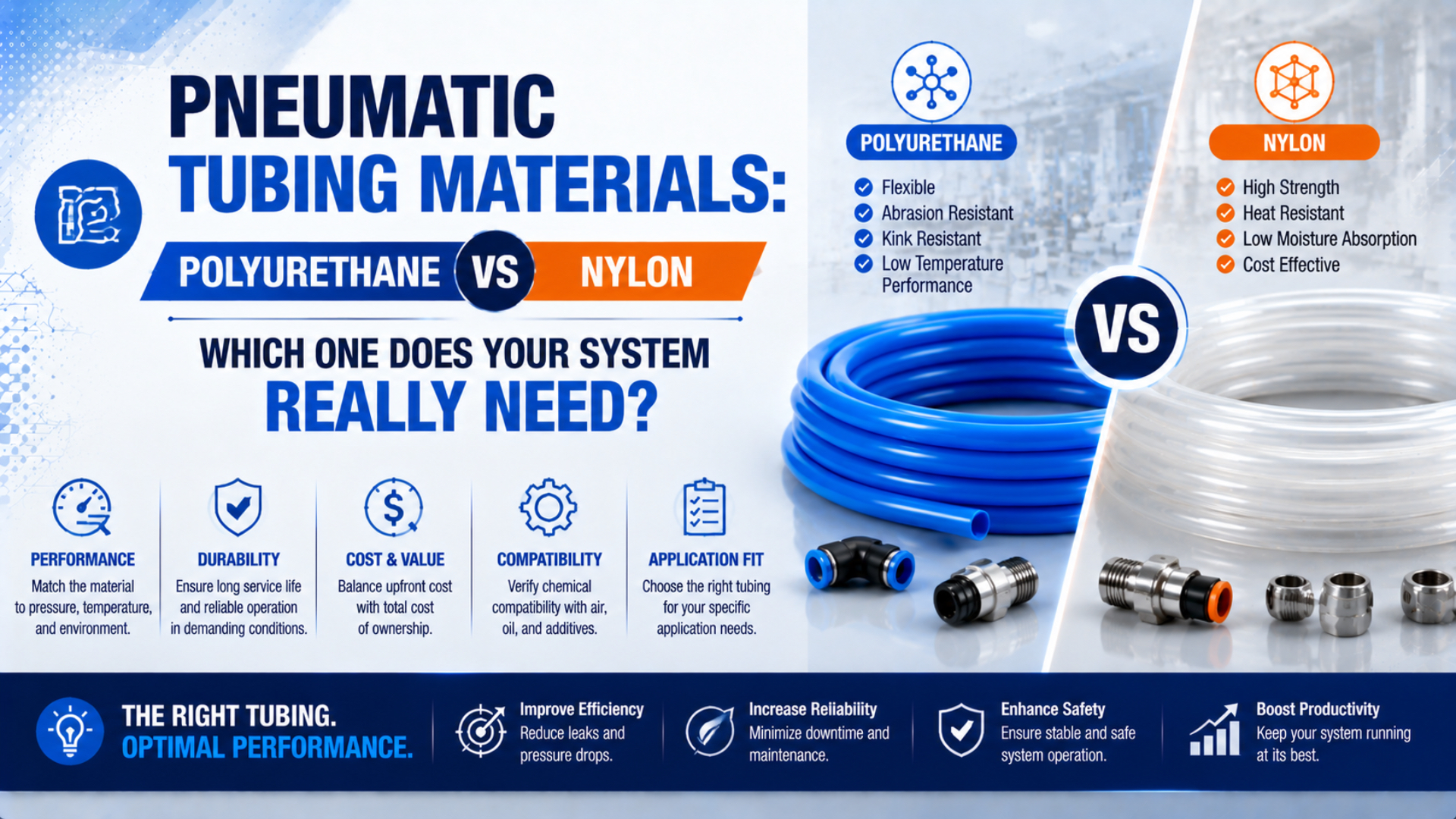
Neither polyurethane nor nylon is the default winner for every pneumatic circuit. Polyurethane tubing is often easier to route through tight moving assemblies, while a specific nylon or polyamide tube may offer a wider temperature range or a higher pressure rating. Those are tendencies, not selection rules. The correct answer comes from the exact tube series, dimensions, pressure-temperature curve, medium, connector, motion, and installation environment.
This distinction matters because a material name does not define a finished tube. Two products sold as 8 mm polyurethane can have different inside diameters, wall thicknesses, hardness, bend limits, pressure derating, and approvals. A nylon product can be rated for an energy chain, and a polyurethane product can be unsuitable for the required chemical or temperature. Compare complete data sheets before comparing labels.
Key Takeaways
- ISO 11619 covers 3 to 16 mm polyurethane and polyamide pneumatic tubing.
- Pressure ratings depend on size, temperature, material, and product series.
- Dynamic suitability requires an explicit motion rating and controlled routing.
- Matching outside diameter alone does not prove push-in fitting compatibility.
Pneumatic tubing material selection is the process of matching a specific tube grade and construction to the circuit’s pressure, temperature, fluid, motion, bend radius, environment, connector, and required service life. It is not a choice based on flexibility or color alone.
What Does ISO 11619 Actually Standardize?
ISO 11619:2024 covers flexible thermoplastic polyurethane and polyamide tubing from 3 to 16 mm outside diameter. It assigns polyurethane tubing a dedicated range of -20 °C to 60 °C and polyamide tubing -20 °C to 80 °C, while stating that working pressure still depends on size, service temperature, and material (ISO 11619, 2024).
That scope gives engineers a useful baseline, but it does not turn every compliant tube into an interchangeable product. The standard separates material families and dimensions from the pressure tables that apply to a finished construction. Manufacturer data may define a different allowable ambient range, pressure curve, medium, or fitting combination for a particular series. Use the narrower applicable limit. ISO 14743:2020 adds another boundary. It specifies requirements and test methods for complete push-in connector assemblies used with thermoplastic tube from 3 to 16 mm outside diameter (ISO 14743, 2020). The assembly is the tested system. A nominal tube size by itself is not a seal, retention, or flow rating.
The practical comparison therefore has six gates. A tube should not advance because one property looks favorable while another remains unknown.
The existing tubing and fitting flow guide covers branch restrictions and dynamic pressure measurement. This article stays with material and product selection.
Polyurethane Is a Family, Not One Tubing Specification
Parker’s pneumatic PU range identifies three grades: polyester, polyether, and food-grade polyether. Its published family covers vacuum to 12 bar and -20 °C to 70 °C, but the manufacturer also states that dependable performance depends on the conveyed fluid and the fittings used (Parker PU Tubing, accessed 2026-07-27).
Polyurethane tubing is commonly made from thermoplastic polyurethane, but the soft segment chemistry and finished formulation change how it behaves. Parker positions polyester PU for standard pneumatic service and polyether PU for water or high-humidity exposure. That distinction alone is enough to reject a generic statement such as “PU has good chemical resistance.” The exact grade and the chemical chart must agree with the application. Nylon is also a family name. Pneumatic catalogs may use nylon, polyamide, soft nylon, hard nylon, or product-specific designations such as TPE-A. SMC, for example, lists a general T Series nylon tube, a softer TS Series, and several flame-resistant or multilayer variants. They do not share one pressure limit, bending behavior, or fitting rule (SMC Tubing Series, accessed 2026-07-27).
| Label on a request | Missing engineering detail | What to request |
|---|---|---|
| PU tube | Polyester, polyether, hardness, reinforcement | Manufacturer, series, full part number, revision |
| Nylon tube | PA grade, soft or semi-rigid construction | Material designation and product family |
| 8 mm tube | Inside diameter and OD tolerance | OD, ID, wall thickness, tolerance |
| High-pressure tube | Temperature and pressure definition | Working-pressure curve and proof or burst distinction |
| Chemical-resistant tube | Fluid, concentration, temperature, exposure time | Product-specific compatibility statement |
Color should remain an identification aid. It is not material evidence. A black line can be PU, nylon, polyethylene, fluoropolymer, or a layered construction. Verify the printing on the tube and the purchase record before making a replacement decision.
How Do Pressure and Temperature Change the Choice?
For one 8 mm Festo example, PUN-H-8X1.25 lists a 5.7 mm inside diameter, 10 bar temperature-dependent maximum, and -35 °C to 60 °C ambient range. PAN-8X1.25 lists a 5.9 mm inside diameter, 15 bar temperature-dependent maximum, and -30 °C to 80 °C range (Festo PUN-H; Festo PAN).
Those numbers illustrate why a product-level comparison is useful. They do not mean that every polyurethane tube is limited to 10 bar or every nylon tube is suitable for 15 bar. A temperature-dependent maximum is not available at every temperature, and the pressure shown in one catalog may use a different convention from another. Read the curve and its notes. SMC provides another model-specific example. Its TU polyurethane series is listed at a maximum operating pressure of 0.8 MPa at 20 °C, while the T Series nylon overview lists 3.0 MPa for model T0604 at 20 °C (SMC TU; SMC T). The models have different constructions. Treat the values as selection inputs, not material constants.
Build a common comparison sheet before selecting. Record allowable continuous pressure at the real tube temperature, transient pressure, ambient and fluid temperature, vacuum requirement, and the lowest rating in the tube-fitting-valve assembly. Never substitute burst pressure for maximum working pressure. Include pressure loss separately because a stronger tube can still have an inside diameter that restricts the actuator.
Why Does Bend Radius Need Two Numbers?
Festo lists a 21 mm minimum bend radius and a 37 mm flow-relevant bend radius for PUN-H-8X1.25. The first screens for unacceptable deformation; the larger value protects the passage from flow-reducing flattening in the intended installation (Festo PUN-H-8X1.25, accessed 2026-07-27).
Even without visible kinking, a route can reduce effective inside diameter. That restriction is especially important near a valve outlet, cylinder port, or high-flow branch. Use the flow-relevant radius when the catalog supplies one. If a manufacturer publishes only one bend value, determine how it was measured and whether it applies to static installation, movement, or both. The bend begins before the eye sees a sharp corner. A tube pulled sideways at a push-in fitting transfers bending and tensile load into the release collet and seal. Add a straight entry near the connector, provide strain relief, and place clips so thermal movement or machine travel cannot tighten the bend. Do not use the fitting as a guide pulley.
For routing details, use the pneumatic tubing routing guide. It covers carrier clearance, neutral length, fixed support, multi-axis motion, and pressure checks during the failed cycle.
Dynamic Motion Does Not Mean PU by Default
Both Festo PUN-H-8X1.25 and PAN-8X1.25 are described as suitable for energy chains in their current data sheets. That product evidence disproves a universal “PU for moving parts, nylon for fixed runs” rule, even though PU often remains easier to route in compact mechanisms (Festo PUN-H; Festo PAN).
An energy-chain statement is still not a complete life prediction. The installed radius, travel, speed, acceleration, tube mass, carrier fill, neighboring cables, temperature, torsion, and end restraint affect the result. A product approved for planar flex may not tolerate continuous twist on a multi-axis wrist. Ask for the motion conditions behind any cycle-life claim. In our experience, the first few centimeters beside each moving-axis fitting deserve inspection before the tube material is blamed. A carrier that is too short, overfilled, or anchored at the wrong neutral point repeatedly pulls on the connector. Changing from nylon to a softer PU tube can hide the routing error without removing it. Watch one complete slow cycle before increasing speed.
Use production motion for validation. Mark the tube at the carrier entrances, run the axis through normal and fault-recovery positions, then check for migration, polishing, flattening, twist, connector pull, and contact with sharp edges. Repeat the inspection at operating temperature. A stationary bench loop cannot reproduce the installed load path.
Tube volume also changes system response and held-position stiffness. The tubing compliance guide explains why material choice should not be separated from inside diameter and total line length in positioning applications.
How Should Chemical and Environmental Exposure Be Checked?
Parker separates polyurethane into polyester and polyether grades, stating that polyether PU has no water absorption and better chemical resistance than its polyester PU. The same product literature limits compatibility to compressed air or industrial fluids according to material type, so “PU resistant” is not an adequate specification (Parker PU Tubing).
Start with the internal medium. Record the compressed-air treatment, compressor oil carryover, intentional lubrication, cleaning fluid, water, vacuum, or process gas. Then document external exposure separately. A tube can be compatible with the conveyed air while its outside surface is attacked by coolant, sanitizer, solvent mist, ultraviolet light, weld spatter, hot chips, or repeated washdown. Chemical charts require the exact polymer grade, fluid concentration, temperature, and exposure duration. Compatibility at 20 °C does not prove suitability at 60 °C. A rating for intermittent splash does not prove continuous immersion. Swelling, softening, embrittlement, permeability, discoloration, and loss of fitting retention are different failure modes, and a simple resistant/not-resistant label may hide them.
Use the ISO 8573-1 compressed-air quality guide to specify particles, water, and oil before judging compatibility with the air inside the tube.
| Exposure question | Required evidence | Installation consequence |
|---|---|---|
| Water or high humidity | PU ether/ester designation or PA water data | Check dimensional and retention effects |
| Oil or cleaning agent | Named-fluid compatibility at concentration and temperature | Inspect both bore and outside surface |
| UV or outdoor service | Product UV or weathering statement | Do not infer resistance from black color alone |
| Weld spatter or flame | Flame-resistant or multilayer product rating | Add guarding and keep away from the source |
| Food, battery, or clean production | Application-specific declaration and restrictions | Validate the installed assembly and cleaning method |
Environmental suitability also includes approvals. A food-contact statement, flame test, clean-production designation, or reduced-substance declaration applies to a named product and specified conditions. It does not transfer to another tube of the same base polymer. Put the required declaration number and revision on the RFQ.
Can Polyurethane Replace Nylon in the Same Push-In Fitting?
SMC’s fitting precautions allow ±0.1 mm outside-diameter tolerance for nylon and +0.15/-0.2 mm for polyurethane when non-SMC tube is considered. The same notice warns against different inside diameter, material, hardness, or surface roughness without consultation (SMC One-Touch Fitting Precautions, accessed 2026-07-27).
Matching nominal OD is necessary for an OD-based push-in fitting, but it is not sufficient. The fitting must accept the material and hardness, the tube must fall within the permitted OD tolerance, and the wall must resist collet and seal loads. A softer tube may need an inner sleeve in a critical circuit. A harder tube can insert differently or damage a seal if the cut is poor. Check connector materials and seals with the pneumatic fitting selection guide. Inside diameter deserves a separate check. In the Festo 8 mm example, PUN-H is 5.7 mm ID and PAN is 5.9 mm ID. Other products can differ more. Compare flow area with the Tube ID Calculator, then estimate the branch effect with the Compressed Air Pressure Drop Calculator. These checks do not replace the connector’s compatibility limits.
Treat a material change as an assembly change, even when the fitting remains on the machine. Cut the tube square with the approved tool, inspect the OD, insert it to the specified depth, perform the required pull and leak checks, and observe it under pressure and motion. Document the tube and fitting part numbers together so a future replacement does not rely on color.
A Six-Step Tubing Material Selection Workflow
ISO 14743 applies uniform test methods to complete push-in connector assemblies from 3 to 16 mm OD, while ISO 11619 makes pressure dependent on tube size, temperature, and material. A defensible workflow must therefore connect product data, connector compatibility, routing, and installed verification rather than ending at a PU-versus-nylon comparison table.
-
Define the service. Record normal and maximum pressure, pressure transients, fluid and ambient temperature, vacuum, air quality, conveyed medium, chemicals, UV, washdown, flame exposure, cleanliness, and regulatory needs.
-
Map the route. Separate fixed, reciprocating, bending, and torsional segments. Mark minimum available radius, straight connector entry, carrier length, pinch points, heat sources, sharp edges, and service access.
-
Shortlist exact products. Obtain manufacturer, series, part number, revision, polymer grade, OD, ID, wall, hardness, temperature range, pressure curve, bend data, compatible fittings, and application approvals. Reject a quote that provides only “PU 8 mm” or “nylon 1/4 inch.”
-
Compare the installed envelope. Apply the real tube temperature to the working-pressure curve. Check the flow-relevant bend radius and exact ID. Confirm the tube remains acceptable during startup, production, cleaning, fault recovery, and maintenance.
-
Validate the assembly. Use the specified cutter and insertion method. Check fitting material compatibility, OD tolerance, sleeve requirement, insertion depth, retention, leakage, and nearby strain relief. Protect depressurized lines from unexpected motion or stored energy during testing.
-
Release with evidence. Cycle production-representative samples, measure point-of-use pressure at peak demand, inspect the complete motion path, and document acceptance limits. Save the tube/fitting pairing, supplier data revision, test conditions, and approved alternatives in the machine record.
The RFQ should make substitutions reviewable:
| RFQ field | Required entry |
|---|---|
| Tube identity | Manufacturer, series, part number, color, and revision |
| Dimensions | OD, ID, wall, tolerance, and length |
| Operating envelope | Continuous and transient pressure with fluid and ambient temperature |
| Media and environment | Air quality, oil, water, chemicals, UV, washdown, heat, and flame |
| Motion | Fixed, bend-only, energy chain, torsion, travel, speed, and minimum radius |
| Connection | Fitting series, sleeve, cutter, insertion, retention, and leak-test method |
| Acceptance | Pressure stability, motion inspection, sample duration, and rejection criteria |
Mixed materials are valid. Each zone still needs its own documented tube/fitting combination. Do not force one material across every branch merely to simplify purchasing, spare parts, and specification control.
Polyurethane vs. Nylon Tubing FAQs: What Should Engineers Verify?
ISO 11619 covers polyurethane and polyamide pneumatic tubing from 3 to 16 mm OD and assigns different dedicated temperature ranges to the two families. It also makes working pressure conditional on tube size, temperature, and material, which is why each answer below returns to the exact product rather than a universal winner (ISO 11619, 2024).
Is polyurethane tubing always more flexible than nylon tubing?
No. PU is often easier to bend, but compare named products and their measurement definitions. Festo’s 8 mm examples list minimum radii of 21 mm for PUN-H and 22 mm for PAN, with flow-relevant radii of 37 and 43 mm. Another size, wall, grade, or manufacturer can change that relationship.
Can nylon pneumatic tubing operate at a higher temperature than PU?
Often, but not automatically. ISO 11619 assigns polyurethane a dedicated -20 °C to 60 °C range and polyamide -20 °C to 80 °C. Product data can add narrower media, pressure, or installation limits. Check the continuous tube temperature and pressure derating instead of using the material family’s endpoint alone.
Should every moving cable carrier use polyurethane tubing?
No. Both Festo PUN-H and PAN examples in this article are described as suitable for energy chains. The product’s motion qualification, installed radius, torsion, carrier fill, speed, temperature, and end restraint matter more than the generic material label. Validate the actual route through normal, setup, and fault-recovery motion.
Can an 8 mm PU tube directly replace an 8 mm nylon tube?
Not without checking the complete assembly. Confirm fitting approval, OD tolerance, hardness, surface, ID, wall thickness, sleeve requirements, insertion depth, retention, leakage, pressure-temperature rating, and flow. ISO 14743 tests connector assemblies, and SMC explicitly warns that equal nominal OD does not resolve all tube differences.
How should chemical compatibility be compared?
Identify the exact polymer grade, chemical, concentration, temperature, exposure duration, and whether contact occurs inside or outside the tube. Use the tube manufacturer’s chart or written approval for that product. PU ester and PU ether can behave differently, while a generic plastics chart may not represent the pneumatic tube formulation or connector.
Sources and technical references
- ISO 11619:2024, polyurethane and polyamide pneumatic tubing
- ISO 14743:2020, push-in connectors for thermoplastic tubes
- Festo PUN-H-8X1.25 technical data
- Festo PAN-8X1.25 technical data
- SMC polyurethane tubing catalog
- SMC nylon tubing catalog
- SMC One-Touch Fitting Precautions
- Parker polyurethane tubing data