

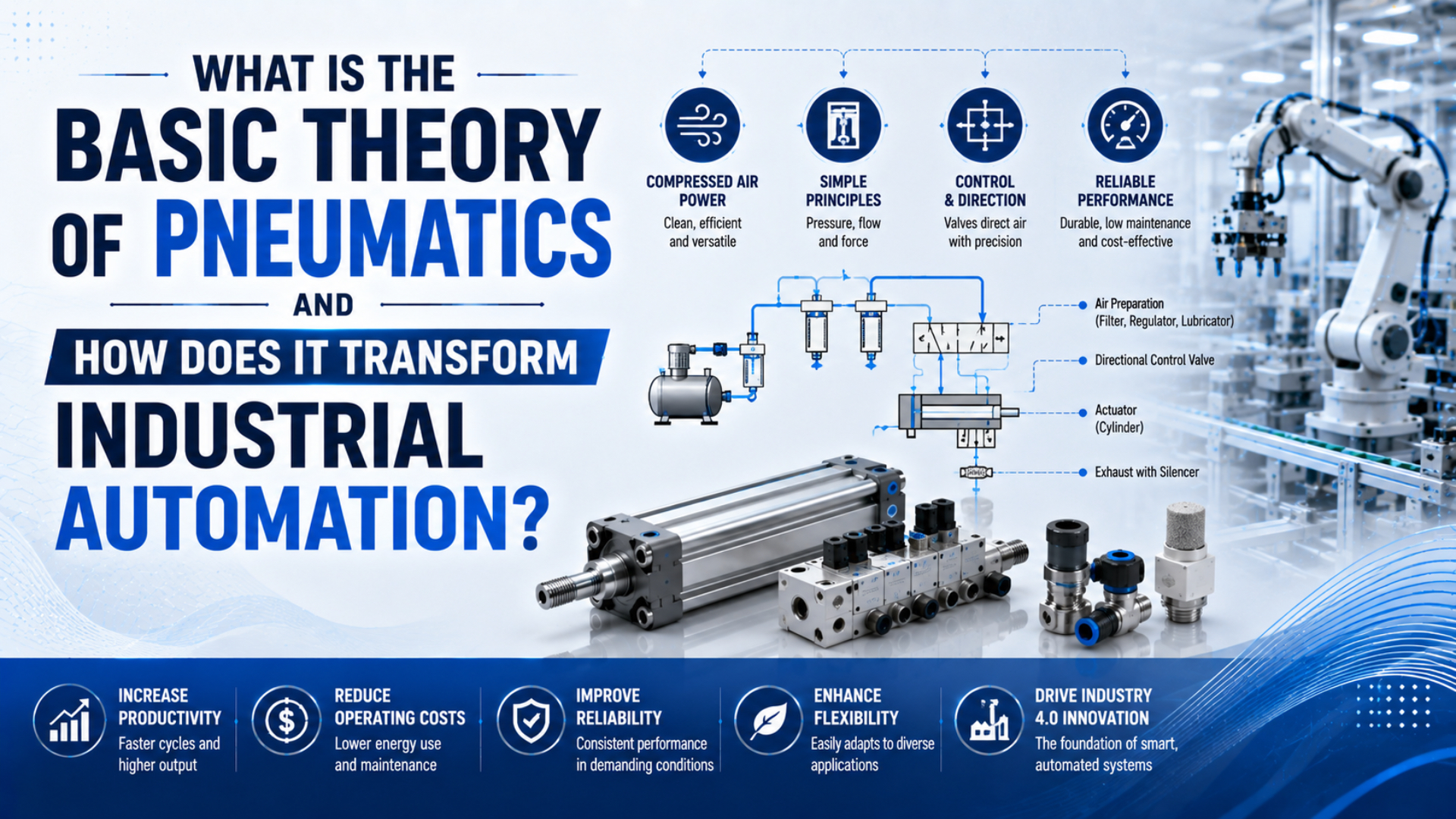
The basic theory of pneumatics is the controlled conversion of compressed-air state into mass flow, pressure difference, force, and motion. A compressor supplies the air, but the machine’s behavior is created downstream by regulators, valves, tubes, cylinder chambers, loads, sensors, and exhaust paths. Each part changes what the next part can do.
That causal chain explains why a cylinder can have enough static force yet move too slowly, hesitate, rebound, or lose repeatability. Pressure isn’t stored force, and catalogue flow isn’t guaranteed cylinder speed. Engineers need separate models for gas state, flow capacity, mechanical load, control timing, and hazardous stored energy.
Key Takeaways
- Standard atmosphere is exactly 101,325 Pa, so gas-law calculations must use absolute pressure (NIST).
- Pneumatic automation combines an energy path, a command path, a feedback path, and a safe-state path.
- ISO 6358 catalogue data describes tested component flow, not complete-machine speed.
- Safe design must control both commanded motion and residual pneumatic energy.
What Does the Basic Theory of Pneumatics Actually Describe?
NIST defines one standard atmosphere as exactly 101,325 Pa. Pneumatic theory starts from that physical reference, then follows how a machine changes pressure, temperature, mass, volume, and flow to produce motion. It is a system model, not a single “air pressure” equation (NIST).
The most useful mental model has five linked domains:
- Gas state: absolute pressure, absolute temperature, mass, and volume describe the air in a receiver, tube, or chamber.
- Flow: restrictions determine how quickly air mass enters or leaves that volume.
- Mechanics: pressure acting over area creates force; force acting through distance performs work.
- Control: valves and sensors decide when flow paths open, close, meter, or exhaust.
- Safety: isolation, restraint, and verified dissipation control unexpected motion and residual energy.
These domains answer different questions. The ideal gas law doesn’t size a directional valve. A valve flow rating doesn’t prove that a load can accelerate. A cylinder force calculation doesn’t predict the pressure available during peak flow. Keeping those boundaries visible prevents one convenient number from standing in for the whole machine.
Three related guides own the detailed mathematics. Use the basic laws of pneumatic systems for the individual laws, the pneumatic-cylinder physics guide for force and acceleration, and the gas-dynamics guide for mass flow, heat transfer, and choked flow. This article focuses on how those models become an automation architecture.
Treat pressure, flow, and motion as three different layers of evidence. A supply gauge describes a state at one point. A flow characteristic describes a component under stated test conditions. Position and time data describe the installed mechanism. Agreement among all three is what turns pneumatic theory into a reliable automation decision.
Which State Variables Must an Automation System Track?
The ideal-gas equation connects four physical quantities: absolute pressure, volume, gas amount, and absolute temperature. NIST technical guidance writes this relationship as and defines each variable. An automation system rarely measures all four, so the designer must decide which states are known, estimated, or left uncertain (NIST).
For a mass-based model:
Here, is absolute pressure in pascals, is volume in cubic metres, is air mass in kilograms, is the specific gas constant for air, and is absolute temperature in kelvins. The equation says that chamber pressure can change because mass enters, mass leaves, volume changes, or temperature changes.
During cylinder extension, the cap-end chamber receives air while its volume grows. The rod-end chamber loses air while its volume shrinks. The valve and both exhaust paths influence the two pressures. A single upstream gauge therefore cannot describe the force acting on the piston, the timing of motion, or the energy remaining after a stop.
For control design, translate the gas variables into observable machine states:
| Physical quantity | Practical observation | Automation use |
|---|---|---|
| Supply pressure | Regulator or manifold sensor | Low-supply alarm and operating permissive |
| Chamber pressure | Port sensor or test transducer | Load inference, clamp confirmation, diagnostic trace |
| Volume | Cylinder geometry plus tube and cavity volume | Fill delay, air demand, residual-energy estimate |
| Temperature | Ambient, compressor, or local sensor | Density correction, seal limit, condensation risk |
| Mass flow | Flow meter or component flow model | Demand profile, restriction diagnosis, leak review |
| Position and time | Reed switch, proximity sensor, encoder, PLC timer | Sequence state, timeout, speed, end-position proof |
The PLC doesn’t control an equation directly. It controls valves, observes sensors, and decides whether the physical process reached an acceptable state within a time window. Good pneumatic theory tells the controls engineer which sensor can genuinely prove that state.
Gauge pressure is useful, but gas laws need absolute pressure
A gauge reads pressure relative to local atmosphere. Gas-law ratios require a zero-based pressure scale. At sea-level standard atmosphere, 0.6 MPa gauge is about 0.701 MPa absolute, not 0.6 MPa absolute. The exact atmospheric reference is 101,325 Pa, though the local atmosphere can differ with elevation and weather.
This distinction becomes especially important when comparing compression ratios, estimating free-air consumption, or evaluating vacuum. See the dedicated guide to absolute pressure in pneumatic systems before mixing gauge and absolute values in one calculation.
Standard flow also needs a declared reference condition
NIST warns that “standard” gas-flow units can assume different temperatures. Its conversion page uses 101,325 Pa and 0°C for the listed standard-volume flow relationships. A catalogue value in NL/min, SLPM, or SCFM is therefore not automatically equal to the volumetric flow inside a cylinder chamber.
Record both the unit and its reference condition. Otherwise, two suppliers can quote the same number while referring to different gas masses per unit time. That error travels directly into air-consumption, valve, and cycle-time comparisons.
Why Must Controls Separate Pressure, Flow, and Motion?
NIST describes the pascal through force per unit area, while ISO 6358-1 defines a separate steady-state method for component flow. Those are different evidence types. An automation sequence needs a third type, measured motion or state confirmation, before it can distinguish “pressurized,” “capable of force,” and “completed the stroke” (NIST; ISO 6358-1).
For a double-acting single-rod cylinder, a more useful screening equation is:
In this equation, and are cap-end and rod-end gauge pressures measured against the same atmosphere, is piston area, is rod area, and is friction. The result is available actuator force before the external load and acceleration demand. The pneumatic-cylinder physics guide provides the worked examples and acceleration model.
Speed starts from , where is volumetric flow at actual chamber conditions, not standard or free-air flow. That local relationship still doesn’t predict valve delay, changing pressure, breakaway friction, load acceleration, or cushioning. Use it to organize inputs, then confirm the installed motion.
This separation changes the controls strategy. A pressure switch can confirm that a threshold was crossed. An end sensor can confirm position. A timer can detect delay. None of them alone proves force throughout motion. Critical clamping, lifting, or pressing functions may need pressure plus position, mechanical restraint, or direct force measurement.
How Does Compressibility Change Machine Behavior?
Compress an ideal trapped gas isothermally from 100% to 75% of its original volume and its absolute pressure rises by 33.3%. That inverse pressure-volume response follows the ideal-gas model reviewed by NIST. It explains why trapped air behaves like a nonlinear spring rather than a rigid mechanical link (NIST).
Compressibility affects an automation system in several practical ways:
- Delay: a valve must add or remove air mass before chamber pressure reaches the level needed to move the load.
- Compliance: trapped air deflects under changing load, so a stopped pneumatic axis isn’t infinitely stiff.
- Temperature: rapid filling and compression can raise gas temperature; expansion and exhaust can cool it.
- Cushioning: the trapped end volume can decelerate a piston, but its pressure depends on speed, restriction, leakage, and remaining volume.
- Stored energy: isolated lines, receivers, and cylinder chambers can still move a mechanism after electrical power is removed.
Dead volume matters. A long tube between valve and cylinder adds gas volume that must be filled and exhausted every cycle. Moving the valve closer can improve response even when its catalogue flow rating stays unchanged. This is why the smallest valve isn’t always the fastest package, and the largest valve isn’t automatically the best controlled package.
Compressibility is not merely a disadvantage. It provides shock tolerance, convenient energy distribution, and adjustable cushioning. The design problem is uncertainty: air volume and restrictions that are left unmeasured become hidden springs and delays. Documenting tube volume, chamber pressure, temperature, and exhaust restriction turns that uncertainty into engineering inputs.
The deeper energy consequences belong in the separate guides to gas dynamics and thermodynamic losses. For machine design, the immediate lesson is simpler: never treat a pneumatic axis as an incompressible position source.
How Does Pneumatic Theory Transform Industrial Automation?
ISO 1219-2:2012 establishes shared rules for drawing fluid-power circuit diagrams, and its current edition was confirmed in 2023. Standardized circuits let mechanical, controls, commissioning, and maintenance teams reason about the same valves, ports, pilots, exhausts, and operating states instead of relying on supplier-specific sketches (ISO 1219-2).
Pneumatics transforms automation by separating the source of energy from the point of motion. One compressor network can supply many compact actuators, while local valves and sensors configure how each mechanism behaves. That architecture supports several control patterns:
- Two-position motion: a directional valve moves a cylinder between physical end states, and sensors confirm the sequence.
- Pressure-limited force: a regulator or electro-pneumatic pressure controller limits the available pressure for clamping, pressing, or balancing.
- Metered speed: flow controls shape filling or exhaust, usually with position or timing feedback to detect drift.
- Proportional motion: proportional valves and continuous sensors regulate pressure, flow, or position where ordinary on/off control is insufficient.
- Energy-isolated state: shut-off, exhaust, restraint, and verification functions place the mechanism in its risk-assessed safe condition.
The transformation isn’t “air instead of electricity.” Electrical controls still provide logic, sensing, communication, diagnostics, and valve actuation. Pneumatics supplies distributed mechanical work at the load. The machine works well when the electrical state model matches the physical pressure, flow, motion, and energy states.
For example, a PLC output labelled “cylinder extended” is only a command. A valve-spool signal says the command reached the valve. A cap-end pressure threshold says the chamber pressurized. An end sensor says the mechanism reached a location. These are four different events, and their timestamps expose different faults.
A strong pneumatic sequence names states by evidence, not intent. Replace a single “extend complete” bit with the states that matter to the risk and process: command issued, valve switched, pressure established, motion detected, endpoint reached, load secured, and residual energy controlled. Not every machine needs every state, but every safety or quality claim needs a matching observation.
The Compressor-to-Actuator Energy and Control Chain
The U.S. Department of Energy organizes compressed-air improvement around both supply and demand, including storage, pressure stabilization, leaks, air quality, and end uses. That whole-system boundary matters because a well-sized cylinder cannot correct an unstable header, poor compressor control, or wasteful point-of-use circuit (DOE).
The chain has distinct engineering responsibilities:
| Stage | Primary quantity | What to verify under real demand |
|---|---|---|
| Compressor and aftercooler | Available mass flow, discharge pressure, temperature | Capacity, control mode, duty, cooling, condensate removal |
| Receiver and distribution | Stored air, pressure profile, pressure drop | Peak-demand support, pipe losses, leakage, pressure stability |
| Air preparation | Cleanliness, water and oil control, regulated pressure | Filter condition, drain function, dynamic regulator behavior |
| Directional and flow control | Conductance, switching state, exhaust path | Both directions, fittings, silencers, meter-in or meter-out setting |
| Actuator and load | Chamber pressure, force, speed, energy | Bore, stroke, friction, guidance, moments, cushioning |
| Sensors and logic | State, timing, diagnostics | Signal location, fault response, safe restart |
This separation prevents a common energy mistake: raising plant pressure to solve a local restriction. CAGI states that every additional 2 psig of operating pressure increases compressor power by approximately 1%, and recommends no more than 10% pressure drop from compressor discharge to point of use for a well-designed system (CAGI).
Those values describe a plant-air path, not an automatic allowance for one machine branch. A cylinder may need a much tighter dynamic-pressure budget to preserve force and timing. Measure the pressure at the actuator ports during peak flow before changing the compressor setpoint. The pressure-drop troubleshooting guide explains where to place those measurements.
Energy accounting also needs a declared boundary. Compressor electrical input, delivered free air, valve losses, cylinder work, useful load work, leaks, and exhaust recovery are different quantities. Quoting “system efficiency” without naming the numerator, denominator, test interval, and operating state doesn’t support a design comparison.
How Do Valves, Tubing, and Exhaust Transform Automation Performance?
ISO 6358-1:2013 defines steady-state testing for pneumatic components using compressible fluids, and its 2026 Amendment 2 addresses measurement uncertainty. The standard applies to tested component flow paths, not cylinders or accumulators. Catalogue flow data therefore needs an installed-system check before it becomes a cycle-time commitment (ISO 6358-1).
Compressed gas can reach choked flow when the downstream-to-upstream absolute pressure ratio falls below a component-specific critical value. Once choked, reducing downstream pressure further doesn’t produce the increase predicted by an incompressible square-root formula. This is why a liquid-style Cv equation is a poor universal basis for compressed-air valve sizing.
Use the supplier’s stated pneumatic flow characterization and its reference conditions. Then review every series element:
- regulator and shut-off valve;
- directional-valve supply and exhaust paths;
- manifold galleries;
- port adapters and elbows;
- tube inside diameter and length;
- one-way flow controls;
- cylinder ports and internal passages; and
- exhaust silencers or common exhaust plumbing.
The smallest effective path can dominate. It may also change by direction. A valve with strong supply flow but restricted exhaust can build backpressure on the opposing chamber, reducing force and slowing motion even when the inlet gauge looks healthy.
For the theory behind catalogue conductance and critical pressure ratio, see the guide to sonic conductance and choked flow. During commissioning, log supply pressure, both cylinder-port pressures, command time, start-of-motion time, end position, and exhaust condition. That data distinguishes a force problem from a filling, exhaust, load, or control-delay problem.
A Six-Step Pneumatic Design Workflow
ISO 4414:2010 covers pneumatic-system design, construction, modification, installation, adjustment, operation, maintenance, reliability, energy efficiency, and environmental considerations. A practical workflow must therefore reach beyond component sizing and finish with verified machine behavior, residual-energy control, and documentation. That scope demands six linked decisions (ISO 4414).
1. Define the mechanical duty
Record load magnitude and direction, stroke, orientation, target time, acceleration, duty cycle, stopping method, side load, moments, external guidance, and acceptable position variation. Separate normal production from setup, jam recovery, maintenance, and loss-of-supply states.
2. Establish the pressure and force budget
Start from the minimum dynamic pressure available at the actuator, not the compressor nameplate or unloaded regulator setting. Calculate pressure-area force in both directions, subtract opposing-chamber pressure and friction, then apply a margin justified by load uncertainty and motion requirements.
3. Convert motion into chamber-flow demand
Use chamber geometry and target motion to estimate the required in-cylinder flow. Convert to standard flow only after declaring reference pressure and temperature. Include tube and clearance volume when response time matters. The cylinder air-consumption guide treats cycle demand separately from instantaneous flow.
4. Verify the complete supply and exhaust path
Check the directional valve, manifold, fittings, tube ID and length, flow controls, ports, and silencers in both directions. Use ISO 6358 data or supplier gas-flow data under stated conditions. Don’t add nominal Cv values from unlike methods and assume the sum predicts cylinder speed.
5. Choose the control and safe-state strategy
Define how the axis starts, stops, vents, holds, or is restrained after faults. A closed valve can trap pressure; an exhausted cylinder can still move under gravity or stored mechanical energy. OSHA includes pneumatic energy within hazardous-energy control and requires isolation or restraint during servicing (OSHA).
ISO 1219-2:2012 remains current after its 2023 confirmation and establishes rules for drawing fluid-power circuit diagrams with ISO 1219-1 symbols. Use that common representation to document normal states, pilot paths, exhausts, isolation points, and residual-energy hazards (ISO 1219-2).
6. Commission with synchronized measurements
Record command, valve signal, both cylinder-port pressures, position, stroke time, load state, regulator pressure, and exhaust condition on the same cycle. Test normal, peak-demand, cold-start, low-supply, stop, restart, and relevant fault states. Revise the model when measured behavior disagrees with the estimate.
The final design record should preserve the causal chain, not just the selected part numbers. If a future technician changes tube length, silencer, regulator setting, payload, or valve manifold, the record should show which pressure, flow, force, timing, energy, and safety assumptions need rechecking.
Pneumatic Theory FAQs for Industrial Automation
ISO 6358-1 separates tested component flow from cylinder behavior, while ISO 4414 covers machinery-level pneumatic safety and operation. These four answers preserve that boundary: pressure, flow, compressibility, and stored energy must be evaluated together, but each needs its own measurement and decision rule (ISO 6358-1; ISO 4414).
Is pneumatic pressure the same as stored force?
No. Pressure is force per area, while actuator force depends on piston geometry, pressure in both chambers, friction, and external load. A pressurized receiver or tube stores pneumatic energy, not a fixed force. The mechanism and active area determine how that energy can create motion.
Why can a cylinder be strong enough but still too slow?
Static force and dynamic response are different checks. The bore and pressure may provide enough theoretical force, yet a restricted valve, small tube, long dead volume, exhaust backpressure, or high breakaway friction can delay chamber-pressure development and limit speed during the commanded stroke.
Should pneumatic calculations use gauge or absolute pressure?
Use gauge pressure for many two-chamber force calculations when both pressures share the same atmospheric reference. Use absolute pressure for gas laws, pressure ratios, compression ratios, standard-flow conversion, vacuum calculations, and choked-flow checks. Always label the pressure basis instead of relying on context.
Does shutting off electrical power make a pneumatic machine safe?
No. Air can remain trapped in receivers, lines, and actuator chambers, while gravity or springs can still move the mechanism. The machine needs a risk-based isolation, venting or restraint strategy, verification of the safe state, and a controlled restart procedure consistent with applicable safety requirements.
Sources and technical references
- NIST pressure and gas-flow unit conversions
- NIST, Perspectives for a New Realization of the Pascal by Optical Methods
- NIST, General Guidelines for On-Site Calibration of Humidity and Moisture Control Systems
- ISO 6358-1:2013, steady-state flow testing for pneumatic components
- ISO 4414:2010, pneumatic-system safety requirements
- ISO 1219-2:2012, fluid-power circuit diagrams
- U.S. Department of Energy compressed-air systems resources
- CAGI, Working With Compressed Air
- OSHA, Control of Hazardous Energy