

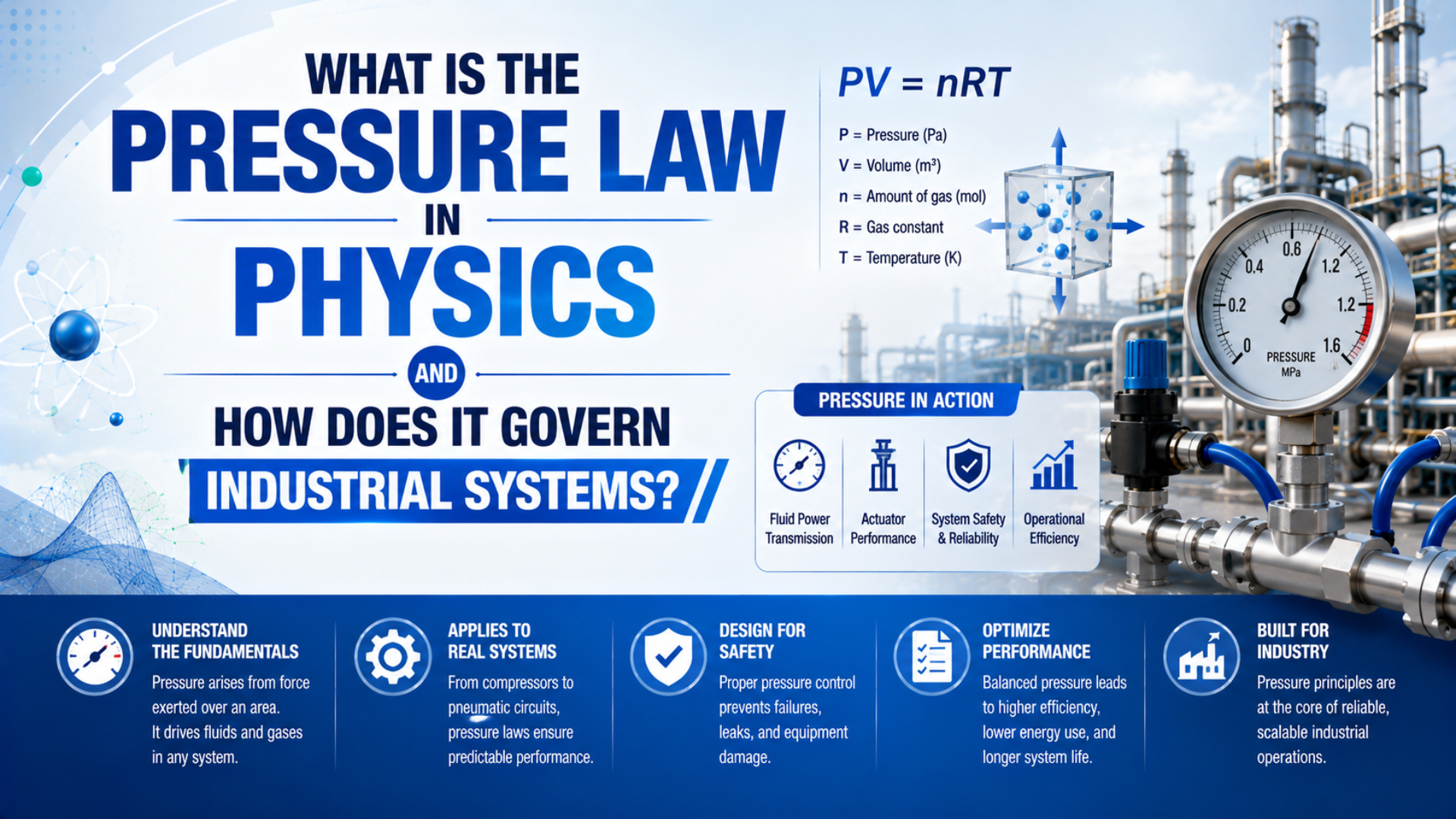
In industrial gas calculations, the pressure law usually means the Amontons or Gay-Lussac pressure-temperature relationship: the absolute pressure of a fixed amount of gas in a fixed volume changes in direct proportion to its absolute temperature. Its two-state form is . The relationship is useful for estimating thermal pressure in a trapped pneumatic volume, but it doesn’t size a pressure vessel or relief device.
Key Takeaways
- Use absolute pressure and kelvin or degrees Rankine.
- Confirm that gas mass and volume remain constant.
- Convert the result back to gauge pressure only after the calculation.
- Treat the result as a screening estimate, not a code design.
What Does the Pressure Law Mean in Industrial Physics?
OpenStax identifies the pressure-temperature relationship as Amontons’s law or Gay-Lussac’s law and writes it as when gas quantity and volume are fixed. Source: OpenStax Chemistry. That boundary matters more than the name: pressure, temperature, gas mass, and volume must all be defined before the result has engineering meaning.
For two equilibrium states:
and are absolute pressures. and are absolute temperatures. The gas quantity and container volume are unchanged between states. Rearranging for the final pressure gives:
The equation predicts the pressure after a temperature change. It doesn’t predict how quickly the gas heats, whether the wall can carry the resulting stress, or how a relief valve will discharge.
Why does pressure rise? At a higher temperature, gas molecules have greater average kinetic energy. In a rigid container they cannot create more volume, so their collisions with the wall produce a higher time-averaged force per unit area.
The pressure law is best treated as a boundary test. If the boundary leaks, moves, vents, receives air from a regulator, or contains condensing vapor, the simple two-state ratio has already lost at least one required condition.
Pressure and Temperature References for the Equation
NIST lists 1 standard atmosphere as exactly 101,325 Pa, or approximately 14.6959 psi. Source: NIST Pressure Conversions. Add the relevant atmospheric pressure to a gauge reading before using a gas-state equation, and convert Celsius or Fahrenheit to an absolute temperature scale.
Use these conversions:
Here, is absolute pressure, is gauge pressure, and is the atmospheric pressure used for the calculation. is temperature in kelvin and is temperature in degrees Celsius.
Gauge pressure is convenient for plant instruments because it reads zero when open to the local atmosphere. A gas-law ratio is different. It must reference zero pressure at a perfect vacuum. Using 6 barg as though it were 6 bar absolute understates the trapped gas’s initial pressure and distorts the calculated change.
Local atmospheric pressure can differ from the standard value because of altitude and weather. Use a measured or project-specified value when the required accuracy justifies it. The Pneumatic Pressure Unit Converter can handle unit changes, but gauge-to-absolute conversion still needs the correct atmospheric reference.
How Do You Calculate Pressure After a Temperature Change?
A trapped air volume starting at 6 barg and 20°C reaches approximately 7.970 bar absolute when heated to 60°C under the ideal, fixed-volume assumptions. Using NIST’s standard atmosphere for the reference, that result is about 6.957 barg, an increase of roughly 0.957 bar rather than the 0.819 bar obtained by incorrectly applying the ratio to gauge pressure.
Start by converting the initial gauge pressure:
Convert both temperatures:
Then calculate the final absolute pressure:
Convert the result back to gauge pressure for comparison with a plant gauge:
This answer assumes no leak, no volume change, one gas phase, uniform equilibrium temperature, and ideal-gas behavior. It also assumes the same atmospheric reference for both gauge conversions.
When Does the Pressure Law Fit a Pneumatic System?
ISO 4414:2010 remains the published pneumatic-system safety standard and covers machinery pneumatic systems, while explicitly excluding compressors, factory distribution systems, gas bottles, and receivers from its scope. Source: ISO 4414. That distinction shows why the component boundary and applicable standard must be identified before a thermal-pressure calculation is used.
The fixed-volume relationship can be a useful first estimate for:
- a blocked-in rigid test fixture after all valves are closed;
- a short rigid manifold section isolated between shut-off valves;
- a pneumatic chamber whose piston is mechanically locked and whose leakage is negligible;
- an instrument cavity with a known sealed gas charge;
- a rigid receiver considered between two settled thermal states, subject to its governing vessel rules.
In application reviews, we start by drawing the gas boundary and marking every valve, seal, moving wall, tube, and possible heat source. That sketch often decides the model before any arithmetic begins. A volume described as “closed” on a schematic may still leak through valve seats, rod seals, regulators, or check valves.
For moving chambers, see the broader guide to pneumatic cylinder physics. For end-of-stroke volumes, the pneumatic cushioning model explains why a cushion chamber is usually an open, variable-volume control volume rather than a sealed jar.
When Does This Law Give the Wrong Engineering Answer?
OpenStax’s ideal-gas equation contains four linked state quantities: pressure, volume, gas amount, and absolute temperature. Source: OpenStax College Physics. Holding only two values constant creates a simple gas-law relationship. If mass or volume changes during operation, a fixed-volume pressure-temperature ratio can’t represent the process by itself.
Don’t use the simple pressure law alone when:
- a regulator, valve, compressor, or leak changes the gas mass;
- a cylinder piston, bladder, diaphragm, bellows, or flexible hose changes volume;
- rapid compression or expansion creates a nonuniform transient temperature;
- vapor condenses, liquid boils, or a chemical reaction generates gas;
- the state is near saturation, at very high pressure, or outside a reasonable ideal-gas range;
- a flowing heat exchanger has inlet, outlet, pressure loss, and heat-transfer effects;
- the task is to size a pipe, valve, vessel wall, relief device, or emergency vent.
What if a double-acting cylinder is stopped mid-stroke? A rod lock may hold its volume nearly constant for a short interval, but valve leakage and seal leakage still change mass. Solar heating may also create different gas, barrel, and ambient temperatures. Measure the actual boundary conditions before treating the chamber as sealed.
Temperature also affects seals, lubricant viscosity, tubing flexibility, sensor drift, and component ratings. Those effects don’t come from . See the dedicated guide to heat transfer in pneumatic systems before attributing every temperature-related problem to gas pressure.
How Does It Connect to the Ideal and Combined Gas Laws?
OpenStax writes the ideal-gas equation as , with absolute pressure and absolute temperature, and also gives the molar form . Source: OpenStax College Physics. The pressure law follows when gas amount , volume , and gas constant remain unchanged.
The ideal-gas equation is:
is absolute pressure, is gas volume, is amount of gas in moles, is the universal gas constant, and is absolute temperature.
For the same trapped gas at two states, the combined relation is:
If , the volume terms cancel and the pressure law remains. If volume changes but mass stays fixed, use the combined form. If mass crosses the boundary, neither two-state expression is sufficient without a mass balance.
This hierarchy prevents formula shopping: start with the physical system, then simplify the general model only after proving which terms remain constant. The pneumatic transmission equation guide follows the same approach for force, flow, air consumption, and pressure loss.
At elevated pressure, near a phase boundary, or with gases far from ideal behavior, use an appropriate compressibility factor or real-gas equation of state. Product data and a validated property method should decide whether the ideal approximation is acceptable.
What Does the Pressure Law Prove About Equipment Safety?
ASME BPVC Section VIII, Division 1 covers the design, fabrication, inspection, testing, and certification of pressure vessels operating above 15 psig. Source: ASME BPVC VIII.1. A temperature-pressure estimate can identify a possible thermal overpressure scenario, but it cannot establish allowable pressure, wall thickness, relief set pressure, or discharge capacity.
Use the pressure-law result to ask better safety questions:
- Does the predicted pressure exceed the lowest-rated component or allowable operating limit?
- Can isolation trap gas between two valves?
- What credible maximum and minimum temperatures apply?
- Does the volume contain only gas, or can liquid, vapor, or reaction products appear?
- Which machine-safety, piping, vessel, fire, and jurisdictional requirements govern the equipment?
- Who is responsible for the relief scenario and capacity calculation?
Relief sizing depends on the credible overpressure cause, required relieving rate, relieving temperature and pressure, fluid properties, backpressure, discharge path, and applicable code. A multiplier such as 1.1 or 1.5 cannot replace that analysis.
ISO 4414 addresses significant hazards in machinery pneumatic systems, but its published scope excludes compressors, factory distribution, gas bottles, and receivers. A system may therefore cross several standards and legal boundaries. Don’t assume that compliance for a pneumatic control circuit proves compliance for an air receiver or process vessel.
If measured pressure or temperature approaches an equipment limit, follow the facility’s approved operating and emergency procedures. Don’t improvise isolation, venting, cooling, or relief adjustments from a blog calculation.
A Pressure-Law Calculation Checklist
The ideal-gas state equation links four quantities, while the pressure law is valid only after gas amount and volume are held constant. Source: OpenStax College Physics. Record eight inputs or decisions before accepting a result, then compare the estimate with equipment and code limits.
Use this sequence:
- Draw the gas boundary.
- Identify every inlet, outlet, leak path, and moving wall.
- Confirm whether the gas quantity remains fixed.
- Confirm whether the volume remains fixed.
- Record initial gauge pressure and local atmospheric pressure.
- Convert both pressures to an absolute basis.
- Convert both temperatures to kelvin or degrees Rankine.
- Calculate the unknown absolute state.
- Convert back to gauge pressure only for instrument comparison.
- Check ideal-gas validity, temperature uniformity, component ratings, and governing requirements.
The numerical precision should match the inputs. A gauge read to the nearest 0.1 bar doesn’t justify a final answer reported to five decimal places. More digits don’t fix uncertain temperature, local atmosphere, leakage, or container expansion.
Pressure Law in Physics FAQs
NIST defines standard atmosphere as exactly 101,325 Pa, yet most industrial gauges display pressure relative to their local atmosphere. The following answers address four recurring calculation decisions: the name of the law, pressure reference, use with cylinders, and the boundary between a thermal-pressure estimate and an engineered safety system.
Is the pressure law the same as Gay-Lussac’s law?
In many introductory engineering contexts, yes. The fixed-volume pressure-temperature relationship is called Gay-Lussac’s law, Amontons’s law, or the pressure law. Because the name is not universal, state the actual relationship and its conditions: fixed gas amount, fixed volume, absolute pressure, and absolute temperature.
Can I use gauge pressure in the pressure law?
No. Convert gauge pressure to absolute pressure before calculating the ratio. Add the relevant atmospheric pressure, apply the temperature ratio, and subtract the same atmospheric reference only if a final gauge value is needed. Mixing gauge pressure with kelvin creates a result that looks plausible but is physically inconsistent.
Does the pressure law apply inside a pneumatic cylinder?
Only during an interval in which gas mass and chamber volume are effectively fixed. A moving piston changes volume, and an open valve changes gas mass. A mechanically locked, isolated chamber may be screened with the law, but leakage, hose expansion, heat transfer, and temperature gradients still limit accuracy.
Can the calculated pressure be used to set a relief valve?
No. The calculated pressure may reveal a credible thermal overpressure concern, but relief-device selection requires the applicable code, allowable equipment pressure, relieving rate, fluid state, relieving temperature, backpressure, and discharge-system analysis. A qualified engineer must evaluate the complete scenario and jurisdictional requirements.