

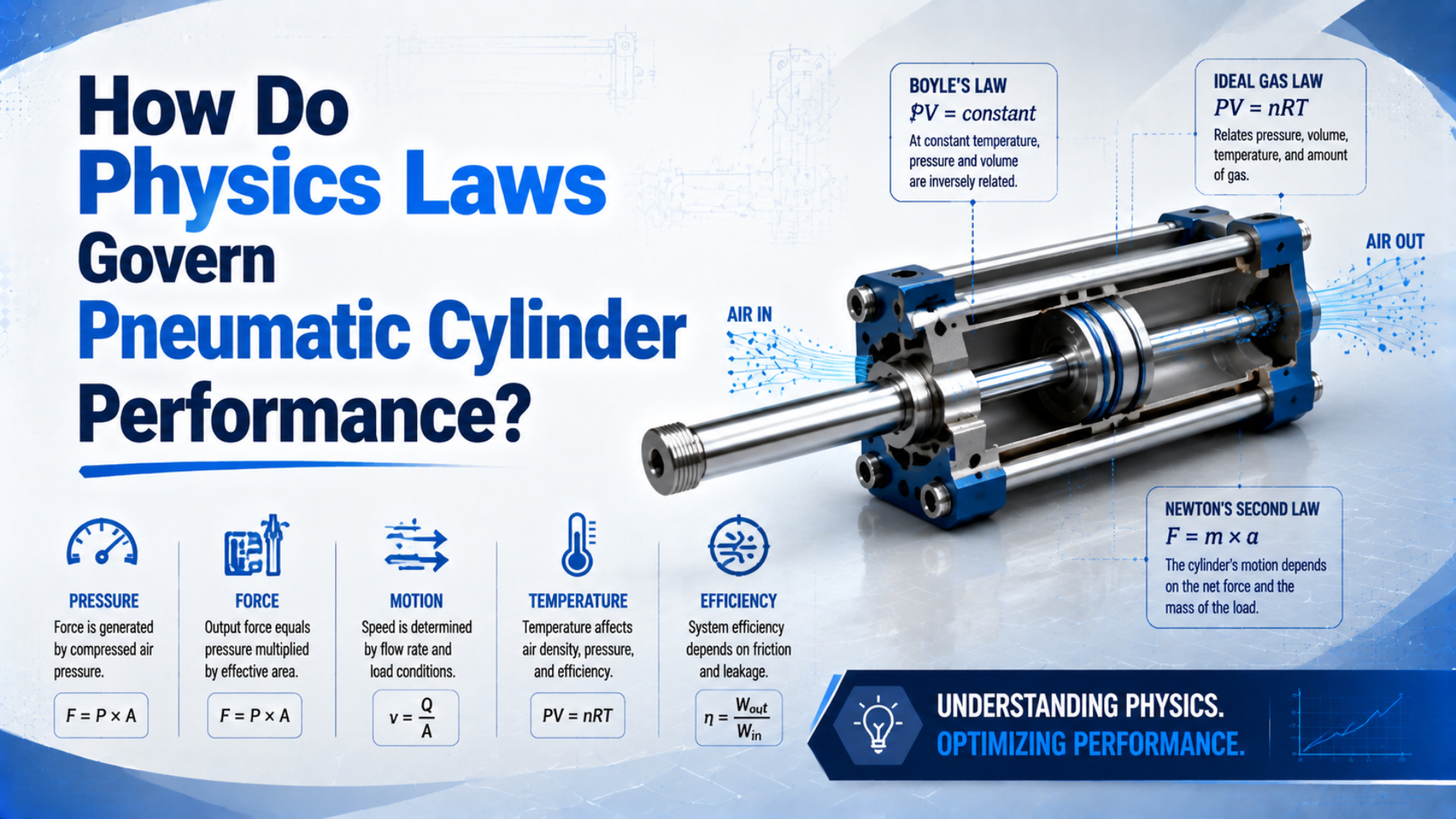
Pneumatic cylinder physics works in layers. Pressure acting on unequal piston areas determines available thrust. Newton’s second law connects the remaining force to acceleration. Gas-state and mass-balance equations explain chamber pressure, while compressible-flow limits determine how quickly the valve can fill and exhaust those chambers. No single equation predicts the whole stroke. The relationship is a useful static starting point, but it can’t account for rod-side backpressure, seal friction, changing gas mass, valve restrictions, moving load, or end-of-stroke energy by itself.
Choose the boundary before calculating.
Key Takeaways
- A 50 mm bore at 6 bar gauge produces 1,178 N of ideal extension force before friction and backpressure.
- Net force depends on both cylinder chambers.
- Gas laws require absolute pressure and temperature.
- Ideal-air flow chokes near a downstream-to-upstream absolute pressure ratio of 0.528.
The Five Models Behind One Cylinder Stroke
NASA expresses pressure as force divided by area, Newton’s second law as force equal to mass times acceleration, and the ideal-gas state equation as (NASA Pressure, 2021; NASA Newton’s Laws, 2021; NASA Ideal Gas). Those three ideas still need mass-flow and energy models in a working cylinder.
Each model answers a different engineering question:
| Model | Main question | Typical inputs | What it cannot predict alone |
|---|---|---|---|
| Pressure-area force | How much axial thrust is available now? | both chamber pressures, bore, rod diameter, friction | acceleration, stroke time, impact |
| Newton’s second law | How quickly will the load accelerate? | net force, moving mass, external resistance | chamber pressure history |
| Gas state and energy | How does chamber pressure respond to mass, volume, and temperature? | absolute pressure, volume, mass, temperature, heat transfer | valve restriction without a flow model |
| Compressible mass flow | How quickly can air enter or leave? | upstream/downstream absolute pressure, temperature, conductance | mechanical load response without chamber and motion equations |
| Kinetic energy | What must cushioning or a shock absorber dissipate? | effective moving mass, velocity | available stroke time or cushion capacity |
Pascal’s principle remains useful: pressure at a point in a confined fluid acts in all directions. Yet a pneumatic cylinder is not a static hydraulic press. Its two gas volumes change while valves add and remove mass. Air compresses, the piston moves, and heat can enter or leave.
Most mistakes come from applying a correct law outside its valid boundary. A static force table cannot prove stroke time, and a valve flow rating cannot prove that the load will accelerate.
How Do Two Chamber Pressures Set Net Force?
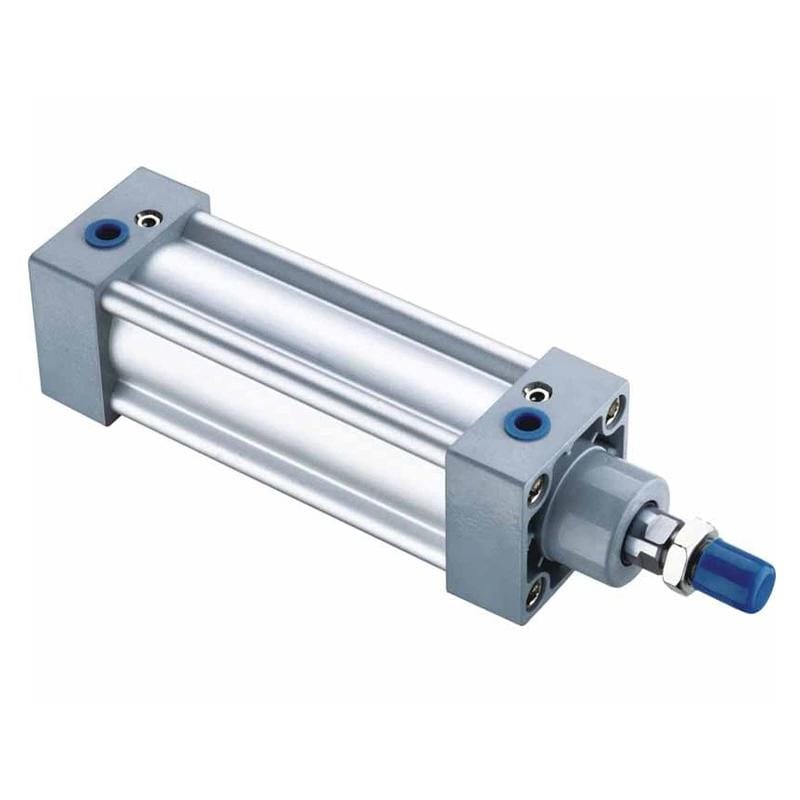
Parker’s cylinder guidance calculates extension and opposing rod-side pressure forces separately and warns that backpressure is never completely absent (Parker Designing With Cylinders). For a 50 mm bore at 6 bar gauge, ideal cap-end force is 1,178 N before any opposing pressure or friction.
For bore diameter and rod diameter , the full piston area and rod-side annular area are:
Using gauge pressures referenced to the same local atmosphere, the available extension thrust is:
Here, is cap-end gauge pressure, is rod-end gauge pressure, and is seal and guide friction. Use pascals and square metres to obtain newtons.
Suppose a 50 mm bore, 20 mm rod cylinder extends with 5.5 bar gauge at the cap end and 0.8 bar gauge at the rod end. Its full area is 0.001963 m², and the annular area is 0.001649 m². With an estimated 70 N friction force:
Although the regulator might show 6 bar, the actuator delivers only about 878 N during that instant. Supply-path loss reduced cap-end pressure; meter-out restriction created rod-side backpressure; friction consumed the remaining margin.
Why can gauge pressure be used here? Atmospheric pressure acts on the exposed rod and cancels the atmospheric part of the two internal pressure forces. If absolute pressures are used instead, that external atmospheric force must also appear in the free-body diagram. Mixing references silently creates an error.
How Does Newton’s Second Law Set Acceleration?
NASA states that constant-mass motion follows , with acceleration determined by the net external force rather than one individual force (NASA Newton’s Laws, 2021). If the cylinder example has 878 N available thrust, a 650 N resisting load leaves 228 N for acceleration.
Axial motion follows:
Here, includes the piston, rod or carriage, fixture, payload, and any reflected mass from the mechanism. includes gravity, process reaction, guide friction, spring force, and other opposing loads.
For an effective moving mass of 45 kg:
That acceleration is instantaneous. Cylinder pressure, mechanism angle, friction, and external process force can all change during the stroke. Linkages can also transform force and velocity, so the cylinder-axis result is not automatically the force at the tool.
Static load is not the same as dynamic load
Horizontal transfers may need little steady force once moving, yet demand high acceleration force at the start. Vertical axes must carry gravity throughout the stroke. Presses and clamps may encounter their largest resistance only near the end.
In our experience, a useful sizing worksheet separates four rows: steady process force, gravity, acceleration force, and friction. Combining them into one unexplained “safety factor” makes troubleshooting harder because nobody can see which assumption changed.
Newton’s second law also explains why higher flow doesn’t directly create more force. Higher mass flow can build chamber pressure faster, which may preserve force during acceleration. Mechanical response still depends on net pressure force minus the load.
When Does the Ideal Gas Law Apply?
NASA gives the ideal-gas state equation as and requires absolute pressure and absolute temperature (NASA Ideal Gas). For a fixed mass at constant temperature, reducing volume by 10% raises absolute pressure by about 11.1%, not 10%.
For a closed, fixed-mass, isothermal gas volume:
If 0.50 L of trapped air starts at 7 bar absolute and is compressed to 0.45 L:
This is a valid Boyle’s-law example because the mass and temperature assumptions are stated. It is not a complete model for a powered stroke while a directional valve remains connected.
Mass still crosses the boundary.
A valve-fed chamber has changing mass
During extension, the cap-end volume grows while air flows in. Meanwhile, rod-end volume shrinks while air flows out. Start with the chamber mass balance:
Geometry supplies the volume rate:
Pressure then follows from mass, volume, and temperature together. Fast filling can raise gas temperature; expansion and exhaust can lower it. Heat transfer through the barrel moves the process away from both perfect isothermal and perfect adiabatic behavior.
See the guide to polytropic cylinder processes for how can approximate selected fixed-mass intervals. It should not be fitted across a period with uncontrolled valve flow.
Why Does Compressible Flow Limit Cylinder Speed?
ISO 6358-1 specifies steady-state flow testing for pneumatic components with fixed or variable internal flow paths, but it excludes cylinders because they exchange energy with the gas (ISO 6358-1, 2013). Valve and fitting data can describe the restrictions around the actuator, not the complete moving-cylinder response.
For a system-wide treatment, the guide to gas dynamics in pneumatic systems covers density, temperature, conductance, line volume, and pressure response in depth. This section stays with one narrower decision: when a cylinder-speed calculation must change from volume rate to compressible mass flow.
The relationship is safe only when is the actual volumetric rate at the chamber’s pressure and temperature. Catalog flow is often stated as NL/min, ANR, SCFM, or another reference condition. Those values represent an equivalent volume at a defined reference state.
Mass flow avoids that ambiguity:
Density changes with pressure and temperature. This is why 500 L/min at a standard reference condition is not the same physical volume rate inside a chamber at 6 bar absolute.
Subsonic and choked flow
For an ideal gas flowing through a restriction, the critical downstream-to-upstream absolute pressure ratio is:
For air with , the ideal ratio is approximately 0.528. If a valve has 7 bar absolute upstream and 1 bar absolute downstream, the ratio is about 0.143, so the narrowest effective passage can be choked. Lowering downstream pressure further will not increase mass flow while upstream state and effective area remain fixed.
NASA derives the mass-flow ceiling at Mach 1 and shows that choked mass flow depends on throat area, upstream total pressure, upstream total temperature, gas constant, and heat-capacity ratio (NASA Mass Flow). Real pneumatic components should use their tested sonic conductance and critical pressure ratio where available.
See the choked-flow cylinder-speed guide for that boundary in more detail. For routine selection, calculate stroke demand first, then check the full supply and exhaust paths using manufacturer data.
Both filling and exhaust matter
Even with adequate supply pressure, a cylinder can move slowly when its exhaust path is restrictive. Rod-side backpressure subtracts force during extension, while a clogged muffler or wrongly oriented speed controller limits mass leaving the chamber.
Measure valve-inlet pressure and both cylinder-port pressures on the same time base. Observing the regulator after the machine stops can’t reveal pressure collapse during acceleration.
Gauge or Absolute Pressure: Which One Belongs in the Equation?
NIST defines 1 standard atmosphere as exactly 101,325 Pa, equivalent to about 14.6959 psi (NIST Pressure and Gas-Flow Conversions). Therefore, 6 bar gauge corresponds to about 7.01325 bar absolute only when local atmosphere equals the standard value.
Use the pressure reference that matches the calculation:
| Calculation | Preferred pressure reference | Reason |
|---|---|---|
| Simplified cylinder force with the opposite side vented | gauge | atmospheric contribution cancels when the force balance is written consistently |
| Two-chamber force | gauge pressures with the same ambient reference, or a complete absolute-pressure free body | both chamber forces and exposed rod atmosphere must be consistent |
| Ideal-gas state equation | absolute | zero pressure must represent vacuum |
| Density and mass flow | absolute | gas density depends on absolute state |
| Choked-flow pressure ratio | absolute | a gauge-pressure ratio has no physical meaning |
| Catalog pressure conversion | preserve the stated reference | bar(g), bar(a), psig, and psia are not interchangeable |
Convert the references with:
Standard atmosphere is a conversion reference, not a promise about the installation. Weather and altitude change local atmospheric pressure. Use local pressure when the required accuracy makes that difference material.
See the absolute-pressure guide for altitude, compression ratio, and reference-state errors. For datasheet work, the Pressure Converter can handle bar, psi, MPa, kPa, and kgf/cm² after the pressure reference has been identified.
A Physics-First Sizing Workflow
Moving a 50 mm bore cylinder through 500 mm sweeps about 0.982 L on its cap side. Completing that stroke in 0.5 s requires an average chamber-volume rate near 118 L/min before dead volume, pressure-reference conversion, leakage, and acceleration effects are added.
Use this sequence:
- Define the mechanical job. Record load direction, process force, effective moving mass, stroke, target time, orientation, mechanism geometry, and stopping method.
- Size theoretical force. Calculate piston and annular areas. Check extension and retraction separately.
- Build the real force balance. Add expected chamber backpressure, friction, gravity, process reaction, and required acceleration.
- Calculate swept volume. Include cylinder dead volume and relevant tube volume when response time matters.
- Convert flow references correctly. State whether flow is actual, normal, standard, ANR, or free-air delivery and name its reference pressure and temperature.
- Select supply and exhaust conductance. Check valve, fittings, tube ID, speed controllers, port passages, and mufflers as connected paths.
- Check stopping energy. Calculate moving kinetic energy and compare it with the cylinder cushion, external stop, or shock absorber rating.
- Validate dynamically. Record both chamber pressures and position or stroke time under the real load.
For the 50 mm example, an estimated average chamber pressure of 6 bar absolute at unchanged temperature corresponds to roughly 698 normal L/min when referenced to 1.01325 bar absolute. That is a screening value, not a guaranteed valve rating.
Use the cylinder formula hub for quick area and air-use equations. The dynamic chamber-pressure guide explains how to test whether the selected circuit delivers those assumptions during motion.
Check energy before increasing speed
End-of-stroke kinetic energy is:
Doubling speed multiplies kinetic energy by four. A flow change that saves cycle time can therefore exceed cushion or mounting capacity even when cylinder force remains unchanged. Use the cushion-energy calculator before increasing speed on a heavily loaded axis.
Defensible design connects every catalog choice to one governing boundary: bore to force, valve conductance to mass flow, tube volume to response, cushion capacity to energy, and mounting to the external load path. That chain is more useful than one oversized safety factor.
Pneumatic Cylinder Physics FAQs
ISO 6358 has standardized component flow characterization since 2013, while NASA’s gas and motion equations show why no one formula covers a valve-fed moving chamber. These four questions address the pressure-reference, force, speed, and gas-law errors most likely to distort a cylinder calculation.
Should pneumatic cylinder force use gauge or absolute pressure?
Gauge pressure is convenient for a consistently written cylinder force balance because the atmospheric contribution cancels. Gas-state, density, and choked-flow calculations require absolute pressure. If absolute pressure is used in a single-rod force diagram, include atmospheric pressure acting on the exposed rod area instead of silently omitting it.
Why is actual cylinder force lower than pressure multiplied by piston area?
The simple product gives one ideal pressure force. Actual available thrust also includes opposing-chamber backpressure, reduced rod-side area, seal and guide friction, gravity, process reaction, and dynamic pressure loss. Measure both port pressures during motion when the static regulator setting predicts more force than the machine produces.
Does increasing pressure always make a pneumatic cylinder move faster?
No. Higher upstream pressure can increase available force and may increase mass flow through a restriction, but speed still depends on valve conductance, tube and port restrictions, exhaust capacity, chamber volume, load, and flow-control settings. Once flow is choked, lowering downstream pressure further does not increase mass flow.
Can Boyle’s law predict an entire powered cylinder stroke?
Not by itself. Boyle’s law describes a fixed mass at constant temperature. A powered cylinder normally gains mass in one chamber, loses mass from the other, changes both chamber volumes, exchanges heat, and accelerates a load. Use mass and energy balances coupled with valve-flow and mechanical-motion equations.
Sources and technical references
- Parker, Designing With Cylinders (accessed 2026-07-27)
- Parker P1D Pneumatic Cylinder Catalogue (accessed 2026-07-27)
- ISO 6358-1:2013, steady-state flow-rate characteristics (accessed 2026-07-27)
- ISO 6358-3:2014, pneumatic systems with subsonic and choked flow (accessed 2026-07-27)
- NASA, Newton’s Laws of Motion (accessed 2026-07-27)
- NASA, Equation of State for an Ideal Gas (accessed 2026-07-27)
- NASA, Mass Flow Rate Equations (accessed 2026-07-27)
- NIST, Pressure and Gas-Flow Unit Conversions (accessed 2026-07-27)