

Select corrosion-resistant cylinders for marine applications by classifying the exposure zone first, then specifying the cylinder body, rod, fasteners, seals, coating, drainage, and test documentation around that zone. For most salt spray and splash-zone pneumatic cylinders, 316L stainless steel is the practical starting point. Use duplex stainless steel, stronger coating systems, or a rodless layout when chloride concentration, crevices, side load, or long exposed rods make 316L too weak for the duty.
The mistake is buying “marine grade” as a label. A cylinder inside a dry engine-room cabinet does not need the same package as a deck winch cylinder that sees salt spray, standing water, washdown chemicals, sun, vibration, and mixed-metal mounting brackets. A useful specification names the exposure, material grade, coating standard, seal compound, rod treatment, fastener grade, mounting details, air quality, and inspection access.
Key Takeaways
- Start with the exposure zone: protected interior, humid machinery space, salt-spray area, splash zone, intermittent submersion, or continuous seawater contact.
- 316L stainless steel is usually the minimum choice for exposed salt spray and splash-zone pneumatic cylinders. 304 stainless steel belongs only in protected or low-chloride locations.
- ISO 9227:2022 is useful for neutral salt spray, acetic acid salt spray, and CASS test procedures, but the standard itself warns that these tests are quality checks, not long-term marine life predictions.
- Duplex stainless steel such as 2205 is a premium option when chloride attack, crevice corrosion, high load, fatigue, or classification review makes ordinary 316L too close to the limit.
- Seals, wipers, fasteners, isolation washers, cable glands, proximity sensors, and mounting brackets must match the same exposure class as the cylinder body.
- Drainage and inspection access are design requirements. A corrosion-resistant cylinder that traps saltwater behind a bracket will still fail early.
- RFQs should include bore, stroke, pressure, load, duty cycle, exposure zone, cleaning method, material certificate needs, coating requirement, seal preference, classification body, and photo or drawing context.
What Do Key Marine Cylinder Terms Mean?
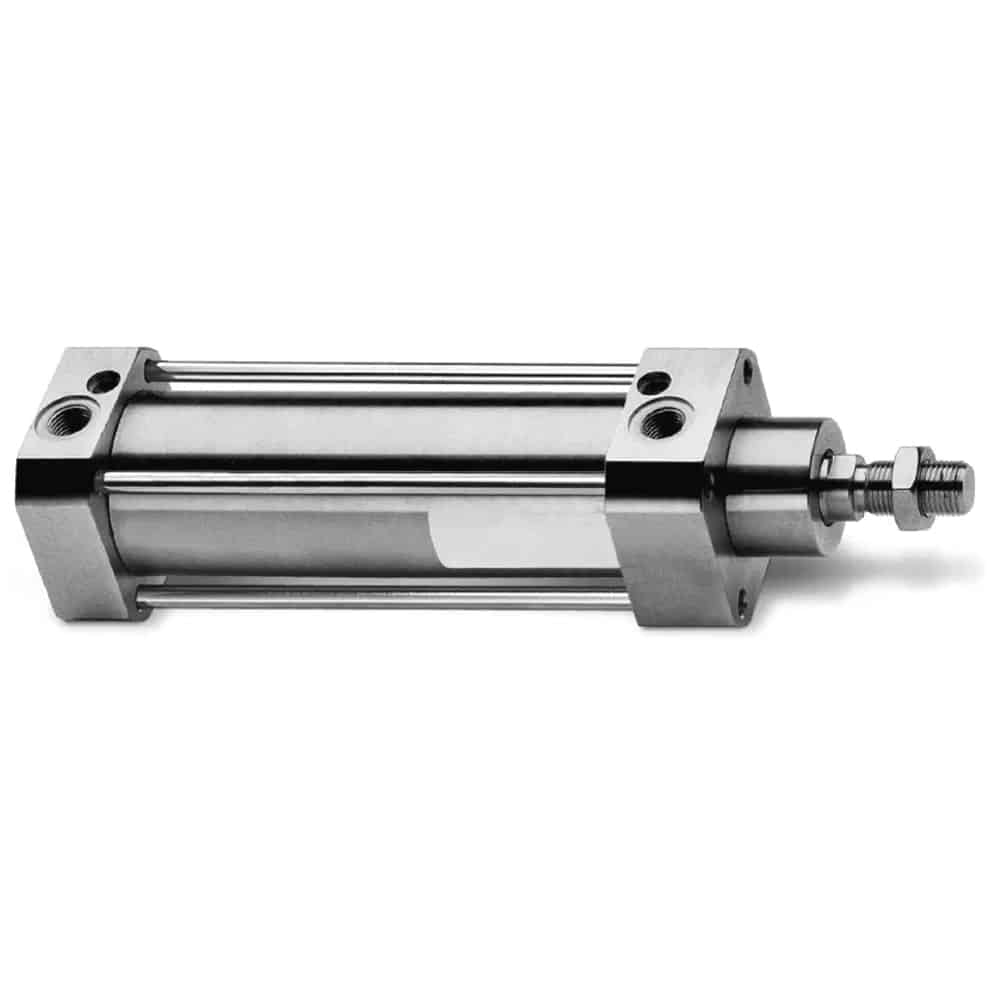
Corrosion-resistant cylinder is a pneumatic cylinder package whose pressure parts, rod, seals, fasteners, sensors, coating, and mounting details are specified for a defined corrosive environment. Marine exposure zone is the actual saltwater contact condition around the actuator, such as protected interior air, salt spray, splash, intermittent submersion, or continuous seawater. Salt-spray test is a laboratory corrosion test method for comparing process quality under a controlled artificial atmosphere, not a direct offshore service-life promise. Galvanic corrosion is accelerated corrosion that occurs when dissimilar metals touch through a conductive liquid such as saltwater.
In our experience, most marine cylinder mistakes start before material selection. We found that failed cylinders often had a reasonable tube material but weak surrounding details: plated pins, unsealed sensors, trapped water under brackets, or wet compressed air inside the actuator. Our team analyzed replacement requests where changing the mount and air preparation mattered as much as upgrading the cylinder from 304 to 316L.
Quick Answer: Select by Exposure Zone First
ISO 9227:2022 defines salt spray test methods for checking the corrosion resistance of metallic materials with or without corrosion protection, and the same ISO abstract warns that these tests are not meant to rank materials or predict long-term corrosion resistance. Treat salt-spray data as a quality screen, then select the cylinder by actual marine exposure.
| Marine exposure zone | Typical cylinder risk | Practical starting specification | Watch point |
|---|---|---|---|
| Protected interior cabinet | Condensation, warm air, occasional cleaning | Aluminum or stainless body, plated or stainless fasteners, dry-air supply | Do not overspecify offshore hardware if the cabinet is dry and sealed |
| Humid machinery room | Condensation, oil mist, heat, vibration | Stainless rod, coated or stainless body, IP-rated sensors, good FRL and dryer | Heat may drive seal selection as much as chloride |
| Salt-spray area | Airborne chlorides, wet/dry cycles, sunlight | 316L body and rod, stainless fasteners, marine coating if aluminum is used | Avoid crevices behind clamps and nameplates |
| Deck splash zone | Direct spray, standing water, washdown, mechanical impact | 316L minimum, duplex for higher-risk parts, heavy-duty wiper, sealed sensors, drain paths | The bracket and pin often fail before the cylinder tube |
| Intermittent submersion | Seawater contact plus drying, trapped salt, galvanic pairs | Duplex or special package, isolated dissimilar metals, documented coating and seals | Standard pneumatic accessories may not survive |
| Continuous seawater contact | Oxygen gradient, biofouling, crevices, repair difficulty | Custom marine or hydraulic-style package after engineering review | Do not assume catalog pneumatic cylinders are suitable |
For comparison with broader actuator choices, use What Environmental Factors Affect the Choice Between Cylinders and Actuators? as the general screening article. This guide is narrower: it is about pneumatic cylinder packages where salt, moisture, and marine maintenance drive the material decision.
Cylinder Sizing Still Comes Before Material
The material package cannot fix an undersized actuator. Confirm the force, bore, rod load, stroke, speed, and mounting style before paying for stainless or duplex hardware.
Why Do Marine Environments Attack Pneumatic Cylinders?
Marine corrosion is not just “rust.” It is a combined load case: chloride-bearing salt spray, moisture, oxygen, deposits, heat, ultraviolet exposure, vibration, crevices, and galvanic couples. ABS rules and guides are built around vessel-specific service conditions, which is why a marine cylinder spec should describe the installation, not only the cylinder part number.
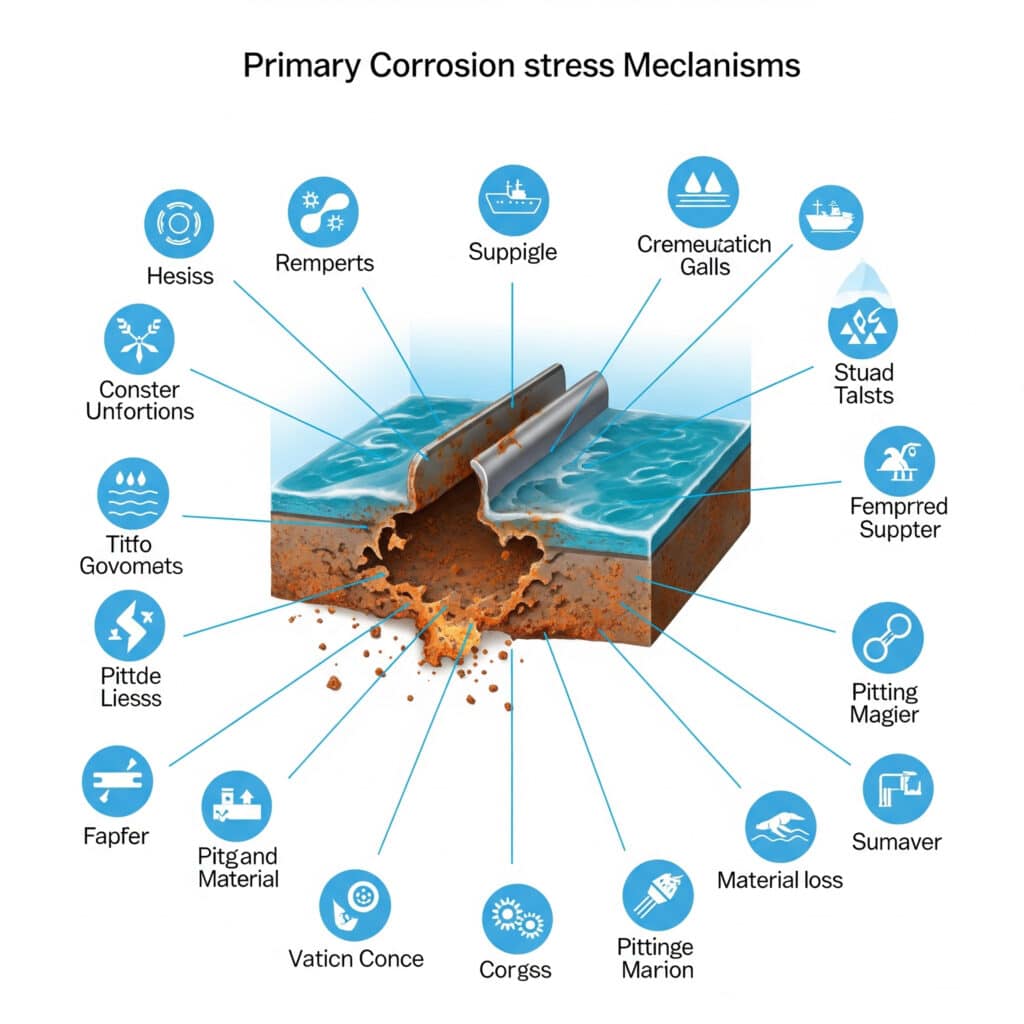
Chlorides are the main reason ordinary industrial cylinders struggle near seawater. A thin salt film can sit on rods, end caps, tie rods, sensor grooves, clevis pins, and bracket pockets. During wet/dry cycling, the liquid evaporates and leaves a more concentrated salt deposit. That is when small scratches, threads, seal pockets, and coating pinholes become corrosion starters.
For example, primary research on 316L passive films reports that chloride ions can alter the surface oxide during early localized corrosion initiation (Wang et al., 2019). That does not mean every 316L cylinder will pit quickly. It means the design should reduce crevices, scratches, deposits, and stagnant saltwater instead of treating stainless steel as a magic shield.
The most common failure modes are predictable:
| Failure mode | Where it starts | What you see in the field | Prevention in the spec |
|---|---|---|---|
| Pitting corrosion | Rods, stainless surfaces, machined pockets | Small holes or dark spots that cut seals | 316L or duplex material, polished rod surface, regular rinsing |
| Crevice corrosion | Under brackets, clamps, labels, gland faces | Local attack hidden until disassembly | Drainage, sealant control, open geometry, avoid water traps |
| Galvanic corrosion | Dissimilar metals with electrolyte contact | Aluminum or zinc-plated parts disappear first | Match metals, isolate with washers, avoid mixed fasteners |
| Coating underfilm corrosion | Scratches, edges, threaded holes | Blistering or lifting around damaged coating | Edge preparation, coating DFT control, touch-up process |
| Seal abrasion and leakage | Rod seal, wiper, rodless sealing strip | Salt crystals, rod scratches, air leakage | Heavy-duty wiper, clean rod, correct air quality, better access |
The fastest field clue is location. If corrosion is strongest under a clamp, behind a washer, inside a sensor slot, or below a horizontal mounting face, the problem is not only material. It is trapped saltwater. Change the geometry, add drainage, or isolate the joint before simply ordering the same cylinder in stainless steel.
Which Materials Work for Marine Pneumatic Cylinders?
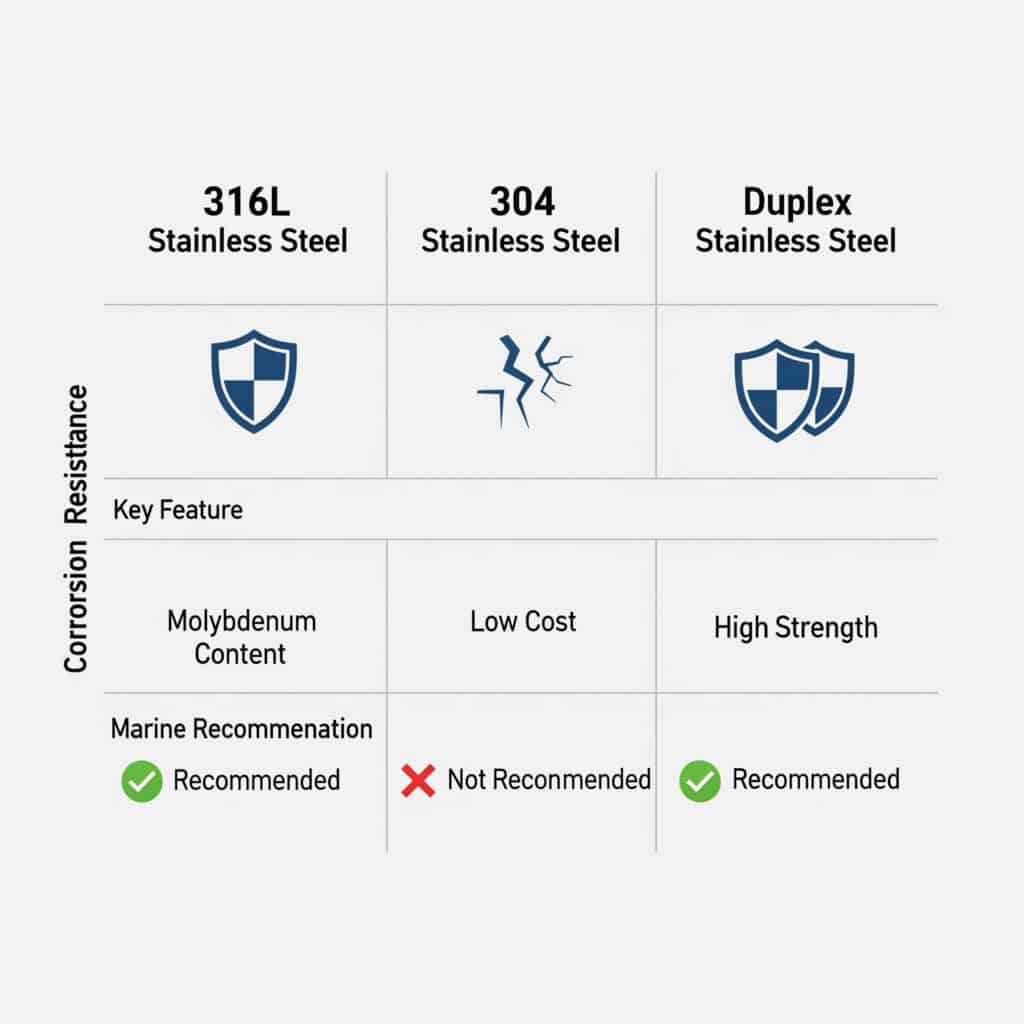
Alleima’s SAF 2205 duplex stainless steel data sheet presents 2205 as a high-strength duplex stainless material used where both corrosion resistance and strength matter. That is the key distinction: 316L is the default marine stainless choice for many exposed pneumatic cylinders, while duplex becomes relevant when higher chloride resistance, fatigue strength, or load margin is needed.
| Material or package | Best fit | Why it works | Main caution |
|---|---|---|---|
| 304 stainless steel | Protected interior equipment with low chloride exposure | Better corrosion resistance than plain carbon steel | Not the right default for open salt spray |
| 316L stainless steel | Salt-spray and splash-zone pneumatic cylinders | Molybdenum-bearing stainless grade with better chloride pitting resistance than 304 | Still vulnerable in tight crevices and stagnant deposits |
| 2205 duplex stainless steel | Higher-load, higher-risk, or classification-reviewed exposed cylinders | Higher strength and stronger chloride corrosion resistance than common austenitic stainless grades | Higher cost and fabrication control requirements |
| Coated aluminum | Lower-cost cylinders in guarded salt-spray locations | Light weight and good performance when coating remains intact | One scratch can expose the base metal |
| Carbon steel with coating | Protected spaces, low-cost replacement, non-marine machinery | Easy to source and repair | Poor choice for direct salt spray unless the coating system is engineered |
| Plastic or composite accessories | Guards, covers, handles, non-pressure parts | Helps isolate metals and reduce galvanic paths | Mechanical strength and UV resistance must be checked |
Do not choose material by price alone. The cylinder tube, piston rod, end caps, tie rods, ports, cushion screws, sensor rails, pins, rod-end bearings, and mounting brackets all see the environment. A 316L body with zinc-plated clevis pins is not a 316L marine assembly. A coated aluminum body with stainless fasteners may also need isolation washers to prevent galvanic attack at the fastener holes.
For cylinder families that can reduce exposed rod length or hide the moving element, review rodless cylinder options early. A rodless design is not automatically corrosion-proof, but it can remove a long exposed piston rod from deck equipment and shift the design problem toward carriage sealing, guide protection, and drainage.
How Should Seals, Rods, Fasteners, and Coatings Be Specified?
ISO 9227:2022 can define a repeatable salt-spray test procedure, but it cannot decide whether your cylinder seal should be FKM, EPDM, polyurethane, or nitrile. Seal choice depends on temperature, cleaning chemistry, lubricant, air quality, speed, rod finish, and contamination. In marine work, the sealing package is often the difference between stainless hardware and a working actuator.
Start with the parts that touch the moving surface:
| Part | Marine selection question | Typical request wording |
|---|---|---|
| Piston rod | Is the rod exposed to spray, scratches, fish waste, ice, or washdown chemicals? | 316L stainless rod or duplex rod, polished finish, heavy-duty wiper |
| Rod seal | Does the seal see dry air, oil, salt crystals, heat, or aggressive cleaning? | Confirm compound and temperature range against media and duty |
| Wiper or scraper | Will the rod drag salt, grit, or dried deposits into the gland? | Add heavy-duty wiper or scraper for deck and splash-zone cylinders |
| Rodless sealing band | Does the slot face upward or collect water? | Orient for drainage and protect the band from grit and foot traffic |
| Fasteners | Are bolts the same grade as surrounding hardware? | Stainless fasteners with isolation where dissimilar metals meet |
| Sensors and cables | Are reed switches, connectors, and cable glands rated for wet service? | IP-rated sensors, sealed connectors, strain relief, drip loops |
| Coating | Is the cylinder aluminum, carbon steel, or mixed-metal? | Marine epoxy or polyurethane system with specified surface prep and inspection |
Seal material should not be guessed from a color or a brand name. FKM is useful for heat and many oils, EPDM is useful in many water and weathering situations, and nitrile is common in pneumatic equipment. However, cleaning chemicals, compressor oil, low temperature, hot engine-room air, and seal groove geometry can reverse a simple rule of thumb. Use industrial cylinder seal selection when leakage or repeat seal wear is part of the project.
Air quality also matters. Wet compressed air can put corrosion inside the actuator even when the outside is stainless. If the installation is far from the compressor room, check filters, dryers, regulators, condensate drains, and pipe slope. The ISO air quality guide and the pressure dew point guide are better references than trying to solve internal rust with external stainless parts.
How Do You Size and Mount Marine Cylinders?
AutomationDirect’s pneumatic cylinder sizing guidance uses load, working pressure, available bore sizes, and a design margin before selecting a cylinder. In marine applications, do that sizing work first. Then add wave motion, vessel vibration, shock, misalignment, salt deposits, friction growth, and access limits to the mounting review.
The sizing workflow is straightforward:
- Define the real load, direction, friction, stroke, speed, and hold position.
- Convert vessel or machine pressure into the same units used by the cylinder catalog.
- Calculate force and bore for push and pull directions.
- Add a safety margin that matches the risk of the function, not a generic number.
- Check rod buckling, side load, bearing wear, and bracket strength.
- Choose material, coating, seal, and accessory requirements after the mechanical layout is stable.
Mounting is where many marine cylinder failures start. A beautiful stainless cylinder can still fail if it is bolted into a pocket that holds seawater. Review the installation drawing for the following details:
| Mounting detail | Good practice | Bad practice |
|---|---|---|
| Drainage | Sloped surfaces, drain holes, open brackets, no blind pockets | Horizontal shelves that hold saltwater against the tube |
| Brackets and pins | Matching material grade or isolated dissimilar metals | Stainless cylinder on painted steel with zinc-plated pins |
| Rod orientation | Protected from direct grit and impact where possible | Rod facing foot traffic, chain splash, or cargo strike |
| Cable routing | Drip loops, sealed connectors, strain relief | Sensor cables entering upward with no strain relief |
| Service access | Rod seal, sensor, fittings, and brackets reachable | Cylinder trapped behind welded guards |
| Air fittings | Stainless or protected fittings, supported tubing | Mixed brass, zinc, and aluminum in direct spray |
When a long rod would be exposed across a deck or handling machine, compare a guided rod cylinder, a rodless cylinder, or a protected mechanical linkage before ordering a larger stainless rod. The maintenance plan should also cover contamination and access, not only nominal force.
Marine Cylinder RFQ Checklist
ABS publishes rules and guides because vessel hardware depends on service, location, load case, and inspection context. A supplier cannot infer that from “marine cylinder” alone. A strong RFQ gives enough information for the supplier to choose a material package and tell you where the catalog part needs a custom change.
Include these items in the RFQ:
| RFQ item | What to send | Why it matters |
|---|---|---|
| Exposure zone | Interior, machinery room, salt spray, splash zone, intermittent submersion, or continuous seawater | Drives material, coating, sensor, and fastener choices |
| Function | Hatch, crane, door, valve, damper, tensioner, lift, guide, lock, or positioning axis | Drives safety margin and fail-safe discussion |
| Bore and stroke | Existing size or calculated requirement | Prevents material discussion before force is known |
| Pressure and air quality | Working pressure, minimum pressure, dryer type, dew point target, filtration | Prevents internal corrosion and weak force margin |
| Load and motion | Load mass, angle, friction, side load, speed, cycle rate, shock | Drives bore, rod, guide, and bracket design |
| Mounting | Photos, drawings, pin sizes, bracket material, drain paths | Finds galvanic and crevice risks |
| Material request | 316L, duplex, coated aluminum, special rod, fastener grade | Makes the corrosion target explicit |
| Coating request | Coating type, salt-spray test requirement, color, touch-up rule | Avoids vague “marine paint” wording |
| Seal request | FKM, EPDM, nitrile, polyurethane, wiper style, cleaning media | Avoids seal incompatibility |
| Documentation | Material certificates, pressure test records, coating report, classification notes | Helps shipyard, owner, and inspector review |
| Spares | Seal kit, wiper, sensor, fittings, rod-end bearing, pins | Reduces downtime in remote ports |
Here is a concise RFQ sentence you can reuse:
Need a corrosion-resistant pneumatic cylinder for a deck splash-zone application. Bore/stroke/load/pressure are attached. Please quote 316L minimum or recommend duplex if needed, stainless or isolated mounting hardware, heavy-duty wiper, sealed sensors, coating documentation if any coated parts remain, and material certificates for pressure-retaining stainless parts.
For a production quote, send the project details through Bepto Pneumatic contact with photos of the installation area, not only the failed cylinder nameplate. For company background, see About Bepto Pneumatic. The surrounding bracket, air fitting, and cable path usually explain more than the cylinder label.
How Should Maintenance Be Planned?
ISO 9227 can verify that a coating or material sample follows a salt-spray test procedure, but it does not remove the need for inspection. In marine service, maintenance planning should focus on rinsing salt deposits, finding coating damage early, keeping compressed air dry, and replacing seals before rod damage spreads.
Use the maintenance plan to protect the weak points:
| Maintenance action | What to inspect | Why it matters |
|---|---|---|
| Freshwater rinse after heavy salt exposure | Rod, brackets, pins, sensor rail, fittings | Removes chloride deposits before they concentrate |
| Visual inspection | Pitting, rust staining, coating blisters, cable cracks, loose fasteners | Finds small corrosion before leakage starts |
| Rod wipe and motion check | Rod scratches, dried salt, wiper damage, uneven speed | Protects rod seals and bearings |
| Air quality check | Filter bowls, condensate drains, dryer status, pressure dew point | Prevents internal corrosion and sluggish motion |
| Coating touch-up | Edges, scratches, mounting holes, clamp marks | Stops underfilm corrosion |
| Spares review | Seal kits, wipers, sensors, fittings, pins | Keeps repair work from waiting on port logistics |
Do not copy a maintenance interval from another vessel without checking exposure. A cylinder under an awning may need periodic inspection only. A deck cylinder that is rinsed with seawater, hit by chains, and exposed to sun may need a much tighter inspection rhythm. The point is not to over-service every actuator. The point is to match the inspection to the zone and the consequence of failure.
For high-temperature machinery rooms, review heat as a separate design condition. Heat can change seal selection, lubricant behavior, and sensor life even when chloride exposure is moderate.
FAQs About Corrosion-Resistant Cylinders for Marine Applications
The answers below keep the same rule: classify exposure first, then choose material, coating, sealing, mounting, and documentation. ISO 9227, ABS guidance, and material data sheets are useful references, but none of them replaces the installation drawing and the actual saltwater exposure path.
Is 316L stainless steel always enough for marine pneumatic cylinders?
No. 316L is a strong starting point for many salt-spray and splash-zone cylinders, but it is not a universal seawater solution. Tight crevices, stagnant deposits, intermittent submersion, high stress, and mixed-metal brackets can still cause corrosion. Use duplex stainless or a custom package when the exposure is more severe.
Can I use 304 stainless steel cylinders on a boat?
Only in protected locations with low chloride exposure. 304 stainless steel is not the right default for open salt spray, deck splash, washdown, or areas where salt deposits sit on the cylinder. If the cylinder is exposed, start the discussion at 316L and justify any downgrade with location evidence.
Does a salt-spray test prove how long a cylinder will last offshore?
No. ISO 9227:2022 is a test method for salt spray conditions, and ISO notes that these tests are not intended to predict long-term corrosion resistance. Use salt-spray testing for coating quality and supplier control, then judge service life from exposure zone, drainage, material, maintenance, and failure consequence.
Are coated aluminum pneumatic cylinders acceptable in marine service?
Sometimes. A coated aluminum cylinder can work in guarded salt-spray areas when the coating system, edges, fasteners, and repair process are controlled. It is risky in impact-prone splash zones because scratches can expose the base metal. Ask how the coating is specified, inspected, and repaired.
What seal material is best for marine pneumatic cylinders?
There is no single best seal material. FKM, EPDM, nitrile, polyurethane, and special wipers each fit different temperature, chemical, lubricant, speed, and contamination conditions. For deck service, ask for the seal compound, rod finish, wiper style, cleaning chemicals, and compressed-air quality in the same review.
What information should I send before asking for a marine cylinder quote?
Send bore, stroke, pressure, load, speed, duty cycle, exposure zone, photos, mounting drawing, bracket material, cleaning method, air quality, sensor needs, seal preference, coating requirement, material certificate needs, classification body if any, and failure photos. Without that context, “marine grade” is too vague.
Sources and Retrieval Notes
- ISO 9227:2022, Corrosion tests in artificial atmospheres - Salt spray tests, published 2022, amended 2024. Used for salt-spray test scope and the limitation that the tests are quality checks, not long-term ranking tools.
- ABS Rules and Guides, accessed 2026-07-08. Used for classification-context framing and documentation expectations.
- Alleima SAF 2205 material data sheet, accessed 2026-07-08. Used as a manufacturer source for duplex stainless positioning.
- Wang et al., Chloride-induced alterations of the passive film on 316L stainless steel, 2019. Used as an academic source for chloride effects on 316L passive films.
- AutomationDirect Cylinder Sizing, accessed 2026-07-08. Used for force-based cylinder sizing sequence before material selection.
- Galvanic corrosion overview, accessed 2026-07-08. Used only as a plain-language conceptual reference for mixed-metal corrosion paths.