

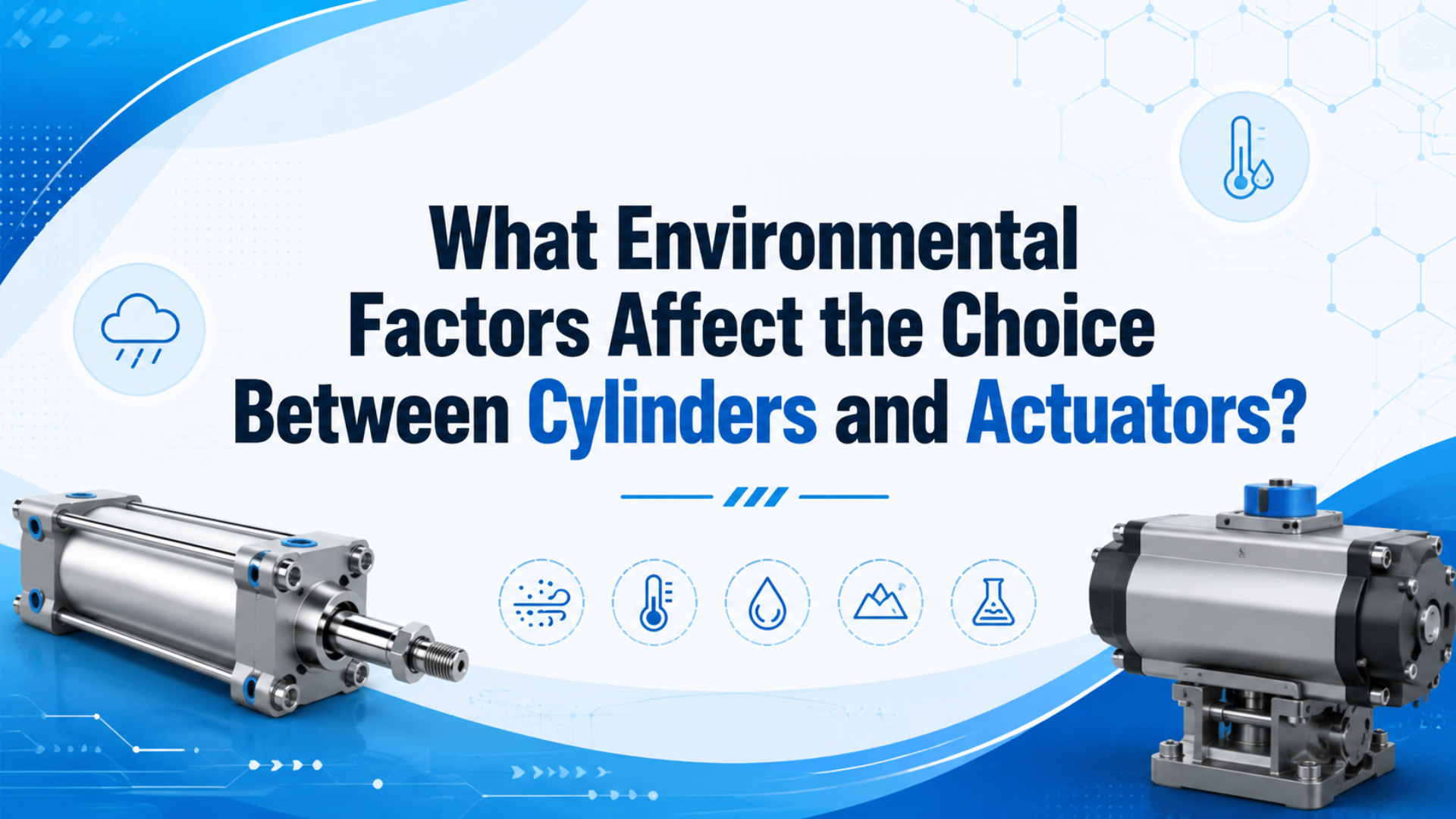
Environmental factors affect actuator selection by changing the risk around temperature, moisture, dust, hazardous-area approval, cleaning chemicals, vibration, shock, corrosion, and maintenance access. A pneumatic cylinder, electric actuator, hydraulic cylinder, or rodless actuator can all be correct in the right setting. The environment decides how much protection the axis needs.
The useful question is not “Which actuator is tougher?” It is “Which actuator can keep its rated motion after the real plant environment is added?” Heat, washdown, dust, solvent vapor, cable routing, and cleaning procedure can overturn a tidy force or price comparison.
Environmental actuator selection is the process of matching motion hardware to heat, washdown, dust, hazardous classification, corrosion, vibration, and maintenance access before comparing force or price. Pneumatic cylinders are compressed-air actuators for linear motion; electric actuators are motor-driven axes for controlled position, speed, and feedback.
Key Takeaways
- Festo says load, precision, dynamics, environment, and life-cycle cost are major actuator selection criteria.
- OSHA 1910.307 and ATEX 2014/34/EU make hazardous-area classification a system-level decision.
- eCFR 21 CFR 117.40 requires food equipment, including pneumatic and automated systems, to be cleanable and maintained in sanitary condition.
- For harsh environments, send the environment data with the RFQ, not after the first failure.
The Short Answer: Match the Environment Before the Actuator Type
Festo’s 2026 actuator-selection guidance lists load, precision, dynamics, environment, and costs as major decision criteria, while ISO 15552 defines a 10 bar series for standardized pneumatic cylinders (Festo, 2026; ISO, 2025). Start with the environment, then compare actuator types.
A clean bench test hides real failure modes. The same axis may behave differently near a fryer, in a freezer, under a washdown hose, beside a solvent tank, or on equipment that vibrates all day. Force, stroke, speed, and cost still matter. They just come after exposure.
Use a pneumatic cylinder when the motion is simple, the plant already has clean compressed air, and the environment rewards simple sealed mechanical hardware. Use an electric actuator when programmable position, speed profile, recipe change, data feedback, or clean energy accounting matters more than simplicity.
In our experience, the expensive mistake is choosing the actuator from the catalog page and adding the environment later. The better order is exposure first, motion second, utilities third, actuator last.
For the broader naming and performance comparison, use the companion article on cylinders vs actuators. This page is narrower: it deals with environment-driven selection.
How Do Temperature, Moisture, and Dust Change the Decision?
SMC’s MY1B rodless-cylinder catalog lists 0.1 to 0.8 MPa operating pressure and 5 to 60 C ambient and fluid temperature for one standard family, while Festo describes pneumatics as low sensitivity to dust, moisture, or temperature (SMC, 2025; Festo, 2026).
Temperature is not only an ambient number. It changes seal hardness, lubrication behavior, condensation risk, electronics life, cable flexibility, and the air-preparation strategy. A cylinder near a furnace may need high-temperature seals and shielding. A freezer installation may need dry air, low-temperature grease, and a clear ice-control plan.
Moisture and dust change the comparison too. A pneumatic cylinder can tolerate a dirty exterior if the rod, seals, guides, sensors, valve, and fittings are selected for the area. An electric actuator may be sealed, but its cables, drive cabinet, connectors, and feedback device still need the same exposure review.
| Environmental factor | Pneumatic cylinder check | Electric actuator check | What to ask before buying |
|---|---|---|---|
| High temperature | Seal compound, grease, tube finish, radiant heat shield | Motor rating, encoder, drive temperature, cable insulation | Is the stated temperature ambient, surface, or process heat? |
| Low temperature | Dry air, low-temperature seals, exhaust icing risk | Lubricant viscosity, cable stiffness, motor and feedback limits | Will the axis start after standing cold overnight? |
| Dust | Rod scraper, guide protection, valve filtration | Ingress rating, screw cover, fanless design, connector sealing | Is the dust abrasive, conductive, combustible, or food-related? |
| Moisture | Corrosion-resistant body, drainage, sensor sealing | IP rating, cable glands, drive cabinet protection | Is the exposure splash, spray, immersion, condensation, or washdown? |
For rodless axes, also check guide exposure and carriage load path. The article on rodless cylinder applications covers food, pharmaceutical, cleanroom, packaging, and long-stroke context in more detail.
Which Hazardous-Area Rules Matter Before You Pick Hardware?
Directive 2014/34/EU covers equipment and protective systems intended for potentially explosive atmospheres, and OSHA 1910.307 requires electrical equipment in hazardous classified locations to be marked and suitable for the class and conditions (EUR-Lex, 2026; OSHA, 2026).
Do not say “pneumatic means explosion-proof” and stop there. The actuator body may remove a motor from the danger area, but the system still includes solenoid valves, limit switches, reed sensors, cable glands, manifolds, exhaust points, static bonding, and maintenance procedures.
For hazardous locations, the first step is classification. Identify gas, vapor, dust, fiber, or hybrid risk. Then document the zone or division, temperature class, surface-temperature limit, ignition-control method, and any required certificates. Only then should the actuator be chosen.
If the final valve or sensor is electrical, its rating must match the location. A solenoid valve installed outside the hazardous zone may simplify the design, but tubing length, response time, exhaust routing, and manual override still need engineering review.
The practical question we ask is simple: where can energy enter the hazardous area? If the answer includes wires, sensors, hot surfaces, static discharge, or maintenance tools, the actuator body is only one part of the protection strategy.
How Do Washdown, Food, and Cleanroom Requirements Change the Choice?
eCFR 21 CFR 117.40 requires food-plant equipment and utensils to be adequately cleanable and says conveying, pneumatic, closed, and automated systems must be maintained in appropriate sanitary condition (eCFR, 2026). In washdown areas, cleanability is a design requirement, not an accessory.
The correct actuator depends on what must be cleaned. A stainless cylinder may survive spray, but exposed threads, crevices, sensor grooves, rod wipers, guide rails, and fittings can still trap residue. An electric actuator may be available with sealed construction, but the cable routing and drive cabinet must be protected too.
IEC’s IP rating system uses the first digit for solids protection and the second digit for water protection, so IP67 and IP69K are not interchangeable labels (IEC, 2026). IP67 relates to temporary immersion. IP69K is associated with high-pressure, high-temperature washdown in many machine specifications.
For cleanrooms, ask what kind of contamination is unacceptable. Pneumatics avoid hydraulic oil but may exhaust air, particles, or lubricant mist if the air system is wrong. Electric actuators avoid plant-air exhaust but may introduce screw lubrication, belt wear, cable particles, or heat.
Pharmaceutical equipment adds record and validation questions. FDA’s Part 11 guidance applies when electronic records are maintained or submitted in place of paper records under predicate rules (FDA, 2003). That does not choose the actuator by itself, but it affects the control system and documentation package.
What Do Vibration, Shock, and Chemical Exposure Tell You?
SMC’s MY1B selection data tells engineers to keep load factor at 0.5 or less and to include dynamic moment when stopper impact is involved (SMC, 2025). Vibration and shock are therefore load-path questions, not just housing questions.
Mechanical exposure changes the support strategy. A pneumatic cylinder with poor mounting can fail early from side load. An electric actuator with a lightly protected encoder or cable can fail from vibration even when its thrust rating looks correct. The axis must survive the dynamic load, not only the catalog thrust.
Chemical exposure is a compatibility problem. List the chemical name, concentration, temperature, cleaning frequency, contact time, and whether exposure is vapor, splash, immersion, or residue. Stainless steel, aluminum, anodizing, hard coating, PTFE, EPDM, FKM, and FFKM are not universal answers. Match them to the chemical.
For guided motion, compare this checklist with the air slide selection guide. Guide load, contamination, and stop impact often matter more than the cylinder body itself.
How Should You Compare Cylinders and Actuators by Environment?
Festo states that there is no universally better actuator technology and that selection depends on the task, including environment and cost; ISO 15552 gives standardized pneumatic cylinder dimensions for 32 to 320 mm bores in the 10 bar series (Festo, 2026; ISO, 2025).
Use the matrix below as a first-pass decision aid. It is not a substitute for a risk assessment, catalog check, or supplier review, but it keeps the discussion grounded in the environment.
| Environment | Often points toward pneumatic | Often points toward electric | Do not forget |
|---|---|---|---|
| Dust, splash, rough handling | Simple two-position motion with protected rod, valve, and sensors | Sealed electric axis when positioning data is needed | Check connectors, exhaust, and maintenance access. |
| Hazardous classified area | Remote valve with air-powered cylinder in the classified area | Certified electric actuator package where wiring is acceptable | Classify the area before selecting components. |
| Food washdown | Sanitary cylinder or cleanable pneumatic slide | Sealed electric actuator when no exhaust or high position control is needed | Check eCFR cleanability, drainage, and chemical compatibility. |
| High precision or recipe changes | Servo-pneumatic only when compliance is acceptable | Electric actuator for position, speed, acceleration, and feedback | Environment still affects cables, drives, and lubrication. |
| Shock and vibration | Rugged cylinder with proper mounts, cushions, and external guides | Electric actuator with protected encoder, cable, and bearing path | Calculate dynamic load, not only static force. |
This is also why calculator tools are not the main content enrichment for this article. Force, flow, and air-use calculators help after the axis type is plausible. Here, the first job is exposure classification and system boundary definition.
What Should You Send in a Harsh-Environment RFQ?
OSHA 1910.307, ATEX 2014/34/EU, and eCFR 21 CFR 117.40 each point to the same practical lesson: actuator selection depends on the installed environment, not just the actuator body (OSHA, 2026; EUR-Lex, 2026; eCFR, 2026).
Send the environment in plain language. Include ambient temperature range, washdown method, cleaning chemicals, dust type, hazardous-area classification, corrosion exposure, vibration source, impact load, mounting orientation, IP or NEMA requirement, required material, and whether sensors or valves sit inside the same exposure zone.
Then send the motion data: stroke, load, speed, duty cycle, stop method, position count, force requirement, utility availability, cycle time, and failure history. A harsh-environment RFQ without photos is weaker. Add photos of the machine, nearby spray pattern, cable routing, exhaust path, and maintenance access.
For replacement work, do not ask only for “same as old.” Explain why the old actuator failed. Was it water ingress, cable failure, seal swelling, corrosion, guide wear, erratic speed, heat, dust packing, chemical attack, or a certification problem? The failure mode is the shortcut to the better selection.
FAQs About Environmental Factors in Actuator Selection
FAQ answers should stay conservative because hazardous locations, food equipment, and validated production systems are governed by specific rules. OSHA 1910.307, ATEX 2014/34/EU, eCFR 21 CFR 117.40, and FDA Part 11 each cover different parts of the selection boundary (OSHA, 2026; FDA, 2003).
Are pneumatic cylinders automatically safe in explosive atmospheres?
No. A pneumatic cylinder may reduce ignition sources at the actuator body, but the complete system still includes valves, sensors, switches, solenoids, wiring, grounding, exhaust, and maintenance activity. Classify the area first, then select components and installation methods that match the required hazardous-location rules.
Which is better for washdown, pneumatic or electric?
Neither is automatically better. A sanitary pneumatic cylinder may be easier to clean for simple two-position motion, while a sealed electric actuator may be better when programmable position and no air exhaust are required. In food plants, eCFR 21 CFR 117.40 makes cleanability and sanitary maintenance central to the decision.
Do IP ratings prove an actuator is food-ready?
No. IP ratings describe ingress protection against solids and water. They do not prove food-contact suitability, chemical compatibility, cleanability, drainage, surface finish, lubricant control, or cleaning validation. Use IP ratings as one input, then check sanitary design, materials, chemicals, and the actual cleaning method.
When should I choose an electric actuator in a harsh environment?
Choose electric when the environmental protection can be engineered and the process needs programmable positions, speed profiles, recipe changes, synchronized motion, force control, or feedback data. Festo notes electric actuators are strong when precise, flexible, or variable processes matter. Protect the motor, drive, feedback, connectors, and cables.
What is the biggest RFQ mistake for harsh-environment actuators?
The biggest mistake is sending only bore, stroke, or thrust. A supplier also needs temperature, water exposure, chemical exposure, dust, hazardous classification, material preference, cycle rate, mounting, shock, vibration, sensor location, valve location, and failure photos. Without that context, the quote may match the motion but miss the environment.
Sources
- Festo: Pneumatics or electrics? How to make the right choice, actuator technology comparison across load, precision, dynamics, environment, and costs. Retrieved 2026-06-04.
- ISO 15552:2018, standardized pneumatic cylinder dimensions for 10 bar series and 32 to 320 mm bores. Retrieved 2026-06-04.
- OSHA 1910.307: Hazardous classified locations, hazardous-location electrical equipment rules. Retrieved 2026-06-04.
- EUR-Lex: Directive 2014/34/EU, ATEX, equipment and protective systems intended for potentially explosive atmospheres. Retrieved 2026-06-04.
- IEC: IP ratings, ingress protection rating framework for solids and water. Retrieved 2026-06-04.
- eCFR 21 CFR 117.40: Equipment and utensils, cleanability and sanitary-maintenance requirements for food plant equipment. Retrieved 2026-06-04.
- FDA: Part 11, Electronic Records; Electronic Signatures, FDA scope and application guidance for electronic records and signatures. Retrieved 2026-06-04.
- SMC: MY1B Mechanically Jointed Rodless Cylinder Catalog, operating range, load-factor, dynamic-moment, guide, and shock guidance for a rodless cylinder family. Retrieved 2026-06-04.
- AutomationDirect: What is a Pneumatic Cylinder?, video overview used for embedded actuator-background reference. Retrieved 2026-06-04.