

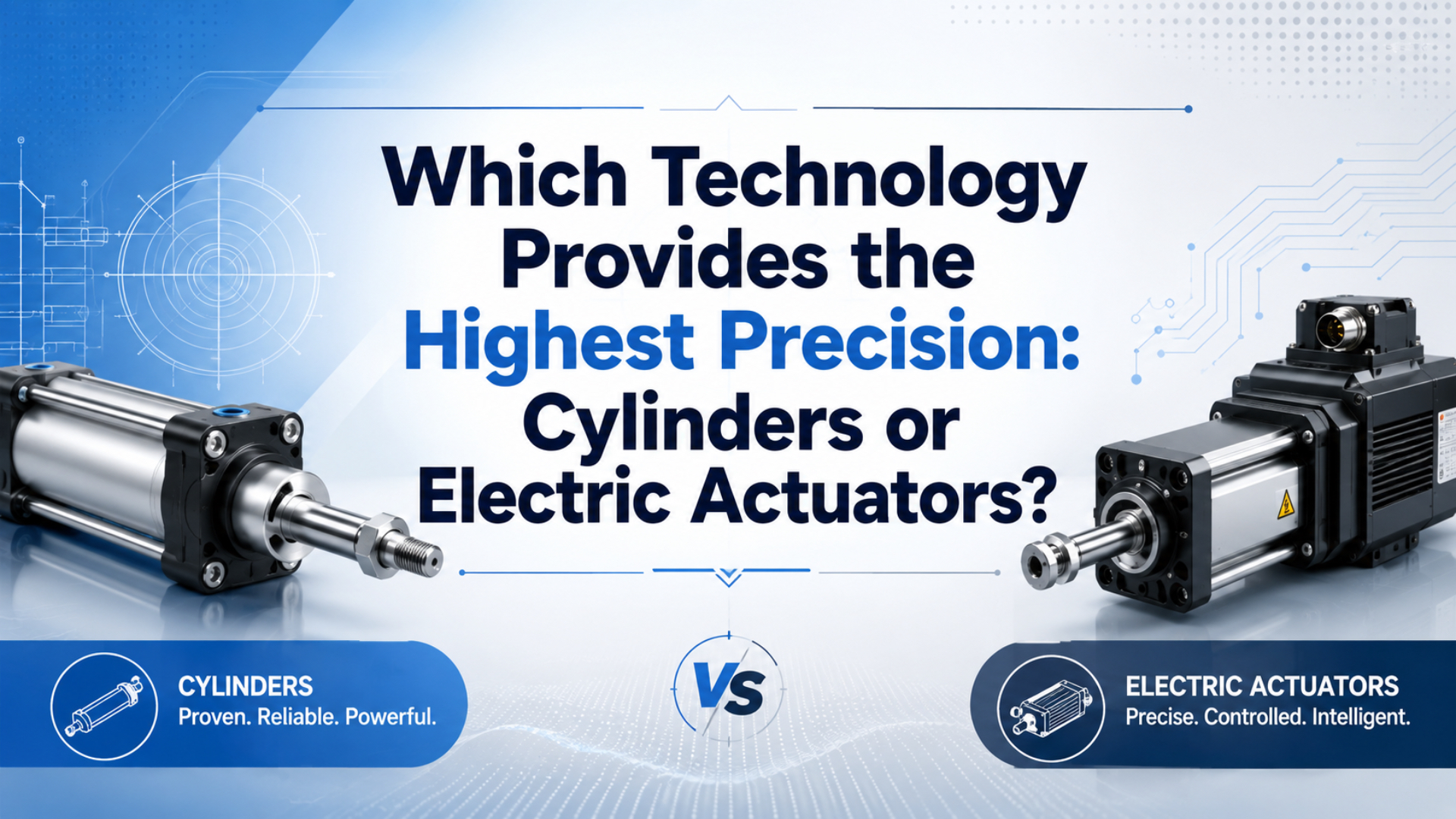
Electric actuators usually provide the highest controllable precision when an axis must stop at many programmed positions, follow a motion profile, or hold repeatable speed, force, and acceleration. Pneumatic cylinders can still be the better choice when the job is a fast two-position move, a clamp, a pusher, or a long-stroke transfer that only needs a known end position.
However, that answer sounds simple while the buying mistake is common. Teams often specify “highest precision” before they define whether they mean accuracy, repeatability, resolution, straightness, load deflection, or final part tolerance. NIST notes that high-precision linear positioning systems can be difficult to certify because different test methods and uncertainty levels change what the performance claim means.
Key Takeaways
- Electric actuators win when the process needs programmable positions, complex profiles, high repeatability, or controlled force.
- Pneumatic cylinders are often enough for simple end-position motion, clamping, pressing, sorting, packaging, and long-stroke handling.
- ISO 15552 standardizes pneumatic cylinders up to 1,000 kPa, or 10 bar, with bores from 32 mm to 320 mm.
- CAGI says well-designed compressed-air systems should normally hold pressure drop to 10% or less between the compressor and point of use.
- The right selection starts with a tolerance audit, not with a technology preference.
In our experience, the expensive error is rarely choosing pneumatics or electrics. We analyzed recurring actuator RFQs and found the same pattern: teams often buy micron-class motion for a process that only verifies a 1 mm pass/fail window, or they buy a basic cylinder for a process that actually needs repeatable mid-stroke positioning.
What Does “Highest Precision” Mean in Actuator Selection?
NIST describes ultra-precision linear motion metrology in terms of position accuracy, repeatability, displacement interferometry, and measurement uncertainty, not one generic “precision” score. Before comparing a pneumatic cylinder with an electric actuator, define the metric you will test, the load condition, and the acceptable error band (NIST, 2010).
In other words, precision is a bundle of separate questions:
- Accuracy is how close the axis gets to the commanded position.
- Repeatability is how tightly it returns to the same position over many cycles.
- Resolution is the smallest commanded move the system can make.
- Straightness and guidance are checks on whether the carriage stays aligned along the full stroke.
- Settling behavior means the bounce, drift, or vibration after the axis reaches position.
- Process tolerance is the position error that the part, fixture, or downstream operation can accept.
For example, an electric actuator can have fine encoder resolution but still miss the process target if the load bends, the mount moves, or the belt stretches. In contrast, a pneumatic cylinder can have poor intermediate-position control but excellent repeatability against a hard mechanical stop. The useful comparison is measured at the working load, working speed, working pressure, and actual mounting arrangement.
When Do Electric Actuators Clearly Win?
Festo says electric drive technology is usually the choice when positions must be reached precisely or paths followed. AutomationDirect lists 3 electric linear-actuator drives: ball screw, lead screw, and belt driven, which convert motor rotation into controlled linear travel (Festo, 2026; AutomationDirect, 2022).
In practice, choose an electric actuator first when the application has one or more of these requirements:
- Several repeatable positions along the same stroke
- Recipe changes with different stop points, speeds, or acceleration ramps
- Coordinated motion between two or more axes
- Controlled approach speed for sensitive parts
- Force, torque, or press-fit feedback from the drive
- Traceable position data for quality records
- Tight tolerance that must be verified during motion, not only at the end stop
Therefore, electric actuators do not win because every electric axis is automatically “more precise.” They win because the motor, drive, encoder, screw or belt, controller, and software can be selected as one closed-loop motion system. If the process needs different positions on Monday and Thursday, the electric axis can change by parameter. A basic cylinder usually needs hardware changes, stop adjustments, or a different control method.
For instance, when a customer sends us a sketch with “stop at 35 mm, 87 mm, and 142 mm, then change by recipe,” I stop treating the question as a normal air-cylinder comparison. That is a motion-axis problem. Pneumatics may still be part of the machine, but the precision axis probably needs electric or servo-pneumatic control.
When Is Pneumatic Cylinder Precision Enough?
ISO 15552 defines an interchangeable pneumatic cylinder series up to 1,000 kPa, or 10 bar. CAGI says well-designed compressed-air systems should usually keep pressure drop to 10% or less between compressor and point of use, so pneumatic precision starts with stable air supply (ISO, 2025; CAGI, 2022).
Therefore, a pneumatic cylinder is usually enough when the process target is one of these:
- Extend fully and retract fully
- Clamp until the part reaches a fixed stop
- Push a carton, tray, pallet, cap, or workpiece into position
- Lift or transfer with mechanical guides
- Open and close a door, chute, diverter, or gate
- Move a carriage across a long stroke where the final stop defines position
- Work in dust, splash, heat, washdown, or simple maintenance environments
That said, the most repeatable pneumatic end position is not created by air alone. It is created by the mechanical stop, the guide, the mounting stiffness, the load path, the pressure regulator, and the approach speed. If those are controlled, the cylinder does not need micron-class feedback to do useful industrial work.
In particular, rodless cylinders deserve separate attention for long-stroke applications. Parker lists OSP-P rodless-cylinder stroke length up to 6,000 mm on its published product page, while the same family is positioned for material handling, packaging, labeling, sorting, feeding, and other long-travel jobs (Parker, 2026). That is a very different use case from a short-stroke electric press axis.
If your requirement is mainly “arrive at the end and do it again,” read the broader cylinder vs actuator comparison first. If the requirement is a compact long-stroke transfer, compare the mechanical fit in our rodless cylinder benefits guide.
Where Do Servo-Pneumatic Systems Fit Between Them?
Enfield describes a servo-pneumatic cylinder positioning system that combines a proportional valve, sensors, and embedded control electronics so cylinders can stop at unlimited mid-stroke positions, follow profiles, and reduce end slamming. That makes servo-pneumatic control an intermediate option, not a replacement for every electric servo axis (Enfield Technologies, 2026).
In practice, servo-pneumatic systems can be attractive when the application needs some positioning flexibility but still benefits from pneumatic force density, fast motion, simple cylinders, or existing air infrastructure. They are often considered for heavy, fast, or long-stroke motion where electric hardware becomes large or costly.
However, use servo-pneumatic control carefully. The cylinder, valve, sensor, tube volume, air supply, friction, payload, and controller all affect final behavior. Air is compressible, so the system has different tuning limits than an electric screw or belt axis. It can be a strong middle path, but it needs application engineering.
For example, good use cases include:
- Mid-stroke stops where tolerance is moderate
- Fast motion with controlled deceleration
- Heavy push or lift axes with feedback
- Applications where end impact damages parts
- Systems that already have pneumatic infrastructure and skilled maintenance staff
Weak use cases include:
- True micron-class positioning
- Very low vibration laboratory stages
- Applications with unstable supply pressure
- Payloads that change sharply without feedback tuning
- Projects with no controls support for proportional valves
If your question is valve-led rather than actuator-led, see the pneumatic flow control valve guide and the article on proportional flow control in rodless cylinder systems.
How Should You Audit the Real Precision Requirement?
Festo lists load, precision, dynamics, environment, and costs as major decision criteria. Tolomatic’s total-cost paper adds maintenance, utility cost, product yield, changeover time, and cycle time, so a precision audit must cover the whole axis, not only the actuator catalog number (Festo, 2026; Tolomatic, 2019).
Therefore, before you buy the actuator, audit the real requirement in this order:
- Name the measured output. Is the process checking part position, press depth, force, speed, straightness, angle, or visual alignment?
- Separate accuracy from repeatability. A system can repeat well at the wrong location, or hit the nominal location with wide scatter.
- Define the tolerance band. Use the process drawing, quality check, fixture datum, or reject condition.
- Test the load case. Include payload weight, side load, friction, acceleration, vibration, and thermal conditions.
- Identify the stop method. The stop may be a cylinder end cap, external hard stop, fixture shoulder, sensor, encoder, or software command.
- Count the positions. Two positions favor standard pneumatics. Many positions favor electric or servo-pneumatic control.
- Check the energy and maintenance model. Pneumatics depends on air quality, leaks, pressure drop, seals, valves, tubing, and plant-air capacity.
- Decide what must be adjustable. If operators need frequent recipe changes, electric motion becomes easier to justify.
For example, the audit often changes the answer. A labeler that looks like a precision problem may only need better product guiding. In contrast, a pick-and-place axis that looks like a cylinder job may actually need controlled approach speed to avoid damaging parts. A long-stroke rodless cylinder may meet the travel and speed need, but only if the carriage is guided and the end stop is designed correctly.
Selection Matrix for Cylinders vs Electric Actuators
Tolomatic defines total cost of ownership as initial purchase cost plus service-life effects such as replacement, maintenance, utility cost, scrap, lost production, changeover time, and cycle time. That is why a low-cost cylinder can be right for one job and expensive for another (Tolomatic, 2019).
In other words, use this matrix as a first-pass screen before detailed sizing:
| Requirement | Standard pneumatic cylinder | Servo-pneumatic system | Electric actuator |
|---|---|---|---|
| Two end positions | Strong fit | Usually too much | Often too much |
| Many programmed positions | Weak fit | Possible | Strong fit |
| Long stroke with simple transfer | Strong fit, especially rodless designs | Possible | Depends on load and budget |
| High repeatable path control | Weak fit | Moderate fit | Strong fit |
| Force or speed profile must be logged | Weak fit | Possible with controls | Strong fit |
| Dust, splash, simple field repair | Strong fit | Moderate fit | Depends on protection rating |
| Stable plant air already available | Strong fit | Stronger case | Not required |
| No compressed-air infrastructure | Weak fit | Weak fit | Stronger case |
| High duty cycle and energy cost sensitivity | Audit carefully | Audit carefully | Often stronger over life |
| Low initial cost and simple maintenance | Strong fit | Moderate fit | Weaker initial-cost fit |
However, do not read this table as “pneumatic is cheap” and “electric is precise.” That shortcut creates bad quotes. Read it as a way to match control depth to the process. If the axis only needs a hard stop and a sensor, the electric system may add cost without adding quality. If the axis needs controlled motion every cycle, the pneumatic system may add tuning time without solving the real problem.
As a result, the next technical check for pneumatic candidates is not precision alone. It is force, bore, stroke, cushioning, valve flow, tubing, regulator stability, and cycle time. If flow or timing is the limiting issue, use the methods in our pneumatic flow-rate guide. If the application is long-stroke material handling, compare use cases in the guide on where rodless cylinders are used.
FAQ About Cylinder and Electric Actuator Precision
Festo warns that actuator choice should not be reduced to one parameter such as precision or energy use. Specifically, the practical answer changes with load, dynamic response, environment, integration effort, maintenance, and life cycle cost, so the FAQ treats precision as a system requirement (Festo, 2026).
Which technology provides the highest precision?
Electric actuators usually provide the highest controllable precision, especially with servo drives, encoders, rigid mechanics, and tuned motion profiles. However, pneumatic cylinders are usually better for simple two-position motion where a hard stop, fixture, or end position defines the result.
Can a pneumatic cylinder be precise enough for industrial automation?
Yes. Many handling, clamping, pushing, sorting, packaging, and transfer tasks do not need programmable micron-level motion. For example, a cylinder with good guidance, stable pressure, correct valve flow, rigid mounting, and a proper end stop can be the right answer.
When should I avoid a basic pneumatic cylinder?
Avoid a basic cylinder when the axis must stop at many intermediate positions, change positions by recipe, follow a velocity profile, synchronize with another axis, log position data, or control force precisely throughout the stroke.
Is servo-pneumatic control a direct substitute for an electric servo actuator?
Not always. Servo-pneumatic control can add mid-stroke positioning and smoother motion to a cylinder. However, air compressibility, tube volume, valve dynamics, friction, payload changes, and supply pressure still affect control. Use it when the tolerance band and tuning resources fit the job.
Does a rodless cylinder have better precision than a rod cylinder?
Not automatically. A rodless cylinder can be a strong long-stroke solution because the carriage and guide options suit material handling and packaging layouts. In particular, precision still depends on the guide, load moment, stop method, speed, pressure stability, and installation alignment.
How do I avoid over-specifying precision?
Start with the reject condition. Ask what position error actually causes scrap, rework, unsafe motion, or failed assembly. Then test whether the process needs accuracy, repeatability, resolution, force control, or profile control. As a result, the actuator can meet a measured need with margin instead of chasing a nicer catalog number.
What should I send in an RFQ for this decision?
Send stroke, payload, required stop positions, tolerance, speed, cycle rate, mounting orientation, side load, environment, available air pressure, available voltage, control system, and whether the axis needs position feedback. In fact, a sketch with the load path is often more useful than a long part-number list.
Source links were checked on 2026-06-04. For application questions or replacement projects, prepare load, stroke, precision, speed, duty-cycle, environment, and budget constraints before requesting an engineering review.
Sources
- Festo, “Electric vs Pneumatic Actuators: How to Choose the Right Solution”. Evidence role: actuator-selection criteria, electric precision strengths, pneumatic end-position strengths.
- AutomationDirect, “What are Electrical Actuators?”. Evidence role: electric linear-actuator construction and selection parameters.
- NIST, “Ultra-Precision Linear Motion Metrology”. Evidence role: accuracy, repeatability, uncertainty, and measurement framing for precision linear motion.
- NIST, “Development of a New Standard for the Performance Evaluation of Single Axis Linear Positioning Systems”. Evidence role: performance-evaluation context for linear positioning systems.
- ISO 15552:2018. Evidence role: pneumatic cylinder pressure series and bore range.
- CAGI, “Technical Brief on Pressure Drop”. Evidence role: compressed-air pressure-drop design guidance.
- Enfield Technologies, S2 Cylinder Positioning System. Evidence role: servo-pneumatic positioning system architecture.
- Parker, OSP-P Rodless Cylinders. Evidence role: rodless-cylinder stroke length, pressure, features, and application examples.
- Tolomatic, “Electric actuators vs. pneumatic cylinders: A comparison based on total cost of ownership”. Evidence role: TCO factors, electric control strengths, and pneumatic maintenance considerations.