

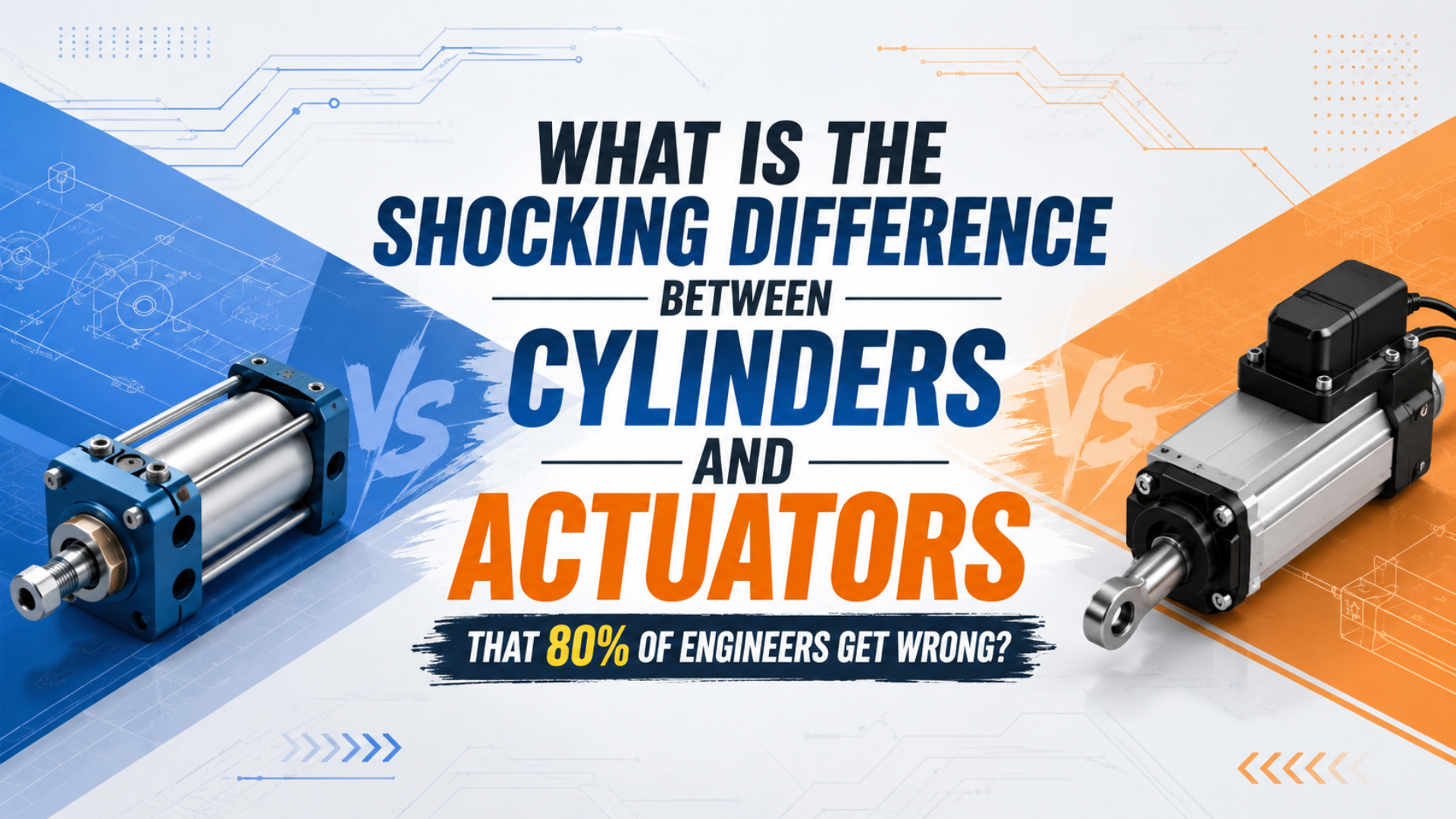
A cylinder is one kind of actuator, not a competing category. ISO 15552 defines a 1,000 kPa, or 10 bar, pneumatic cylinder dimensional series with bores from 32 mm to 320 mm, while “actuator” covers any device that converts energy into controlled motion (ISO 15552, 2025).
That definition matters in purchasing. If an RFQ says “cylinder” but the application needs programmable mid-stroke positioning, the supplier may quote the wrong family. If the RFQ says “actuator” but the job is a simple clamp, the quote may become too complex and too expensive.
Key Takeaways
- Every cylinder is an actuator, but not every actuator is a cylinder.
- ISO 15552 pneumatic cylinders are standardized up to 10 bar and 32-320 mm bores.
- DOE says compressed-air systems often deliver only about 10% wire-to-work efficiency, so energy cost belongs in actuator selection.
The better question is not “cylinder or actuator?” It is “which actuator technology fits the motion, force, control, environment, and maintenance model?” Once the team asks that, the naming problem usually disappears.
What Defines a Cylinder vs an Actuator?
The clean definition is hierarchical: a cylinder is a fluid-powered linear actuator, while an actuator is the wider motion category. AutomationDirect calls pneumatic cylinders “sometimes called pneumatic actuators,” and ISO 15552 limits its standardized pneumatic cylinder scope to 10 bar rated pressure (AutomationDirect, 2026; ISO 15552, 2025).
A cylinder usually has a pressure chamber, piston, rod or carriage, seals, ports, and mounting hardware. Pneumatic cylinders use compressed air. Hydraulic cylinders use pressurized oil. Both convert pressure and piston area into linear force.
An actuator is any device that produces controlled motion from an energy input. That includes pneumatic cylinders, hydraulic cylinders, electric linear actuators, rotary actuators, motors, grippers, slides, voice-coil stages, and mechanical screw jacks. Some move in a straight line. Some rotate.
Use this rule in RFQs:
Cylinder = specific fluid-powered actuator
Actuator = broad motion device category
Pascal’s principle explains the fluid-power side. NASA states that an added pressure in a confined fluid is transmitted through the fluid, and the piston-force relationship follows F1 / A1 = F2 / A2 (NASA Glenn, 2021). In a practical cylinder, the useful first estimate is:
Cylinder force = working pressure x effective piston areaHow Do Construction Differences Affect Selection?
Construction separates a fluid cylinder from an electric actuator at the component level, which matters for sourcing, installation, and maintenance. ISO 15552 covers pneumatic cylinders rated to 10 bar, while AutomationDirect describes 3 electric linear-actuator drive families: ball screw, lead screw, and belt driven (ISO 15552, 2025; AutomationDirect, 2026).
For a buyer, construction is not trivia. It predicts failure modes. A pneumatic cylinder fails around seals, air quality, side load, mounting alignment, cushions, and flow restrictions. An electric actuator fails around screw wear, bearings, belts, motor sizing, encoder feedback, cables, and drive settings.
| Technology | Main construction | Typical weak point | RFQ detail to include |
|---|---|---|---|
| Pneumatic cylinder | Tube, piston, rod, seals, ports | Air leaks, seal wear, side load | Bore, stroke, pressure, mounting, valve flow |
| Hydraulic cylinder | Barrel, piston, rod, seals, oil ports | Leakage, contamination, rod damage | Bore, rod, pressure, load, duty, oil type |
| Electric actuator | Motor, screw or belt, guide, encoder | Screw wear, motor load, control setup | Stroke, load, speed, duty, accuracy |
| Rotary actuator | Vane, rack-pinion, motor, or gear | Torque margin and end stop shock | Torque, angle, cycle time, stop method |
From what we’ve seen in replacement requests, the fastest way to prevent a wrong quote is to send the load path. A cylinder part number alone tells us size. A sketch showing load, guide, bracket, speed, and stop position tells us whether the part is doing the job it was designed to do.
Don’t use the word “actuator” as a shortcut for a complete axis. A powered linear axis may also need a guide rail, coupler, sensor, brake, controller, drive, cable, and safety function. A basic cylinder may need a solenoid valve, FRL unit, flow controls, tubing, fittings, and switches.
What Performance Differences Should You Compare?
Compare force, stroke, speed, repeatability, control, and duty cycle under the same load case. NASA’s F1 / A1 = F2 / A2 relation supports cylinder force math, while Festo says load, precision, dynamics, environment, and life cycle costs should guide actuator choice (NASA Glenn, 2021; Festo, 2026).
The old way is to ask, “Which technology is strongest?” That question is too broad. Hydraulic cylinders often win force density. Pneumatic cylinders often win simple fast two-position motion. Electric actuators often win programmable positioning and repeatability. The right answer depends on the job.
Force
For pneumatic and hydraulic cylinders, start with:
Force = pressure x effective piston areaThen subtract friction, spring force, back pressure, pressure drop, side load, and safety factor. For electric actuators, start with thrust, screw or belt rating, motor torque, speed, duty cycle, and stopping method. Catalog thrust is not the same as usable thrust at your requested speed.
Speed
Pneumatic speed depends on valve flow, port size, tube length, exhaust path, load, and available pressure at the cylinder. Electric speed depends on screw lead or belt drive, motor torque, drive current, acceleration limits, guide capacity, and control profile.
Positioning
Simple cylinders naturally stop at end positions unless you add sensors, proportional valves, servo-pneumatic control, or mechanical stops. Electric actuators can be programmed for multiple positions when the motor, encoder, drive, and mechanics are sized together.
How Do Power Sources Change the System?
Power infrastructure changes the total system, not just the actuator or its machine economics. DOE puts compressed-air wire-to-work efficiency around 10%, and CAGI says well-designed air systems should keep pressure drop to no more than 10% from compressor to point of use (DOE Sourcebook, 2016; CAGI, 2026).
That makes pneumatic selection different from electric selection. A pneumatic cylinder is cheap and simple at the device level, but it depends on plant air quality, air storage, compressor controls, pressure drop, dryer performance, leaks, and exhaust noise. You are buying into the air system.
An electric actuator depends on motor power, drive capacity, encoder feedback, cable management, control cabinet space, and software parameters. It may cost more at the axis, but it can reduce air demand and simplify multi-position motion.
Hydraulic cylinders sit in another bucket. They can provide high force in compact packages, but the system needs pumps, valves, filtration, hoses, cooling, oil maintenance, leak control, and pressure-safety procedures.
| Power source | Infrastructure needed | Selection warning |
|---|---|---|
| Compressed air | Compressor, receiver, dryer, FRL, valves, tubing | Check pressure drop at the cylinder, not only header pressure |
| Hydraulic oil | Pump, tank, filters, valves, hoses, cooling | Control contamination and leakage before sizing only by force |
| Electric power | Drive, motor, controller, cables, encoder | Check thrust at speed and duty cycle, not only peak force |
This companion article on pneumatic laws and cylinder force explains why pressure and area are only the first pass. Flow and pressure drop decide whether the cylinder actually moves on time.
What Control Capability Do You Need?
Control capability is often the real divider between a simple cylinder and a programmable axis. Festo says electric actuators are increasingly used where high precision, flexible variants, or variable processes matter, while Tolomatic frames electric-actuator value around control of position, speed, acceleration, and force (Festo, 2026; Tolomatic, 2019).
Simple pneumatic cylinders are excellent when the machine needs two repeatable endpoints: extend and retract. Add magnetic piston switches or external proximity sensors, and the controller can confirm the end position. That is enough for many clamps, pushers, stops, and transfer gates.
The limits appear when the process needs intermediate stops, smooth acceleration, recipe-based positions, soft force control, or data feedback. You can build servo-pneumatic systems, but they add proportional valves, position sensors, tuning time, and air-system sensitivity.
Electric actuators are better when the axis needs:
- Multiple programmable positions
- Controlled acceleration and deceleration
- Recipe changeovers
- Force or torque limits
- Motion diagnostics
- Networked axis control
The hidden selection question is “how many positions does the process really need?” If the honest answer is two hard stops, a pneumatic cylinder may be the elegant answer. If the answer is “it depends on the product,” electric motion deserves the first look.
When Should You Choose Each Technology?
Application fit should start from the motion requirement, not the part name. Festo recommends evaluating load, precision, dynamics, environment, and life cycle costs; ISO 15552 covers standardized pneumatic cylinders for 10 bar systems, making them strong candidates for ordinary air-powered linear motion (Festo, 2026; ISO 15552, 2025).
Choose a pneumatic cylinder when the application needs simple, fast, clean, two-position motion and the plant already has stable compressed air. Good examples include ejecting, clamping, lifting light loads, shifting gates, indexing stops, and pushing parts into fixtures.
Choose a hydraulic cylinder when the application needs high force density, rugged operation, or high holding force and the site can manage oil, filtration, leakage, heat, and pressure safety. Pressing, forming, lifting, and heavy mobile equipment often live here.
Choose an electric actuator when the application needs repeatable positioning, recipe changes, speed profiles, force limits, cleaner energy accounting, or data. Packaging changeovers, inspection stations, lab automation, and adjustable assembly fixtures often fit this path.
Use this RFQ filter before sending a request:
| Requirement | Ask this first | Likely direction |
|---|---|---|
| Two endpoints only | Does extend/retract solve it? | Pneumatic cylinder |
| High force in small space | Is oil infrastructure acceptable? | Hydraulic cylinder |
| Multiple positions | Does each product need a different stop? | Electric actuator |
| Clean environment | Is oil contamination unacceptable? | Pneumatic or electric |
| Hazardous area | What classification is documented? | Certified pneumatic or electric system |
| Low air cost | Is compressed air already optimized? | Pneumatic only after air audit |
What Cost, Maintenance, and Energy Tradeoffs Matter?
Cost should include device price, infrastructure, energy, maintenance, downtime, product quality, and the complete axis around the cylinder or actuator. DOE says leaks can waste 20-30% of compressor output in poorly maintained plants, while proactive leak repair can reduce leakage below 5-10% (DOE Sourcebook, 2016).
That changes the cylinder-versus-actuator discussion. A pneumatic cylinder may be the lowest-cost component, but compressed air is not free. Leaks, oversized pressure, long tubing, dirty filters, and bad regulators can turn a cheap actuator into an expensive axis.
Tolomatic’s TCO paper makes the same broader point: initial purchase cost alone misses utility cost, maintenance, product yield, changeover time, and cycle-time impact (Tolomatic, 2019). Treat that as a method, not a universal conclusion. Some pneumatic jobs are still the right answer.
Maintenance patterns differ:
- Pneumatic systems: filter bowls, water, leaks, seals, fittings, mufflers, valve spool contamination.
- Hydraulic systems: oil condition, filters, hoses, seals, heat, leakage, pump and valve wear.
- Electric systems: bearings, screws or belts, cables, drives, encoders, software parameters, thermal margins.
Environmental and Safety Factors
Environment can overturn a neat performance comparison during final actuator selection for real factory installations. OSHA requires hazardous-location electrical equipment to be intrinsically safe, approved, or otherwise safe for that location; ISO 15552 also includes pneumatic cylinders up to 10 bar with optional magnetic sensor provisions (OSHA 1910.307, 2026; ISO 15552, 2025).
For hazardous locations, don’t assume air-powered equipment is automatically safe. Pneumatic hardware may reduce electrical ignition sources at the actuator, but the valve, switch, sensor, solenoid, controller, and nearby wiring still need the correct classification and installation method.
For washdown or dusty areas, compare the whole assembly. A stainless pneumatic cylinder may survive splashing, but the sensors and valve island might not. An electric actuator may be available with sealed construction, but its cable routing and drive cabinet still need protection.
For clean rooms, ask where contamination can come from. Pneumatics avoid hydraulic oil but can exhaust particles or oil mist if the air system is not clean. Electric actuators avoid plant-air exhaust but may need lubrication controls around screws or guides.
For cold areas, check condensation and lubricant behavior. Pneumatic systems need dry air and drains. Hydraulic systems need viscosity control. Electric actuators need motor and drive derating checks. The weak point is rarely the headline actuator family; it is the unlisted supporting detail.
Conclusion
Cylinder vs actuator is a hierarchy problem first and a selection problem second. ISO 15552 defines standardized pneumatic cylinders for 10 bar systems, DOE puts compressed-air wire-to-work efficiency around 10%, and Festo recommends selecting by load, precision, dynamics, environment, and life cycle cost (ISO 15552, 2025; DOE Sourcebook, 2016; Festo, 2026).
So don’t ask the supplier for “a cylinder” when you mean a controlled axis. Don’t ask for “an actuator” when a simple ISO pneumatic cylinder will do the job beautifully. Define the work: force, stroke, speed, positions, duty cycle, environment, utilities, and maintenance. The correct technology usually becomes obvious.
FAQs About Cylinders vs Actuators
FAQ answers should stay precise for buyers and engineers because this topic is easy to overgeneralize. ISO 15552 covers pneumatic cylinders up to 10 bar, while AutomationDirect explicitly notes that pneumatic cylinders are sometimes called pneumatic actuators, which explains the naming overlap (ISO 15552, 2025; AutomationDirect, 2026).
What is the main difference between a cylinder and an actuator?
A cylinder is a specific actuator type, usually a pneumatic or hydraulic linear device using pressure acting on piston area. An actuator is the broader category for any device that converts energy into motion, including cylinders, electric linear actuators, rotary actuators, motors, grippers, and mechanical screw devices.
Are all cylinders actuators?
Yes. All working cylinders are actuators because they convert fluid pressure into mechanical motion or force. The reverse is not true. Electric linear actuators, rotary motors, grippers, voice-coil stages, and screw jacks are actuators, but they are not normally called cylinders.
When should I choose a pneumatic cylinder?
Choose a pneumatic cylinder when the job is simple, fast, clean, and mostly two-position. Good examples include clamps, stops, pushers, light lifts, and transfer gates. Check local pressure, valve flow, tubing length, exhaust restriction, and air quality before assuming the cylinder will meet the cycle time.
When should I choose an electric actuator?
Choose an electric actuator when you need multiple positions, controlled speed profiles, recipe changes, data feedback, torque or force limits, or lower dependence on plant compressed air. It usually needs a motor, drive, controller, cables, and setup work, so compare the full axis, not only the actuator body.
Are electric actuators always cheaper over time?
No. Electric actuators can win when compressed-air leakage, energy cost, changeover time, and precision losses are high. Pneumatic cylinders can still be cheaper and better for simple two-position work. Use a total-cost calculation that includes utilities, downtime, maintenance, product quality, and required controls.
Can pneumatic cylinders and electric actuators be used together?
Yes. Mixed systems are common. A pneumatic cylinder may clamp or eject a part while an electric actuator handles adjustable positioning. The design only works when each axis is specified by its own load, stroke, speed, position count, environment, and safety requirement.
Sources
- ISO: ISO 15552:2018, pneumatic cylinder dimensions, 10 bar maximum rated pressure, and 32-320 mm bore scope. Retrieved 2026-06-03.
- NASA Glenn: Pascal’s Principle and Hydraulics, confined-fluid pressure transmission and piston force equations. Retrieved 2026-06-03.
- DOE: Improving Compressed Air System Performance, Third Edition, compressed-air wire-to-work efficiency and leakage ranges. Retrieved 2026-06-03.
- CAGI: Technical Brief on Pressure Drop, 10% pressure-drop target and pressure-drop reduction guidance. Retrieved 2026-06-03.
- Festo: Pneumatics or Electrics? How to Make the Right Choice, actuator selection criteria for load, precision, dynamics, environment, and life cycle costs. Retrieved 2026-06-03.
- AutomationDirect: What is a Pneumatic Cylinder?, pneumatic-cylinder terminology and video explainer. Retrieved 2026-06-03.
- AutomationDirect: What are Electrical Actuators?, electric actuator basics, linear-actuator construction, and motion categories. Retrieved 2026-06-03.
- Tolomatic: Electric Actuators vs. Pneumatic Cylinders TCO, total-cost method and electric-control comparison factors. Retrieved 2026-06-03.
- OSHA: 1910.307 Hazardous Classified Locations, hazardous-location electrical equipment requirements. Retrieved 2026-06-03.