

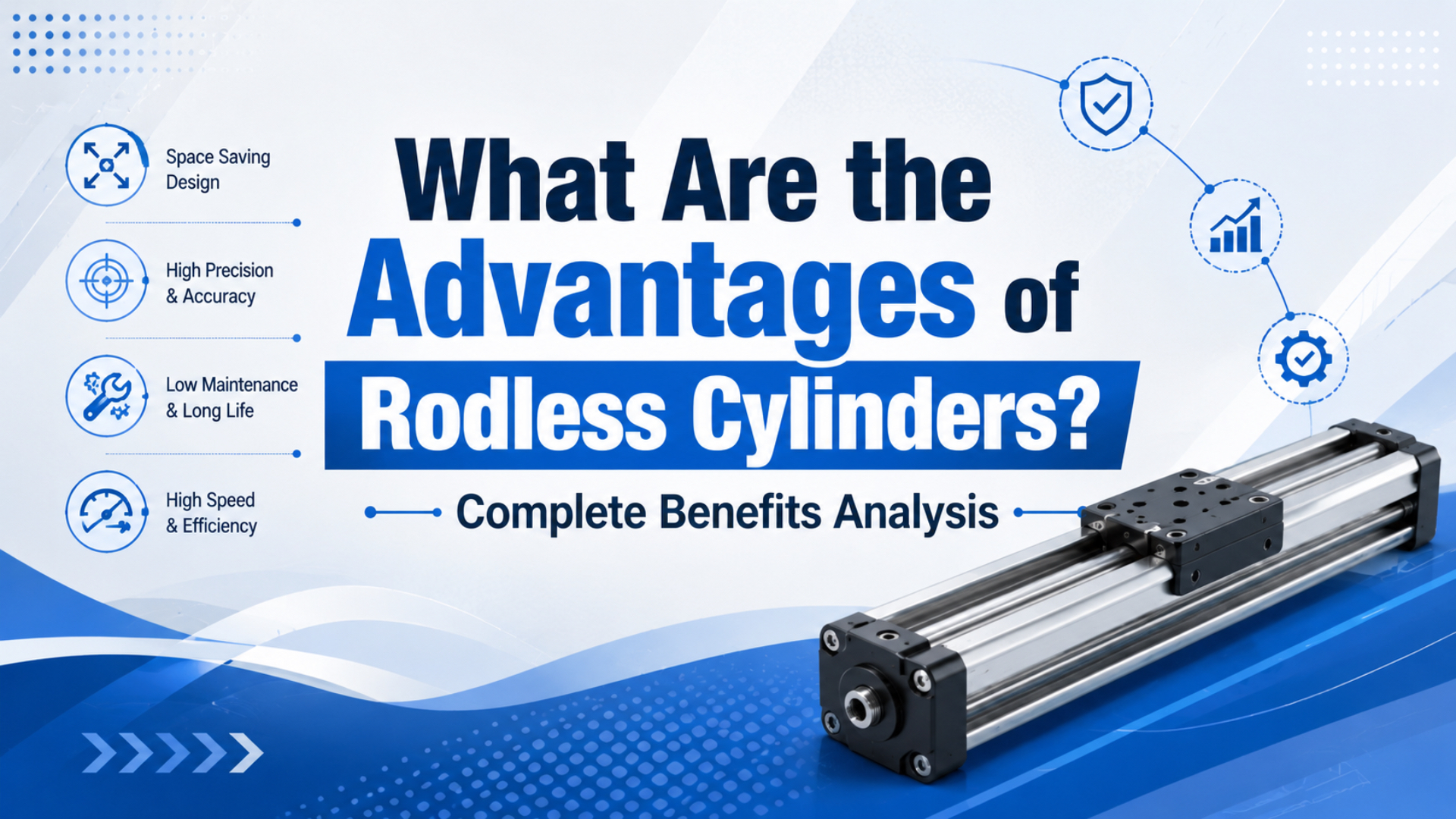
Rodless cylinders give machine builders one core advantage: the load moves on a carriage instead of on an exposed piston rod. That changes the machine envelope, the long-stroke risk, the guarding problem, and the way engineers check side loads. It also changes the RFQ.
Parker’s rodless cylinder catalog lists OSP-P bore sizes from 10-80 mm, a maximum pressure of 8 bar, and stroke lengths up to 5500 mm in its cataloged U.S. table (Parker Rodless Cylinder Catalog, 2025). That catalog data is a safer basis for comparison than blanket claims like “unlimited stroke” or “50% savings.”
Key Takeaways
- Rodless cylinders save machine length because the stroke stays inside the actuator envelope instead of requiring rod-extension clearance.
- Machine Design notes rodless cylinders fit long strokes and high moment loads, especially when carriage designs are matched to the load.
- The best RFQ includes stroke, mass, moment arm, speed, pressure, guide type, stop method, sensors, and environment.
How Do Rodless Cylinders Provide Superior Space Efficiency?
Rodless cylinders improve space efficiency because the load travels on a carriage along the cylinder body instead of on a rod that extends beyond the cylinder. Machine Design explains that rodless cylinders contain the stroke within the overall cylinder envelope and suit long-stroke applications (Machine Design, 2011). That is the real space advantage.
A rod cylinder needs room for its body plus the extended rod. A rodless cylinder needs room for its body and carriage travel. For a 1000 mm stroke, the difference can be large enough to decide whether a machine cell fits beside a conveyor, inside a guard, or under a low frame.
Do the space math directly:
Rod cylinder envelope = body length + stroke + rod clearance
Rodless cylinder envelope = body length + carriage travel
The exact saving depends on body length, mounting, stops, sensors, cable routing, shock absorbers, and guarding. A clean 50% claim may be true in a sketch and wrong in a real machine. Measure the envelope, not the brochure headline.
Space savings are most valuable when they remove a second design problem. A rodless cylinder may let you shorten guarding, avoid overhead clearance, keep a transfer axis inside a frame, or fit a full stroke where a rod cylinder would collide with a door, robot, or operator aisle.
What Performance Advantages Do Rodless Cylinders Offer?
Rodless cylinders can handle long strokes and carriage loads better when the guide type matches the application. SMC’s MY1 family shows five guide choices and describes slide-bearing, cam-follower, linear-guide, and high-rigidity linear-guide versions for different moment and accuracy needs (SMC MY1B catalog, 2025). That variety is the performance advantage.
Performance does not come from removing the rod alone. It comes from combining the drive with the right carriage and guide. A basic rodless cylinder may still need an external guide if the load is offset. A linear-guide version can carry moment more cleanly, but it costs more and needs proper mounting.
Rodless cylinders also make long-stroke motion less awkward. Machine Design says rodless cylinders suit long strokes and high moment loads, while traditional rod cylinders face envelope and rod-support issues on long travel. The selection still has to check bore, pressure, load, moment, speed, and cushioning.
SMC lists piston-speed ranges such as 100-1000 mm/s for several MY1 configurations, with some stroke-adjustment unit conditions extending to 1500 mm/s (SMC MY1B catalog, 2025). Do not turn that into a universal speed promise. Load mass and cushioning capacity decide the usable speed.
| Performance factor | Rodless cylinder advantage | What still needs checking |
|---|---|---|
| Long stroke | No extended rod clearance | Tube support, sag, alignment, carriage travel |
| Offset load | Guided carriage can carry moment | Pitch, roll, yaw moment and load center |
| Speed | Shorter moving envelope and direct carriage motion | Valve flow, tubing, cushioning, impact energy |
| Position feedback | Carriage location is easy to sense externally | Sensor type, repeatability, control valve choice |
How Do Rodless Cylinders Improve Safety and Reliability?
Rodless cylinders can reduce exposed-rod hazards, but they do not remove the need for machine guarding. OSHA says many hazards are created by moving machine parts and that safeguards protect workers from ingoing nip points, rotating parts, flying chips, and sparks (OSHA Machine Guarding eTool, 2026). A moving carriage is still a moving part.
The safety advantage is narrower and more practical: there is no long piston rod sweeping into the work area. That can reduce collision risk, bending risk, and the number of clearance zones in a machine. The carriage path still needs guards, interlocks, safe speed, stops, and lockout procedures when people can reach it.
Reliability improves when the load path is honest. A rod cylinder that carries side load through the rod and seals will wear poorly. A guided rodless cylinder moves side load into the guide system. Better load support usually means less binding, less seal abuse, and more predictable adjustment.
Do not oversell “fail-safe” behavior. A pneumatic axis may coast, drop, drift, or hold depending on load orientation, valve type, exhaust path, friction, locks, and stored air. If gravity can move the load, specify a brake, lock, counterbalance, safe exhaust strategy, or mechanical support.
In our experience, the best safety review starts with a simple sketch. Mark the carriage path, pinch points, end stops, sensor brackets, manual access points, and maintenance positions. If a hand can enter the carriage path during setup or cleaning, the rodless design still needs guarding.
What Economic and Space Benefits Matter?
The economic benefit of a rodless cylinder is strongest when it avoids extra machine length, guarding, structural steel, or a second actuator. Parker lists 8 bar maximum pressure and cataloged OSP-P stroke lengths up to 5500 mm, which supports long transfer axes without rod-extension space (Parker Rodless Cylinder Catalog, 2025).
Skip generic ROI claims unless you have plant data. A rodless cylinder can cost more than a simple rod cylinder. It may still be cheaper at the system level if it shortens the frame, avoids a custom guard, reduces collision risk, or eliminates a jackshaft, linkage, or paired cylinder arrangement.
The right comparison is total installed cost:
- Actuator and guide cost
- Valves, fittings, tubing, and sensors
- Frame length and guarding
- Installation time and alignment effort
- Maintenance access
- Downtime risk from rod bending, binding, or contamination
How Do Rodless Cylinders Excel in Harsh Environments?
Rodless cylinders help in harsh environments when the design protects the moving interface better than an exposed rod arrangement. Machine Design notes pneumatic cylinders tolerate high humidity, dusty environments, and repetitive high-pressure washdowns as a broad actuator category (Machine Design, 2011). The rodless choice still depends on seal, guide, strip, and carriage protection.
In dusty or dirty areas, removing an exposed piston rod can reduce one contamination path. That does not make the axis immune. Mechanical-slot rodless cylinders still have sealing strips. Guided carriages still have bearings or sliders. Dirty environments need wipers, covers, suitable lubrication, and maintenance access.
In washdown areas, ask for the material and sealing package before assuming suitability. Stainless hardware, corrosion-resistant fasteners, compatible seals, and drainage matter. Some rodless designs are easier to clean than others because they avoid long exposed rods and reduce hidden cavities.
In clean applications, look at particle generation and lubrication. A magnetic coupling may avoid a mechanical slot, but it has force limits. A mechanically coupled rodless cylinder may provide higher force, but the sealing strip and carriage must be appropriate for the environment.
What Design and Installation Advantages Matter?
Rodless cylinders give designers more layout choices because the moving element does not project beyond the cylinder body. SMC’s MY1 selection flow checks load mass, allowable moment, cushioning at stroke end, port variations, and auto-switch mounting before model selection (SMC MY1B catalog, 2025). That is also a strong installation checklist.
Mounting flexibility is useful only when alignment is controlled. A long rodless cylinder bolted to a flexible frame can bind, leak, or wear early. Support spacing, flatness, parallelism, and tube sag matter more as stroke increases.
Sensors are another advantage. Reed switches, proximity sensors, linear transducers, and external feedback devices can track carriage position without building brackets around an extending rod. The Enfield rodless positioning demo shows a guided Parker Origa cylinder with external feedback for velocity and position control (Enfield Technologies, 2026).
For replacement work, do not send only a photo and a stroke. Send the model code if available, bore, stroke, mounting orientation, moving mass, offset distance, speed target, air pressure, stop method, sensor type, environment, and failure symptom.
How Do Rodless Cylinders Compare to Traditional Alternatives?
Rodless cylinders compare best against rod cylinders when stroke length, rod clearance, moment load, or guarding drives the design. Machine Design describes rodless cylinders as a separate cylinder family where an external carriage carries the load and slides on the tube (Machine Design, 2011). That carriage is the deciding difference.
Choose a rod cylinder when the stroke is short, side load is low, space is available, and low first cost matters. Choose a guided rod cylinder when the stroke is moderate and the load needs anti-rotation support. Choose a rodless cylinder when long travel or footprint dominates. Choose an electric actuator when programmable motion profiles and many intermediate positions dominate.
| Selection question | Rod cylinder | Guided cylinder | Rodless cylinder | Electric actuator |
|---|---|---|---|---|
| Short stroke, low side load? | Strong fit | Possible | Usually unnecessary | Only if programmable motion is needed |
| Long stroke in tight space? | Poor fit | Limited | Strong fit | Strong fit if budget and controls allow |
| Offset load or moment? | Poor fit | Good fit | Good fit with right guide | Good fit with right guide |
| Many programmable stops? | Weak fit | Weak fit | Needs feedback and control | Strong fit |
For a fast replacement quote, this one-line RFQ is far stronger than “need rodless cylinder”: “Stroke 1800 mm, horizontal mount, moving load 22 kg, load center 110 mm above carriage, extend time 1.5 s, 6 bar supply, end sensors, dusty packaging area, old unit has carriage play.” That tells an engineer what to check.
Conclusion
Rodless cylinders are advantageous when they solve a real layout or load-path problem: long stroke, tight space, rod-clearance hazard, high moment load, or difficult guarding. Parker lists OSP-P rodless cylinders with 8 bar maximum pressure and cataloged strokes up to 5500 mm, while SMC’s MY1 family shows guide choices for different accuracy and moment requirements (Parker Rodless Cylinder Catalog, 2025).
The best buying decision is not “rodless is always better.” It is “rodless removes the specific constraint that a rod cylinder creates.” Check the envelope, load moment, speed, cushioning, environment, guarding, and controls. Then compare total installed cost.
FAQs About Rodless Cylinder Advantages
Rodless cylinder advantages are strongest in long-stroke, space-constrained, or high-moment applications. Parker publishes OSP-P rodless cylinder data with 10-80 mm bores, 8 bar maximum pressure, and cataloged strokes up to 5500 mm (Parker Rodless Cylinder Catalog, 2025). Use those limits instead of generic percentage claims.
What are the main advantages of rodless cylinders?
The main advantages are shorter installation envelope, long-stroke capability, reduced rod-clearance problems, better options for guided carriage loads, and easier external sensing. The advantage is strongest when a rod cylinder would require extra clearance, risk rod bending, create guarding difficulty, or need separate guide hardware.
How much space can a rodless cylinder save?
The saving depends on stroke, body length, stops, sensors, and mounting. A rod cylinder needs body length plus rod-extension clearance, while a rodless cylinder keeps the stroke inside the actuator envelope. For long strokes, that difference can be large enough to change the whole machine layout.
Are rodless cylinders faster than rod cylinders?
They can be, but speed is not automatic. SMC lists MY1 piston-speed ranges such as 100-1000 mm/s for several configurations, with conditions that affect higher ranges. Real speed depends on load mass, valve flow, tubing, pressure, cushioning, and how much impact energy the axis must absorb.
Do rodless cylinders improve machine safety?
They can reduce hazards from an exposed moving rod, especially in long-stroke applications. OSHA still requires safeguards for hazardous moving machine parts, so the carriage path, end stops, pinch points, and maintenance access must be guarded or controlled. Rodless design reduces one hazard source; it does not remove safety engineering.
What is the disadvantage of a rodless cylinder?
Rodless cylinders usually cost more than simple rod cylinders and need careful checks for carriage moment, sealing strips, tube support, alignment, and environmental contamination. They are not always the right choice for short, simple strokes where a standard rod cylinder fits cleanly and safely.
When should I choose a rodless cylinder instead of an electric actuator?
Choose rodless pneumatic when the motion is mostly end-to-end, compressed air is already available, and the priority is long stroke or compact footprint. Choose electric when the machine needs many programmable stops, smooth acceleration profiles, high-resolution positioning, or easy recipe changes without pneumatic tuning.
What information is needed to replace a rodless cylinder?
Send the model code, bore, stroke, mounting style, moving mass, load offset, speed target, working pressure, port size, sensor type, stop method, guide condition, and environment. Photos help, but the load and moment data decide whether the replacement will last.
Sources
- Parker: Rodless Pneumatic Cylinders OSP-P Series Catalog, bore sizes, 8 bar maximum pressure, cataloged stroke lengths, and rodless cylinder specifications. Retrieved 2026-06-03.
- SMC: MY1B Mechanically Jointed Rodless Cylinder catalog, guide choices, selection flow, moment checks, and piston-speed ranges. Retrieved 2026-06-03.
- Machine Design: Guidelines for Selecting Pneumatic Cylinders, rodless cylinder use cases, long-stroke suitability, force, speed, and pneumatic cylinder selection. Retrieved 2026-06-03.
- OSHA: Machine Guarding eTool, General Requirements, safeguarding requirements and hazards from moving machine parts. Retrieved 2026-06-03.
- Enfield Technologies: S2 Positioning - Better Rodless Cylinder Positioning, video demo of guided rodless cylinder velocity and position control. Retrieved 2026-06-03.