

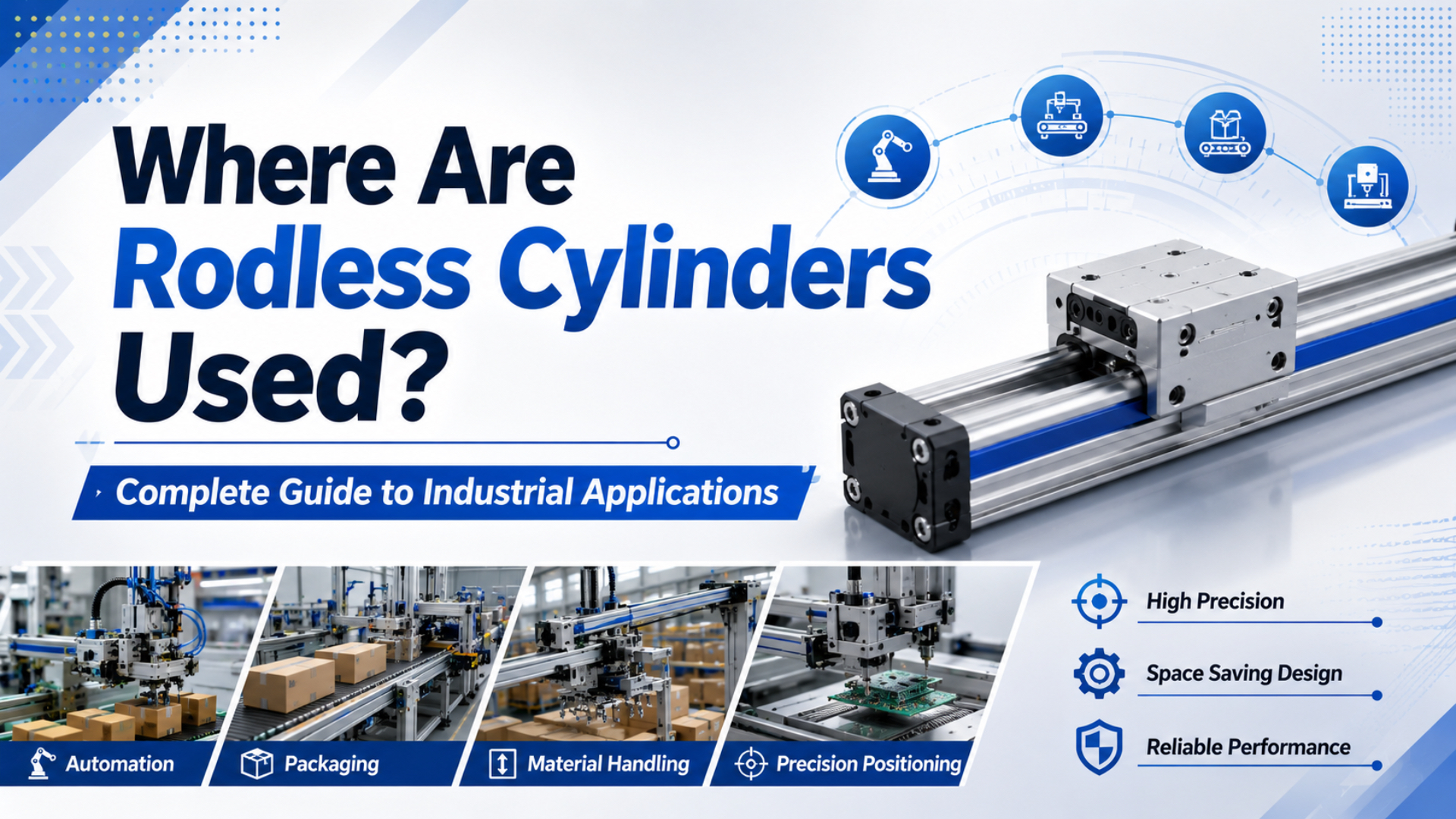
Rodless cylinders are used where a machine needs long linear travel without the extra rod-extension space of a standard cylinder. Parker lists OSP-P rodless actuators for packaging machinery, material handling equipment, food and beverage, medical, machine tools, printing, and factory automation, with catalog specs up to 6000 mm stroke and 8 bar maximum operating pressure (Parker OSP-P Series, 2026).
That is the practical answer. Rodless cylinders are not “for every long stroke.” They are for long strokes that also need compact installation, a moving carriage, guided load support, cleaner motion, or easier integration inside a machine frame.
Key Takeaways
- Rodless cylinders are common in packaging, material handling, assembly, machine tools, food, medical, and cleanroom equipment.
- Parker lists OSP-P bore sizes from 10-80 mm, 8 bar maximum pressure, and 6000 mm maximum stroke on its product page.
- The right application is defined by stroke, load moment, speed, guide type, environment, stopping method, and maintenance access.
What Industries Use Rodless Cylinders Most Often?
Rodless cylinders show up most often in industries that need compact transfer motion: packaging, material handling, food and beverage, medical/life science, printing, machine tools, and factory automation. Parker names those markets directly for its OSP-P series and lists actions from 47 to 3010 N at 6 bar (Parker OSP-P Series, 2026).
The common thread is not the industry label. It is the movement pattern. The machine needs a carriage to move a load along a body, often inside a guard, under a conveyor, beside a fixture, or across a station where a protruding rod would collide with something.
Packaging machines use rodless cylinders for carton motion, pusher plates, film handling, label heads, diverters, and end-of-line transfers. Material handling systems use them for stops, pushers, lifts, merge lanes, sorters, and compact cross transfers.
Machine tools and assembly systems use rodless cylinders when a workpiece, nest, probe, guard door, or fixture plate needs repeatable travel. Food, medical, and life science equipment add another requirement: the actuator must be cleanable, protected from washdown, or selected for low particle generation.
| Industry | Typical rodless cylinder use | Main reason it fits |
|---|---|---|
| Packaging | Pusher, labeler, wrapper, case packer, carton transfer | Long motion in a compact machine frame |
| Material handling | Diverter, stop, merge, lift, shuttle, sorting lane | Carriage motion beside conveyors |
| Machine tools | Guard doors, part feed, fixture motion, probe movement | Compact traverse and guided load support |
| Food and medical | Washdown packaging, filling, inspection, clean transfer | Cleanable or low-particle actuator options |
The best way to spot a rodless-cylinder application is to draw the clearance box, not the cylinder. If the extended rod blocks a door, guard, aisle, conveyor, robot reach, or operator access point, a rodless actuator deserves a look.
Which Manufacturing Applications Benefit From Rodless Cylinder Technology?
Manufacturing applications benefit when the load needs guided long-stroke travel, not just push-pull force. SMC lists five standardized MY1 guide types and bore-size options from 10 to 100 mm across its mechanically jointed MY1 family, because load mass and required accuracy change the actuator choice (SMC MY1 Web Catalog, 2026).
That is why “rodless cylinder” is not specific enough for a purchase order. A basic actuator may be fine for a light pusher. A slide-bearing version may suit moderate loads. A cam-follower or linear-guide version may be needed when the load center sits above, below, or far from the carriage.
Assembly lines use rodless cylinders for part transfer, pallet shuttles, tooling movement, and operator-assist slides. These are usually point-to-point motions where speed and repeatability matter, but full servo positioning is not always required.
Machine builders also use rodless cylinders for guard-door motion, fixture indexing, part ejection, test-head travel, and inspection-camera movement. The compact body helps keep the motion inside the equipment envelope.
What should you check first? Moment load. A rodless cylinder may tolerate more overhung load than a plain rod cylinder, but the carriage guide still has pitch, roll, and yaw limits. Send the moving mass and load-center offset with the RFQ.
How Are Rodless Cylinders Used in Packaging and Material Handling?
Packaging and material handling are natural fits because Parker lists OSP-P applications including packaging, labeling, wrapping, pushers, pickers, grippers, feeding, cutting, and sorting. The same page lists 6000 mm maximum stroke and 8 bar maximum pressure, enough range for many conveyor-side and end-of-line motions (Parker OSP-P Series, 2026).
In packaging, the rodless cylinder is usually not the star of the machine. It is the motion axis behind a product pusher, carton transfer, label head, reject gate, wrapper carriage, indexing bar, or case-packing slide.
The reason is simple: long travel must fit inside a compact machine. A conventional cylinder can require space for the body plus the extended rod. A rodless cylinder keeps the moving carriage near the actuator body, which often makes the enclosure shorter and easier to guard.
Material handling applications are similar. Diverters, cross transfers, accumulation stops, merge controls, tote shuttles, and pallet stops all need motion beside a conveyor. The actuator has to stay out of the product path, cable path, maintenance path, and operator reach zone.
Do not choose the actuator from stroke alone. Check cycle rate, cushion energy, carriage moment, product impact, sensor mounting, and whether the load can jam. A conveyor jam can turn a simple pusher into a damaged carriage if the coupling or guide was undersized.
What Automotive Applications Use Rodless Cylinders?
Automotive use is strongest in fixture, transfer, guarding, and test equipment where long travel and compact machine layout matter. Reid Supply describes BIW manufacturing as a staged process using robots, workholding devices, fixtures, locator pins, and positioning devices, with robots handling 200 lb roof panels in one example (Reid Supply, 2026).
Rodless cylinders can support that environment when the motion is a fixture slide, part locator, guard door, test-head transfer, weld-cell shuttle, or component positioning axis. They are not a substitute for the robot. They are often the compact linear motion inside the cell.
Body-in-White fixtures may need repeatable positioning of clamps, pins, panels, or tooling. Paint and finishing equipment may need clean motion away from overspray. Final assembly tools may need compact slides for positioning, checking, pressing, or supporting parts near the line.
The key selection issue is stiffness. A long automotive fixture can create a large moment arm on the carriage. That pushes the decision toward a guided rodless cylinder, a separate linear guide, or an electric linear axis if programmable motion is needed.
In replacement work, the most useful automotive photos show the whole fixture, not only the failed cylinder label. A close-up tells us bore and stroke. A wide photo tells us the load offset, sensor position, hose routing, guard clearance, and what will be hit if the new carriage is taller.
Where Do Food, Pharmaceutical, and Cleanroom Equipment Use Rodless Cylinders?
Food and pharmaceutical machines use rodless cylinders where compact motion must also be cleanable or low-contamination. The eCFR 21 CFR 117.40 rule requires food plant equipment to be cleanable and says conveying, pneumatic, closed, and automated systems must be maintainable in an appropriate sanitary condition (eCFR 21 CFR 117.40, 2026).
That does not mean every rodless cylinder is food-ready. It means the actuator must be evaluated as part of the equipment design: material, surface exposure, lubrication, seals, drainage, washdown chemistry, cable routing, and maintenance access all matter.
ISO 14159:2002 is also relevant because it specifies hygiene requirements for machines used where consumer hygiene risks can occur; ISO lists the standard as 30 pages and last reviewed and confirmed in 2018 (ISO 14159:2002, 2026). For food and pharma buyers, that pushes the conversation toward cleanable design, not only actuator stroke.
Cleanroom and electronics equipment add particle control. SMC’s 12-CY3B-Z clean-room magnetically coupled rodless cylinder is described as ISO Class 5 (Class 100) rated, with bore sizes from 6 to 63 mm and stroke lengths listed up to 5000 mm on the SMC USA page (SMC USA Clean Room Rodless Cylinder, 2026).
This is where magnetic coupling often earns its keep. A fully sealed tube can avoid the slot found in mechanically coupled designs. The tradeoff is force and load support. SMC notes that clean-room magnetic versions still need an external guide to support the load in some configurations.
How Are Rodless Cylinders Applied in Specialized Industrial Equipment?
Specialized machines use rodless cylinders when a standard cylinder creates a packaging, guarding, contamination, or support problem. SMC Europe describes rodless actuators for transferring, moving, or positioning components in long-stroke applications, assembly automation, packaging, and electronics, and notes that CY magnetic versions are available in 9 bore sizes from 6 to 63 mm (SMC Europe Rodless Actuators, 2026).
Printing and converting equipment use rodless cylinders for web edge movement, register adjustment, cutting support, roll-cleaning motion, and sheet handling. These applications care about smooth travel and stable support because wrinkles, bounce, and impact show up as product defects.
Glass, solar, and display equipment use rodless cylinders when long travel must be gentle. The actuator may move a shuttle, alignment stop, vacuum head, cover, or inspection stage. Magnetic versions can reduce contamination paths, but the guide and external load support still need careful engineering.
Semiconductor and electronics equipment use rodless cylinders in wafer, PCB, and substrate handling when pneumatic motion is acceptable and particle control is part of the design. If the axis needs many programmable stops, closed-loop electric motion may be a better match.
How Do You Decide Whether a Rodless Cylinder Is the Right Application Choice?
Choose a rodless cylinder when the stroke is long, the envelope is tight, and the load can be carried safely by the carriage or an external guide. Parker’s OSP-P page warns that users must analyze all application aspects and follow applicable industry standards before final component selection (Parker OSP-P Series, 2026).
Start with the machine envelope. If a rod cylinder needs body length plus rod extension and that space is not available, rodless becomes attractive. If the stroke is short and space is open, a standard cylinder may be cheaper and easier to maintain.
Then check the load. A carriage-mounted load creates moments. A vertical or inclined axis may need a brake, lock, counterbalance, or external stop. Pneumatic pressure alone is not a safety device.
Finally, check the motion profile. Simple two-position transfer is a good pneumatic job. Multiple programmable stops, synchronized axes, soft motion profiles, or tight dynamic positioning may point toward a servo-pneumatic package or an electric actuator.
For fast triage, use this sentence in your RFQ: “Stroke 1800 mm, horizontal mount, 18 kg moving load, load center 120 mm above carriage, 6 bar supply, 0.9 s extend time, dusty carton line, end sensors, old unit has carriage play.” That gives an engineer enough data to start checking guide load, speed, cushioning, and replacement family.
Conclusion
Rodless cylinders are used in packaging, material handling, assembly automation, automotive fixtures, machine tools, food and beverage equipment, medical/life-science machines, electronics, and cleanroom systems. The strongest applications share the same pattern: long linear travel, compact space, guided carriage motion, and a load path that a standard rod cylinder handles poorly.
Do not select one only because an old machine used one. Check stroke, force, moment, speed, cushioning, environment, stopping method, and safety requirements. If the load is offset, choose the guide first and the cylinder second.
FAQs About Rodless Cylinder Applications
What are rodless cylinders used for most often?
Rodless cylinders are most often used for compact long-stroke motion in packaging, material handling, assembly, labeling, wrapping, sorting, feeding, cutting, machine tools, food equipment, and cleanroom handling. Parker lists many of those applications for OSP-P, with 6000 mm maximum stroke and 8 bar maximum pressure.
Are rodless cylinders used in packaging machinery?
Yes. Packaging machines use rodless cylinders for product pushers, label heads, carton transfer, case packing, reject gates, wrapper carriages, diverters, and end-of-line transfers. They fit when a standard cylinder would need too much rod-extension space inside the guarded machine envelope.
Where are rodless cylinders used in automotive plants?
Automotive plants use rodless cylinders mainly in fixtures, transfer slides, guard doors, part locators, test equipment, and compact handling axes. In BIW cells, the broader motion problem is accurate positioning and workholding; the rodless cylinder is one possible actuator when the stroke and envelope fit.
Can rodless cylinders be used in food and pharmaceutical equipment?
Yes, but the actuator must match the sanitary design requirement. eCFR 21 CFR 117.40 requires food equipment and conveying or pneumatic systems to be cleanable and maintainable in sanitary condition. For washdown or cleanroom work, check materials, seals, lubrication, drainage, particle generation, and cleaning chemicals.
Are rodless cylinders good for cleanroom or semiconductor applications?
Magnetically coupled clean-room rodless cylinders can be a good fit when particle control and sealed motion matter. SMC’s 12-CY3B-Z clean-room series is described as ISO Class 5 rated, with bore sizes from 6 to 63 mm and listed strokes up to 5000 mm, but load support still needs guide verification.
When should I avoid a rodless cylinder?
Avoid a rodless cylinder when the stroke is short, space is not constrained, the load moment exceeds the carriage guide rating, or the axis needs many programmable positions. In those cases, a standard cylinder, guided cylinder, servo-pneumatic system, or electric actuator may be a better choice.
What information should I send for a rodless-cylinder quote?
Send stroke, bore or old model, moving mass, load-center offset, orientation, pressure during motion, speed target, cycle rate, guide type, sensors, stop method, environment, photos, and failure symptom. For replacements, include whether the problem is leakage, carriage play, weak force, hard impact, or inconsistent speed.
Sources
- Parker OSP-P Series, rodless pneumatic cylinder markets, applications, stroke, force, pressure, and safety-selection notes. Retrieved 2026-06-03.
- SMC MY1 Web Catalog, mechanically jointed rodless-cylinder guide types and bore ranges. Retrieved 2026-06-03.
- SMC Europe Rodless Actuators, rodless actuator applications, cylinder types, and selection considerations. Retrieved 2026-06-03.
- SMC USA Clean Room Rodless Cylinder, clean-room magnetic rodless cylinder ratings and ranges. Retrieved 2026-06-03.
- eCFR 21 CFR 117.40, food-equipment cleanability and pneumatic-system sanitation requirements. Retrieved 2026-06-03.
- ISO 14159:2002, hygiene requirements for machinery used where consumer hygiene risks can occur. Retrieved 2026-06-03.
- Reid Supply BIW Workholding, automotive BIW positioning, workholding, fixtures, and pneumatic-assisted tooling context. Retrieved 2026-06-03.
- HeBaiele rodless pneumatic cylinder guide, source page containing the embedded YouTube video “How RODLESS CYLINDER works? (Animation | Sub)”. Retrieved 2026-06-03.