

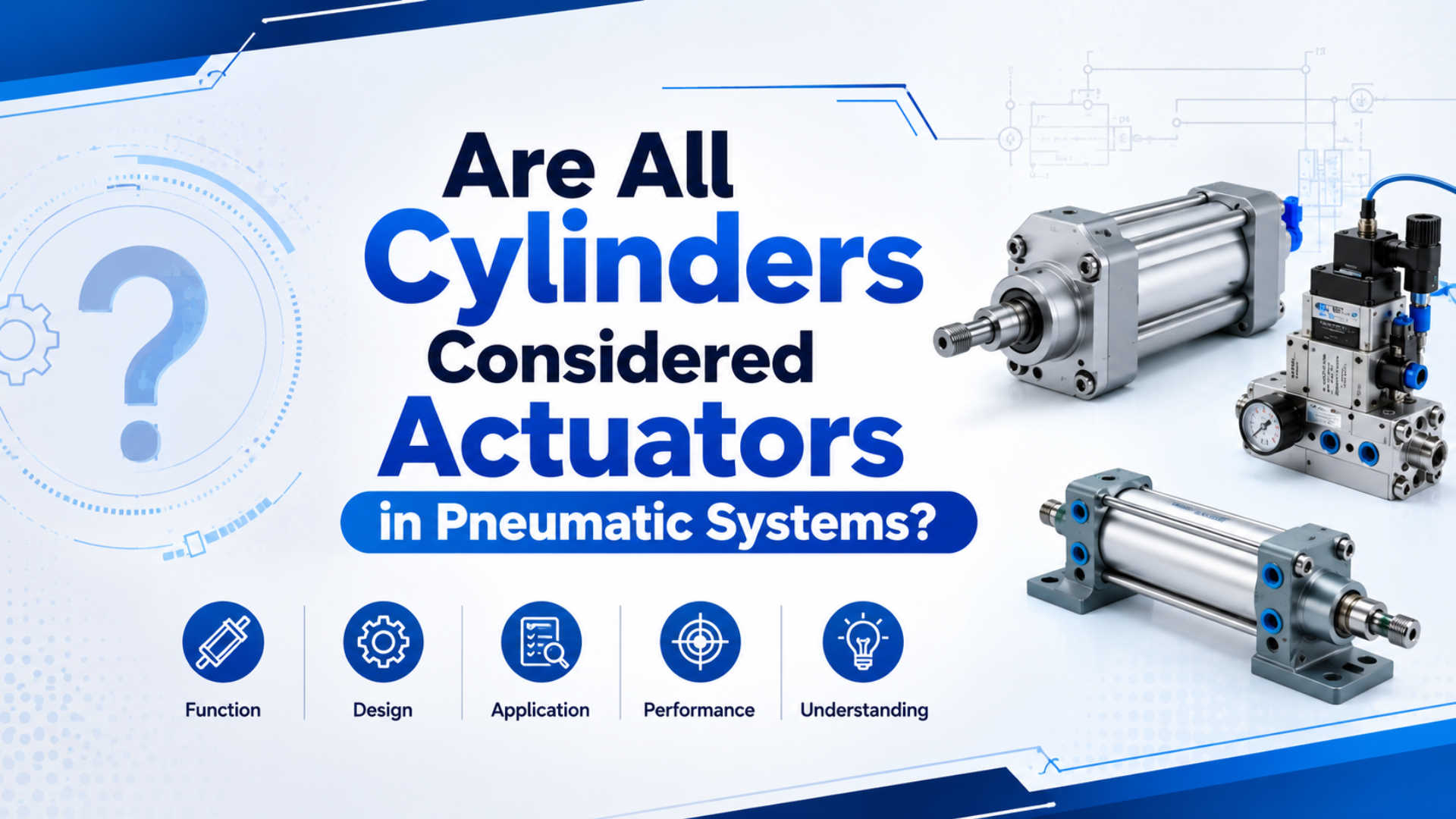
Yes. In pneumatic systems, cylinders are actuators because they convert compressed-air energy into mechanical motion. More precisely, a pneumatic cylinder is a linear actuator. ISO 15552 covers pneumatic cylinders in a 1,000 kPa, or 10 bar, series, while AutomationDirect says pneumatic cylinders are sometimes called pneumatic actuators (ISO 15552, 2025; AutomationDirect, 2026).
The important boundary is the reverse statement: not every actuator is a cylinder. Rotary actuators, electric linear axes, grippers, motors, and servo-pneumatic packages are also actuators. Use this page as a short terminology answer. For the full category comparison, use the deeper guide on the difference between cylinders and actuators.
Key Takeaways
- A pneumatic cylinder is a linear actuator.
- ISO 15552 covers 10 bar pneumatic cylinders with 32-320 mm bores.
- “Actuator” is broader than “cylinder,” so RFQs should name the motion, load, stroke, and control requirement.
The terminology problem usually appears in quotes, not textbooks. If a buyer asks for an “actuator” when the machine only needs a simple extend-retract cylinder, the quote can become unnecessarily complex. If the buyer says “cylinder” when the process needs stored positions, the quote can become too simple.
Short Answer: Cylinders Are Pneumatic Actuators
The direct answer is yes: a pneumatic cylinder is an actuator when it converts air pressure into motion. ISO 15552:2018 was confirmed current in 2025 and applies to 1,000 kPa, or 10 bar, pneumatic cylinders with detachable mountings (ISO 15552, 2025).
In practical language, a cylinder is a specific actuator type. The cylinder body, piston, rod or carriage, seals, ports, and mounting hardware create linear movement. In a standard rodded cylinder, the rod extends and retracts. In a rodless cylinder, the load moves along the body instead of outside it.
Use this hierarchy:
Actuator
  -> Linear actuator
      -> Pneumatic cylinder
          -> Rod cylinder, rodless cylinder, guided cylinder, compact cylinder
That hierarchy prevents two common RFQ errors. A cylinder request should not be treated as a full programmable motion axis unless the application needs it. An actuator request should not be quoted as a simple cylinder unless the required motion is truly end-to-end.
What Makes a Cylinder a Pneumatic Actuator?
A cylinder qualifies as a pneumatic actuator because pressure acting on area creates force and movement. NASA states that pressure equals force per unit area and gives the fluid-power relation F1/A1 = F2/A2, while ISO 15552 defines standardized pneumatic-cylinder dimensions (NASA Glenn, 2021; ISO 15552, 2025).
For a simple cylinder, the working idea is:
Cylinder force = working pressure x effective piston areaThat is why a pneumatic cylinder is not just a tube with a rod. It is an energy-conversion device. Compressed air enters a chamber, pressure acts on piston area, and the piston moves. The actuator output is linear force over a stroke.
The actual usable force is lower than the ideal calculation. Friction, back pressure, seal drag, side load, mounting alignment, pressure drop, and speed requirement all matter. A cylinder remains an actuator, but it still has to be sized like an actuator.
For force math, use the dedicated guide on the cylinder formula for pneumatic systems. This page keeps the focus on terminology and RFQ language.
Where Do Cylinders Sit in the Actuator Family?
Cylinders sit inside the linear-actuator branch of the actuator family, not above it. ISO 15552 covers pneumatic cylinders from 32 mm to 320 mm bore, and AutomationDirect’s transcript says pneumatic cylinders are sometimes called pneumatic actuators for clamping, positioning, lifting, and other linear motion functions (ISO 15552, 2025; AutomationDirect, 2026).
The wider actuator family includes more than cylinders:
| Actuator type | Motion output | Typical pneumatic example | Use “cylinder” for it? |
|---|---|---|---|
| Linear actuator | Straight-line movement | Rodded or rodless cylinder | Yes, when it uses a cylinder body |
| Rotary actuator | Angular movement | Vane or rack-pinion rotary actuator | No |
| Gripper actuator | Clamping motion | Parallel or angular pneumatic gripper | No |
| Electric linear actuator | Motor-driven linear axis | Screw or belt actuator | No |
| Servo-pneumatic axis | Controlled linear motion | Cylinder plus valve, feedback, controller | Sometimes, but not as the whole system |
The clean language is: every working pneumatic cylinder is an actuator, but many actuators are not cylinders. That distinction matters when a buyer compares a rodless cylinder with an electric linear axis, or a rotary actuator with a valve-turning cylinder arrangement. For angular motion, use the separate guide on pneumatic rotary actuators instead of a cylinder page.
When Should an RFQ Say Cylinder Instead of Actuator?
Use “cylinder” in an RFQ when the required motion is a pneumatic linear stroke. Festo says actuator selection should compare load, precision, dynamic response, environment, and costs, and ISO 15552 defines the standardized 10 bar pneumatic-cylinder family (Festo, 2026; ISO 15552, 2025).
Use “pneumatic cylinder” when the buyer already knows the motion is extend-retract, clamp-release, lift-lower, push-return, or slide-to-end-stop. That wording directs the supplier toward bore, stroke, mounting, cushioning, sensors, valve flow, and air preparation.
Use “actuator” when the technology is still open. The supplier may need to compare pneumatic cylinders, electric axes, hydraulic cylinders, rotary actuators, or grippers. In that case, the RFQ should describe the task rather than naming a product too early.
Good RFQ language looks like this:
| If the need is | Say this |
|---|---|
| Two-position air-powered stroke | Pneumatic cylinder |
| Long stroke without rod extension | Rodless cylinder or rodless pneumatic actuator |
| Multiple programmable stops | Electric actuator or servo-pneumatic axis |
| Angular movement | Rotary actuator |
| Part handling | Pneumatic gripper |
| Technology undecided | Linear actuator, with load/stroke/speed data |
For the decision boundary against electric motion, use when to choose a cylinder over an electric actuator. That article is narrower than the terminology question here.
What Should Not Be Called a Cylinder?
Do not call every actuator a cylinder. Festo states there is no generally “better” actuator technology and lists load, precision, dynamic response, environment, and costs as major selection factors; AutomationDirect separates pneumatic cylinders from electric actuator construction such as screw and belt designs (Festo, 2026; AutomationDirect, 2022).
A rotary actuator is not a cylinder just because it uses compressed air. It produces angular motion. A gripper is not normally called a cylinder, even if a tiny piston drives the jaw. An electric linear actuator is not a cylinder because its motion comes from a motor and transmission.
This matters for replacement sourcing. If the old component is a rotary table, asking for a “cylinder replacement” can lead the supplier toward the wrong product family. If the old component is a rodless cylinder, asking for a generic “linear actuator” can return an electric axis quote when the buyer wanted a pneumatic replacement.
In replacement work, photos often solve the terminology problem quickly. A side view shows whether there is a piston rod, a carriage, a rotary shaft, jaw fingers, cable carriers, or a motor. The name on the request matters less than the motion and mounting evidence.
FAQs About Cylinders and Actuators
FAQ answers should keep the hierarchy precise. ISO 15552 covers pneumatic cylinders up to 10 bar with bores from 32 mm to 320 mm, while AutomationDirect explicitly says pneumatic cylinders are sometimes called pneumatic actuators (ISO 15552, 2025; AutomationDirect, 2026).
Are all pneumatic cylinders actuators?
Yes. Pneumatic cylinders are actuators because they convert compressed air into mechanical movement. They are specifically linear actuators because their output is straight-line motion. The term “actuator” is broader, so a cylinder is an actuator, but an actuator is not automatically a cylinder.
Are all actuators cylinders?
No. Actuators include pneumatic cylinders, hydraulic cylinders, electric linear axes, rotary actuators, grippers, motors, slides, and other motion devices. Use “cylinder” only when the device has cylinder construction or is commonly sold as a pneumatic cylinder family.
Is a rodless cylinder an actuator?
Yes. A rodless cylinder is a pneumatic linear actuator. It moves a carriage along the cylinder body instead of pushing an external piston rod out of the barrel. Use the related rodless actuator guide when comparing pneumatic and electric rodless axes.
Is a pneumatic gripper a cylinder?
Usually no. A pneumatic gripper is an actuator because it creates controlled motion from compressed air, but it is normally classified by its gripping function rather than called a cylinder. Internally it may use pistons, wedges, cams, or links to move the jaws.
Why does this terminology matter for sourcing?
The wrong term can produce the wrong quote. “Cylinder” points toward bore, stroke, mounting, cushioning, valve flow, and air preparation. “Actuator” keeps the technology open. For complex applications, send the motion requirement first, then let the supplier map it to the right actuator family.
Source and retrieval notes:
- ISO 15552:2018, pneumatic cylinder 1,000 kPa or 10 bar series, 32-320 mm bore scope, confirmed current in 2025. Retrieved 2026-07-08.
- AutomationDirect: What is a Pneumatic Cylinder?, transcript states pneumatic cylinders are sometimes called pneumatic actuators and describes linear-motion uses. Retrieved 2026-07-08.
- NASA Glenn: Pascal’s Principle and Hydraulics, pressure, area, and force relation used to explain cylinder force. Retrieved 2026-07-08.
- Festo: Electric vs Pneumatic Actuators, actuator selection factors including load, precision, dynamic response, environment, and costs. Retrieved 2026-07-08.
- AutomationDirect: What Are Electrical Actuators?, electric actuator construction context for non-cylinder actuators. Retrieved 2026-07-08.