

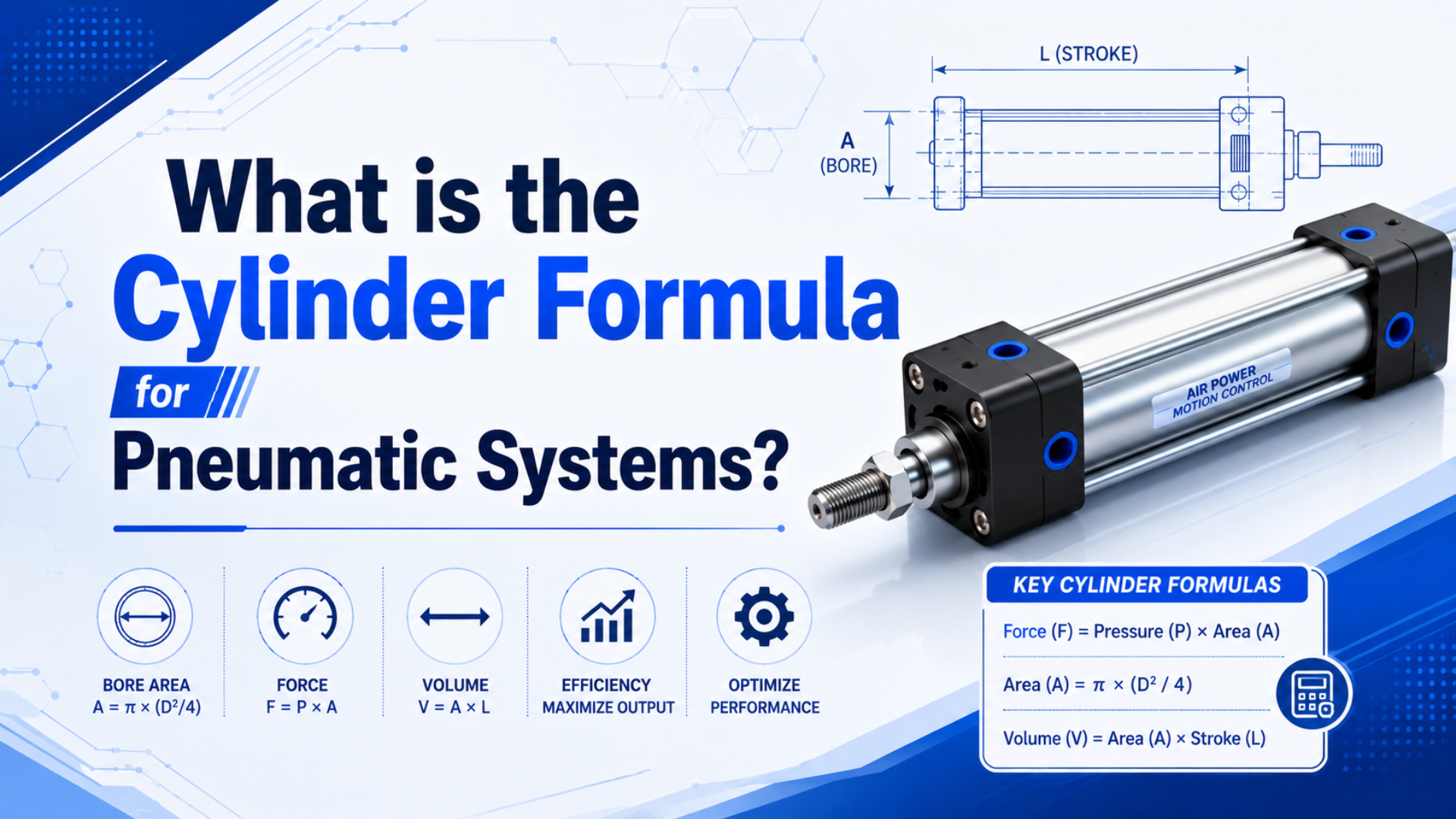
The main cylinder formula for pneumatic systems is F = P x A: force equals working pressure times effective piston area. Use full piston area for extension, subtract rod area for single-rod retraction, use speed = flow / area for first-pass speed, and calculate air consumption from chamber volume, pressure ratio, and cycle rate.
That sounds simple. The field mistake is using the right formula with the wrong pressure, wrong area, or wrong unit. A regulator set to 6 bar does not guarantee 6 bar at the cylinder port during motion, and total outside surface area does not calculate thrust.
Cylinder force is the theoretical push or pull created when working pressure acts on the piston face. Effective piston area is the area that actually sees pressure after rod area is removed on the retract side.
Key Takeaways
F = P x Ais the starting formula; NIST lists 1 psi as 6,894.757 Pa.- ISO 15552 covers standard cylinders up to 10 bar and bores from 32 mm to 320 mm.
- For air use, SMC includes cylinder volume, piping volume, cycle rate, pressure, and compressor margin.
The useful shortcut is to treat every cylinder calculation as a map, not a single answer. Force tells you bore. Speed tells you flow. Air consumption tells you compressor demand. Rod area tells you retract force. Pressure drop tells you why the real machine disagrees with the worksheet.
What Is the Basic Cylinder Force Formula?
The basic cylinder force formula is F = P x A, where pressure acts on effective piston area. AutomationDirect gives the same relationship and shows that a 4 inch bore cylinder has 12.57 in2 piston area, producing 1,257 lbf at 100 psi before practical losses (AutomationDirect, 2026).
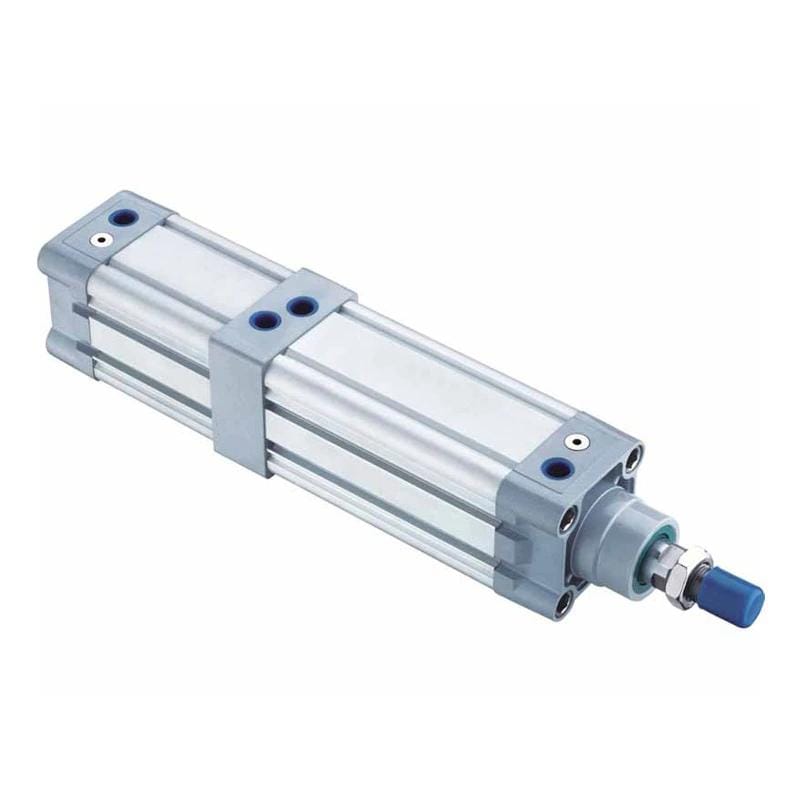
The clean formula is:
Force = pressure x effective area
F = P x A
Use consistent units:
| Pressure unit | Area unit | Force output |
|---|---|---|
| psi | in2 | lbf |
| bar | mm2 | N, after converting pressure to N/mm2 |
| MPa | mm2 | N |
| Pa | m2 | N |
For metric pneumatic work, the fastest conversion is:
1 bar = 0.1 N/mm2
6 bar = 0.6 N/mm2
Force (N) = pressure_bar x 0.1 x area_mm2
That one line prevents a common 10x error. If someone multiplies 6 x area_mm2, they used bar as if it were N/mm2. The correct multiplier at 6 bar is 0.6, not 6.
Extension Force
Extension force uses the full piston area:
A_piston = pi x bore^2 / 4
F_extend = pressure x A_piston
Example for a 63 mm bore at 6 bar:
A_piston = pi x 63^2 / 4 = 3,117 mm2
F_extend = 0.6 x 3,117 = 1,870 N
That is theoretical force. The usable design force should include friction, pressure drop, back pressure, acceleration, load direction, and margin.
Retraction Force
Retraction force on a single-rod double-acting cylinder uses annulus area:
A_rod = pi x rod^2 / 4
A_retract = A_piston - A_rod
F_retract = pressure x A_retract
For a 63 mm bore with a 20 mm rod:
A_rod = pi x 20^2 / 4 = 314 mm2
A_retract = 3,117 - 314 = 2,803 mm2
F_retract = 0.6 x 2,803 = 1,682 N
So why does retract force feel weaker? The rod occupies part of the pressure-acting piston face. At the same pressure, less area means less force. For a deep dive, use the dedicated guide on pneumatic cylinder rod area.
Safety Margin
AutomationDirect’s sizing page recommends designing calculated forces at least 25% above actual requirements, and its selection video uses a 25% increase for friction, pressure drop, and related factors (AutomationDirect video, 2026). That is a practical starting margin, not a substitute for risk review.
Use this first pass:
Required theoretical force = actual load force x 1.25
Required area = required theoretical force / working pressure
Then check the nearest standard bore. A force worksheet that stops before bore availability, mounting, speed, cushioning, and air supply is not finished.
Piston Area, Rod Area, and Unit Checks
Piston area is calculated from bore diameter, but standard cylinder selection also has dimensional limits. ISO 15552:2018 covers detachable-mounting pneumatic cylinders rated to 1,000 kPa, or 10 bar, with bores from 32 mm to 320 mm, and ISO confirmed the standard in 2025 (ISO, 2025).
The area formula is:
A = pi x D^2 / 4Where:
Ais piston area.Dis bore diameter.- Use diameter, not radius, in this version of the formula.
Here are useful bore checkpoints:
| Bore | Piston area | Force at 6 bar | Force at 100 psi |
|---|---|---|---|
| 32 mm | 804 mm2 | 482 N | 125 lbf, if using 1.26 in equivalent |
| 40 mm | 1,257 mm2 | 754 N | 195 lbf, if using 1.57 in equivalent |
| 50 mm | 1,963 mm2 | 1,178 N | 304 lbf, if using 1.97 in equivalent |
| 63 mm | 3,117 mm2 | 1,870 N | 483 lbf, if using 2.48 in equivalent |
| 80 mm | 5,027 mm2 | 3,016 N | 779 lbf, if using 3.15 in equivalent |
NIST lists 1 psi = 6,894.757 Pa, so imperial-to-metric conversions should go through pressure units before force comparisons (NIST, 2025). Don’t mix psi, bar, square inches, and square millimeters in one line without converting.
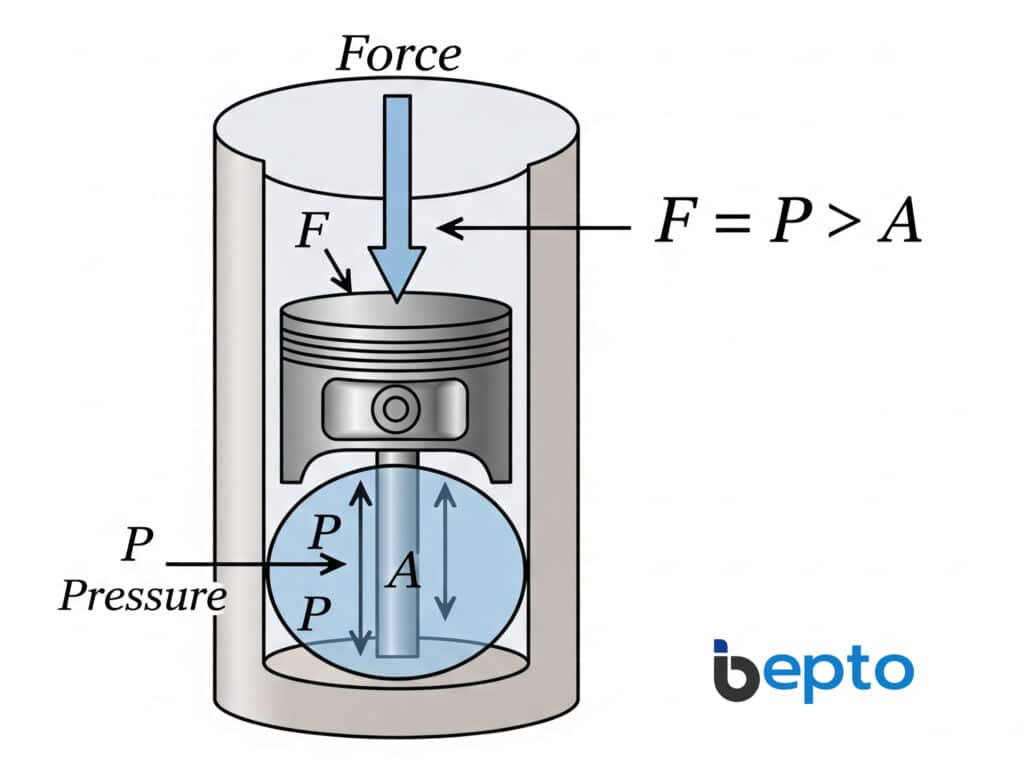
The Unit Trap
Use this checklist before trusting any formula result:
| Check | Correct method | Common error |
|---|---|---|
| Diameter vs radius | A = pi x D^2 / 4 |
Using diameter in pi x r^2 |
| Bar to N/mm2 | bar x 0.1 |
Multiplying area by bar directly |
| Retract area | piston area - rod area |
Using full piston area both ways |
| Gauge vs absolute | Force uses pressure differential | Using atmospheric pressure twice |
| Published bore | Match catalog bore | Measuring outside barrel diameter |
In our experience, the fastest way to catch a bad cylinder formula is to ask for the unit written after every number. “63 bore, 6 pressure, 18700 force” is not a calculation. “63 mm bore, 6 bar, 1,870 N theoretical extension force” is.
Formula Selection Table
Use the formula that matches the job:
| Question | Formula | Use this for |
|---|---|---|
| How much push force? | F_extend = P x A_piston |
Extension thrust |
| How much pull force? | F_retract = P x (A_piston - A_rod) |
Single-rod retraction |
| What bore size? | A = F / P, then D = sqrt(4A / pi) |
Initial cylinder sizing |
| What piston area? | A = pi x D^2 / 4 |
Force and speed checks |
| What rod area? | A_rod = pi x d_rod^2 / 4 |
Retract force and air volume |
| What outside surface? | 2 x pi x r x h + 2 x pi x r^2 |
Coating, cleaning, heat, not force |
If your question is about coating or heat exposure, use the surface-area calculation article. If your question is thrust, stay with piston area.
How Do You Calculate Cylinder Speed?
Cylinder speed is a flow problem, not only a pressure problem. SMC gives the practical pneumatic speed relation s = 28.8q / A, where s is inches per second, q is SCFM, and A is piston area in in2, while warning that ports and tubing also affect speed (SMC, 2026).
The simplified formula is:
Speed = flow rate / effective areaIn SMC’s imperial form:
s = 28.8q / AWhere:
s= piston speed in inches per second.q= airflow in SCFM.A= piston area in square inches.
Example:
q = 5 SCFM
A = 3.14 in2
s = 28.8 x 5 / 3.14 = 45.9 in/s
That result is theoretical. The actual speed depends on inlet pressure, load, exhaust restriction, valve Cv, tube length, fitting size, mufflers, cushioning, and meter-out adjustment.
Pressure Makes Force, Flow Makes Speed
This phrase is not perfect physics, but it is useful field language. Pressure sets available force. Flow sets how fast the chamber fills and exhausts.
If a cylinder has enough calculated force but moves slowly, start with the air path:
- Measure pressure at the cylinder port while moving.
- Check solenoid valve flow capacity.
- Check tube inside diameter and length.
- Check exhaust mufflers and silencers.
- Adjust flow-control valves on the exhaust side.
- Confirm the FRL unit and regulator can hold flow.
SMC notes that the common industry practice for actuator speed control is to control exhaust flow, often with a meter-out flow control or needle valve (SMC, 2026). That is why a speed complaint often belongs to the circuit, not only the cylinder.
Speed and Rod Area
Retract speed can be faster than extend speed on a single-rod cylinder because the retract-side volume is smaller. The rod reduces the active chamber volume on that side.
Use:
Extend speed = flow into cap end / piston area
Retract speed = flow into rod end / annulus area
Annulus area = piston area - rod area
That doesn’t mean retract always moves faster in the real machine. Valve flow, exhaust back pressure, load direction, and cushioning can reverse what the simple area math predicts.
Air Consumption and Compressor Sizing Formulas
Air consumption should include cylinder volume, piping volume, pressure, cycle rate, and compressor margin. SMC defines air consumption as the air used in the cylinder or piping each time the switching valve operates, and its example reaches 678 L/min ANR for 10 cylinders at 5 cycles/min (SMC, 2026).
Air consumption is the amount of free air a cylinder circuit uses per minute after chamber volume, pressure ratio, stroke count, and piping volume are converted back to atmospheric reference conditions.
AutomationDirect describes cylinder air consumption as a function of cylinder volume, cycle time, and inlet pressure, normally expressed as SCFM of free air (AutomationDirect, 2026). Festo’s calculator uses cylinder size, stroke length, and operating pressure as core inputs (Festo, 2026).
For a double-acting single-rod cylinder:
V_extend = A_piston x stroke
V_retract = (A_piston - A_rod) x stroke
V_cycle = V_extend + V_retract
For SCFM:
SCF_per_cycle = V_cycle_in3 x (P_gauge + 14.7) / (14.7 x 1728)
SCFM = SCF_per_cycle x cycles_per_minute
The 14.7 term converts gauge pressure to approximate absolute pressure in psi. The 1728 term converts cubic inches to cubic feet.
Example:
Bore = 2 in
Rod = 0.625 in
Stroke = 6 in
Pressure = 80 psi
Cycles = 30/min

A_piston = 3.14 in2
A_rod = 0.31 in2
A_retract = 2.83 in2
V_cycle = (3.14 + 2.83) x 6 = 35.82 in3
SCF/cycle = 35.82 x (80 + 14.7) / (14.7 x 1728) = 0.134 SCF
SCFM = 0.134 x 30 = 4.0 SCFM
That is cylinder chamber air only. Add valve-to-cylinder tube volume when the valve is mounted away from the actuator. AutomationDirect’s air-consumption page also calls out tubing consumption as potentially significant in some pneumatic projects (AutomationDirect, 2026).
Compressor Margin
SMC recommends selecting a compressor with generous capacity and gives a minimum reference of 1.4 times calculated air consumption, with more capacity as needed (SMC, 2026). That margin is helpful because real systems include leakage, temperature effects, simultaneous demand, tubing volume, and future equipment.
Use:
Minimum compressor capacity = total calculated demand x 1.4Then check plant conditions. The DOE sourcebook says leaks can waste 20-30% of compressor output in some industrial compressed-air systems, while proactive leak detection can reduce leakage to less than 5-10% of compressor output (DOE Sourcebook, 2016).
Air Use Decision Table
| Change | Force effect | Speed effect | Air consumption effect |
|---|---|---|---|
| Larger bore | Higher force | Slower at same flow | Higher per stroke |
| Longer stroke | No static force gain | Longer fill/exhaust time | Higher per cycle |
| Higher pressure | Higher force | Can improve response | Higher per cycle |
| Smaller tube | No theoretical force gain | Slower, more pressure drop | Can waste energy |
| More cycles/min | No force gain | Requires more flow | Higher SCFM |
| Rodless cylinder | No free force gain | Depends on carriage and flow | Depends on bore and stroke |
For long-stroke applications where rod extension space becomes the problem, compare a rodless cylinder instead of only increasing bore.
Which Formula Should You Use for Real Machine Selection?
Use the formula that answers the failure mode, then verify pressure at the actuator. CAGI says well-designed compressed-air systems usually have no more than 10% pressure drop between compressor discharge and point of use, while DOE warns poor leak control can waste 20-30% of air capacity (CAGI, 2026; DOE Sourcebook, 2016).
A pneumatic cylinder formula is a starting estimate. The final selection still needs the machine context:
| Selection question | Formula to start | What to verify next |
|---|---|---|
| Will it push the load? | F = P x A |
Dynamic pressure, friction, safety margin |
| Will it pull the load? | P x (A_piston - A_rod) |
Rod-side area, back pressure, load direction |
| Will it hit cycle time? | speed = flow / area |
Valve flow, tubing, exhaust, cushioning |
| Will the compressor keep up? | chamber volume x pressure ratio x cycles | Tube volume, leakage, simultaneous demand |
| Will it fit? | stroke plus mounting dimensions | ISO/NFPA style, bracket, sensors, ports |
| Will it last? | kinetic energy and load moment checks | Cushion, side load, guide, alignment |
RFQ Formula Worksheet
Send these values with a sizing or replacement request:
- Load force and motion direction.
- Bore, stroke, rod diameter, and cylinder type.
- Working pressure at the cylinder port during motion.
- Required extend and retract force.
- Required cycle time and target speed.
- Valve model, port size, tube inside diameter, and tube length.
- Cycle rate, duty cycle, and estimated SCFM or L/min ANR.
- Mounting style, guide load, side load, and cushion requirement.
- Environment: dust, washdown, heat, oil mist, or outdoor exposure.
- Photos of the old cylinder label, ports, rod, brackets, and sensors.
For product selection, start with a standard pneumatic cylinder when the stroke and rod extension fit the machine. Review the FRL unit, pressure regulator, solenoid valve, and polyurethane tubing before deciding the cylinder is wrong.
We’ve found that the best RFQs include two numbers many worksheets skip: moving pressure at the cylinder port and tube length from valve to port. Those numbers explain many “formula says yes, machine says no” failures.
When Advanced Formulas Matter
Use advanced formulas when the load moves fast, stops hard, or hangs vertically:
Acceleration force = mass x acceleration
Kinetic energy = 0.5 x mass x velocity^2
Power = force x velocity
Total required force = load + friction + acceleration + margin
For high speed, cushioning matters. For vertical axes, trapped air and loss-of-pressure behavior matter. For side load, a guide or rodless guided actuator may matter more than bore size.
For broader force-path troubleshooting, use the companion article on pneumatic cylinder power. For system theory, see pneumatic cylinder theory.
FAQ: Cylinder Formulas for Pneumatic Systems
These answers keep the main formulas separate: force uses pressure and effective area, speed uses flow and area, and air consumption uses volume, pressure ratio, and cycle rate. ISO 15552’s 10 bar cylinder scope and NIST’s psi conversion are useful guardrails for checking the numbers (ISO, 2025; NIST, 2025).
What is the basic cylinder force formula?
The basic cylinder force formula is F = P x A, where force equals working pressure times effective piston area. Use full piston area for extension. For single-rod retraction, subtract rod area from piston area before multiplying by pressure. At 6 bar, use 0.6 N/mm2.
How do you calculate pneumatic cylinder speed?
Use speed = flow / effective area as the first pass. SMC gives s = 28.8q / A for inches per second when q is SCFM and A is in2. Actual speed still depends on valve flow, tube size, exhaust restriction, load, and cushioning.
What is the cylinder area formula?
Piston area is A = pi x D^2 / 4, where D is bore diameter. Rod area uses the same formula with rod diameter. Retract effective area on a single-rod cylinder is piston area - rod area, which is why retract force is lower than extend force at equal pressure.
How do you calculate air consumption for a cylinder?
Calculate the extend chamber volume and retract chamber volume, multiply by the absolute-pressure ratio, then multiply by cycles per minute. For a double-acting single-rod cylinder, use (A_piston x stroke) + ((A_piston - A_rod) x stroke), then add tube volume when the valve is remote.
What safety factor should I use in cylinder calculations?
AutomationDirect recommends calculated forces at least 25% above the actual requirement, and its cylinder-selection video uses a 25% addition for friction, pressure drop, and related effects. Use more margin for vertical motion, variable loads, shock, poor air supply, worn equipment, or safety-related holding tasks.
Why does the calculated force not match the real machine?
The formula uses ideal effective pressure and area. Real machines lose usable force through pressure drop, leakage, seal friction, exhaust back pressure, side load, alignment error, and acceleration demand. CAGI’s 10% pressure-drop reference and DOE’s 20-30% leak warning explain why port-pressure measurement matters.
Sources
- AutomationDirect: Cylinder Sizing and Force, force formula, piston area examples, 4 inch bore at 100 psi, rod-side force note, and design margin. Retrieved 2026-06-04.
- AutomationDirect video: How to Select a Pneumatic Cylinder, 25% force allowance and bore-selection walkthrough. Retrieved 2026-06-04.
- ISO 15552:2018, 1,000 kPa (10 bar) standard-cylinder scope, 32 mm to 320 mm bore range, confirmed current in 2025. Retrieved 2026-06-04.
- NIST: Pressure and Gas Flow Unit Conversions, psi-to-pascal conversion table. Retrieved 2026-06-04.
- SMC: Control Air Flow of Cylinders, cylinder speed relation
s = 28.8q / Aand meter-out speed-control guidance. Retrieved 2026-06-04. - SMC Best Pneumatics: Air Cylinders Model Selection, cylinder air consumption, piping air volume, compressor sizing margin, and L/min ANR example. Retrieved 2026-06-04.
- AutomationDirect: Air Consumption, SCFM framing and cylinder/tubing air-consumption calculator context. Retrieved 2026-06-04.
- Festo: Air Consumption of Cylinders, air-consumption inputs including cylinder size, stroke length, and operating pressure. Retrieved 2026-06-04.
- CAGI: Technical Brief on Pressure Drop, 10% pressure-drop reference for well-designed compressed-air systems. Retrieved 2026-06-04.
- DOE: Improving Compressed Air System Performance, Sourcebook for Industry, leak-loss ranges and leak-management guidance. Retrieved 2026-06-04.