

Back pressure in a pneumatic system is exhaust-side pressure that resists air leaving a valve, cylinder, muffler, tube, or manifold. It matters because the trapped exhaust pressure pushes against the piston while supply pressure tries to move it. The result can be slower motion, weaker net force, heat, noise, unstable speed control, and false troubleshooting clues.
CAGI says a well-designed compressed-air system should keep pressure drop from compressor discharge to point of use within 10 percent. That is a system target, not a universal exhaust-port limit. For back pressure, the useful question is narrower: how much pressure remains on the exhaust side while the cylinder is moving?
Key Takeaways
- Back pressure is local exhaust-side resistance, while pressure drop is the broader pressure loss between two points.
- CAGI’s 10 percent pressure-drop target is useful context, but cylinder back pressure must be measured during motion.
- Check mufflers, meter-out valves, exhaust ports, tube ID, quick disconnects, and shared exhaust manifolds before changing compressor pressure.
The fastest diagnostic split is simple: if supply pressure is low at the actuator, solve pressure drop. If supply pressure is normal but the cylinder slows or weakens during exhaust, measure back pressure at the exhaust port.
What Is Back Pressure in a Pneumatic System?
Back pressure is pressure remaining on the exhaust side of a pneumatic component while air is trying to leave. In cylinder circuits, it is usually measured at the cylinder port, valve exhaust port, muffler inlet, or shared exhaust manifold. CAGI’s 10 percent system pressure-drop target gives a useful warning threshold for air-path restrictions, but the cylinder-specific answer comes from a dynamic exhaust-port reading (CAGI Pressure Drop Technical Brief, 2026).
Back pressure is not always bad. A controlled meter-out restriction can make a vertical or variable-load cylinder move more smoothly. The problem starts when the exhaust pressure is accidental, excessive, or unmeasured. A clogged silencer, small valve exhaust port, or long exhaust tube can make the cylinder fight its own trapped air.
In our experience, many slow-cylinder complaints start with the wrong question: “Is the compressor pressure high enough?” A better first question is: “What pressure is on both cylinder ports while the load is actually moving?”
How Is Back Pressure Different From Pressure Drop?
Pressure drop is the loss between two points while air flows through resistance. Back pressure is one specific form of that problem: pressure left on the exhaust side. CAGI’s pressure-drop brief names piping, fittings, filters, dryers, and components as common loss points, but this article stays narrower and focuses on the cylinder and valve exhaust path (CAGI Pressure Drop Technical Brief, 2026).
| Term | Where it is measured | What it usually means | Typical fix path |
|---|---|---|---|
| Supply pressure | Regulator outlet, valve inlet, cylinder supply port | Available pressure feeding the working chamber | Check regulator, FRL, supply tube, valve Cv |
| Pressure drop | Difference between two points during flow | Any air-path loss under demand | Find the largest upstream or downstream loss |
| Back pressure | Exhaust port, muffler inlet, return manifold, trapped chamber | Exhaust air cannot leave fast enough | Check mufflers, meter-out valves, exhaust ports, tube ID |
| Residual pressure | Cylinder chamber after venting should be complete | Air remains trapped after the valve shifts | Check valve function, silencer, blocked exhaust, timing |
Residual pressure is pressure left in a chamber after the valve should have vented it. It becomes a troubleshooting clue when a cylinder stops, waits, or restarts with trapped air still present.
For the broader plant-air diagnosis, use the separate guide on what causes pressure drop in pneumatic systems. This article should not repeat that full system workflow. It answers the narrower exhaust-side problem.
Where Does Exhaust Back Pressure Come From?
Most exhaust back pressure comes from parts that look harmless after installation: mufflers, silencers, speed-control needles, undersized push-in fittings, small exhaust ports, long tubes, quick disconnects, and shared manifolds. CAGI also recommends keeping compressed-air velocity in piping near 20 ft/s or lower for good distribution design, which explains why small passages become trouble when flow rises (CAGI Pressure Drop Technical Brief, 2026).
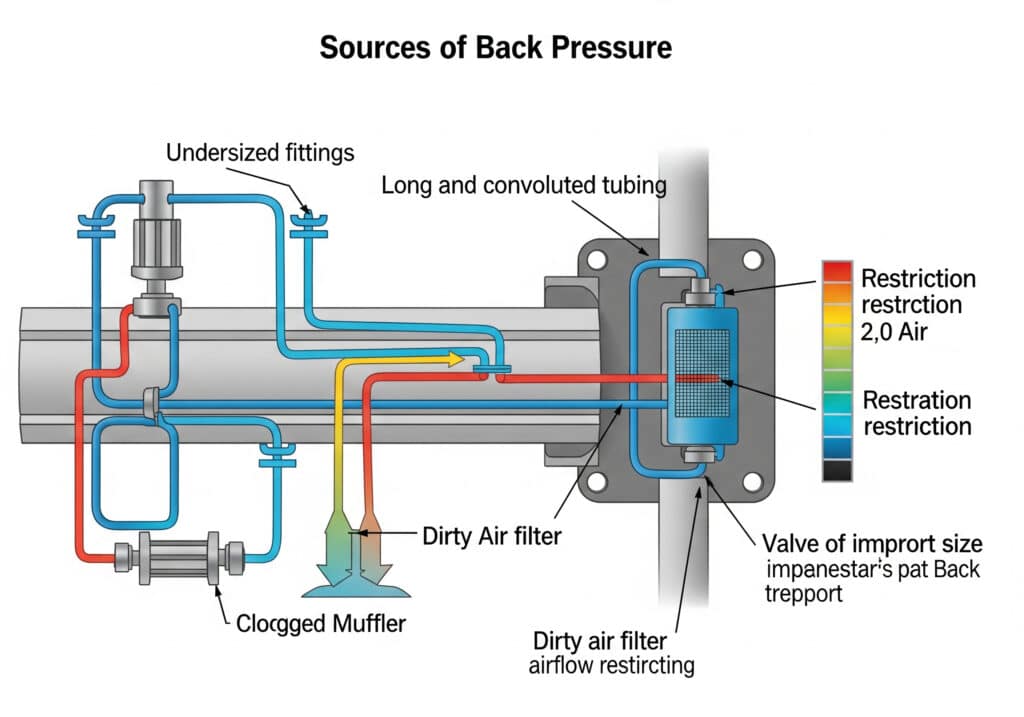
| Source | Why it creates back pressure | Field symptom |
|---|---|---|
| Clogged muffler or silencer | Exhaust area shrinks as debris, oil, or water collects | Stroke slows after weeks of operation |
| Meter-out valve closed too far | Needle restriction traps exhaust air | Stable but weak or sluggish motion |
| Small valve exhaust port | Valve cannot release peak chamber flow fast enough | Good bench test, slow production cycle |
| Long exhaust tube | Friction loss rises with length and bends | Remote exhaust station slows retraction |
| Shared exhaust manifold | Several cylinders exhaust into the same path | One actuator changes speed when another runs |
| Quick disconnect or reducer | Local opening is smaller than the tube | High hiss, heat, or sudden speed limit |
From what we’ve seen in replacement reviews, mufflers are the easiest part to miss because the machine may still move. The clue is timing drift: speed looks acceptable after cleaning, then gets worse as contamination builds again.
For flow-control direction, use the related article on meter-in vs meter-out pneumatic control. Meter-out deliberately creates exhaust resistance. This article explains when that resistance becomes too much.
How Does Back Pressure Reduce Cylinder Speed and Force?
SMC states cylinder speed depends on airflow and piston area, using the relation s = 28.8q / A. Back pressure reduces the usable exhaust flow, so the chamber empties more slowly. It can also subtract from net cylinder force because trapped exhaust pressure pushes against the piston while supply pressure pushes the other way (SMC Control Air Flow of Cylinders, 2026).
The force penalty is easy to miss. A double-acting cylinder does not only “see” the supply pressure. During motion, it also sees whatever pressure is trapped in the opposite chamber.
Extension net force, simplified:
Fnet = Psupply x piston area - Pback x rod-side area - friction

Retraction net force, simplified:
Fnet = Psupply x rod-side area - Pback x piston area - friction
That second line is why retraction problems often show up first. During retraction, the cap-end air must leave. If the exhaust path is restricted, the trapped cap-end pressure acts across the full piston area and fights the smaller rod-side driving area.
For example, a horizontal slide with generous force margin may only slow down when exhaust is restricted. A vertical lift with little reserve can stall because the same back pressure subtracts from usable force during the return stroke.
Do not read this as a reason to remove every exhaust restriction. Meter-out control can be useful. The goal is controlled exhaust pressure, not zero resistance at any cost.
How Do You Measure Back Pressure at a Cylinder or Valve?
Measure back pressure dynamically, not at rest. CAGI identifies filter differential pressure of 5 to 7 psig as a practical service signal, and the same field logic applies here: a small gauge reading at rest can hide a large restriction during the high-flow part of the stroke (CAGI Pressure Drop Technical Brief, 2026).
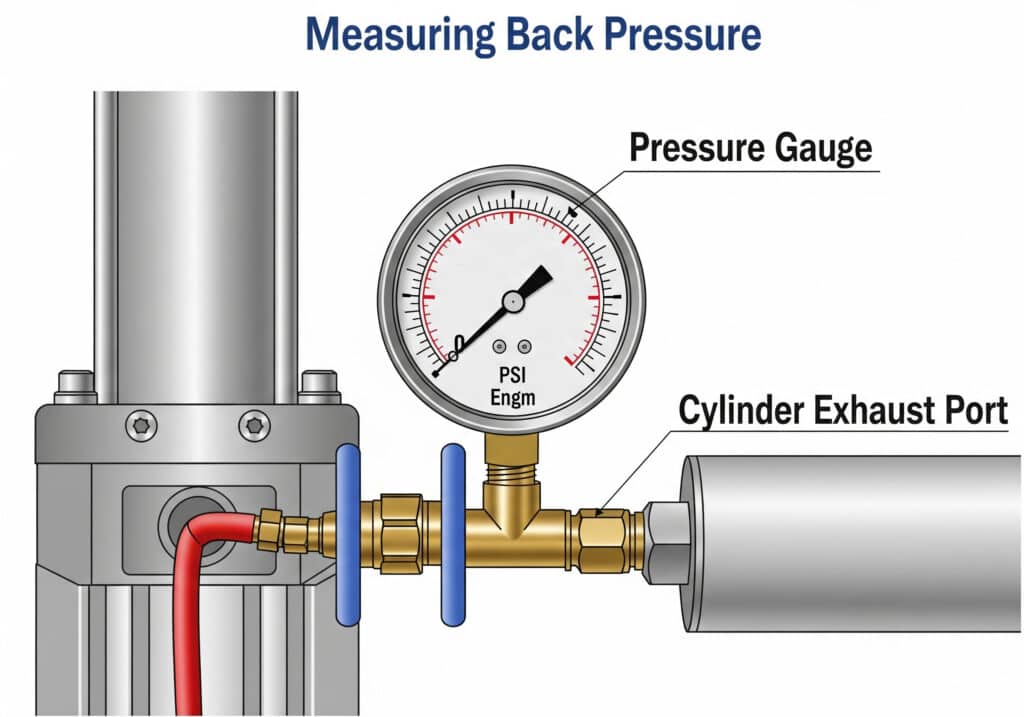
Use two sensors if you can. One sensor should read the working chamber pressure. The other should read the exhaust chamber or exhaust path pressure. Cycle the machine at the speed, load, and timing that causes the complaint.
For instance, a cylinder can pass a static leak check and still show a pressure spike at the muffler inlet during the first half of the return stroke. That spike is the data you need.
| Measurement point | What it tells you | If pressure is high |
|---|---|---|
| Cylinder exhaust port | Whether the cylinder is fighting trapped air | Check speed control, fitting, hose, port adapter |
| Valve exhaust port | Whether the valve is the restriction | Check valve Cv, exhaust port, spool condition |
| Muffler inlet | Whether the silencer is loaded or undersized | Remove briefly for test, then replace with correct part |
| Shared exhaust manifold | Whether other actuators are interfering | Separate lines or oversize manifold |
| Upstream and downstream of a quick disconnect | Whether the connector is the bottleneck | Use high-flow connector or remove needless coupling |
What should the number be? It depends on force margin, cylinder bore, load direction, and speed target. A small amount of meter-out back pressure may stabilize a vertical stroke. The same pressure can be too much if the actuator is already near its load limit.
How Do You Calculate Whether Exhaust Back Pressure Is the Real Problem?
Calculate back-pressure risk from flow demand, line length, equivalent fitting length, internal diameter, valve Cv, muffler data, and the force margin of the actuator. ISO 6358-1 defines steady-state flow-rate characteristics for pneumatic components, so manufacturer flow curves and measured pressure differences are better than guessing from port thread size alone (ISO 6358-1, 2013).
Start with the air path:
- Estimate the free-air flow needed for the target stroke time.
- Convert that flow to the actual pressure and units used by the datasheet.
- Check tube or hose internal diameter, not only outside diameter.
- Add equivalent length for elbows, quick disconnects, manifolds, and mufflers.
- Compare valve Cv and muffler flow data against peak exhaust flow.
- Calculate the remaining cylinder force with measured back pressure included.
If tube sizing is the suspected issue, keep the pressure-drop calculation near the measurement data. A long small exhaust line to a remote muffler can look clean in a diagram and still create a slow return stroke.
How Can You Reduce Back Pressure Without Making Motion Unstable?
Reduce accidental restriction first, then retune deliberate speed control. AutomationDirect notes that two flow controls on a double-acting cylinder can adjust extension and retraction independently; that is useful only after mufflers, valve exhaust ports, fittings, and tubes are sized for the required flow (AutomationDirect Cylinder FAQ, 2026).
Use this order:
- Clean or replace mufflers: A loaded silencer is the fastest test and the easiest miss.
- Confirm flow-control direction: A reversed one-way flow control can restrict the wrong side.
- Open the meter-out needle carefully: Check speed and force together, not speed alone.
- Shorten exhaust routing: Long remote exhaust tubes add friction and delay.
- Increase tube or hose ID: Check internal diameter, not just outside diameter.
- Resize low-Cv valves or manifolds: Port thread size does not prove flow capacity.
- Separate shared exhaust paths: One cylinder should not pressurize another cylinder’s exhaust route.
- Retune cushions and speed controls: Do this after the air path is fixed.
Do not simply remove every muffler. Exhaust noise, oil mist, dust movement, and operator exposure matter. The practical answer is to use the correct muffler and flow path, then tune speed controls with pressure gauges installed.
For broader operating-cost work, use pneumatic energy efficiency guidance. DOE’s compressed-air systems page groups assessment tools, tip sheets, case studies, and the Sourcebook for Industry under system-performance improvement resources, but that energy work is separate from exhaust back-pressure tuning (DOE Compressed Air Systems, 2026).
What Should You Send for a Back Pressure RFQ or Troubleshooting Review?
A useful RFQ needs measured pressure during motion, not only component photos. Include supply pressure, exhaust-port pressure, valve model, muffler model, tube ID, tube length, fittings, flow controls, cylinder bore, rod diameter, stroke, load, orientation, and target cycle time. CAGI’s 10 percent pressure-drop target gives a plant-air reference, but the exhaust path needs local data (CAGI Pressure Drop Technical Brief, 2026).
Send this checklist:
| Data point | Why it matters |
|---|---|
| Cylinder bore, rod diameter, and stroke | Sets chamber volume and force margin |
| Motion direction and load orientation | Shows whether gravity can overrun the stroke |
| Supply pressure during motion | Confirms the working chamber is being fed |
| Exhaust-side pressure during motion | Confirms whether back pressure is fighting the stroke |
| Valve model and port size | Checks flow capacity and exhaust route |
| Muffler or silencer model | Finds clogging or undersized exhaust parts |
| Tube ID, length, and fittings | Captures the real exhaust path |
| Flow-control type and direction | Separates deliberate meter-out control from accidental restriction |
For replacement or engineering support, include photos of the cylinder ports, valve station, mufflers, speed controls, and tube routing when you contact Bepto Pneumatic. If the issue involves a long transfer axis, also review rodless cylinder options and the article on how a rodless air slide works.
FAQs About Back Pressure in Pneumatic Systems
What is considered excessive back pressure in a pneumatic system?
Excessive back pressure is any exhaust-side pressure that prevents the actuator from meeting force, speed, or repeatability requirements. There is no universal psi limit for every cylinder. Compare the measured exhaust pressure with load margin, bore area, rod area, speed target, and whether the restriction is deliberate meter-out control or accidental blockage.
Is back pressure always bad?
No. Deliberate meter-out back pressure can stabilize motion when the load changes or tries to overrun the cylinder. It becomes a problem when it is accidental, too high for the available force margin, caused by a clogged muffler, or hidden in a shared exhaust path that changes with other machine motions.
Why is my cylinder slower on retraction than extension?
Retraction can be more sensitive because the driving area is smaller on the rod side, while exhaust from the cap end may act across the full piston area if it is trapped. Check rod-side supply pressure, cap-end exhaust pressure, meter-out valve direction, muffler condition, and valve exhaust capacity during the actual return stroke.
Can a muffler cause back pressure?
Yes. A muffler can become a restriction if it is clogged, oil-soaked, water-loaded, too small, or used on a high-flow exhaust path. Test carefully by measuring pressure at the muffler inlet during the fault cycle. Do not leave the system without proper noise and exhaust control after the test.
Should I raise compressor pressure to overcome back pressure?
Not first. Raising compressor pressure can hide a local exhaust restriction and increase plant air cost. Measure both cylinder ports during motion, clean or resize the exhaust restriction, confirm valve and muffler flow capacity, then reset the regulator to the lowest pressure that still gives reliable motion.
How do I tell back pressure from a supply pressure problem?
Use two gauges or pressure sensors during the fault. If supply pressure falls before the valve or at the working chamber, diagnose pressure drop. If supply pressure is acceptable but the opposite chamber or exhaust port stays pressurized while the cylinder moves, diagnose back pressure.
External Technical References
These fact-check references support the technical framing in this article. They do not replace the cylinder, valve, muffler, or tubing supplier’s own flow curves and operating limits.
- CAGI Pressure Drop Technical Brief: Supports the 10 percent system pressure-drop target, 20 ft/s velocity guidance, and 5 to 7 psig filter differential-pressure service signal. Retrieved 2026-07-08.
- DOE Compressed Air Systems: Lists compressed-air assessment tools, tip sheets, case studies, training, and technical publications for system-performance work. Retrieved 2026-07-08.
- SMC Control Air Flow of Cylinders: Supports the cylinder-speed relation
s = 28.8q / Aand exhaust-side flow-control context. Retrieved 2026-07-08. - AutomationDirect Cylinder FAQ: Supports double-acting cylinder speed-control context using flow controls. Retrieved 2026-07-08.
- ISO 6358-1: Supports the use of component flow-rate characteristics when checking pneumatic valve and component restrictions. Retrieved 2026-07-08.