

Pneumatic mufflers reduce the sharp noise created when compressed air leaves a valve exhaust port. They do this by expanding the air, spreading the discharge through porous media or chambers, and lowering the sound energy before the exhaust reaches the operator’s ear.
The important part is sizing. A muffler that is too restrictive can quiet the machine while slowing the cylinder. A muffler that is too open can protect cycle time but leave noise above the plant’s target. The right choice balances measured dBA, valve exhaust flow, acceptable back pressure, contamination, and maintenance access.
Pneumatic muffler is the exhaust-port device that reduces compressed-air discharge noise while still passing the air volume needed for cylinder motion. Back pressure is residual pressure on the exhaust side that can slow or destabilize a pneumatic actuator. Exhaust flow is the air leaving the venting chamber through the valve, speed controller, and muffler.
Key Takeaways
- OSHA requires a hearing conservation program at an 85 dBA 8-hour TWA action level and lists 90 dBA as the 8-hour permissible exposure level.
- NIOSH recommends keeping 8-hour average worker exposure below 85 dBA and halves exposure time for each 3 dBA increase.
- Size a pneumatic muffler from exhaust flow and measured noise, then verify cylinder speed after installation.
The muffler is part of the exhaust circuit, not a decorative accessory. If a cylinder is slow in one direction, the exhaust muffler on the opposite chamber can be the bottleneck.
How Do Pneumatic Mufflers Reduce Exhaust Noise?
Pneumatic mufflers reduce exhaust noise by slowing and spreading the compressed-air discharge before it reaches open air. OSHA says decibels use a logarithmic scale, so small numerical changes can mean large changes in noise energy and hearing risk (OSHA Occupational Noise Exposure, 2026).
When a directional valve shifts, one cylinder chamber fills and the opposite chamber exhausts. The exhaust side can release a short, high-velocity pulse. That pulse creates broadband noise, especially when air leaves a small port directly into the room.
A pneumatic muffler changes that release in three ways:
- It gives the air a larger internal volume to expand into.
- It breaks the exhaust into many smaller paths through porous bronze, plastic, mesh, or chambers.
- It reduces the line-of-sight path from the pressure pulse to the surrounding air.
That is why the same part is often called a pneumatic silencer, exhaust muffler, air muffler, or valve silencer. The job is the same: lower the exhaust sound while letting the actuator breathe.
In our experience, the first useful test is simple. Run the machine at its normal cycle rate, measure noise at the operator position, then compare cylinder speed before and after the muffler change. A quiet but slow machine is still a sizing problem.
What Parts Inside a Pneumatic Muffler Do the Work?
A muffler’s working parts are the threaded inlet, expansion volume, porous or baffled flow path, and outlet surface area. NIOSH recommends controlling 8-hour average noise exposure below 85 dBA, so the internal design has to reduce the exhaust pulse without making the valve path unusable (NIOSH, 2024).
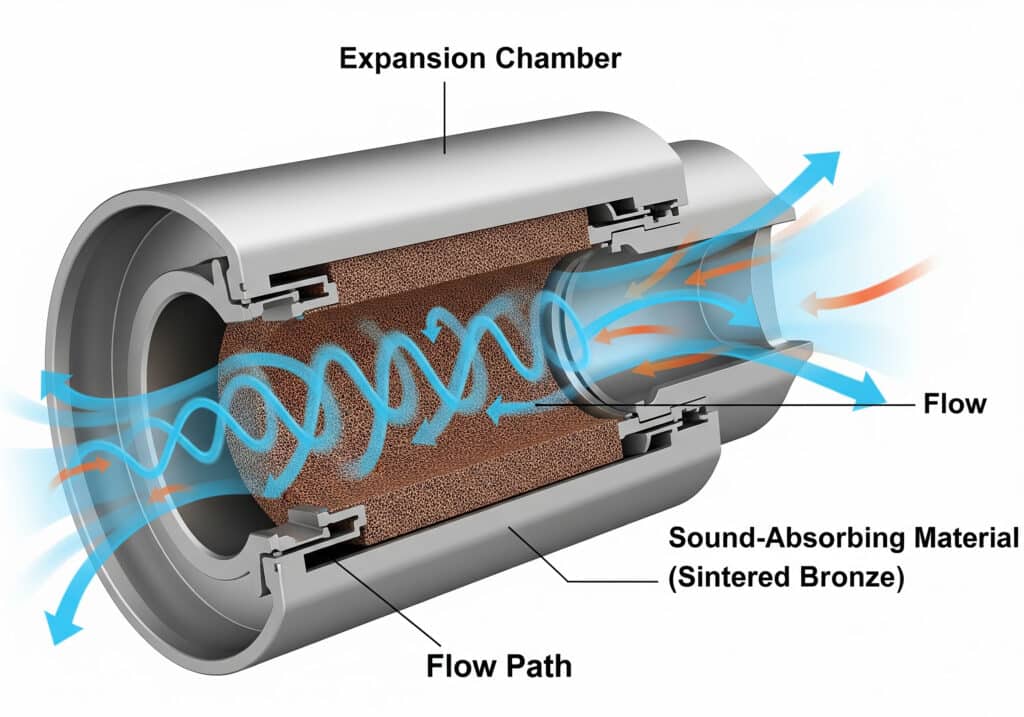
Most compact pneumatic mufflers use one of these approaches:
| Design feature | What it does | What to watch |
|---|---|---|
| Expansion volume | Lets compressed air expand before leaving the port | Larger bodies may need more space around the valve |
| Sintered bronze or porous plastic | Splits the exhaust pulse into many tiny paths | Oil, water, and dust can clog the pores |
| Multi-hole diffuser | Spreads discharge over more outlet area | Must be protected from impact and contamination |
| Exhaust cleaner element | Combines noise reduction with oil mist capture | Requires maintenance and pressure-drop checks |
| Adjustable needle or speed muffler | Adds exhaust flow control at the port | Can create too much back pressure if overtightened |
The material choice matters less than the installed result. A bronze element is useful on a rugged machine. A plastic silencer may be fine in a clean panel. An exhaust cleaner is better when oil mist is the concern. What matters is the measured noise reduction and the remaining flow capacity.
Why Does Muffler Sizing Affect Cylinder Speed and Back Pressure?
Muffler sizing affects speed because cylinder speed depends on airflow. SMC gives the relation s = 28.8q / A, where speed depends on SCFM and piston area, and notes that exhaust-side flow control is common for pneumatic actuators (SMC, 2026).
The supply side fills one chamber. The exhaust side must empty the other chamber. If the exhaust muffler is undersized, clogged, or over-adjusted, pressure remains in the chamber that should be venting. That is back pressure.
Back pressure can be useful in controlled amounts. Meter-out control uses exhaust restriction to stabilize motion. But accidental back pressure is different. It steals force differential, slows the stroke, creates uneven motion, and can make a rodless cylinder miss its sensor window.
Use this check before choosing a muffler:
| Question | Why it matters |
|---|---|
| What cylinder bore and stroke are exhausting? | Larger volume needs more exhaust flow |
| What stroke time is required? | Shorter time means higher peak flow |
| Is the muffler on EA, EB, or a shared exhaust manifold? | Each direction may behave differently |
| Is there a meter-out speed controller already installed? | Stacking restrictions can hide the real bottleneck |
| Is the air oily, wet, dusty, or clean? | Contamination changes maintenance interval |
| Can you measure noise and stroke time after installation? | Selection without verification is only a guess |
For valve-port context, use the 4-way 5-port valve guide. For a deeper explanation of local pressure loss, use the pressure drop troubleshooting guide.
Which Pneumatic Muffler Type Should You Choose?
Choose the muffler type from measured noise, exhaust flow, contamination, and maintenance access, not from thread size alone. OSHA Table G-16 lists 90 dBA for 8 hours and 100 dBA for 2 hours, while OSHA’s hearing conservation action level starts at 85 dBA 8-hour TWA (OSHA 1910.95, 2026).
The table below is a practical selection map. Treat it as a first pass, then verify with noise and cycle-time measurements.
| Muffler style | Best fit | Main risk |
|---|---|---|
| Compact sintered muffler | Valve exhaust ports in general machinery | Pores can clog in oily or dusty service |
| Plastic porous silencer | Clean panels, light-duty equipment, low weight | Heat and impact resistance may be limited |
| High-flow diffuser | Fast cylinders or large exhaust volume | May not reduce noise enough alone |
| Exhaust cleaner | Oil mist plus noise concern | Element service and pressure drop |
| Speed-control muffler | Simple local exhaust tuning | Easy to overtighten and slow the actuator |
The old habit is to match NPT or BSP thread and stop there. That is not enough. A 1/4 inch port can feed a slow, small cylinder or a fast, high-cycle actuator. The thread is only the connection. The flow path decides whether the machine still performs.
The safest replacement rule is this: if the machine became slow after the muffler changed, do not blame the cylinder first. Compare the old and new exhaust flow path, then check whether the new part added filtration, needle control, or smaller outlet area.
How Should You Install and Maintain Pneumatic Mufflers?
Install mufflers as close to the exhaust port as practical and check them as flow components during maintenance. CAGI says well-designed compressed air systems usually stay within 10% pressure drop from compressor to point of use and warns against raising pressure before fixing restrictions (CAGI, 2026).
Use these installation rules:
- Mount the muffler directly on the exhaust port when space allows.
- Avoid elbows, adapters, and small tube stubs that become extra restrictions.
- Protect the muffler from impact, coolant, chips, washdown, or blocked airflow.
- Keep enough clearance so exhaust can leave the outlet surface.
- Label EA and EB mufflers separately when each direction has its own exhaust path.
- Measure stroke time after installation, not only sound level.
Maintenance is not complicated, but it needs a trigger. If noise rises, the muffler may be damaged or missing. If the cylinder slows, the muffler may be clogged or too restrictive. If oil mist appears, the exhaust path may need an exhaust cleaner or upstream lubrication review.
| Maintenance check | What to record | Action if abnormal |
|---|---|---|
| Noise at operator position | dBA during normal cycle | Replace damaged or missing muffler |
| Stroke time by direction | Extend and retract time | Inspect the opposite exhaust path |
| Visual condition | Dirt, oil, broken body, impact marks | Clean or replace |
| Valve-port pressure behavior | Residual pressure on exhaust side | Check muffler, meter-out valve, and tubing |
| Air quality at exhaust | Oil mist, water, debris | Review FRL, lubrication, and exhaust cleaner |
For related exhaust tuning, read the meter-in vs meter-out flow control guide. For pressure setpoint context, use the working pressure guide.
When Should You Replace a Pneumatic Muffler Instead of Cleaning It?
Replace the muffler when cleaning does not restore both noise control and actuator speed. CAGI identifies friction and resistance in fittings, filters, dryers, and other components as pressure-drop causes, and the same logic applies to clogged exhaust parts in the local valve circuit (CAGI, 2026).
Cleaning makes sense when the element is lightly contaminated and the manufacturer allows it. Replacement is better when the body is cracked, the threads are damaged, the porous element is oil-soaked, the machine is safety-critical, or the same muffler keeps clogging.
Here is the practical decision path:
| Symptom | Clean first? | Replace first? |
|---|---|---|
| Light dust on outer surface | Yes | No |
| Oil-soaked sintered element | Sometimes | Often |
| Broken plastic body | No | Yes |
| Damaged thread or loose fit | No | Yes |
| Noise increases after impact | No | Yes |
| One direction slows repeatedly | Maybe | Yes, if cleaning does not restore speed |
| Oil mist at exhaust | No, review exhaust cleaner | Usually |
Do not remove the muffler permanently to “fix” speed. That only transfers the problem to the operator and the noise survey. If removing the muffler restores cycle time, the correct next step is a higher-flow muffler, exhaust cleaner review, or a different meter-out setting.
What Data Should You Send for a Muffler RFQ?
A useful muffler RFQ should include thread, valve port, cylinder bore, stroke, target stroke time, working pressure, measured noise, air quality, and contamination. SMC links cylinder speed to SCFM and piston area, so geometry and timing are more useful than a photo alone (SMC, 2026).
Send this data when asking for a replacement or review:
| RFQ item | Example | Why it matters |
|---|---|---|
| Exhaust port thread | NPT 1/4, BSPP G1/4, M5 | Connection fit |
| Valve function | EA, EB, shared exhaust manifold | Direction-specific diagnosis |
| Cylinder type | rodless cylinder, guided cylinder, clamp | Exhaust volume and speed behavior |
| Bore and stroke | 32 mm x 800 mm | Flow estimate |
| Target stroke time | 0.8 seconds extend, 1.0 seconds retract | Peak flow demand |
| Working pressure | 6 bar, 90 psi | Flow and force context |
| Measured noise | 92 dBA at operator station | Noise reduction target |
| Air condition | dry, oily, wet, dusty | Material and maintenance choice |
| Current symptom | loud exhaust, slow retract, oil mist | Selection priority |
For small accessory orders, include a product-family link such as pneumatic fittings or the NPT sintered bronze pneumatic muffler silencer. For a circuit-level issue, include the valve, tube ID, flow control, and cylinder data so the exhaust path can be reviewed as a system.
Conclusion
Pneumatic mufflers are critical because OSHA’s 85 dBA action level and NIOSH’s 85 dBA recommended exposure limit make exhaust noise a measurable workplace risk, while SMC’s airflow relation shows why the same part can affect cylinder speed (OSHA 1910.95, 2026; NIOSH, 2024; SMC, 2026).
Choose the muffler after measuring noise and estimating exhaust flow. Install it where it protects the operator without choking the valve. Then verify both dBA and stroke time. That is the difference between a quiet machine and a correct pneumatic circuit.
FAQs About Pneumatic Mufflers
How much noise reduction can a pneumatic muffler provide?
Noise reduction depends on the muffler design, exhaust flow, valve port, and installation. Do not assume a fixed 15 dB or 30 dB value without a datasheet and test condition. OSHA uses 85 dBA as the hearing conservation action level and 90 dBA as the 8-hour PEL, so measure before and after installation.
Can a pneumatic muffler slow down a cylinder?
Yes. SMC states that cylinder speed depends on airflow, and exhaust-side restriction changes back pressure. A correctly sized muffler should preserve the required stroke time. An undersized, clogged, or over-adjusted muffler can slow one direction, especially on long-stroke rodless cylinders and fast valve circuits.
Should I remove a muffler if the cylinder runs faster without it?
No. Removing the muffler may restore exhaust flow, but it also restores exhaust noise at the operator position. Use that test only as a diagnosis. If the cylinder speeds up without the muffler, choose a higher-flow muffler, clean the element, or review the meter-out setting.
Are pneumatic mufflers and pneumatic silencers the same thing?
In most pneumatic catalogs, yes. Muffler, silencer, exhaust silencer, and air muffler usually refer to a device installed on a valve or actuator exhaust port to reduce discharge noise. Some exhaust cleaners also capture oil mist, so confirm whether the part is only a silencer or a combined cleaner.
How often should pneumatic mufflers be inspected?
Inspect mufflers during normal preventive maintenance and whenever noise or stroke time changes. CAGI recommends correcting pressure-drop restrictions before raising compressor pressure; a clogged muffler is one local restriction to check. Dirty, oily, wet, or dusty environments need more frequent inspection than clean control panels.
What is the best muffler for a rodless cylinder?
The best muffler is the one that meets the noise target while passing the required exhaust flow for the bore, stroke, pressure, and target stroke time. Rodless cylinders often use long strokes, so check both directions separately and verify the muffler on the opposite chamber exhaust path.
Sources and Retrieval Notes
- OSHA 1910.95 Occupational noise exposure, official U.S. regulation for permissible noise exposures, action level, monitoring, and hearing conservation. Retrieved 2026-07-08.
- OSHA Occupational Noise Exposure overview, official OSHA overview explaining decibels, 85 dBA risk context, and noise-control methods. Retrieved 2026-07-08.
- NIOSH Noise-Induced Hearing Loss, official CDC/NIOSH page stating the 85 dBA recommended exposure limit and 3 dBA exchange rate. Retrieved 2026-07-08.
- CAGI Pressure Drop Technical Brief, compressed-air pressure-drop guidance including 10% system-drop target and maintenance triggers. Retrieved 2026-07-08.
- SMC Control Air Flow of Cylinders, manufacturer guidance linking cylinder speed to airflow and exhaust-side flow control. Retrieved 2026-07-08.
- SMC Silencers and Exhaust Cleaners, manufacturer product-family reference for pneumatic silencers and exhaust cleaners. Retrieved 2026-07-08.
- AutomationDirect video: Understanding Pneumatic Valve Ports and Ways, visual supplement for valve supply, work, and exhaust port layout. Retrieved 2026-07-08.