

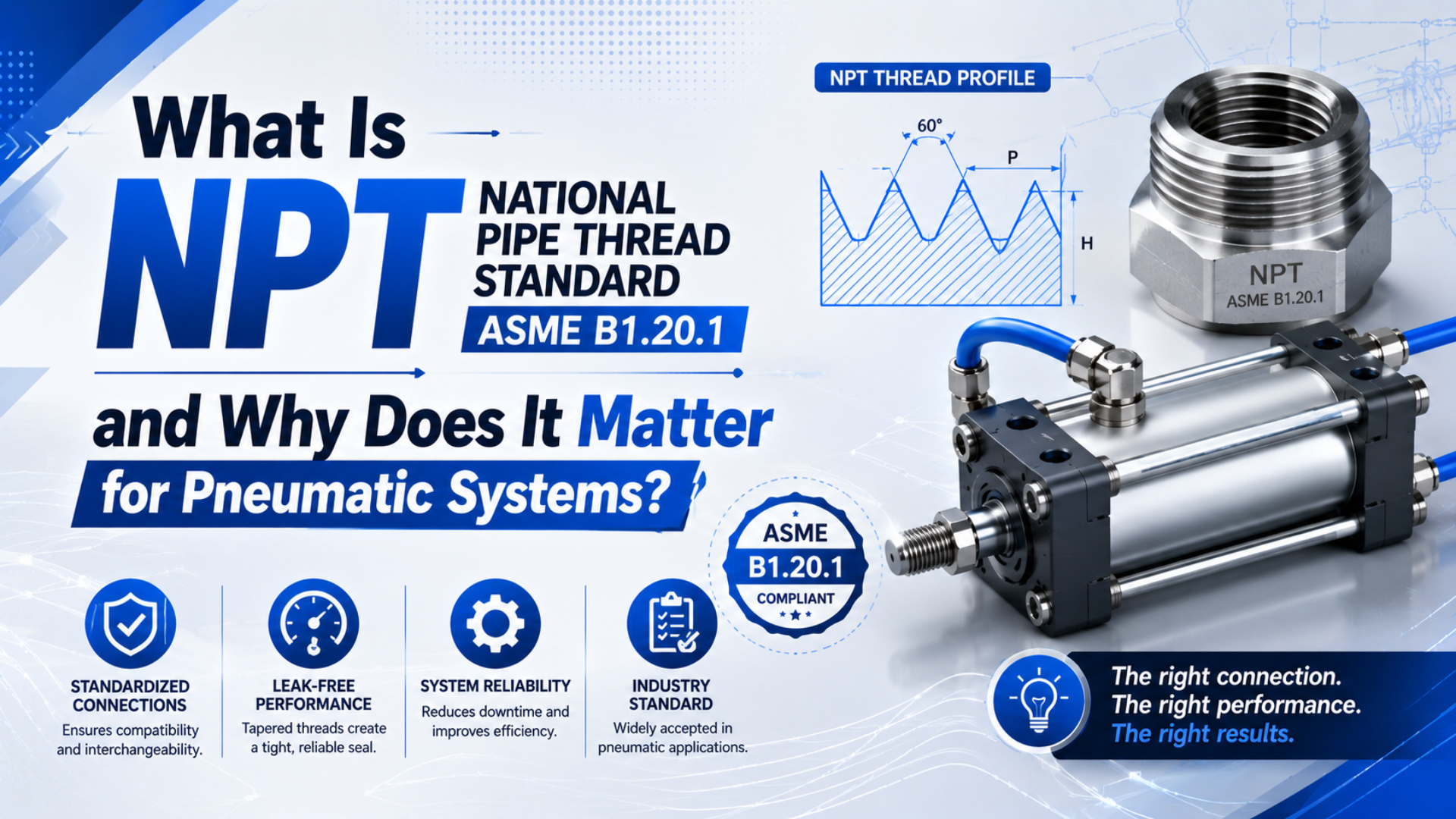
NPT is the tapered inch pipe thread most North American pneumatic teams meet on cylinder ports, manifolds, regulators, silencers, and adapter fittings. ASME says B1.20.1 covers dimensions and gaging for NPT, NPSC, NPTR, NPSM, and NPSL pipe threads (ASME B1.20.1, 2013). In a compressed-air system, that standard matters because a thread that screws in can still leak if the taper, pitch, sealant, or mating standard is wrong.
Key Takeaways
- ASME B1.20.1 defines the inch pipe-thread family that includes NPT, and common shop tables list 1/8“ NPT at 27 TPI and 1/4“ NPT at 18 TPI (ITEX, 2026).
- NPT seals by tapered thread interference plus sealant, not by thread torque alone.
- BSPT, BSPP, NPT, and NPTF can look close enough to fool a hurried technician.
The practical risk is not that engineers ignore standards. It’s that a pneumatic fitting can feel “almost right” for two or three turns. That almost-right fit is where cross-threading, cracked ports, and slow air loss begin.
How Does NPT Threading Work in Pneumatic Applications?
NPT works because its thread diameter changes at a 1:16 taper, equal to 3/4 inch per foot, while the thread form uses a 60 degree angle (ToolGrit, 2026). When a male fitting enters a female port, the flanks wedge together and create the interference needed for a pressure joint.
That wedging action is useful, but it is not magic. Standard NPT leaves small spiral leak paths between thread roots and crests, so sealant normally has to fill the remaining gaps. In our experience, the mistake most teams make is treating NPT like a straight bolt. They tighten harder when the better fix is usually cleaner threads, the right sealant, and a verified mating standard.
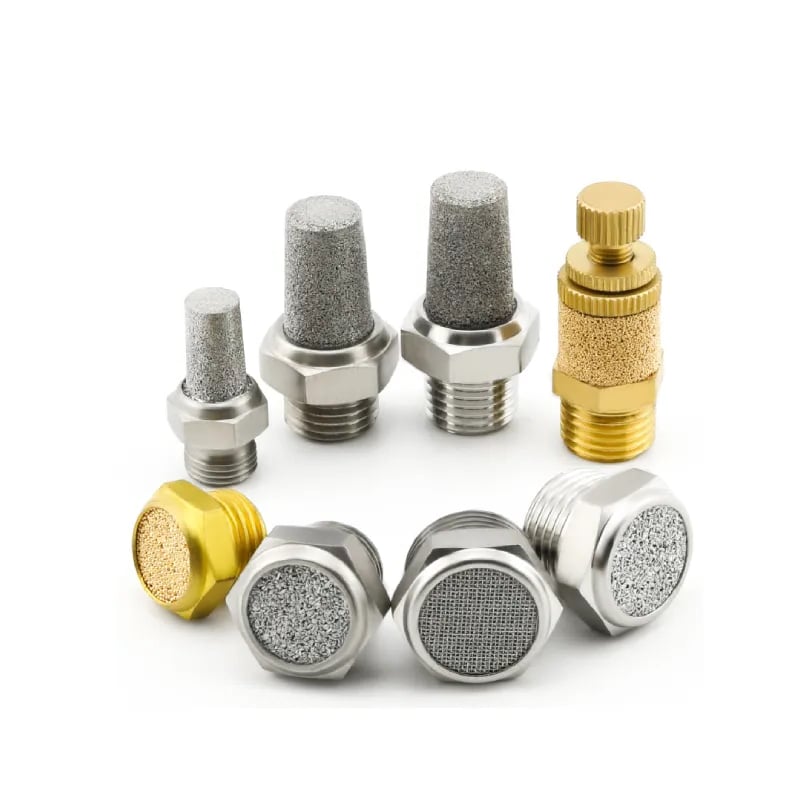
NPT sintered bronze pneumatic mufflers are a simple example. The muffler body may be small, but the thread still has to match the cylinder, valve, or exhaust port. A tiny exhaust leak can make a machine sound harmless while it slowly wastes air.
What Does ASME B1.20.1 Actually Control?
ASME describes B1.20.1 as the standard for dimensions and gaging of common inch pipe threads, including NPT (ASME B1.20.1, 2013). In practical terms, it controls the reference geometry that lets one supplier’s fitting enter another supplier’s port without guesswork.
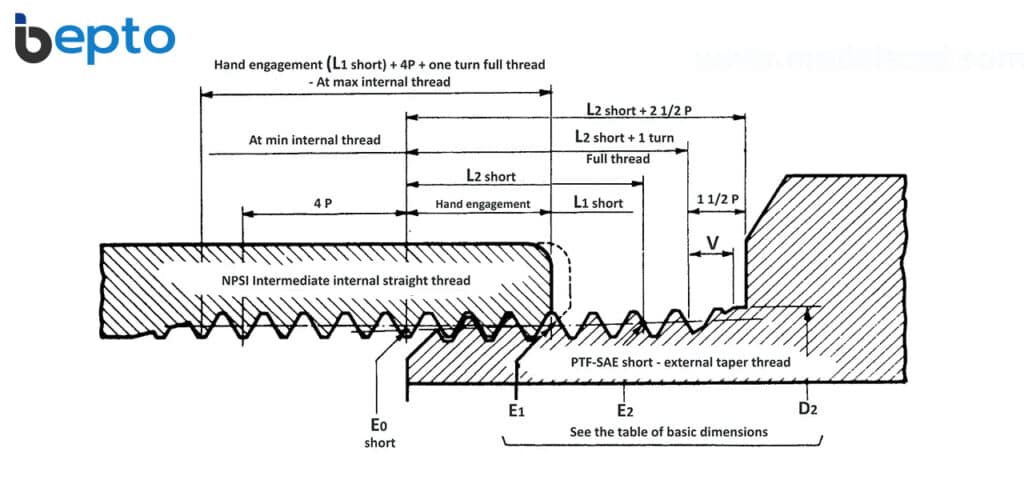
The standard is not a generic “pipe thread idea.” It defines how the thread should be dimensioned and checked. That includes the pitch diameter at reference planes, the taper relationship, and the gaging method used to decide whether a thread is within limits. If the port is tapped too shallow, too deep, or with poor form, the fitting may assemble but seal inconsistently.
Use the standard NPT pitch table instead of memory when identifying ports. Common ASME B1.20.1 dimension tables list 1/8“ NPT as 27 TPI, 1/4“ NPT as 18 TPI, 3/8“ NPT as 18 TPI, and 1/2“ NPT as 14 TPI (ITEX, 2026). That pitch check matters when a technician uses a gauge to identify a port.
| Nominal NPT size | Threads per inch | Typical pneumatic use | Check before assembly |
|---|---|---|---|
| 1/8“ NPT | 27 TPI | Small valves, pilot ports, compact fittings | OD and pitch gauge |
| 1/4“ NPT | 18 TPI | Many cylinder, regulator, and manifold ports | Pitch and taper |
| 3/8“ NPT | 18 TPI | Higher-flow valves and medium manifolds | Port depth and sealant |
| 1/2“ NPT | 14 TPI | Larger supply lines and high-flow exhaust | Engagement and support |
When we review a drawing, we treat the nominal size as a label first and a measurement second. “1/4 NPT” does not mean the male thread measures 0.250 inch outside diameter. That one misunderstanding causes a surprising number of wrong fitting selections.
Which NPT Sizes Matter Most on Pneumatic Cylinders and Manifolds?
The four sizes most often seen around compact pneumatic assemblies are 1/8“, 1/4“, 3/8“, and 1/2“ NPT, with TPI values of 27, 18, 18, and 14 respectively in ASME-style tables (ITEX, 2026). The size decision affects both sealing and available flow.
Small ports are not automatically wrong. A 1/8“ NPT pilot port on a compact valve can be perfectly reasonable. The problem starts when the same small port is expected to feed a fast actuator, a long tube run, or a high-cycle machine. Thread standard and flow path are related, but they are not the same calculation.
Use the thread standard to make the connection safe. Use flow, pressure drop, tubing ID, and valve Cv to decide whether the machine will move correctly. For the flow side, the tube ID calculator and compressed air pressure drop calculator are better fits than a thread chart. If the buyer sends only “1/4 fitting,” ask whether they mean 1/4“ NPT, 1/4“ tube OD, G1/4, or a nominal pipe size. Want a related example? The pipe surface area guide shows why nominal pipe labels should not be used as measured diameters.
For rodless cylinders, the port also sits inside a moving system context. A long actuator can have large air volume, long tubing, and remote valve placement. A correct NPT thread keeps the joint sealed, but it doesn’t remove the need to size the valve and tubing for the stroke time. That’s why thread review belongs beside cylinder, valve, and tube review, not after it.
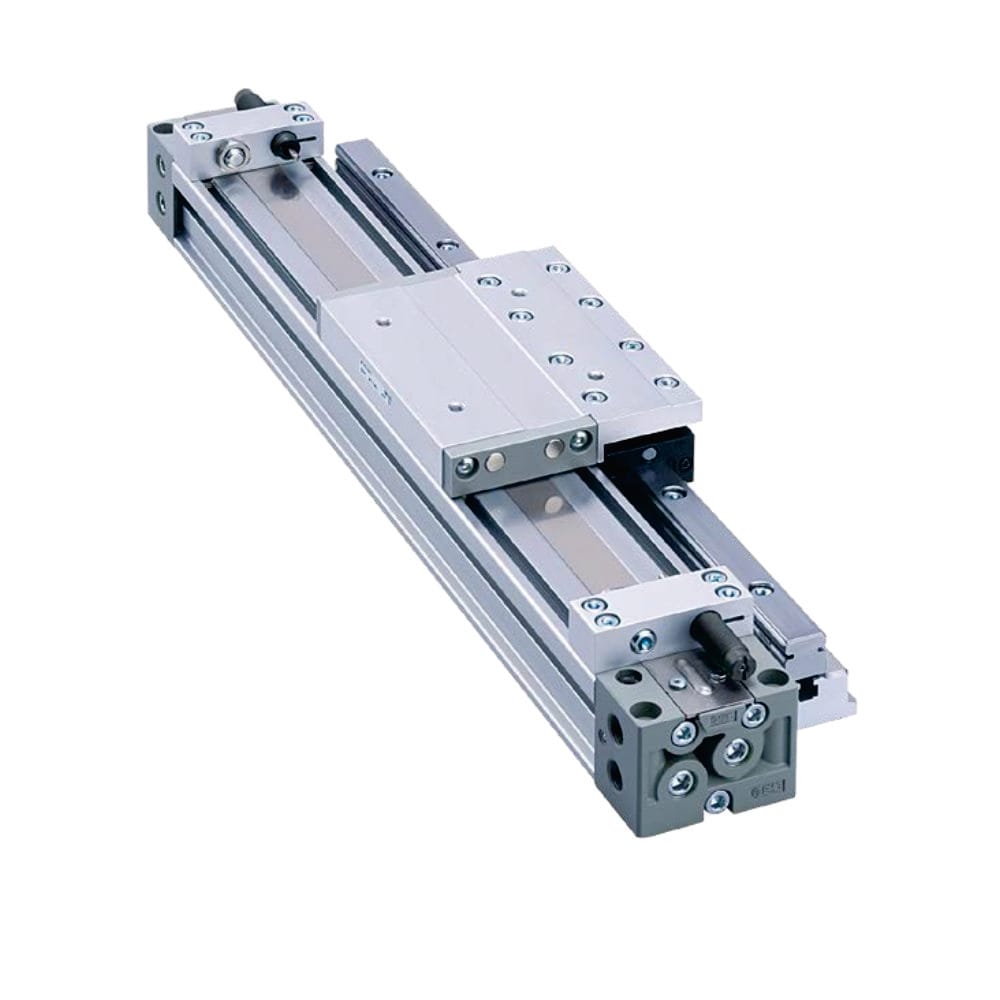
For actuator context, see the guide to what a rodless cylinder does in industrial automation. The port thread is only one interface, but it is one of the few interfaces maintenance teams touch repeatedly.
Where Do NPT, NPTF, BSPT, and BSPP Get Confused?
NPT and NPTF share the same basic taper and thread angle, but NPT normally relies on sealant while NPTF is designed as a dryseal form (ISM, 2026). AutomationDirect also notes that pneumatic fittings commonly use NPT, BSPT, or BSPP threads, which can look close before measurement (AutomationDirect, 2026).
NPT is a general-purpose tapered pipe thread under ASME B1.20.1. NPTF is a dryseal tapered pipe thread under a different standard, ASME B1.20.3. They can often physically mate, but “threads together” is not the same as “specified correctly.” What happens if a repair technician mixes them? The joint may hold during a quick bench check and then seep after pressure cycling.
BSPT is also tapered, but it uses a different thread form. BSPP, often called G thread, is parallel and normally seals with an O-ring, bonded seal, or gasket face. AutomationDirect’s transcript makes the shop-floor rule simple: straight threads need a separate sealing element, while tapered threads seal in the thread with sealant or thread-form interference (AutomationDirect, 2026).
| Thread type | Shape | Common seal method | Pneumatic risk if confused |
|---|---|---|---|
| NPT | Tapered | Thread interference plus sealant | Leak path if sealant or engagement is poor |
| NPTF | Tapered dryseal | Controlled crest-root interference | False confidence when mixed with NPT |
| BSPT / R | Tapered | Thread sealant | Can start into NPT and still leak |
| BSPP / G | Parallel | O-ring, gasket, or bonded seal | Won’t seal by thread wedging |
The fastest field test is not “does it screw in?” The better first pass is: does the pitch gauge match, does the taper match, and does the port’s sealing method match the fitting’s sealing method?
How Should You Install NPT Fittings Without Chasing Leaks?
Installation should start with clean threads, compatible sealant on the male thread, finger-tight engagement, and controlled wrench tightening. ISM gives a practical rule of finger tight plus 1 to 2 wrench turns for many tapered pipe threads, with caution against overtightening (ISM, 2026).
Start by inspecting both parts. Look for burrs, chips, dented crests, plating buildup, or a port that was already cracked by a previous repair. If the first turn feels rough, stop. Backing out a damaged connection is cheaper than replacing a cracked valve body.
Apply sealant to the male thread, leaving the first thread light or clean when the sealant manufacturer’s instruction says so. A one-page NPT air-brake fitting instruction sheet, for example, tells installers to clean both threads, apply sealant to the male side, start by hand, and check for leaks with soapy water after tightening (Abstrailquip, 2024). The same document lists 1/4“ NPT at 12 to 15 ft-lb, 3/8“ at 18 to 25 ft-lb, and 1/2“ at 25 to 35 ft-lb for that fitting family.
Those torque numbers are not universal values for every material, wall thickness, or port design. Use the component supplier’s instruction when available. Aluminum, brass, stainless steel, plastic, and zinc fittings do not all tolerate the same abuse. In our experience, shaped fittings such as elbows and tees need extra care because people are tempted to back them off for orientation. Don’t do that after the sealant has been disturbed.
Practical Installation Sequence
- Confirm thread standard and nominal size with a pitch gauge and calipers.
- Inspect male and female threads for damage, contamination, and plating defects.
- Apply compatible sealant to the male thread according to the sealant instruction.
- Start by hand until finger tight so cross-threading is obvious.
- Wrench-tighten to the specified engagement or supplier torque range.
- Align shaped fittings by tightening forward, not by backing off.
- Pressure-test the connection and use soapy water or approved leak-detection fluid.
When Should a Pneumatic Design Avoid NPT?
NPT is useful, but it is not the best answer for every pneumatic interface. ISM notes that NPTF may be chosen when sealant contamination is unacceptable, while parallel threads use a separate sealing surface instead of thread wedging (ISM, 2026). Maintenance frequency, cleanliness, and port material should drive the choice.
Choose a parallel thread with an O-ring or face seal when the connection will be opened often. NPT threads deform during sealing, so repeated assembly can wear the sealing surfaces. That doesn’t mean NPT is disposable after one use, but it does mean every reuse deserves inspection.
Avoid forcing NPT into thin-wall plastic or fragile cast ports unless the component was designed for it. A tapered thread acts like a wedge. Over-tightening can split the female port, and the crack may appear after the machine has already returned to production. It’s a quiet failure mode.
For export machines, check thread standards early. A North American manifold may use NPT while a European accessory uses G thread and a Japanese component may use R thread. If your RFQ includes pressure values in mixed units, the pressure converter is a quick sanity check, but thread identity still needs physical verification.
Conclusion: What Should Engineers Remember About NPT?
ASME B1.20.1 gives the dimensional and gaging basis for NPT pipe threads, and common NPT tables show the size-specific pitches that technicians must verify before assembly (ASME B1.20.1, 2013; ITEX, 2026). For pneumatic systems, the standard protects interchangeability, but installation practice protects the seal.
Treat NPT as a controlled interface, not just a thread that happens to fit. Confirm the standard, check the pitch, use compatible sealant, avoid overtightening, and test the assembled joint. If a port leaks twice, stop adding torque and review the thread form, sealant, and mating standard. That’s usually where the answer is hiding.
FAQs About NPT Threading in Pneumatic Systems
The most common NPT questions come from mixed standards, reuse, and installation force. AutomationDirect identifies NPT, BSPT, and BSPP as common pneumatic thread types, while ASME B1.20.1 covers the inch pipe-thread dimensions and gaging used for NPT (AutomationDirect, 2026; ASME B1.20.1, 2013).
Can I reuse NPT threaded connections multiple times?
You can sometimes reuse NPT connections, but inspect them first. NPT sealing deforms thread contact surfaces, and ISM warns that reuse requires caution because wear and overtightening affect the seal (ISM, 2026). Replace fittings with damaged crests, pulled threads, galling, or ports that need extra torque to stop leaking.
What is the difference between NPT and NPTF threads?
NPT is the general-purpose tapered pipe thread defined by ASME B1.20.1, while NPTF is a dryseal tapered form under ASME B1.20.3. ISM explains that NPT normally needs sealant for leakproof sealing, while properly made NPTF can seal without sealant through controlled crest-root interference (ISM, 2026).
Why do some pneumatic cylinders use metric or G threads instead of NPT?
Thread choice often follows machine origin, supplier standard, and sealing philosophy. AutomationDirect notes that U.S. pneumatic equipment often uses NPT, while metric tubing can point toward British Standard Pipe forms, including BSPT or BSPP/G thread (AutomationDirect, 2026). Parallel G threads usually seal with an O-ring, not thread deformation.
How do I identify NPT thread size on an existing cylinder port?
Use calipers and a thread pitch gauge. Do not treat the nominal label as the measured outside diameter. ITEX lists 1/8“ NPT at 27 TPI, 1/4“ and 3/8“ at 18 TPI, and 1/2“ at 14 TPI (ITEX, 2026). If taper or pitch is unclear, compare against a known-good fitting or gage.
What thread sealant works best for pneumatic NPT connections?
Use a sealant compatible with compressed air, fitting material, temperature, and maintenance practice. ISM states that leakproof NPT connections require appropriate thread sealant, while NPTF is the dryseal alternative in some systems (ISM, 2026). Follow the sealant maker’s cure time and keep excess material out of valves and regulators.
Should I use PTFE tape on pneumatic NPT threads?
PTFE tape can work when allowed by the component and site standard, but it must be wrapped correctly and kept out of the flow path. Some factories prefer anaerobic paste because fragments of tape can migrate into small pneumatic valves. The safest rule is simple: follow the fitting, sealant, and maintenance instructions for the exact equipment.
Source Notes
These notes keep the article’s 6 cited sources tied to standards, dimensions, installation, and pneumatic-thread identification. ASME anchors the standard scope, while the other references provide shop-floor interpretation, video context, and installation details that should be rechecked during future updates (ASME B1.20.1, 2013).
- ASME B1.20.1: Pipe Threads, General Purpose, Inch, standard scope for NPT and related inch pipe threads. Retrieved 2026-06-04.
- ITEX Precision Piping: ANSI / ASME B1.20.1, NPT dimension table including threads per inch by nominal size. Retrieved 2026-06-04.
- ToolGrit: NPT Pipe Thread Dimensions and Standards Explained, 1:16 taper, 3/4 inch per foot, NPT/NPTF/BSPT comparison, and engagement guidance. Retrieved 2026-06-04.
- ISM: Getting to Leakproof with NPT & NPTF Threads, NPT/NPTF sealing mechanism, sealant guidance, reuse cautions, and installation sequence. Retrieved 2026-06-04.
- AutomationDirect: Understanding Pneumatic Thread Size & Type, pneumatic thread identification transcript and embedded YouTube video. Retrieved 2026-06-04.
- Abstrailquip: Air Brake Fitting NPT Thread Installation Instructions, NPT installation sequence and family-specific torque table. Retrieved 2026-06-04.
t>