

Maintenance requirements compare best at the system level, not by counting parts on the actuator alone. DOE/ENERGY STAR says compressed-air leaks can waste 20-30% of compressor output in many systems, while Tolomatic’s TCO method includes replacement, maintenance, utilities, scrap, and lost production time (ENERGY STAR, 2004; Tolomatic, 2017).
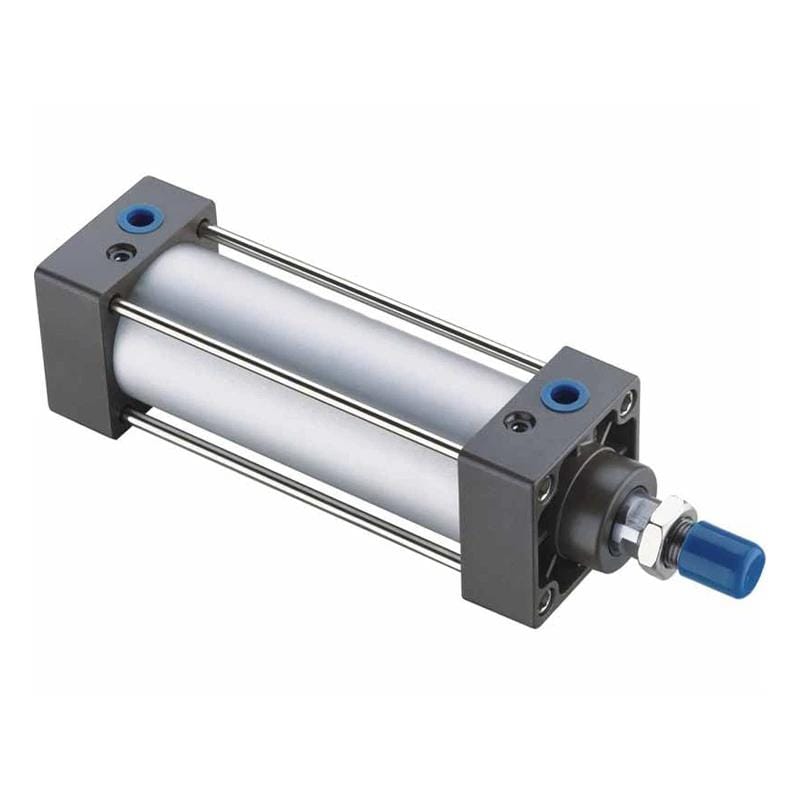
SCSU Series Pneumatic Tie-Rod Cylinders
Key Takeaways
- Pneumatic cylinders usually need mechanical inspection, air-quality control, leak checks, and seal planning.
- Electric actuators add motor, drive, cable, feedback, software, and electrical-safety work.
- DOE’s 20-30% leak-loss range means a “simple” pneumatic axis still needs air-system maintenance.
The fair comparison is not “pneumatic cylinder maintenance versus electric actuator maintenance.” It is “which failure mode can this plant detect, isolate, repair, and return to production fastest?” A cheap cylinder can become expensive when leaks are ignored. A costly electric actuator can be the cheaper system when it removes changeover, scrap, or compressed-air waste.
This article is a maintenance-focused companion to the broader cylinder vs actuator comparison. Use that article for terminology and selection categories. Use this one when the buyer’s real concern is service time, technician skill, leak cost, spare parts, and downtime risk.
What Maintenance Problem Should Buyers Compare First?
Start with the maintenance window, because OSHA treats electrical, mechanical, hydraulic, pneumatic, chemical, thermal, and other stored energy as hazardous during service (OSHA, 2026). A cylinder that needs a 20-minute seal check can still stop production if the line cannot be locked out, vented, tested, and restarted cleanly.
Ask four questions before comparing actuator families:
- Can the plant isolate the axis without stopping upstream and downstream equipment?
- Does the technician need mechanical, pneumatic, electrical, programming, or network skills?
- Are the wearing parts stocked locally, or are they tied to a single supplier?
- Does the fault show up visually, acoustically, electrically, or only through data?
That last question is underrated. Pneumatic faults often announce themselves through leakage, slow stroke time, pressure drop, drift, or damaged seals. Electric actuator faults may appear as alarms, following error, encoder noise, cable intermittency, overheating, or lost parameters. Neither is automatically easier. The easier system is the one your team can diagnose under real production pressure.
In maintenance reviews, we’ve found that the fastest repairs usually have boring preparation behind them: a current schematic, a known spare kit, written isolation steps, and a technician who has already practiced the fault path. The actuator technology matters, but the service plan matters more.
How Do Pneumatic Cylinder Maintenance Tasks Stay Simple?
Pneumatic cylinder maintenance is usually mechanical and air-system focused: inspect mounting, check leakage, confirm stroke speed, drain water, replace filters, and plan seal replacement. ISO 8573-1 defines compressed-air contaminant and purity classes, so air quality is part of cylinder maintenance, not a separate utility problem (ISO 8573-1, 2010).
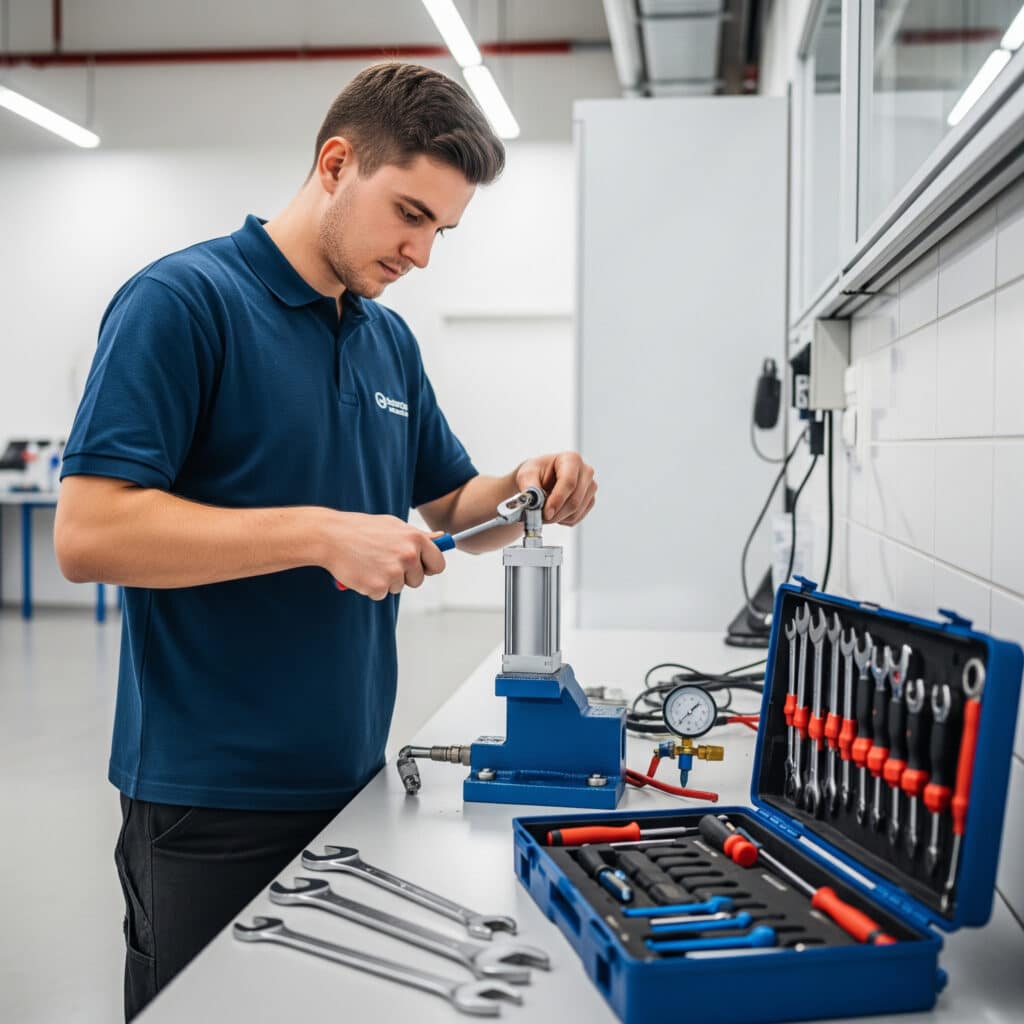
The common checks are straightforward, especially when the machine uses documented FRL units, accessible fittings, and standard cylinder ports:
- Listen for external leakage at ports, fittings, rod seals, and valve exhausts.
- Watch extend and retract time under the normal load, not only on a bench.
- Confirm the cylinder reaches both end positions before adjusting sensors.
- Check the rod, guide, carriage, or load bracket for side load and looseness.
- Review filter bowls, drains, regulators, lubricators, and local shutoff valves.
Pneumatic simplicity has a catch. The cylinder is only as healthy as the air system feeding it. DOE/ENERGY STAR warns that leaks can waste 20-30% of compressor output and that effective programs can reduce leakage to 5-10% of compressor output (ENERGY STAR, 2004). That turns leak checks into maintenance work with a measurable energy consequence.
For simple end-to-end machines, pneumatic cylinder maintenance often fits inside routine mechanical PM. For long-stroke rodless cylinders, guided loads, dirty environments, or high-cycle equipment, add guide wear, carriage alignment, cushion settings, and tubing pressure drop to the inspection list. The cylinder can still be simple, but the axis around it may not be. For long-stroke context, see the guide to what a rodless cylinder does in industrial automation.
Where Do Electric Actuators Add Maintenance Skill Requirements?
Electric actuators add electrical safety, motor-drive diagnostics, encoder or feedback review, cable checks, software parameters, and sometimes network troubleshooting. NFPA 70E covers electrical safety in the workplace, while OSHA requires hazardous-energy control training for workers who service equipment (NFPA 70E, 2024; OSHA, 2026).
That does not mean electric actuators are unreliable. It means the maintenance burden moves. A plant may trade air leaks and seal kits for drives, motors, brakes, cables, encoders, limit switches, firmware, and motion profiles. If the team already supports servo axes, that trade may be easy. If the team is mostly mechanical, the same trade may create a bottleneck.
Electric actuator service commonly includes:
- Saving and restoring drive parameters.
- Checking motor insulation, grounding, and brake function.
- Inspecting cables for flex fatigue, connector damage, and noise problems.
- Verifying home position, encoder feedback, and limit configuration.
- Reviewing screw, belt, guide, or bearing wear based on duty cycle.
Festo’s actuator selection guidance makes the decision application-specific rather than technology-specific, and it lists technical and economic criteria such as precision, dynamics, costs, spare parts availability, and operating conditions (Festo, 2026). That is the right frame. Don’t punish electric actuators for needing different skills. Count whether your plant has those skills when the line is down.
How Should Teams Compare Downtime and Service Cost?
Use total cost of ownership, not parts price. Tolomatic defines TCO as initial purchase cost plus years of service multiplied by yearly operating cost, and includes replacement, maintenance, utility cost, scrap, and lost production time in the yearly cost bucket (Tolomatic, 2017).
Do not use exact downtime or service-cost ranges without site evidence. A reliable worksheet asks for the failure mode, estimated service window, parts source, technician type, line value per hour, safety isolation time, recommissioning time, and any quality loss after restart.
| Cost item | Pneumatic cylinder check | Electric actuator check |
|---|---|---|
| Isolation time | Lockout, vent pressure, verify zero energy | Lockout, verify absence of voltage, discharge stored energy |
| Fault finding | Leak, pressure, valve, seal, tubing, side load | Alarm, drive, encoder, cable, motor, program, mechanics |
| Common parts | Seal kit, fitting, tubing, valve, sensor | Cable, sensor, drive, motor, belt, screw, brake |
| Restart risk | Speed setting, cushion, leaks, sensor position | Homing, parameter restore, tuning, network status |
| Hidden cost | Compressed-air leakage and pressure drop | Specialized labor, proprietary parts, software access |
A maintenance comparison should separate diagnosis time from repair time. Pneumatic faults are often quick to identify but can recur if the air system stays dirty or wet. Electric faults may take longer to diagnose, but a correctly sized electric axis may need fewer routine interventions in some precision applications.
For downtime cost, use this simple structure:
Maintenance cost = labor + parts + outside service + lost production + restart scrapThen compare 3 scenarios: planned PM, typical failure, and ugly failure. The ugly failure is where decisions become clear. If a pneumatic seal kit is cheap but a leak takes months to notice, the air cost grows quietly. If an electric drive rarely fails but needs a factory technician and a proprietary cable, the recovery risk may be too high for a remote plant.
Which Calculators Help Check Compressed-Air Maintenance Risk?
Compressed-air maintenance has two useful calculator jobs: estimate the cost of a visible leak and estimate leak rate from a pressure-decay test. DOE/ENERGY STAR’s 20-30% leak-loss range gives the reason to measure; the calculators help turn a maintenance note into a repair priority (ENERGY STAR, 2004).
Use the compressed air leak cost calculator when a technician can estimate or measure a leak diameter. Use the pressure decay leak rate calculator when production can isolate a receiver, branch, or machine circuit and record pressure drop over time. Neither tool replaces an audit, but both stop the conversation from drifting into guesswork.
For electric actuators, the calculator work is different. You usually need software logs, drive current, alarm history, motion profile, load data, and mechanical inspection. That data belongs in the maintenance record. If an electric actuator fails every time the machine changes recipe, the issue may be configuration or load case, not mechanical wear.
When Should Electric Actuators Still Win the Maintenance Comparison?
Electric actuators can win when the axis needs precise programmable stops, faster changeover, reduced compressed-air demand, or lower routine leakage risk. Tolomatic notes that pneumatic cylinders often have a lower initial purchase cost, while electric systems can change the TCO result through service life, utilities, product scrap, and lost time (Tolomatic, 2017).
Choose electric when maintenance benefit comes from control:
- The machine needs many positions or recipe-driven changeover.
- Scrap risk is tied to position, speed, force, or acceleration.
- Compressed air is already expensive, leaky, undersized, or unavailable.
- Maintenance staff can support drives, feedback, software, and electrical safety.
- The application needs cleaner operation without air exhaust near the product.
Choose pneumatic when maintenance benefit comes from simplicity:
- The motion is end-to-end, repetitive, and tolerant of small speed variation.
- The plant already has clean, dry, adequately sized compressed air.
- Mechanical technicians can service most faults without outside support.
- Standard cylinders, solenoid valves, fittings, and sensors are locally available.
- The environment is dusty, wet, impact-heavy, or harsh for electronics.
That makes this article narrower than a general technology comparison. The buyer is not asking, “Which actuator is best?” The buyer is asking, “Which actuator can my plant maintain without surprise downtime?” That answer depends on the installed utility system, the maintenance team, and the production loss behind the machine.
Conclusion: What Is the Practical Maintenance Rule?
The practical rule is to compare the complete service model: stored-energy control, air quality, leakage, spare parts, diagnostic skills, software access, and restart risk. OSHA includes pneumatic and electrical sources in hazardous-energy control, and Festo says actuator choice should consider both technical and economic criteria (OSHA, 2026; Festo, 2026).
Pneumatic cylinders are often easier for mechanical teams to inspect and repair. Electric actuators often offer stronger control, cleaner motion data, and lower compressed-air dependence. Neither choice is automatically lower maintenance. The better choice is the one whose failure modes your plant can detect early, isolate safely, repair quickly, and restart confidently.
FAQs About Cylinder vs Electric Actuator Maintenance
FAQ answers should stay site-specific because maintenance cost depends on the machine, utility system, and available skills. DOE/ENERGY STAR gives a 20-30% leak-loss warning for compressed air, while Tolomatic’s TCO method includes downtime, maintenance, utilities, scrap, and replacement cost rather than purchase price alone (ENERGY STAR, 2004; Tolomatic, 2017).
Can my existing maintenance team service pneumatic cylinders without extra training?
Usually, yes, if the team already handles mechanical equipment, air isolation, fittings, and basic leak checks. OSHA still requires workers to understand hazardous-energy control before service work (OSHA, 2026). Add focused training for air quality, seal replacement, cylinder alignment, pressure testing, and rodless-cylinder guide inspection.
How much downtime should I expect for pneumatic cylinder maintenance?
Do not use a universal downtime number. A simple rod cylinder seal check may fit a short PM window, while a buried rodless axis with guards, sensors, and tubing may need much longer. Use the worksheet: isolate, vent, inspect, replace parts, test leakage, confirm speed, verify sensors, and restart production.
What tools are needed for pneumatic cylinder maintenance versus electric actuators?
Pneumatic maintenance usually needs mechanical tools, gauges, leak-detection fluid or ultrasonic detection, seal tools, and air-preparation spares. Electric actuator maintenance adds electrical test equipment, drive software, cables, parameter backups, and safe electrical work practices under NFPA 70E where applicable (NFPA 70E, 2024).
How do emergency repair capabilities compare between these technologies?
Pneumatic repairs can be fast when standard cylinders, valves, fittings, and seals are stocked. Electric repairs can be fast when the plant has the right drive files, cables, spare motor, and trained technician. The weak point is not always the actuator. It is often spare-parts control and diagnostic access.
Do rodless cylinders require more maintenance than standard cylinders?
Rodless cylinders have the same air-quality and leakage concerns as other pneumatic cylinders, plus guidance, carriage, band, magnet, or external load checks depending on the design. In dusty or side-loaded applications, inspect guides and mounting more often. For long strokes, also check tubing pressure drop and valve flow.
Are electric actuators lower maintenance than pneumatic cylinders?
Sometimes. Electric actuators may reduce leakage, air-preparation work, and manual changeover, especially in programmable positioning applications. Pneumatic cylinders may still be lower maintenance for simple two-position motion in plants with clean, dry air and strong mechanical service coverage. Compare the whole service model, not the actuator label.
Source Notes
The six sources below support standards, safety, leak-cost, and TCO boundaries for the maintenance comparison. Use citation-backed maintenance criteria, stored-energy safety checks, compressed-air leak economics, and site-specific calculation methods instead of unsourced service-time or cost ranges (ENERGY STAR, 2004).
- ENERGY STAR / DOE: Energy Tips - Minimize Compressed Air Leaks, compressed-air leakage range and leak-reduction target. Retrieved 2026-06-04.
- OSHA: Control of Hazardous Energy Lockout/Tagout, stored-energy hazards and training expectations for service work. Retrieved 2026-06-04.
- ISO 8573-1:2010 Compressed air - contaminants and purity classes, compressed-air quality framework for pneumatic systems. Retrieved 2026-06-04.
- NFPA 70E: Standard for Electrical Safety in the Workplace, electrical safety standard for maintenance planning. Retrieved 2026-06-04.
- Festo: Electric vs Pneumatic Actuators, application-specific selection criteria and economic factors. Retrieved 2026-06-04.
- Tolomatic: Total Cost of Ownership, Pneumatic vs Electric Linear Actuators, TCO method including maintenance, utilities, scrap, and lost production time. Retrieved 2026-06-04.