

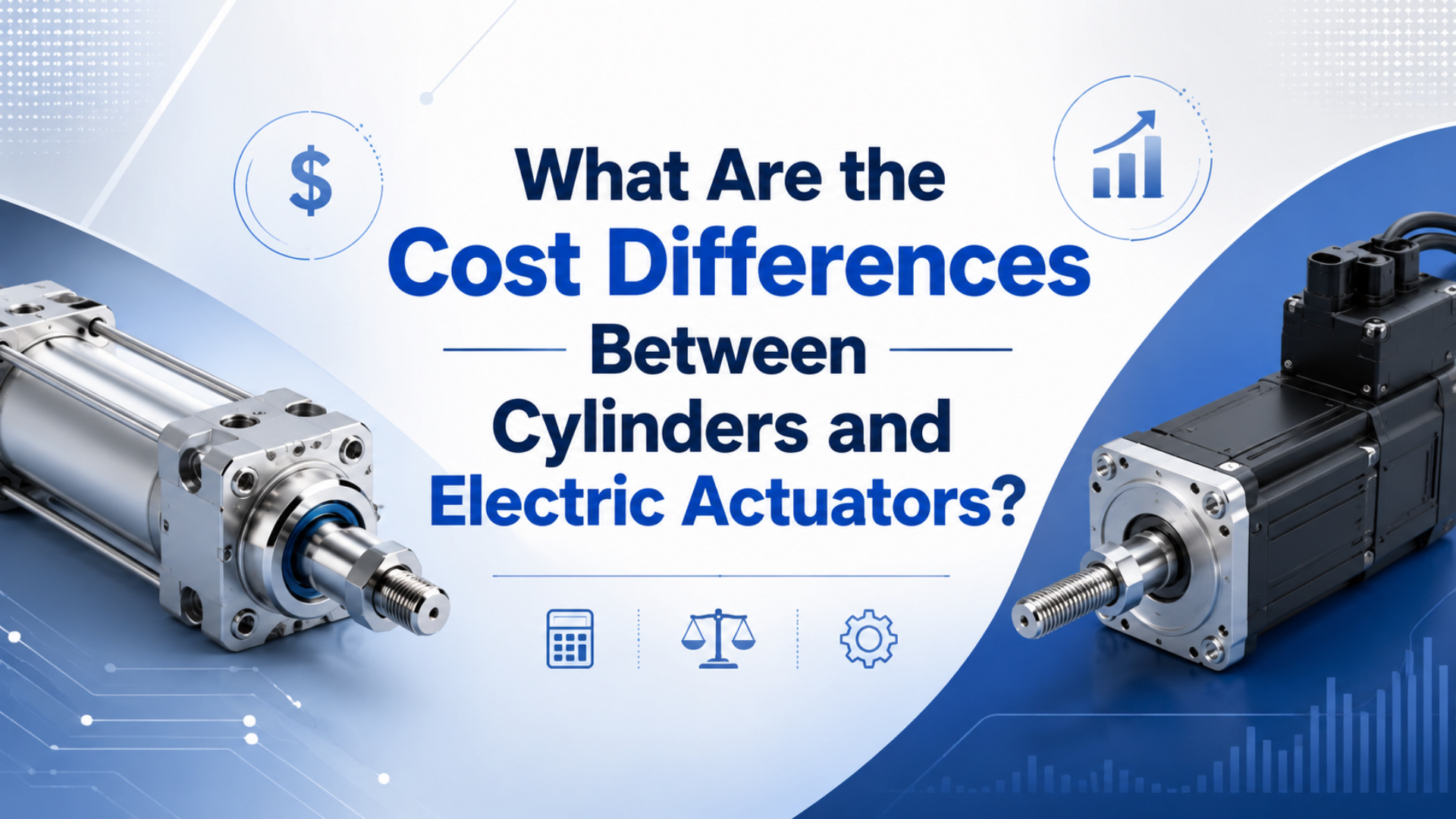
The cost difference between pneumatic cylinders and electric actuators depends on the complete axis, not only the actuator body. Tolomatic defines actuator total cost of ownership as initial purchase cost plus years of service times yearly operating cost, including maintenance, utility cost, scrap, and lost production (Tolomatic, 2017).
That framing is important because the low-cost choice can change by application. A pneumatic cylinder often wins the first purchase for simple two-position motion. An electric actuator can win when programmable positions, changeover speed, utility cost, and quality control outweigh the higher axis hardware cost.
Key Takeaways
- Tolomatic’s TCO model separates purchase price from yearly operating cost.
- DOE says poorly maintained compressed-air systems can lose 20-30% of air capacity to leaks.
- CAGI recommends no more than 10% pressure drop from compressor discharge to point of use.
- Electric actuators cost more at the axis, but they may reduce air demand and manual changeover cost.
The practical cost question is not “pneumatic or electric?” It is “which cost bucket dominates this machine: hardware, utilities, setup time, maintenance skill, changeover, or quality risk?” Once that bucket is clear, the technology choice becomes much less ideological.
What Costs Should Be Compared First?
Compare the full axis before comparing actuator prices. Tolomatic’s TCO equation includes initial purchase plus yearly operating cost, while AutomationDirect describes electric linear actuators as motor-driven devices that may use ball screws, lead screws, or belts and supporting motion hardware (Tolomatic, 2017; AutomationDirect, 2022).
For a pneumatic cylinder, the axis cost usually includes the cylinder, valve, fittings, tubing, flow controls, sensors, FRL capacity, compressed-air supply, and maintenance access. For a rodless cylinder, add guide load, carriage moments, cushioning, stroke length, and valve flow.
For an electric actuator, the axis cost usually includes the actuator body, motor, drive, controller, cable set, encoder or feedback option, mounting hardware, software setup, safety integration, and cabinet space. The axis may be more expensive upfront, but it can change position by recipe.
Use this cost-bucket table before asking for quotes:
| Cost bucket | Pneumatic cylinder question | Electric actuator question |
|---|---|---|
| Hardware | Cylinder, valve, FRL, tube, fittings? | Actuator, motor, drive, cables, controller? |
| Utilities | What air flow and pressure are required? | What kWh and peak current are required? |
| Setup | Can maintenance staff tune it? | Who programs and commissions it? |
| Maintenance | Are leaks, seals, filters, and mufflers accessible? | Are screws, belts, cables, and drives serviceable? |
| Changeover | Are hard stops enough? | Are stored positions or profiles needed? |
| Quality risk | Can pressure variation change output? | Does feedback reduce scrap or rework? |
This article should stay focused on cost. For the naming and category problem, use the related article on the difference between cylinders and actuators.
When Is the Pneumatic Cylinder Cheaper Up Front?
Pneumatic cylinders are usually cheaper at first purchase when the motion is simple. Tolomatic says pneumatic cylinders generally cost less initially, and ISO 15552 standardizes pneumatic cylinders for 1,000 kPa, or 10 bar, systems with 32-320 mm bore dimensions (Tolomatic, 2017; ISO 15552, 2025).
That advantage is strongest when the machine needs two endpoints: extend and retract. A pneumatic axis can be built from a cylinder, valve, flow controls, tubing, fittings, sensors, and an air-preparation path. If the plant air system is already healthy, installation can be straightforward.
Upfront pneumatic cost becomes less clear when the machine needs extra hardware. Add proportional valves, external position feedback, brakes, special guides, shock absorbers, local receivers, or multiple sensors, and the “simple cylinder” is no longer simple.
In RFQ reviews, the cheapest-looking pneumatic request usually becomes expensive when the drawing hides three missing items: a guide for side load, a valve large enough for target stroke time, and a safe way to stop the moving mass.
Pneumatic is usually the lower first-cost option when:
| Requirement | Why pneumatic may cost less |
|---|---|
| Two-position motion | No motor drive or motion profile is needed |
| Short, simple stroke | Low hardware count and easy setup |
| Existing compressed air | Utility infrastructure is already in place |
| Low positioning demand | End sensors can be enough |
| Wet or dusty area | Simple hardware may tolerate the environment better |
For a rodless or guided axis, compare this page with where rodless cylinders are used before treating first purchase as the whole answer.
When Can an Electric Actuator Cost Less Over Time?
An electric actuator can cost less over time when control value beats first price. Festo recommends comparing load, precision, dynamics, environment, and life cycle costs, while AutomationDirect says electric actuators are efficient and accurate and can support linear motion with ball screw, lead screw, or belt designs (Festo, 2026; AutomationDirect, 2022).
Electric motion earns its cost when the process needs programmable stops, recipes, acceleration profiles, position feedback, force limits, or data. If a station changes product size several times per shift, the labor and quality benefit may matter more than the actuator body price.
It can also help when plant air is expensive, unstable, or already near capacity. Removing an air-consuming axis may avoid compressor upgrades or reduce leak-related waste. The energy math still needs measurement. A low-duty pneumatic cylinder can remain cheap to operate.
Electric is more likely to win the total-cost case when:
| Requirement | Why electric may pay back |
|---|---|
| Many positions | Position changes can be stored in software |
| Frequent changeover | Less manual adjustment and less setup time |
| Tight repeatability | Feedback can reduce scrap or inspection labor |
| Long duty cycle | Air use may cost more than motor energy |
| Data requirement | Drives can report position, current, and faults |
Do not assume electric is always cleaner, cheaper, or easier. Motors, drives, cables, cabinets, software, heat, and spare-part strategy belong in the same cost model.
Compressed Air Energy Pricing
Compressed-air energy should be priced from measured air demand, not from cylinder purchase price. DOE says leaks can waste 20-30% of compressor output in poorly maintained systems and can be reduced below 5-10% with proactive repair, while CAGI targets no more than 10% pressure drop (DOE Sourcebook, 2016; CAGI, 2026).
A pneumatic cylinder uses air every powered stroke. That air cost depends on bore, stroke, pressure, cycle rate, duty cycle, compressor efficiency, leaks, pressure drop, and operating hours. If the air system is leaky, the actuator may inherit costs that are not visible on the component quote.
The useful sequence is:
- Estimate air per cycle from bore, stroke, pressure, and action type.
- Multiply by cycles per minute and annual operating hours.
- Apply duty cycle and simultaneous-actuator timing.
- Convert air demand into compressor energy using measured specific power where possible.
- Add leak, pressure-drop, and artificial-demand checks.
For the calculation path behind this section, use the related guide on how to calculate pneumatic flow rate. For a broader utility-cost discussion, connect it with pneumatic energy conversion efficiency.
Which Maintenance Costs Are Easy to Miss?
Maintenance cost is not just the price of a replacement part. Tolomatic includes maintenance, replacement, scrap, and lost production in yearly operating cost, while DOE notes leaks can lower system pressure and create operating losses beyond wasted energy (Tolomatic, 2017; DOE Sourcebook, 2016).
Pneumatic maintenance is usually visible: air leaks, worn seals, loose fittings, dirty filters, water in bowls, muffler restriction, bad valve spools, or cushion needles that have drifted. These issues are often simple to understand, but they can multiply across a plant.
Electric actuator maintenance is different. The risks move toward ball screw or belt wear, bearing load, coupling alignment, cable damage, drive faults, encoder feedback, thermal limits, and software parameters. The parts may last a long time, but troubleshooting can require different skills.
Do not compare maintenance by slogan. Compare the failure mode:
| Cost item | Pneumatic cylinder | Electric actuator |
|---|---|---|
| Common wear | Seals, fittings, valves, mufflers | Screws, belts, bearings, cables |
| Main utility risk | Leaks and pressure drop | Motor load and drive heat |
| Troubleshooting skill | Air-path and pressure measurement | Motion drive and feedback diagnosis |
| Downtime risk | Many small leaks across the plant | Single-axis fault can need specialist support |
| Good preventive check | Leak survey and point-of-use pressure | Axis current, alignment, backlash, cable condition |
The costliest failures are not always the expensive parts. A two-dollar fitting leak repeated across 40 stations can cost more than a healthy electric actuator, while one mis-sized electric axis can stall a line if nobody on site can diagnose the drive fault.
How Do Installation and Commissioning Costs Differ?
Installation cost depends on infrastructure and skill, not only mechanical mounting. Festo says digital engineering tools help size pneumatic movement, force, speed, cycle time, and electric axes, while AutomationDirect notes electric actuator implementations include motors, options, sensors, wiring, and motion hardware (Festo, 2026; AutomationDirect, 2022).
A pneumatic installation can be quick when the plant air supply, regulator, valve, tubing, and exhaust path are already planned. It becomes slower when the team has to add air drops, fix pressure drop, route tubes through moving guards, or solve water and filtration problems.
An electric installation can be quick when the controls team already has standard drives, cables, safety functions, and commissioning templates. It becomes slower when cabinet space, network setup, grounding, encoder signals, software licenses, or motion tuning are new to the plant.
Ask these questions before quoting installation cost:
| Question | Why it changes cost |
|---|---|
| Is compressed air already available at the point of use? | New drops and pressure-drop fixes add pneumatic cost |
| Is cabinet space already available? | Drives and power supplies may need panel work |
| Does the axis need safety-rated stop behavior? | Both technologies may need extra hardware |
| Who tunes the motion? | Pneumatic flow tuning and electric profiles need different skills |
| Is the stroke fixed or recipe-based? | Electric setup may pay back through changeover |
For long-stroke motion, connect this cost check to rodless actuator selection rather than treating every axis as a short rodded cylinder.
Five-Year TCO Worksheet
A five-year worksheet should calculate one axis, then scale to the machine. Tolomatic’s formula uses initial purchase plus years of service times yearly operating cost, and DOE’s leak calculation method expresses leakage as a percentage of compressor capacity using load and unload time (Tolomatic, 2017; DOE Sourcebook, 2016).
Use the same rows for both technologies. If one side has an unknown value, write “unknown” instead of pretending the cost is zero.
| TCO row | Pneumatic input | Electric input |
|---|---|---|
| Initial hardware | Cylinder, valve, FRL, tube, fittings, sensors | Actuator, motor, drive, cables, controller |
| Installation | Air drop, brackets, tubing, exhaust | Panel space, wiring, drive setup, safety |
| Utility | Air consumption, leaks, pressure drop, hours | kWh, duty cycle, peak current, hours |
| Maintenance | Seals, filters, leaks, mufflers, valve service | Screws, belts, bearings, cables, drive support |
| Changeover | Manual stops and flow settings | Stored positions and motion profiles |
| Quality | Pressure variation, end-stop shock | Repeatability, feedback, data |
| Downtime | Leak survey, part access, local skill | Diagnostic access, spare drives, controls skill |
Which Technology Is the Lower-Cost Choice?
The lower-cost choice is the one that fits the motion without hiding system costs. Festo recommends selecting by application needs and life cycle costs, and Tolomatic warns that purchase price alone misses utility, maintenance, scrap, lost production, changeover, and cycle-time costs (Festo, 2026; Tolomatic, 2017).
Choose pneumatic when the job is simple, fast, mostly two-position, tolerant of end-stop sensing, and backed by stable compressed air. That covers many clamps, stops, pushers, reject gates, and transfer motions.
Choose electric when the process needs many positions, programmable profiles, changeover speed, data feedback, lower air demand, or better control over scrap and repeatability. It may cost more to buy, but the machine may save time and quality cost.
Choose a mixed system when each axis has a different job. A pneumatic cylinder can clamp or eject while an electric actuator handles adjustable positioning. That is not indecision. It is cost discipline.
For RFQs, send the motion requirement before asking which technology is cheaper:
- Load, stroke, orientation, speed, and duty cycle.
- Position count: two endpoints, several stops, or continuous profile.
- Available utilities: measured air pressure and electric capacity.
- Annual operating hours and expected changeover frequency.
- Maintenance skill on site and spare-part rules.
- Quality risk from pressure variation, backlash, or missed position.
For pneumatic force and pressure context, add working pressure of an air cylinder to the RFQ pack when the cost discussion includes bore, load, and pressure margin.
FAQs About Cylinder vs Electric Actuator Costs
FAQ answers should avoid universal savings claims. DOE gives measurable compressed-air leak ranges of 20-30% for poorly maintained systems and less than 5-10% for proactive repair, while Tolomatic’s TCO equation separates first purchase from yearly operating cost (DOE Sourcebook, 2016; Tolomatic, 2017).
Are pneumatic cylinders always cheaper than electric actuators?
No. Pneumatic cylinders are often cheaper at first purchase for simple two-position motion, but total cost depends on compressed-air energy, leaks, pressure drop, maintenance, cycle time, and changeover. Electric actuators may cost more upfront, yet pay back when programmable positions or quality control remove labor and scrap.
How should compressed air cost be included in actuator comparison?
Estimate cylinder air demand from bore, stroke, pressure, action type, cycle rate, duty cycle, and annual hours. Then price that demand using compressor specific power and electricity cost. DOE’s leak guidance means the plant air system condition must be part of the calculation, not an afterthought.
When does an electric actuator justify the higher first cost?
Electric actuators justify higher first cost when the machine needs multiple positions, recipe changes, acceleration profiles, position feedback, force or torque limits, data, or lower dependence on compressed air. Festo recommends checking application requirements and life cycle costs before choosing the technology.
What hidden pneumatic costs should buyers watch?
Watch leaks, pressure drop, water, filtration, long tubing, undersized valves, muffler restriction, seal wear, and point-of-use pressure loss. CAGI’s 10% pressure-drop target is a useful first screen. A cheap cylinder can become expensive if the air path is unhealthy.
What hidden electric actuator costs should buyers watch?
Watch motor sizing, drive capacity, controller hardware, cabinet space, cable routing, encoder feedback, software setup, spare drives, and on-site troubleshooting skill. AutomationDirect notes electric actuators are complete motion devices, not just a sliding body, so quote the whole axis.
Are rodless cylinders cheaper than electric linear actuators?
Rodless cylinders can be lower cost for long, fast, two-position transfer when the air system is already healthy. Electric linear actuators can be lower TCO when the same long stroke needs programmable stops, smooth profiles, frequent changeover, or detailed feedback. Compare the full axis.
Source and retrieval notes:
- Tolomatic: Total Cost of Ownership, Pneumatic vs Electric Linear Actuators, TCO equation and cost-bucket framing. Retrieved 2026-06-04.
- U.S. DOE: Improving Compressed Air System Performance, Third Edition, leak loss ranges, leak calculation method, and compressed-air system economics. Retrieved 2026-06-04.
- CAGI: Technical Brief on Pressure Drop, pressure-drop sources and 10% target for well-designed compressed-air systems. Retrieved 2026-06-04.
- Festo: Electric vs Pneumatic Actuators, application-led actuator selection and engineering-tool guidance. Retrieved 2026-06-04.
- AutomationDirect: What Are Electrical Actuators?, electric actuator construction, ball screw, lead screw, and belt drive context. Retrieved 2026-06-04.
- ISO 15552:2018, standardized pneumatic cylinder dimensional series and 1,000 kPa pressure scope. Retrieved 2026-06-04.
- AutomationDirect: What is a Pneumatic Cylinder?, pneumatic cylinder overview video used for background context. Retrieved 2026-06-04.