

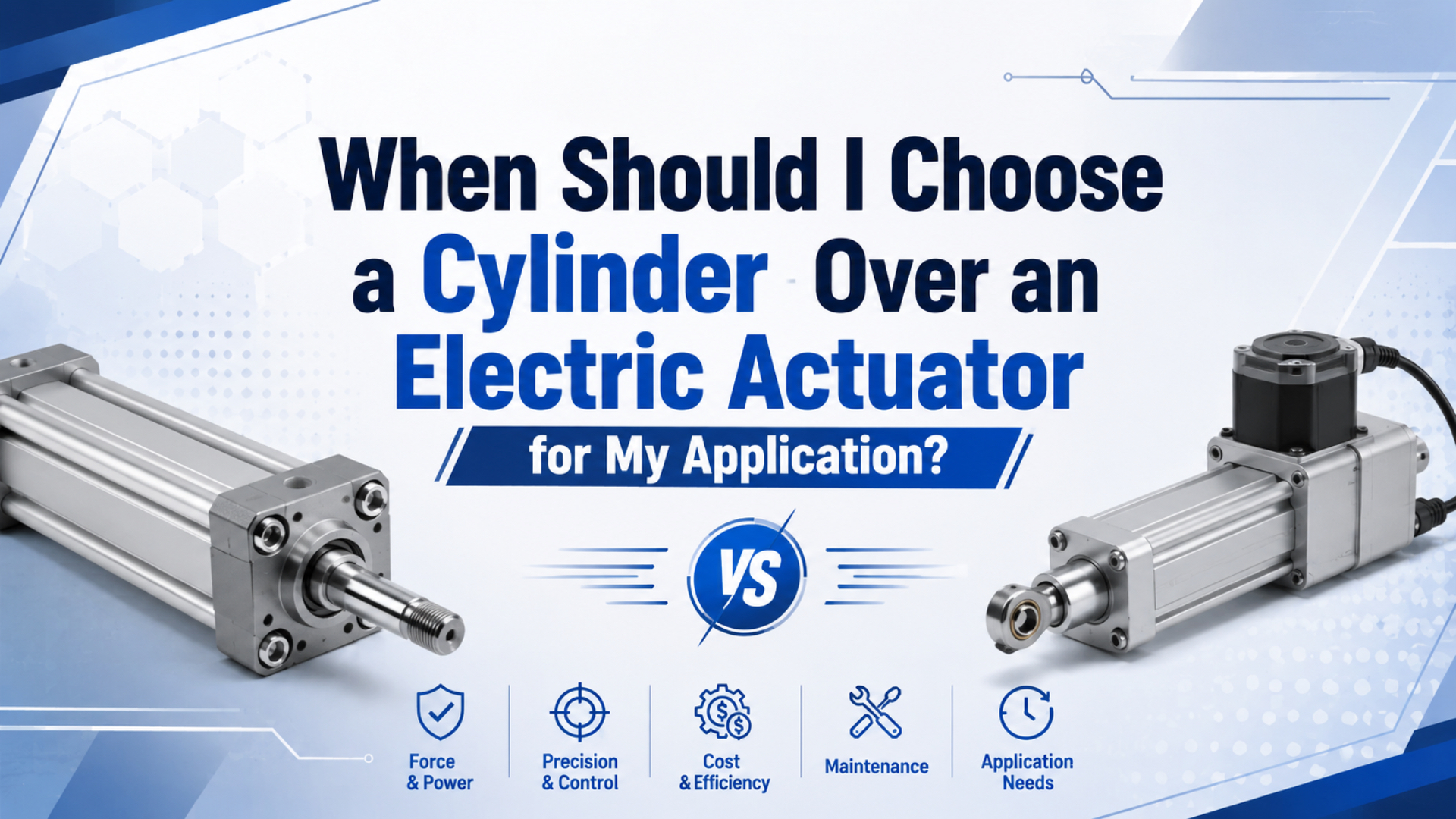
Choose a pneumatic cylinder over an electric actuator when the axis has two clear end positions, the plant already has stable compressed air, the required motion is fast and repetitive, and the process does not need programmable intermediate stops, force feedback, or recipe-based profiles. If those last controls matter, start the comparison with an electric actuator.
That is the practical answer. The deeper question is this: does the machine need controlled motion, or does it need reliable motion? Many costly actuator mistakes start when a simple extend-retract task is specified as a full motion axis, or when a programmable positioning task is reduced to “just add a cylinder.”
Pneumatic cylinder is a compressed-air linear actuator that moves a piston, rod, or carriage between positions. Electric actuator is a motor-driven axis that uses a screw, belt, or other transmission to control position, speed, and sometimes force. Two-position motion means the process only needs extend and retract, open and close, clamp and release, or push and return.
Key Takeaways
- ISO 15552 covers 10 bar pneumatic cylinders with 32-320 mm bores.
- Festo lists load, precision, dynamics, environment, and cost as the main actuator-selection criteria.
- Use a cylinder first for two-position motion; use electric first for programmable motion.
In our experience, the best first question is not “Which actuator is better?” It is “What would make this station reject a part?” If the reject condition is a missed hard stop, a cylinder may fit. If the reject condition is a missed profile, the actuator probably needs feedback.
Short Answer: Choose a Cylinder When the Motion Has Two Stops
ISO 15552 defines a pneumatic cylinder series for 1,000 kPa, or 10 bar, and bores from 32 mm to 320 mm. Choose a cylinder when that standardized air-powered motion can reach two physical end positions with the needed force, speed, and repeatability (ISO, 2025).
The clearest cylinder applications are mechanical. A gate opens. A clamp closes. A diverter shifts. A pusher ejects a carton. A stop pin rises. A slide moves to the end of stroke. In each case, the machine cares that the actuator reaches the end position and confirms it, not that it follows a programmed path.
Use this first screen:
- Choose a cylinder when extend and retract solve the task.
- Choose a cylinder when a hard stop defines final position.
- Choose a cylinder when speed and simple service matter more than stored profiles.
- Choose a cylinder when the plant air system is already sized and maintained.
- Choose electric when the axis needs many positions, coordinated motion, or feedback data.
For the category-level explanation, read the companion article on the difference between cylinders and actuators. This article is narrower. It decides when the cylinder should be your first option.
What Requirements Make a Cylinder the Better First Choice?
Festo lists load, precision, dynamic response, environment, and costs as the major factors in actuator selection, and says pneumatics fits fast, repetitive movements with clear end positions. A cylinder is the better first choice when those 5 factors point toward simple air-powered motion (Festo, retrieved 2026).
Start with the mechanical job. If the station only needs to move a known load between two positions, a cylinder can stay simple: cylinder, valve, tubing, fittings, flow controls, end sensors, and air preparation. That simplicity is the advantage. Do not add a servo-level solution unless the process needs servo-level control.
Typical cylinder-first jobs include:
- Product ejection from a fixture or conveyor pocket
- Clamp and release motion
- Gate, flap, or diverter actuation
- Stopper cylinders and locating pins
- Short-stroke pressing where force is pressure based
- Packaging transfer with clear end positions
- Long-stroke movement where a rodless cylinder or guided slide carries the load
Force is the first calculation. For a pneumatic cylinder:
Cylinder force = working pressure x effective piston area
1 bar = 0.1 N/mm2
For extension, use full piston area. For retraction, subtract the rod area. Then apply friction allowance, side-load reality, speed loss, and safety factor. A cylinder that looks large enough on force can still fail if the guide, valve flow, cushion, or mounting is wrong.
When Should You Switch From a Cylinder to an Electric Actuator?
Festo says electric drive technology is usually the obvious first choice when positions must be reached precisely or paths followed. AutomationDirect lists 3 common electric linear-actuator drive families: ball screw, lead screw, and belt driven (Festo, retrieved 2026; AutomationDirect, 2022).
Switch the first choice to electric when the application needs controlled motion rather than simple motion. In practice, this means programmable positions, acceleration ramps, synchronized axes, position logging, measured force, or stored recipes. A pneumatic cylinder can be upgraded with feedback and proportional control, but that also adds tuning and air-system sensitivity.
Use electric first when the process needs:
- More than two repeatable positions
- Position changes by product recipe
- Speed and acceleration profiles
- Force or torque limits with feedback
- Multi-axis coordination
- Traceable position or force data
- Low dependence on compressed-air quality
For detail on accuracy, repeatability, and the servo-pneumatic middle ground, use the cylinder vs electric actuator precision guide. This page focuses on when the station-level decision favors a pneumatic cylinder over an electric actuator.
How Do Cost and Energy Change the Decision?
Tolomatic frames actuator total cost of ownership as initial purchase plus yearly operating cost over service life, and states electric systems can operate around 70-80% efficiency while pneumatic systems are often 10-30% efficient. That does not make electric automatic; it makes the duty cycle important (Tolomatic, retrieved 2026).
A cylinder can still be the lower-cost choice when the air system already exists, the axis is intermittent, and the hardware stays simple. The quote may include a cylinder, valve, tube, fittings, sensors, and flow controls. If the station only cycles occasionally, the energy penalty may be smaller than the extra electric hardware and setup work.
However, pneumatic cost can rise when the cylinder is large, the stroke is long, the cycle rate is high, the pressure is raised, or the air system leaks. The low-cost part can become an expensive air consumer. That is why air demand must be calculated before a pneumatic choice is approved.
Use the cost articles for the broader model:
- For full TCO, see cost differences between cylinders and electric actuators.
- For air-system sizing, see how to calculate pneumatic flow rate.
- For force math, see the basic law of pneumatics.
What Safety and Environment Checks Come Before the Final Choice?
OSHA 1910.307 requires hazardous classified locations to be documented and requires electric equipment in those locations to be intrinsically safe, approved, or otherwise safe for the location. CAGI says well-designed compressed-air systems usually have no more than 10% pressure drop to point of use (OSHA, 2026; CAGI, 2022).
Do not write “pneumatic equals explosion-proof” into a specification. The cylinder body may remove a motor from the axis, but the installed system still includes solenoid valves, sensors, cable glands, manifolds, exhaust points, maintenance procedures, and grounding. The area classification comes first.
The same applies to washdown, dust, temperature, and chemicals. A cylinder can be a strong choice in harsh surroundings, but seals, rod wipers, guide rails, tubing, fittings, sensors, and valves must fit the exposure. An electric actuator can also be protected, but its motor, drive, feedback, connectors, and cables need the same review.
Use this environment checklist before final selection:
| Check | Cylinder question | Electric actuator question |
|---|---|---|
| Hazardous area | Are valves, sensors, exhaust, and fittings approved for the zone or division? | Are motor, cable, drive, and feedback devices approved? |
| Washdown | Are seals, grease, surface finish, and sensor mounting cleanable? | Are connectors, cable paths, and enclosure ratings suitable? |
| Dust | Are wipers, guides, and valve filtration specified? | Can the screw, belt, guide, and feedback survive contamination? |
| Heat | Are seals, lubrication, and tube finish rated for the real temperature? | Are motor, encoder, drive, and cable limits acceptable? |
| Maintenance | Can local staff replace seals, fittings, and valves? | Can local staff diagnose drives, encoders, and software faults? |
For a deeper environment review, use the dedicated article on environmental factors in actuator selection.
Cylinder-First Decision Matrix
CAGI recommends no more than 10% pressure drop from compressor discharge to point of use, while Festo warns that precision, energy use, load, dynamics, environment, and cost should not be judged in isolation. Use a matrix only after those system checks are visible (CAGI, 2022; Festo, retrieved 2026).
| Application condition | Choose cylinder first | Choose electric first |
|---|---|---|
| Position count | Two end positions | Many stored positions |
| Motion profile | Simple extend and retract | Controlled acceleration, path, or stop profile |
| Force requirement | Force can be set by pressure and bore | Force must be measured or logged |
| Air supply | Stable pressure and enough flow at the axis | No air supply, weak air supply, or high air cost |
| Environment | Simple hardware is easier to protect | Protected electric package is practical and needed |
| Maintenance skill | Mechanical and pneumatic service available | Motion-control support available |
| Changeover | Stops rarely change | Recipes change position or speed often |
| Data | End-position confirmation is enough | Position, force, current, or fault data is required |
This matrix also protects the related article set. The cost page handles detailed TCO. The environment page handles exposure. The precision page handles accuracy and repeatability. This page should answer the buyer’s immediate go/no-go question: “Can I choose the cylinder first?”
For long-stroke transfer jobs, compare the cylinder-first result with where rodless cylinders are used. A rodless cylinder may be the right answer when the application needs compact long travel but not programmable motion.
FAQ About Choosing a Cylinder Over an Electric Actuator
Festo’s actuator-selection guidance names 5 major factors: load, precision, dynamic response, environment, and costs. The FAQ below applies those same factors to the narrow question of when a cylinder should lead the comparison instead of an electric actuator (Festo, retrieved 2026).
Are pneumatic cylinders always faster than electric actuators?
No. Pneumatic cylinders are often strong for fast, repetitive end-to-end motion, but speed depends on bore, stroke, load, valve flow, tube length, pressure drop, cushioning, and exhaust path. Electric actuators can also move quickly when selected correctly, especially when profile control is needed.
Which technology is more precise?
Electric actuators usually lead when the axis needs programmable positions, repeatability, profiles, and feedback. A pneumatic cylinder can still repeat well against a hard stop. If precision is the main requirement, use the dedicated precision comparison before choosing.
Is a pneumatic cylinder automatically safer in hazardous areas?
No. A pneumatic cylinder can remove a motor from the moving axis, but the installed system may still include electrical valves, sensors, switches, and wiring. OSHA 1910.307 requires hazardous classified locations and electrical equipment choices to be documented and approved for the location.
When should I not choose a cylinder first?
Do not choose a basic cylinder first when the machine needs many programmed positions, synchronized axes, measured force, logged position data, frequent recipe changes, or controlled acceleration. Those requirements point toward electric motion or a carefully engineered servo-pneumatic system.
What should I calculate before approving a cylinder?
Calculate push force, pull force, safety-adjusted load, required flow, target stroke time, cushion energy, pressure drop, and air consumption. At minimum, check force with bore and pressure, then check flow with stroke, cycle time, valve size, and tube length.
What information should I send in an RFQ?
Send stroke, load, motion direction, target cycle time, required positions, tolerance, available pressure at the actuator, valve voltage, environment, mounting orientation, side load, guide method, safety classification, and photos or sketches. A load-path sketch prevents many wrong quotes.
Source links were reviewed on 2026-07-07. For an application review, prepare stroke, load, target cycle time, position tolerance, available pressure, environment, mounting orientation, side load, guide method, safety classification, and photos or sketches.
Sources
- ISO 15552:2018. Evidence role: 1,000 kPa or 10 bar pneumatic cylinder series and 32-320 mm bore range. Retrieved 2026-07-07.
- Festo, “Electric vs Pneumatic Actuators: How to Choose the Right Solution”. Evidence role: actuator-selection criteria and pneumatic/electric application boundaries. Retrieved 2026-07-07.
- AutomationDirect, “What are Electrical Actuators?”. Evidence role: electric actuator drive families and construction context. Retrieved 2026-07-07.
- AutomationDirect, “What is a Pneumatic Cylinder?”. Evidence role: pneumatic cylinder background video. Retrieved 2026-07-07.
- Tolomatic, “Total cost of ownership: pneumatic vs electric linear actuators”. Evidence role: TCO framing, service-life factors, and energy-efficiency comparison. Retrieved 2026-07-07.
- OSHA 1910.307, “Hazardous classified locations”. Evidence role: hazardous classified locations, documentation, and approved electrical equipment requirements. Retrieved 2026-07-07.
- CAGI, “Technical Brief on Pressure Drop”. Evidence role: 10% pressure-drop target and point-of-use compressed-air checks. Retrieved 2026-07-07.