

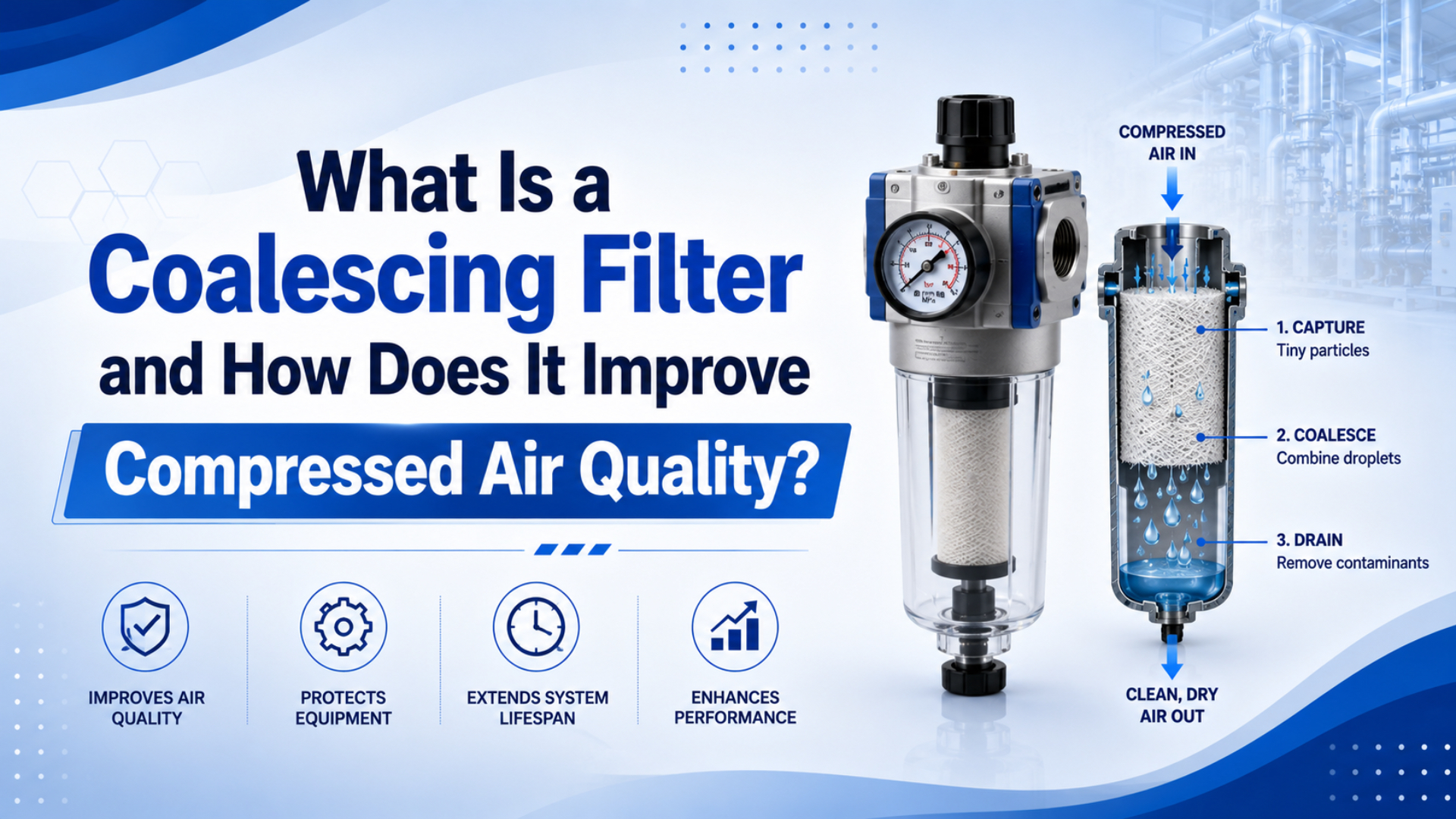
A coalescing filter is a compressed air filter that captures fine liquid aerosols, especially oil mist and water droplets, by forcing them through a fine media pack where small droplets merge into larger droplets and drain out of the bowl. It improves compressed air quality by reducing oil carryover, liquid contamination, and fine mist before the air reaches valves, cylinders, instruments, or product-contact equipment.
ISO 8573-1:2010 classifies compressed air purity by particles, water, and oil, and ISO states that those classes apply regardless of where the air is specified or measured in the compressed air system (ISO, 2010). A coalescing filter is one tool for meeting the oil and liquid-aerosol part of that target. It is not a dryer, and it should not be specified as a device that removes water vapor or controls pressure dew point.
Key Takeaways
- A coalescing filter removes oil aerosol, liquid water droplets, and fine mist, but it does not dry compressed air vapor.
- Start with an ISO 8573-1 particle:water:oil target, then choose the filter grade and location.
- Watch pressure drop: CAGI says well-designed systems should keep total pressure drop under 10%.
How Does a Coalescing Filter Remove Oil Aerosol?
A coalescing filter removes oil aerosol by making tiny liquid droplets collide with fibers inside the element, merge into larger droplets, and drain to the filter bowl. ISO 8573-1 separates compressed air purity into particles, water, and oil, so the practical job of a coalescing filter is not “general cleanliness.” It is aerosol and liquid removal within a defined air-quality target (ISO, 2010).
The process has three parts:
- Air enters the filter and passes through a fine media pack.
- Oil mist and liquid water droplets impact, intercept, or diffuse into the fiber structure.
- The captured droplets coalesce, grow heavier, move to the drainage layer, and leave through the bowl drain.
That boundary matters. A coalescing filter can remove liquid oil mist. It can remove entrained water droplets. It can reduce fine aerosols that would otherwise move downstream into air filters, valve manifolds, sensors, or pneumatic cylinders. It cannot remove dissolved water vapor in the way a refrigerated dryer, membrane dryer, or desiccant dryer controls dew point.
Oil aerosol means tiny suspended liquid oil droplets carried in the compressed air stream. Differential pressure means the pressure loss from filter inlet to filter outlet. Those two terms belong together because a finer element can improve aerosol capture while also increasing restriction. Good selection balances both.
The most useful way to specify a coalescing filter is not “add a 0.01 micron filter.” A better note names the contaminant, the air-quality target, the rated flow, the operating pressure, the acceptable clean pressure drop, and the replacement trigger. That turns a catalog choice into a maintainable system requirement.
What Contaminants Should a Coalescing Filter Handle?
A coalescing filter should handle liquid aerosols and fine mist, especially oil aerosol and entrained water droplets. ISO 8573-1 identifies particles, water, and oil as the main compressed-air purity classes, but one filter element does not control all three contaminant groups equally (ISO, 2010).
Use this boundary before selecting equipment:
| Contaminant | Coalescing filter role | What may still be needed |
|---|---|---|
| Oil aerosol | Primary use case: captures fine liquid oil mist from compressor carryover or contaminated pipework. | Activated carbon or other polishing stage if oil vapor or odor must be controlled. |
| Liquid water droplets | Captures entrained droplets after cooling, separation, or condensation. | Dryer and drain strategy when water vapor or pressure dew point is the problem. |
| Solid particles | Captures some fine particles, but loading can shorten element life. | Upstream particulate prefilter for rust, scale, and bulk dirt. |
| Water vapor | Not the right control device. | Refrigerated, membrane, or desiccant dryer based on dew point target. |
| Oil vapor | Not the same as oil aerosol. | Adsorption media or activated carbon where the process requires it. |
This is where many compressed air systems are overpromised. If the problem is liquid water after a night shift, a coalescing filter may collect some droplets, but it does not fix a warm wet air line that condenses downstream. If the problem is oil smell or vapor in a clean process, a coalescing filter may reduce liquid oil aerosol, but it may not meet the total oil requirement alone.
For pneumatic motion, the practical warning signs are familiar: sticky solenoid valves, drifting regulator settings, wet bowls, rust at manual drains, swollen seals, contaminated mufflers, and speed changes that reappear after every repair. Those symptoms call for air-quality checks at the machine, not only at the compressor room.
Which Coalescing Filter Grade Fits the Application?
The right coalescing filter grade depends on air demand, pressure, and the required air quality. CAGI says compressed-air equipment selection starts with demand in cfm, pressure in psig, and air quality, and notes that direct product-contact applications require stricter quality than general plant air (CAGI, 2026).
Start with the application, then choose the grade:
| Application | Typical filtration intent | Selection note |
|---|---|---|
| General machine air | Protect valves and cylinders from fine mist and small liquid carryover. | Use a particulate prefilter when the line has rust or scale. |
| Valve island or actuator manifold | Keep oil mist and liquid droplets out of small spool clearances. | Size for peak machine flow, not average compressor output. |
| Painting, electronics, packaging, food, pharma | Reduce oil aerosol and support a documented air-quality target. | Confirm ISO 8573-1 class, test method, and acceptance point. |
| Dryer protection or downstream polishing | Protect membrane dryers, desiccant beds, or final filters from oil aerosol. | Place the filter where the equipment supplier specifies. |
| Legacy oily pipework | Reduce carryover from old lubricated branches. | Expect shorter element life until the branch is cleaned or isolated. |
Do not copy a filter grade from another machine unless the duty is the same. A small test bench, a high-cycle pick-and-place line, and a product-contact air knife may all use compressed air, but they do not carry the same contamination risk.
For a written specification, include:
- Required ISO 8573-1 particle:water:oil target.
- Normal and peak flow rate.
- Operating pressure and minimum acceptable point-of-use pressure.
- Expected inlet temperature and condensate load.
- Compressor type and whether oil-lubricated equipment is used.
- Existing dryer type and dew point target.
- Maximum acceptable clean pressure drop and replacement pressure drop.
- Bowl material, drain type, port size, and mounting orientation.
In field reviews, the biggest quoting gap is peak flow. A purchasing request often says “1/2 inch coalescing filter,” but the machine problem is a short high-flow cylinder stroke through a valve bank. Port size alone does not prove the element can pass the air without pushing the point-of-use pressure below the actuator requirement.
How Do Pressure Drop and Flow Capacity Affect Filter Selection?
Pressure drop affects filter selection because every restriction must be paid for by compressor pressure or machine performance. CAGI says every 2 psig of excess operating pressure increases compressor power by approximately 1%, and a well-designed system should have no more than 10% pressure drop from compressor discharge to the final point of use (CAGI, 2026).
A coalescing filter creates pressure drop even when clean. As the element loads with oil, water, and particles, the differential pressure rises. If maintenance teams ignore it, the compressor room may still show acceptable pressure while the valve manifold sees low pressure during motion.
Use these checks before buying:
- Convert the machine’s peak demand to the same flow unit used in the filter datasheet.
- Check the filter’s rated flow at the actual operating pressure.
- Compare clean pressure drop at that flow, not only the port size.
- Set a replacement trigger based on differential pressure or manufacturer guidance.
- Confirm the downstream regulator still has enough inlet pressure during peak demand.
The wrong solution is raising plant pressure to hide a dirty or undersized element. That can make the filter problem invisible while increasing compressor energy use and leakage. If pressure must be raised to keep a cylinder moving, test the filter, dryer, pipe, fittings, valve, and tube path before changing the compressor setpoint.
Use that calculator for the branch and treatment path, not as a substitute for a manufacturer’s filter-element test curve. Filter pressure drop depends on the element design, contaminant loading, bowl design, and rated conditions.
Where Should a Coalescing Filter Sit in the Air Treatment Train?
A coalescing filter should sit where it protects downstream equipment from liquid aerosol without being overloaded by bulk liquid, rust, or scale. The U.S. Department of Energy lists compressed-air air-quality and maintenance resources as tools for improving system performance and saving energy, which is a good reminder that filtration is part of a system, not a standalone fitting (DOE, 2026).
A practical treatment train often looks like this:
- Compressor and aftercooler.
- Receiver tank with reliable condensate drain.
- Bulk water separator or prefilter if the line carries liquid water.
- Dryer selected for the pressure dew point target.
- Particulate prefilter for rust and scale.
- Coalescing filter for oil aerosol and fine liquid mist.
- Activated carbon or final filter only when the process needs it.
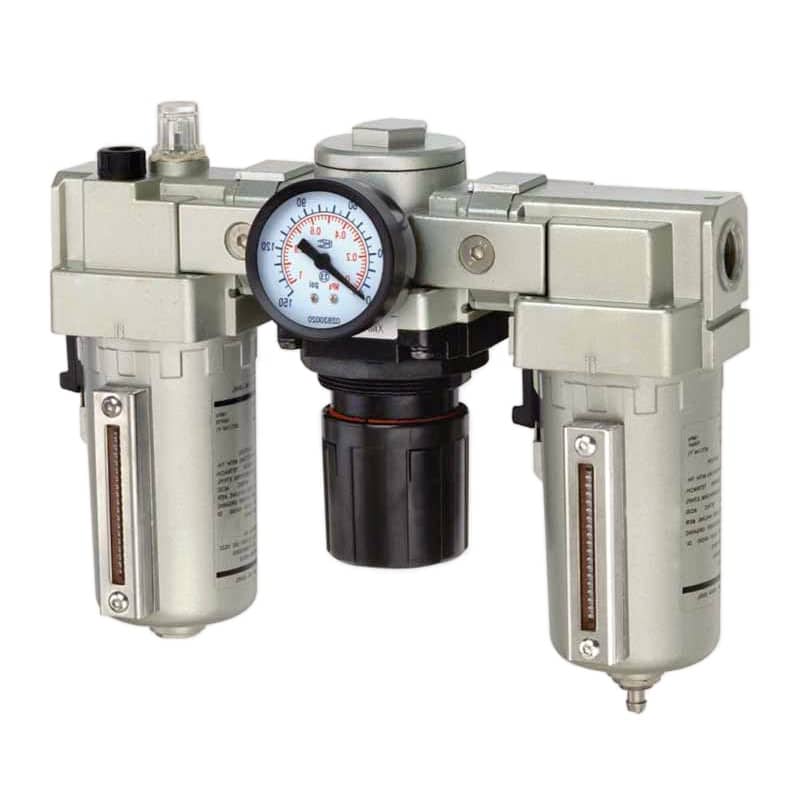
- Local filter regulator or FRL unit before the machine.
- Valve manifold and actuator.
There is no universal location that fits every plant. Some systems need a main coalescing filter near the dryer. Some need a point-of-use filter at the machine. Critical applications may use both. The rule is simple: protect the element from bulk contamination, then verify the result where the machine actually uses air.
If your real issue is dew point, use the related guide on pressure dew point in pneumatic systems. If your issue is system pressure loss, use the guide on pressure drop in pneumatic systems. A coalescing filter may appear in both problems, but it should not be blamed for all air-quality failures.
How Should You Maintain a Coalescing Filter?
Maintain a coalescing filter by tracking differential pressure, draining liquid reliably, replacing the element before restriction becomes excessive, and checking whether the upstream system is overloading the element. CAGI specifically warns that dirty or undersized filters can create restrictions and pressure drops in compressed air systems (CAGI, 2026).
Use this maintenance routine:
| Check | What to record | Why it matters |
|---|---|---|
| Clean differential pressure | Baseline inlet-outlet pressure drop after new element installation. | Gives maintenance a real comparison point. |
| Loaded differential pressure | Reading during normal and peak flow. | Shows element loading and hidden capacity loss. |
| Drain function | Automatic drain cycle, manual drain result, bowl liquid level. | A flooded bowl can carry liquid downstream. |
| Bowl and seal condition | Cracks, chemical attack, leaks, loose fittings. | Prevents safety and bypass problems. |
| Upstream contamination | Wet receiver, failed dryer, rusted pipe, dirty prefilter. | Stops the same element from failing again. |
| Replacement record | Date, operating hours, pressure drop, reason for change. | Builds a plant-specific service interval. |
Do not rely only on calendar replacement. A lightly loaded instrument-air branch may run much longer than a dirty legacy line with oil carryover and rust scale. The better trigger is a combination of differential pressure, manufacturer guidance, inspection data, and application risk.
Also check the drain. A coalescing element is designed to move captured liquid out of the media and into the bowl. If the bowl stays full, the filter can re-entrain liquid or force air through a saturated path. That is especially risky ahead of small valve islands, proportional valves, flow controls, and precision regulators.
For actuator troubleshooting, record pressure before and after the filter while the machine is moving, not only while it is idle. Many pressure-drop complaints disappear at idle because the filter is passing very little flow. The restriction appears when multiple cylinders stroke, a blow-off cycle starts, or a valve bank opens at once.
What Data Should You Send for a Coalescing Filter RFQ?
Send operating flow, pressure, ISO 8573-1 target, contaminant risk, and installation details when requesting a coalescing filter quotation. CAGI’s three starting parameters for compressed-air equipment selection are demand, pressure, and air quality, and those map directly to the RFQ data a supplier needs (CAGI, 2026).
Use this RFQ checklist:
| RFQ item | Example value | Why the supplier needs it |
|---|---|---|
| Application | Valve island for packaging machine | Shows whether the risk is motion reliability or product contact. |
| Flow demand | 350 L/min normal, 700 L/min peak | Prevents undersizing by average flow. |
| Operating pressure | 6 bar at machine inlet | Sets density, rated flow, and regulator margin. |
| Required air quality | ISO 8573-1 target at machine inlet | Defines the performance outcome, not just the part number. |
| Compressor type | Oil-lubricated screw compressor | Indicates oil aerosol risk. |
| Dryer type and dew point | Refrigerated dryer, 3 deg C pressure dew point | Separates vapor control from filter duty. |
| Upstream filtration | 5 um particulate prefilter | Tells whether the coalescing element will be protected from solids. |
| Installation | Vertical bowl, automatic drain, metal guard | Confirms layout, safety, and service access. |
| Replacement policy | Differential-pressure indicator required | Helps maintenance catch loading before production faults. |
If the project is for food, pharmaceutical, electronics, paint, or other sensitive service, add the process owner’s written acceptance criteria. The FDA describes current good manufacturing practice regulations as minimum requirements for methods, facilities, and controls used in manufacturing, processing, and packing drug products (FDA, 2025). That does not mean a coalescing filter automatically makes an air line compliant. It means the air-treatment decision should be documented, verified, and approved within the process quality system.
For Bepto Pneumatic RFQs, include photos of the current treatment assembly, the port size, flow demand, pressure setting, drain type, and any failed element markings. If the filter protects rodless cylinders, valve manifolds, or air source treatment units, include the downstream component list so the review can balance cleanliness and pressure drop.
In our experience, coalescing-filter mistakes are usually found in the RFQ data, not in the media grade. We found the same pattern when reviewing pneumatic air-preparation requests: teams often send the port size but omit peak flow, clean differential pressure, and dryer status. From our analysis, those three missing fields explain why a filter that looks correct on paper becomes a pressure-drop fault during a cylinder stroke.
How Is a Coalescing Filter Different From a Dryer?
A coalescing filter removes liquid aerosols and droplets, while a dryer controls water vapor by lowering the pressure dew point or removing moisture before condensation happens. ISO 8573-1 treats water as its own compressed-air purity group, which is why water vapor control should not be hidden inside an oil-removal filter specification (ISO, 2010).
Here is the practical difference:
| Device | Main job | Common mistake |
|---|---|---|
| Coalescing filter | Remove oil aerosol and entrained liquid droplets. | Expecting it to dry vapor-saturated air. |
| Particulate filter | Remove solid dirt, rust, and scale. | Using it as the only protection against oil mist. |
| Refrigerated dryer | Reduce pressure dew point for general plant air. | Expecting it to remove downstream oil aerosol. |
| Desiccant dryer | Achieve lower dew point for cold or critical service. | Ignoring oil carryover that damages the desiccant bed. |
| Activated carbon filter | Reduce oil vapor or odor in selected applications. | Installing it without upstream aerosol protection. |
If water droplets appear downstream of a coalescing filter, inspect the whole route. A failed automatic drain, saturated element, high inlet temperature, bad dryer bypass, low pipe section, or uninsulated cold branch can all create liquid downstream. Replacing the coalescing element may help temporarily, but it will not solve a dew point problem by itself.
This is also why an ISO air-quality note is stronger than a part-number note. “Use coalescing filter” describes hardware. “ISO 8573-1 particles:water:oil target measured before the valve manifold” describes the outcome the hardware must deliver.
When Does a Coalescing Filter Improve Pneumatic Reliability?
A coalescing filter improves pneumatic reliability when oil mist or liquid carryover is causing valve sticking, seal contamination, blocked small passages, unstable regulation, or process contamination. CAGI notes that compressed-air system design should consider air quality along with pressure and demand, because stricter applications need stricter quality (CAGI, 2026).
Look for these symptoms:
- Oil film in tubing, manifolds, or exhaust mufflers.
- Wet filter bowls after the dryer or at the machine.
- Solenoid valves sticking after short service intervals.
- Fine pneumatic controls drifting or becoming slow.
- Cylinder speed changes that return after cleaning.
- Product-contact air complaints after compressor or pipework changes.
- Pressure drop rising across the air-treatment unit.
The filter improves reliability only if it addresses the actual contaminant path. If the root cause is undersized tubing, blocked mufflers, poor valve Cv, or low compressor capacity, cleaner air will not fix the motion fault. If the root cause is oil aerosol, however, a correctly placed and maintained coalescing filter can protect the small clearances that make pneumatic control repeatable.
For motion-related checks, connect air quality to actuator behavior. Rodless cylinder systems are especially sensitive because seal friction, guide contamination, and pressure loss all show up as carriage instability. Cleaner air helps, but only when pressure, flow, and mechanical loading are also correct.
What Mistakes Should You Avoid When Selecting a Coalescing Filter?
The biggest mistakes are treating the filter as a dryer, choosing by port size, ignoring clean pressure drop, skipping the prefilter, and failing to define the ISO 8573-1 target. ISO’s standard covers contaminant classes, while CAGI warns that dirty or undersized filters increase restriction and pressure drop (ISO, 2010; CAGI, 2026).
Avoid these decisions:
- Specifying “best filter” without an air-quality class. A stricter element can add pressure drop without solving the real failure.
- Using port size as the main selection variable. Two filters with the same port can have very different rated flow and element area.
- Skipping the particulate prefilter in dirty pipework. Rust and scale can load the coalescing element quickly.
- Leaving the drain unverified. A full bowl can undo the work of the media.
- Installing after a point where condensation still forms. Vapor can condense downstream if the dew point is not controlled.
- Replacing filters by habit only. Differential pressure tells you whether the actual system is loading the element.
- Raising compressor pressure to mask restriction. That can increase energy use while the root cause remains.
The safer approach is slower at the start but faster in service: define the target, measure the flow, check the pressure margin, protect the element, install a drain that maintenance can trust, and record differential pressure from day one.
Conclusion
A coalescing filter improves compressed air quality by removing oil aerosol and liquid droplets before they reach sensitive pneumatic components. It supports ISO 8573-1 oil and liquid-contamination targets, but it does not replace a dryer for water vapor or a carbon stage for oil vapor. That distinction prevents overbuying, underdrying, and pressure-drop problems.
For a reliable system, specify the air-quality target, flow, pressure, acceptable pressure drop, element replacement trigger, drain type, and measurement point. CAGI’s pressure-drop guidance makes the maintenance side clear: restrictions cost energy and reduce point-of-use pressure, so filtration has to be selected and monitored as part of the whole compressed-air path (CAGI, 2026).
FAQ
Does a coalescing filter remove water vapor?
No. A coalescing filter removes liquid water droplets and mist, not water vapor. ISO 8573-1 treats water as its own air-quality category, so vapor control should be handled by a dryer and verified by pressure dew point. Use the coalescing filter for liquid aerosols, not as a dryer replacement.
What is the difference between a coalescing filter and a particulate filter?
A particulate filter mainly removes solid dirt, rust, and scale. A coalescing filter is designed to capture liquid aerosols such as oil mist and fine water droplets, then drain the collected liquid. Dirty systems often need both: a particulate prefilter first, followed by the coalescing element.
Should a coalescing filter be installed before or after a dryer?
Follow the dryer and filter manufacturer’s installation order, but the common goal is clear: remove bulk liquid and particles before they overload the fine element, and protect dryers or downstream equipment from oil aerosol where required. Final placement depends on compressor type, dryer design, dew point target, and point-of-use air quality.
How often should a coalescing filter element be replaced?
Replace it based on differential pressure, manufacturer guidance, drain condition, operating hours, and application risk. A clean branch and a dirty legacy line will not load the same way. Record the clean baseline pressure drop after installation, then change the element before restriction affects point-of-use pressure or air quality.
Can a coalescing filter make compressed air suitable for food or pharmaceutical use?
Not by itself. A coalescing filter can reduce oil aerosol and liquid contamination, but food and pharmaceutical applications need a documented air-quality target, validated installation, maintenance records, and process approval. FDA cGMP expectations are about controlled methods, facilities, and systems, not a single filter part number.
Why did pressure drop rise after installing a finer coalescing filter?
Finer media can create more restriction, especially at high flow or when loaded with oil, water, and particles. CAGI notes that dirty or undersized filters cause restrictions and pressure drops. Check rated flow at operating pressure, upstream prefiltration, drain function, and element loading before increasing compressor pressure.
Sources
Use the source list below to separate coalescing-filter selection from ISO 8573-1 class selection, pressure dew point, and general pressure-drop troubleshooting.