

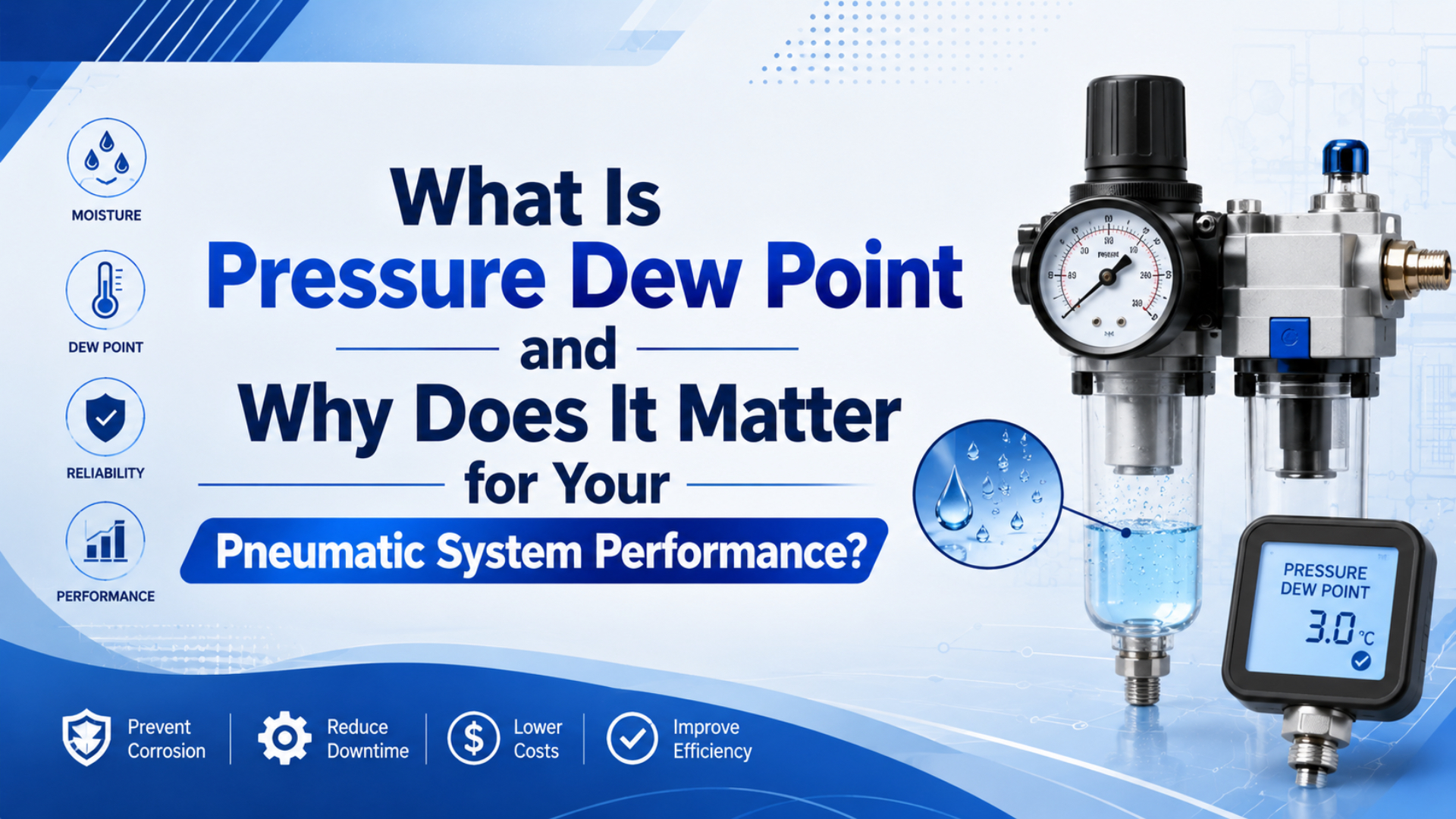
Pressure dew point is the temperature at which water vapor starts to condense in compressed air at its actual line pressure. AMS defines dewpoint as the temperature required for saturation at constant pressure and water vapor content (AMS Glossary, 2026). In a pneumatic system, that definition becomes practical: if the pipe, valve manifold, or actuator sees a temperature below the pressure dew point, liquid water can appear where the machine needs dry air.
That is why pressure dew point should be treated as a point-of-use acceptance value, not only a dryer catalog number. A dryer outlet may be dry while an old branch line, wet receiver, blocked drain, or undersized local filter still sends water toward the valve island.
Key Takeaways
- Pressure dew point is a compressed-air moisture limit at line pressure, not a comfort-humidity number.
- ISO 8573-1 classifies compressed air by particles, water, and oil, independent of where the air is specified or measured.
- CAGI recommends no more than 10% pressure drop from compressor discharge to point of use, so dryer and filter choices must be checked for moisture and flow loss.
In our experience, the hard failures rarely come from a team “forgetting” dryers exist. They come from a missing acceptance point. If the drawing says “dry air” but not pressure dew point, location, flow condition, and lowest ambient temperature, maintenance teams end up guessing.
What Is Pressure Dew Point?
Pressure dew point is dew point measured at the compressed-air line pressure. AMS defines dewpoint as the temperature at which an air parcel reaches saturation at constant pressure and water vapor content (AMS Glossary, 2026). In plant air, the useful question is direct: will this line ever cool below that temperature?
Atmospheric dew point describes air at atmospheric pressure. Pressure dew point describes the compressed air while it is still inside the pressurized network. That distinction matters because a dryer, receiver, drop leg, regulator, valve manifold, or actuator can all sit at different pressures and temperatures.
Do not ask only, “What dryer do we have?” Ask where the air is accepted. A dryer outlet value is useful, but the machine cares about the air after the receiver, distribution pipe, local treatment, and hose run.
Field Definition
For pneumatic troubleshooting, define pressure dew point this way:
| Term | Practical meaning | What to record |
|---|---|---|
| Pressure dew point | Condensation threshold at line pressure | temperature, pressure, measuring point |
| Atmospheric dew point | Condensation threshold after expansion to atmosphere | useful for comparison, not machine acceptance |
| Frost point | Dew point below freezing where ice can form | critical for outdoor or cold-room lines |
| Point-of-use dew point | Actual moisture condition near the machine | acceptance value for valves and actuators |
If a specification says only “dry air,” it is incomplete. A useful note says, for example, “pressure dew point at machine inlet shall remain below the lowest expected ambient temperature during normal flow.”
Pressure Dew Point vs Atmospheric Dew Point
Pressure dew point stays tied to the pressure at the measuring point. Atmospheric dew point describes the same gas after release to ambient pressure. ISO 8573-1 is built around compressed-air purity, and ISO says it applies independent of where air is specified or measured (ISO 8573-1, 2010).
Avoid fixed pressure-dew-point to atmospheric-dew-point conversions unless the water content, temperature, pressure, and measurement method are defined. A single conversion sentence can become wrong when the inlet condition changes.
The safer engineering rule is simpler: compare the pressure dew point at the machine to the coldest surface the compressed air will touch. If the line, manifold, or actuator body gets colder than the pressure dew point, water can condense inside the system.
Which Pressure Dew Point Should a Pneumatic System Specify?
Specify pressure dew point from application risk, lowest ambient temperature, and measurement location. ISO 8573-1 specifies compressed-air purity classes for particles, water, and oil, independent of where the air is specified or measured (ISO 8573-1, 2010). That means the note must name the acceptance point.
A general indoor factory line may only need enough drying to prevent liquid water at normal room temperature. Outdoor lines, cold rooms, high-speed valves, electronics, food contact, painting, and pharmaceutical equipment need a lower pressure dew point because condensation, ice, or product contamination creates more risk.
Use this selection map before choosing a dryer:
| Application condition | Dew point decision | Practical reason |
|---|---|---|
| Warm indoor plant air | Keep pressure dew point below the coldest pipe temperature | prevent liquid water in receivers and branches |
| Outdoor or cold-room pneumatic lines | Specify margin below the lowest expected ambient temperature | prevent freezing in valves, silencers, and small orifices |
| Precision valves or rodless actuators | Measure near the valve manifold or actuator supply | protect seals, guides, and switching consistency |
| Food, beverage, electronics, or painting | Match customer, process, and ISO air-quality requirements | avoid product contamination and quality defects |
| Critical clean process | Require documented monitoring and alarm limits | prove ongoing compliance, not only startup performance |
This is also where the article should link back to the broader ISO air quality standards guide. That article covers the full particles:water:oil class language. This article should stay narrower: water, dew point, dryer choice, and point-of-use verification.
How Does High Pressure Dew Point Damage Pneumatic Equipment?
High pressure dew point matters because condensed water becomes a mechanical and energy problem. Festo lists corrosion, blocked orifices, increased pressure losses, unstable switching behavior, and microbial risk as consequences of water in compressed air (Festo, 2026).
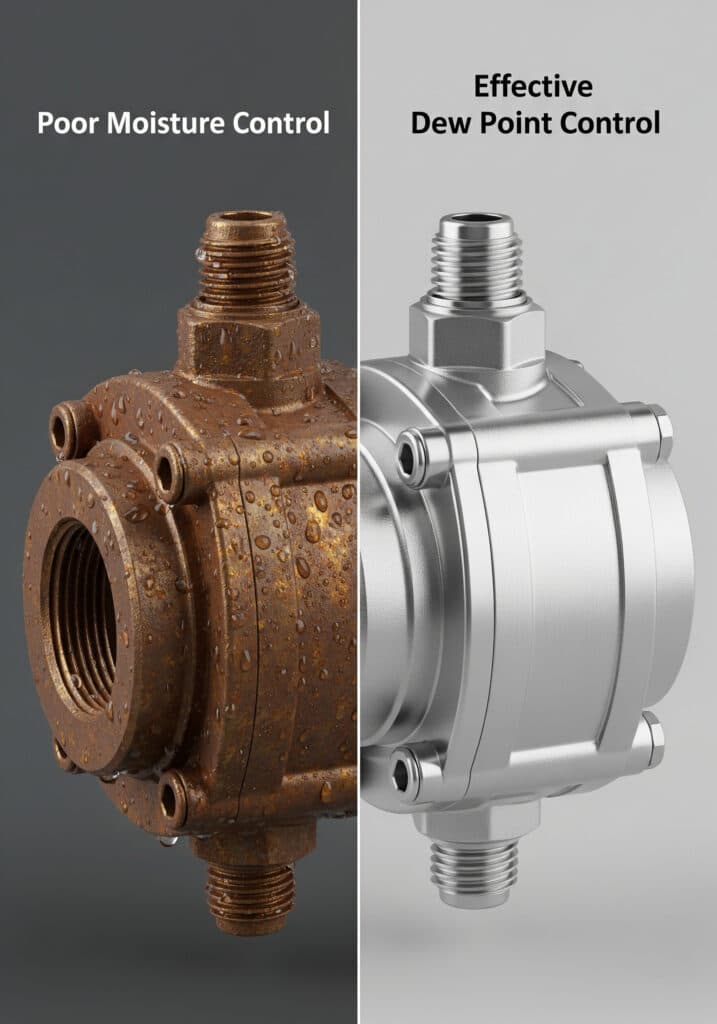
Water causes trouble in several places:
- Steel receivers and pipework: corrosion forms rust particles that travel downstream.
- Valve islands: small spool clearances and pilot passages can stick or switch slowly.
- Cylinders and rodless cylinders: seals, guides, and bearings see more friction and wear.
- Silencers and exhaust controls: moisture and debris can block exhaust paths.
- Cold areas: trapped water can freeze in narrow passages.
- Filters and dryers: loaded elements add pressure drop, which can push operators to raise system pressure.
CAGI says every 2 psig of excess operating pressure increases compressor power consumption by about 1%, and it recommends no more than 10% pressure drop from compressor discharge to any point of use (CAGI, 2026). That is why moisture control and pressure control belong in the same review.
When we review slow or erratic actuator complaints, the failed component is only the start of the diagnosis. Rust on a fitting, water in a bowl, pressure drop across a dirty filter, and condensate after a night shift tell a better story than the cylinder alone.
For rodless cylinders, moisture risk is especially visible because the actuator often has long travel, external guide load, and repeated cycling. A dry supply will not fix a side-load problem, but a wet supply can make every other issue harder to separate.
Dryer Selection for Dew Point Targets
Dryer selection should follow the required pressure dew point, flow, pressure drop, and maintenance model. CAGI says compressed-air equipment sizing depends on 3 parameters: demand in cfm, pressure in psig, and air quality (CAGI, 2026).
Festo lists water separators, refrigeration dryers, adsorption dryers, and membrane dryers as moisture-removal options, and notes that the correct technology depends on required pressure dew point and operating environment (Festo, 2026).
| Dryer or treatment stage | Best fit | Watch point |
|---|---|---|
| Separator and automatic drain | bulk liquid water after receiver or cooler | does not remove water vapor to a low dew point |
| Refrigerated dryer | general indoor plant air where freezing is not a risk | limited by cooling temperature and drain performance |
| Desiccant dryer | low pressure dew point, cold areas, or critical dry air | purge air, regeneration energy, and prefilter condition |
| Membrane dryer | smaller point-of-use dry-air demand | flow loss and installation conditions |
| Final filter or coalescing filter | particle and aerosol removal after drying | pressure drop and element replacement interval |
Do not buy the lowest dew point number by default. A very dry specification can add purge demand, pressure drop, maintenance cost, and monitoring needs. Use the lowest dew point that protects the actual process. Then verify it where the air is used.
Measurement Points for Pressure Dew Point
Measure pressure dew point at the location where the air-quality promise is made. ISO 8573-1 says compressed-air purity classes apply independent of the location where air is specified or measured (ISO 8573-1, 2010). A dryer outlet reading alone does not prove the valve manifold receives dry air.
Use more than one measuring point when failures are intermittent:
- Dryer outlet: proves the dryer can produce the expected condition.
- After receiver or main filter: catches carryover, drain, and storage issues.
- End of distribution branch: catches wet pipework and low points.
- After local filter regulator: checks the final treatment stack.
- Before valve manifold: ties the value to the component that fails.
Festo specifically calls out dew point monitoring as a maintenance task for verifying dryer performance and maintaining required moisture levels (Festo, 2026). That monitoring is most useful when the measurement point is written down.
The same logic applies to pressure. If the cylinder is weak, test dynamic pressure while it moves. Static gauge pressure can look fine while the flow path collapses under demand. The pressure fluctuation guide covers that side of the diagnosis.
How Should You Troubleshoot a Pressure Dew Point Failure?
Troubleshoot pressure dew point by separating dryer capacity, condensate removal, distribution contamination, local pressure drop, and measurement error. CAGI identifies undersized or dirty air-treatment equipment, especially filters, as a source of significant pressure drop (CAGI, 2026). That restriction can appear at the same time as moisture carryover.
Start with evidence, not assumptions:
| Symptom | Likely checks | What it may mean |
|---|---|---|
| Water after night shift | drains, receiver, pipe slope, low points | condensate is collecting when flow stops |
| Dew point alarm only at peak demand | dryer sizing, inlet temperature, flow profile | dryer is overloaded during high cfm periods |
| Good dryer reading, wet machine inlet | branch pipe, receiver, local bowl, hose route | water enters downstream of the dryer |
| High differential pressure across filter | element loading, wrong grade, undersized housing | air is dry enough but flow is restricted |
| Valve sticking plus rust debris | pipe corrosion, old steel drops, poor drains | water problem has become a particle problem |
The fastest field test is often a sequence test: check dew point and pressure before production starts, during peak demand, and after a temperature drop. One stable reading at noon does not prove the system is dry at 5 a.m. in a cold corner of the plant.
If the issue appears only after a new machine is added, review compressor compression ratio and pressure strategy before raising pressure. Higher pressure can increase artificial demand and energy cost, and it may hide the moisture fault instead of fixing it.
RFQ and Maintenance Checklist
A good pressure dew point RFQ names at least 4 items: target pressure dew point, measuring point, normal flow or peak demand, and lowest expected ambient temperature. CAGI says demand, pressure, and air quality must be clearly defined before compressed-air equipment decisions are made (CAGI, 2026).
Use this checklist before quoting dryers, filters, air source treatment units, or actuator replacements:
- Required pressure dew point at the machine inlet.
- Normal working pressure and unit system, such as bar, psi, MPa, or kPa.
- Average flow and peak flow during the real production cycle.
- Lowest ambient temperature around pipes, outdoor runs, and cold rooms.
- Current dryer type, model, service age, and alarm history.
- Receiver, drain, and filter maintenance records.
- Point-of-use pressure during actuator motion.
- Existing ISO 8573-1 particles:water:oil target if the customer has one.
- Photos of failed valves, cylinders, silencers, filters, bowls, and pipe low points.
For standard motion equipment, pair air-quality notes with actuator data: bore, stroke, load, tube length, valve size, cycle rate, and environment. The working pressure guide for air cylinders is the right internal reference when the complaint includes weak force or unstable speed.
If you are preparing a replacement review, include the moisture history in the request. A supplier can match a pneumatic cylinder more accurately when the cause is separated from symptoms such as rust, swelling seals, or blocked exhaust.
For project background, review Bepto’s pneumatic manufacturing and application support and send dew point, pressure, flow, and failed-part photos through the engineering contact page.
FAQs About Pressure Dew Point
Pressure dew point FAQs should not be answered as generic humidity advice. ISO 8573-1 treats water as one of 3 compressed-air contaminant groups, alongside particles and oil (ISO 8573-1, 2010). The practical answer always depends on pressure, measurement point, and application risk.
Is pressure dew point the same as atmospheric dew point?
No. Atmospheric dew point is measured or stated at atmospheric pressure. Pressure dew point is stated at the compressed-air line pressure where the system operates. Use pressure dew point for pneumatic equipment acceptance, because condensation risk is inside pipes, valves, filters, and actuator ports.
What happens if pressure dew point is too high?
If pressure dew point is above the coldest point in the air route, water can condense inside the system. That water can cause corrosion, rust particles, blocked orifices, unstable switching, higher pressure losses, and seal problems. In cold areas, the same moisture can freeze.
Can a filter fix a high pressure dew point?
Usually no. A filter can remove particles or liquid droplets, but a normal local filter does not lower water vapor content the way a dryer does. Use filters for particulate and aerosol control, and use the correct dryer technology when the problem is vapor-phase moisture or low dew point.
Where should I measure pressure dew point?
Measure at the point where the air-quality requirement is promised. For machine reliability, that is often after local treatment and before the valve manifold. Also check the dryer outlet, receiver outlet, and branch end when the dryer reading is good but the machine still shows moisture.
Should every pneumatic system use the lowest possible dew point?
No. The correct target is the lowest pressure dew point needed to prevent condensation, freezing, or product contamination in that application. A more severe target can add purge demand, pressure drop, controls, monitoring, and maintenance. Match the target to risk first.
Sources and Retrieval Notes
- AMS Glossary: Dewpoint, definition of dewpoint at constant pressure and water vapor content. Retrieved 2026-07-08.
- ISO: ISO 8573-1:2010 Compressed air, Part 1: Contaminants and purity classes, official standard page for compressed-air purity classes by particles, water, and oil. Retrieved 2026-07-08.
- CAGI: Working With Compressed Air, compressed-air sizing, energy, pressure-drop, and air-quality guidance. Retrieved 2026-07-08.
- Festo: Compressed air contamination, risks, impacts and solutions, practical contamination, dryer, monitoring, and maintenance guidance. Retrieved 2026-07-08.
- U.S. Department of Energy: Compressed Air Systems, compressed-air tools, training, publications, and system-performance resources. Retrieved 2026-07-08.
- YouTube: AIR QUALITY CLASSES ISO 8573 1, visual supplement for ISO 8573-1 air-quality class concepts. Retrieved 2026-07-08.