

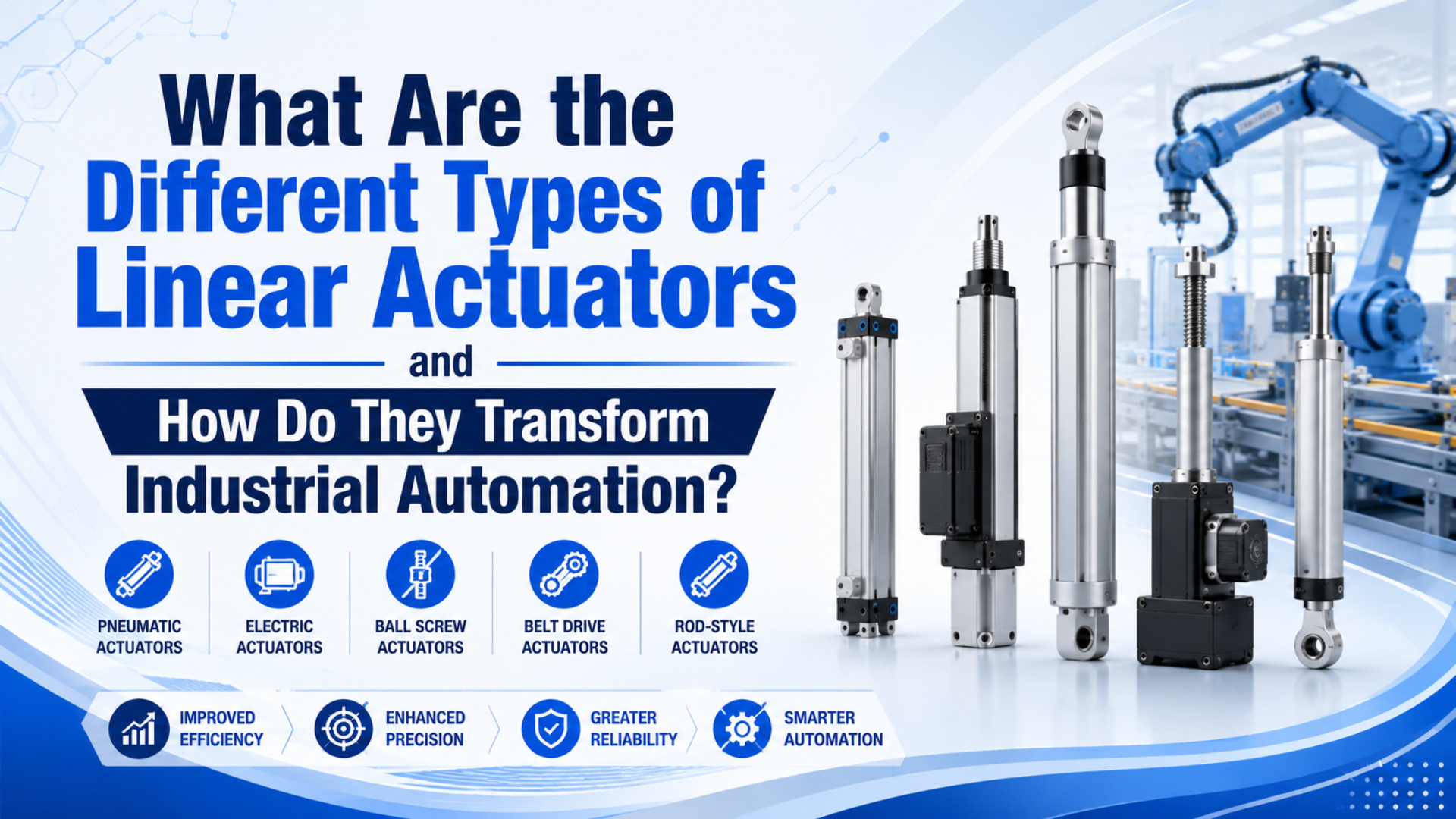
Linear actuator types can be grouped by how they create straight-line motion: pneumatic cylinders, rodless pneumatic actuators, electric screw or belt axes, hydraulic cylinders, servo-controlled axes, and specialty actuators such as stepper or voice-coil stages. The useful choice is not the longest list. It is the actuator family that matches force, stroke, speed, accuracy, environment, and control needs.
Festo states that there is no universally better actuator technology. The main selection factors are load, precision, dynamic response, environment, and costs (Festo, 2026). That is the frame for this article.
Key Takeaways
- Linear actuator types should be sorted by drive source, guidance, position control, and RFQ data.
- ISO 15552 covers 10 bar pneumatic cylinders with 32-320 mm bores.
- AutomationDirect lists three major electric linear actuator families: ball screw, lead screw, and belt driven.
- Parker lists OSP-P rodless cylinders with 10-80 mm bores and 6000 mm maximum standard stroke.
In our experience, the expensive mistake is treating “linear actuator” as one product category. It is really a motion requirement. A clamp, a pusher, a guided slide, a long transfer axis, and a servo inspection axis all move in a straight line, but they fail for different reasons.
This article is intentionally a taxonomy and RFQ map. For deeper pneumatic-family detail, use the existing pneumatic actuator guide. For the narrow cylinder-vs-electric decision, use when to choose a cylinder over an electric actuator.
Use manufacturer data and current standards when comparing actuator families; the right choice depends on load, stroke, duty cycle, environment, control target, and maintenance plan.
What Is a Linear Actuator?
A linear actuator is a device that converts energy into straight-line motion. AutomationDirect describes linear motion as movement on one X axis or multi-axis X-Y and X-Y-Z arrangements, with selection based on load, travel, intermediate stops, speed, and accuracy (AutomationDirect, 2022).
The energy source can be compressed air, hydraulic oil, an electric motor, a magnetic field, or a combined control package. The output may be a rod, carriage, table, guided slide, belt axis, screw axis, or rodless cylinder carrier.
Linear actuator is the parent category. Pneumatic cylinder is one air-powered linear actuator type. Electric linear actuator is usually a motor plus a screw, belt, or other mechanical transmission. Rodless actuator is a compact linear design where the moving carriage travels along the body instead of extending a rod outside the actuator.
That hierarchy matters in purchasing. If an RFQ only says “linear actuator,” the supplier must guess whether the application needs a simple two-position cylinder, a long rodless transfer, a high-force hydraulic cylinder, or a programmable electric axis.
Which Linear Actuator Types Should Be on the Shortlist?
Start with six families: pneumatic cylinders, rodless pneumatic cylinders, electric screw or belt actuators, hydraulic cylinders, servo-controlled axes, and specialty linear actuators. ISO 15552 gives one hard anchor for the pneumatic branch: 10 bar rated pneumatic cylinders with 32-320 mm bores (ISO 15552, 2025).
Use this table as a first-pass sorter, not as the final design:
| Linear actuator type | Drive source | Best first use | Main selection risk |
|---|---|---|---|
| Standard pneumatic cylinder | compressed air | clamp, push, eject, lift, stop | force loss from pressure drop, side load, bad mounting |
| Rodless pneumatic cylinder | compressed air | long stroke in limited space | guide moments, coupling load, exhaust flow |
| Electric ball screw actuator | motor and ball screw | accurate positioning under load | screw speed, duty cycle, alignment |
| Electric lead screw actuator | motor and lead screw | lower-cost adjustment or slower positioning | efficiency, wear, heat, speed limits |
| Electric belt actuator | motor and timing belt | long travel and high speed | belt stretch, load support, guarding |
| Hydraulic cylinder | pressurized oil | high force and compact power | leaks, maintenance, oil handling, controls |
| Servo or stepper linear axis | motor plus controller | profiles, recipes, feedback, multi-position work | programming, drive sizing, mechanical stiffness |
| Voice-coil or specialty stage | electromagnetic or custom | short-stroke high-response motion | stroke, heat, force range, cost |
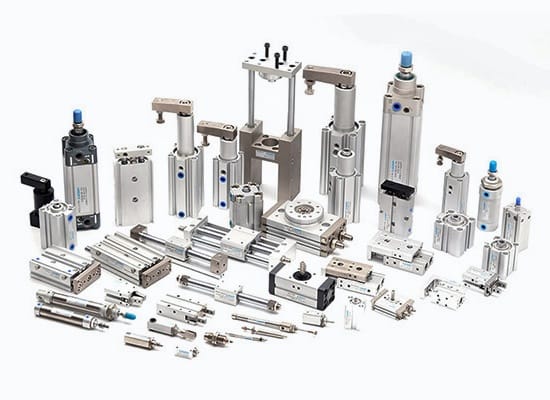
The mistake is ranking these from “best” to “worst.” Festo’s actuator-selection guidance is stricter: load, precision, dynamic response, environment, and costs decide the match. A simple pneumatic pusher can be the best actuator for one station and the wrong actuator for the next station on the same machine.
When Should You Choose Pneumatic Linear Actuators?
Choose pneumatic linear actuators when the task needs fast, simple, force-based motion with clear end positions. Festo describes pneumatics as suitable for fast repetitive movements with clearly defined end positions, while ISO 15552 standardizes many detachable-mounting cylinders at 10 bar and 32-320 mm bore sizes (Festo, 2026; ISO 15552, 2025).
Pneumatic cylinders are usually the first actuator to check for clamp and release, gate open and close, push and return, lift and lower, product eject, and stop-pin applications. They work well when the final position is defined by a hard stop, sensor, fixture, or mechanical datum.
The force check is straightforward:
Ideal cylinder force = working pressure x effective piston areaThe field check is less tidy. Usable force changes with pressure drop, back pressure, friction, seal drag, side load, guide alignment, valve flow, and speed. That is why a cylinder that looks correct on bore size can still miss cycle time.
Use pneumatic first when these conditions are true:
- The motion has two clear end positions.
- The load and stroke are repeatable.
- Plant air is already available and maintained.
- The process can tolerate air compliance.
- The station values simple hardware and fast service.
- Position feedback is limited to end sensors or a few checkpoints.
For the broader pneumatic family map, use the existing pneumatic actuator overview. This article keeps the linear-actuator comparison at the family-selection level.
When Do Electric Linear Actuators Fit Better?
Electric linear actuators fit better when the axis needs programmable positions, controlled speed profiles, repeatable acceleration, or feedback data. AutomationDirect lists three major electric linear actuator types: ball screw driven, lead screw driven, and belt driven, with selection based on load, travel, intermediate stops, speed, and accuracy (AutomationDirect, 2022).
An electric actuator is not only the actuator body. The real axis includes motor, drive, controller, feedback, cables, mounting, safety logic, software, and sometimes an external linear guide. That is why comparing only cylinder price against electric actuator price creates bad decisions.
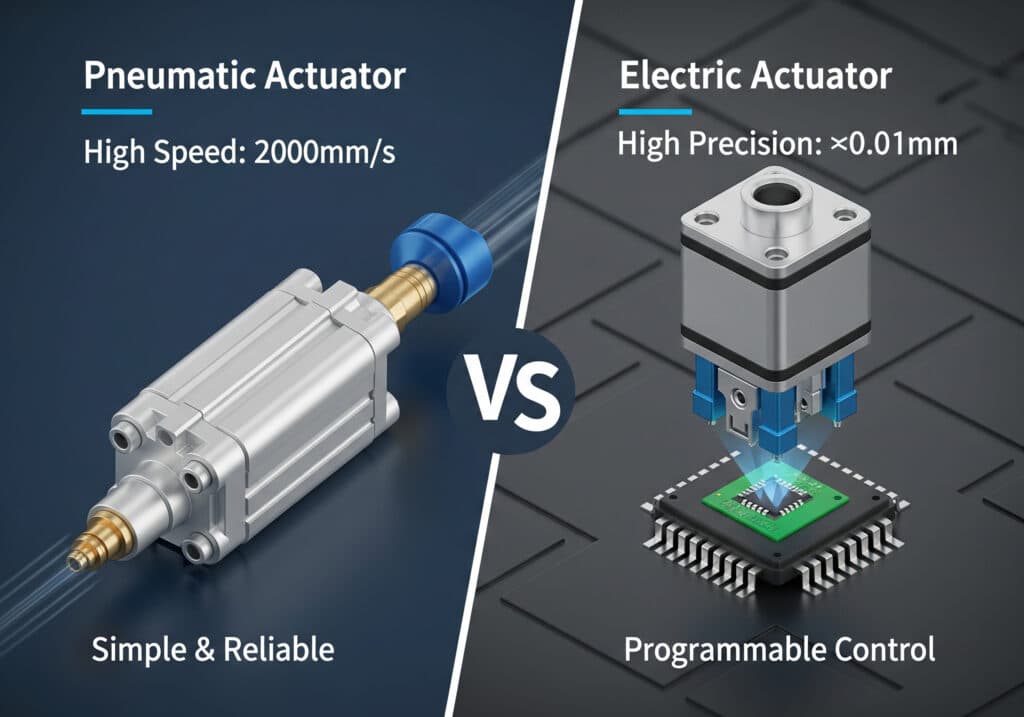
Use electric first when these requirements dominate:
| Requirement | Why electric fits |
|---|---|
| Many stored positions | motor control can move to recipe values |
| Speed and acceleration profiles | drive controls ramp, stop, and smooth motion |
| Force feedback or measured insertion | controller can monitor and limit motion |
| Frequent changeover | recipes reduce manual stop adjustment |
| Data and diagnostics | position, alarms, load, and cycle data can be captured |
| Clean utility accounting | electrical energy is easier to meter than compressed-air end use |
The same point applies to precision claims. Do not say “electric is better” until you define accuracy, repeatability, resolution, straightness, and settling time. For the precision-specific comparison, use the cylinder vs electric actuator precision guide.
Where Do Rodless and Long-Stroke Linear Actuators Fit?
Rodless linear actuators fit when stroke length and installation envelope matter. Parker lists its OSP-P rodless pneumatic cylinders in 10-80 mm bores, with 6000 mm maximum standard stroke, 8 bar maximum operating pressure, and 47-3010 N force at 6 bar (Parker OSP-P, 2026).
A standard rodded cylinder needs room for the body and the extended rod. A rodless cylinder keeps the carriage travel along the actuator body, which can reduce the clearance box. That is useful near guards, conveyors, doors, operators, and machine frames.
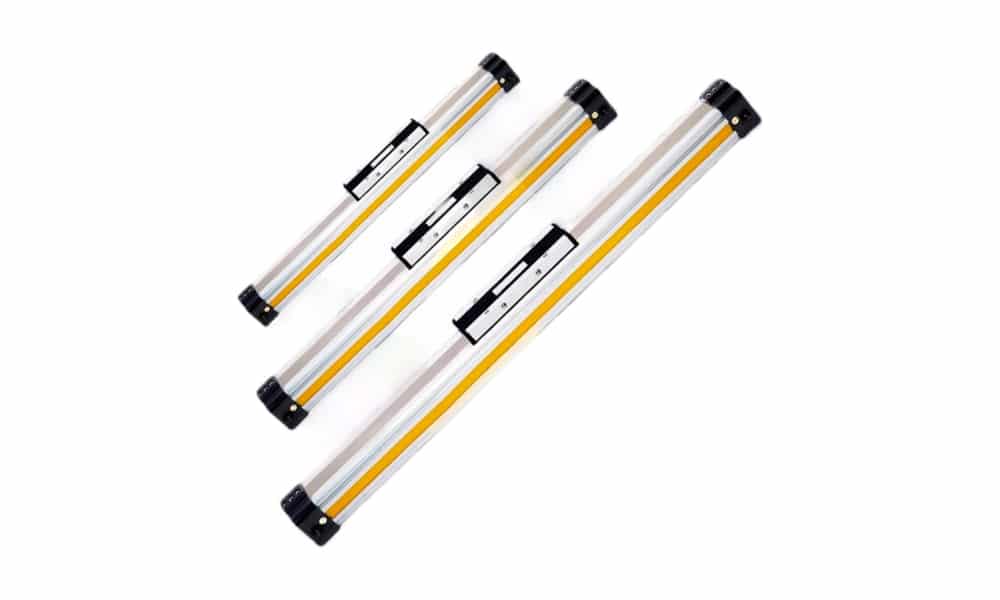
Rodless does not mean “no guide problem.” The carriage, external load, moment arms, stops, cushions, sensors, and valve flow still have to be checked. A long stroke can also expose pressure drop and exhaust restriction that were invisible on a short cylinder.
Use rodless or guided linear actuators when:
- Stroke is long and a rod would create too much extra space.
- The load must ride on a carriage or slide.
- External guidance is needed to carry moment load.
- The process needs fast point-to-point transfer.
- The application can use end stops or limited intermediate control.
Avoid making this page another rodless actuator article. For mechanism detail, use how rodless actuators work or the guide to different rodless pneumatic cylinder types.
When Are Hydraulic, Servo, Stepper, or Voice-Coil Actuators Worth It?
Special linear actuators are worth it when the requirement cannot be solved by a basic pneumatic or electric axis. AutomationDirect notes that hydraulics can achieve greater forces than other motive technologies, while Festo says selection must balance load, precision, dynamic response, environment, and costs (AutomationDirect, 2022; Festo, 2026).
Hydraulic cylinders belong in the review when force density matters more than cleanliness, leak risk, and maintenance simplicity. Pressing, forming, lifting, and heavy machine motion can justify that package.
Servo linear axes belong in the review when the process needs programmed motion, coordinated axes, profile control, or measured force. A servo actuator is not just “more accurate.” It is a motor, drive, feedback, controller, mechanics, safety, and commissioning job.
Stepper linear actuators can fit simpler positioning jobs where cost and command simplicity matter. They still need a load and speed review. Open-loop stepper systems can lose position if the axis is overloaded or accelerated too aggressively.
Voice-coil and other specialty actuators fit short strokes, high response, low friction, or test-and-measurement applications. They are not general replacements for pneumatic cylinders or belt axes. The stroke, heat, force, and control limits usually decide quickly.
How Should You Size Force, Stroke, Speed, and Air Demand?
Size the actuator from the load case, not from the catalog family name. CAGI says most well-designed compressed-air systems have no more than 10% pressure drop from compressor discharge to point of use, and DOE lists compressed-air tools and publications for improving performance and saving energy (CAGI, 2022; DOE, 2026).
For any linear actuator, define these values before choosing the product family:
| Sizing variable | Why it matters |
|---|---|
| Load mass and direction | sets force, guidance, and safety factor |
| Stroke length | separates short cylinder jobs from rodless or belt-axis jobs |
| Required speed or cycle time | exposes flow, motor speed, screw speed, and cushion limits |
| Accuracy and repeatability | decides whether end stops, feedback, or servo control is needed |
| Duty cycle | affects heat, lubrication, seal life, and compressor demand |
| Environment | changes seal, corrosion, washdown, dust, and cable choices |
| Controls | decides valve, sensor, PLC, drive, or motion-controller requirements |
From application reviews, the most common miss is separating force from speed. A cylinder can have enough static force and still fail the cycle if the valve, tubing, muffler, or point-of-use pressure cannot move enough air. An electric axis can have enough thrust and still fail if the screw speed, heat, or guide load is ignored.
Use this order:
- Define the motion: push, pull, lift, clamp, transfer, adjust, inspect, or press.
- Define the load: weight, friction, side load, moment, and acceleration.
- Define the stop behavior: hard stop, sensor, profile, stored position, or feedback.
- Define the utilities: plant air, hydraulic power unit, or electrical drive capacity.
- Define the environment: dust, water, chemicals, temperature, vibration, or cleanroom.
- Define the service plan: seal replacement, lubrication, drive access, or spare axis swap.
The pressure side deserves special attention. CAGI warns that increasing compressor discharge pressure should not be the first response to low point-of-use pressure. Check tubing, filters, dryers, fittings, leaks, receiver strategy, and regulators first.
What RFQ Data Prevents the Wrong Linear Actuator Quote?
The RFQ should describe the motion job in measurable terms. CAGI divides compressed-air applications into power, process, and control uses and lists linear actuators under power service, so an actuator request should name the force, stroke, pressure, and control requirement instead of only the product label (CAGI, 2026).
Send enough data for the supplier to identify the family, not only the size:
| RFQ field | Pneumatic detail | Electric or hydraulic detail |
|---|---|---|
| Motion | extend/retract, clamp, push, transfer | position profile, force profile, speed profile |
| Load | mass, orientation, friction, moment | same load data plus stiffness and duty cycle |
| Stroke | rod stroke, rodless travel, guide length | screw, belt, or cylinder travel |
| Force | working pressure and required thrust | thrust, torque, pressure, or motor sizing |
| Speed | target stroke time and cycle rate | velocity, acceleration, deceleration |
| Position control | end sensors, stops, cushions | encoder, home switch, stored positions |
| Environment | air quality, washdown, dust, temperature | IP rating, cables, drive cabinet, oil handling |
| Safety state | spring return, exhaust, lock, brake | brake, STO, lockout, overload response |
Need a cleaner category boundary? Use are all cylinders considered actuators for terminology and cylinders vs actuators for the broader hierarchy.
Conclusion: How Do Linear Actuators Change Automation?
Linear actuators change automation by turning motion requirements into repeatable machine actions. Festo’s five decision factors - load, precision, dynamic response, environment, and costs - are a practical way to avoid picking a technology before defining the job (Festo, 2026).
Use pneumatic cylinders for simple, fast, force-based motion. Use rodless actuators when travel is long and space is tight. Use electric axes when position control, profiles, feedback, or recipes matter. Use hydraulic and specialty actuators when force, response, stroke, or environment moves outside the normal pneumatic/electric range.
The best selection is rarely the most advanced actuator. It is the actuator that does the specific job with the fewest hidden risks.
FAQs About Linear Actuator Types
What are the main types of linear actuators?
The main types are pneumatic cylinders, rodless pneumatic actuators, electric screw actuators, electric belt actuators, hydraulic cylinders, servo-controlled axes, stepper linear actuators, and specialty devices such as voice-coil stages. The best first split is by drive source, then by stroke, force, accuracy, environment, and control need.
Are pneumatic cylinders linear actuators?
Yes. A pneumatic cylinder is a compressed-air linear actuator. ISO 15552 covers a 10 bar standardized pneumatic-cylinder series with 32-320 mm bores. The term “linear actuator” is broader, so a cylinder is one type inside the larger straight-line motion family.
What is the difference between a rodless cylinder and an electric linear actuator?
A rodless cylinder uses compressed air to move an internal piston and external carriage along the cylinder body. An electric linear actuator uses a motor with a screw, belt, or other transmission. Rodless pneumatic units often fit fast long-stroke transfers, while electric axes fit programmable positions and profiles.
Which linear actuator type is best for precision positioning?
Electric servo or screw-driven actuators are usually the first choice for many stored positions, profiles, and feedback-controlled movement. Pneumatic cylinders can still repeat well against hard stops, but they are not the first choice when the process needs programmable mid-stroke positions or measured force control.
What information should I send before asking for a linear actuator quote?
Send load, stroke, orientation, target cycle time, required accuracy, duty cycle, environment, available utilities, control method, safety state, and maintenance access. For pneumatic actuators, include working pressure and air quality. For electric axes, include motor, drive, feedback, cable, and controller requirements.