

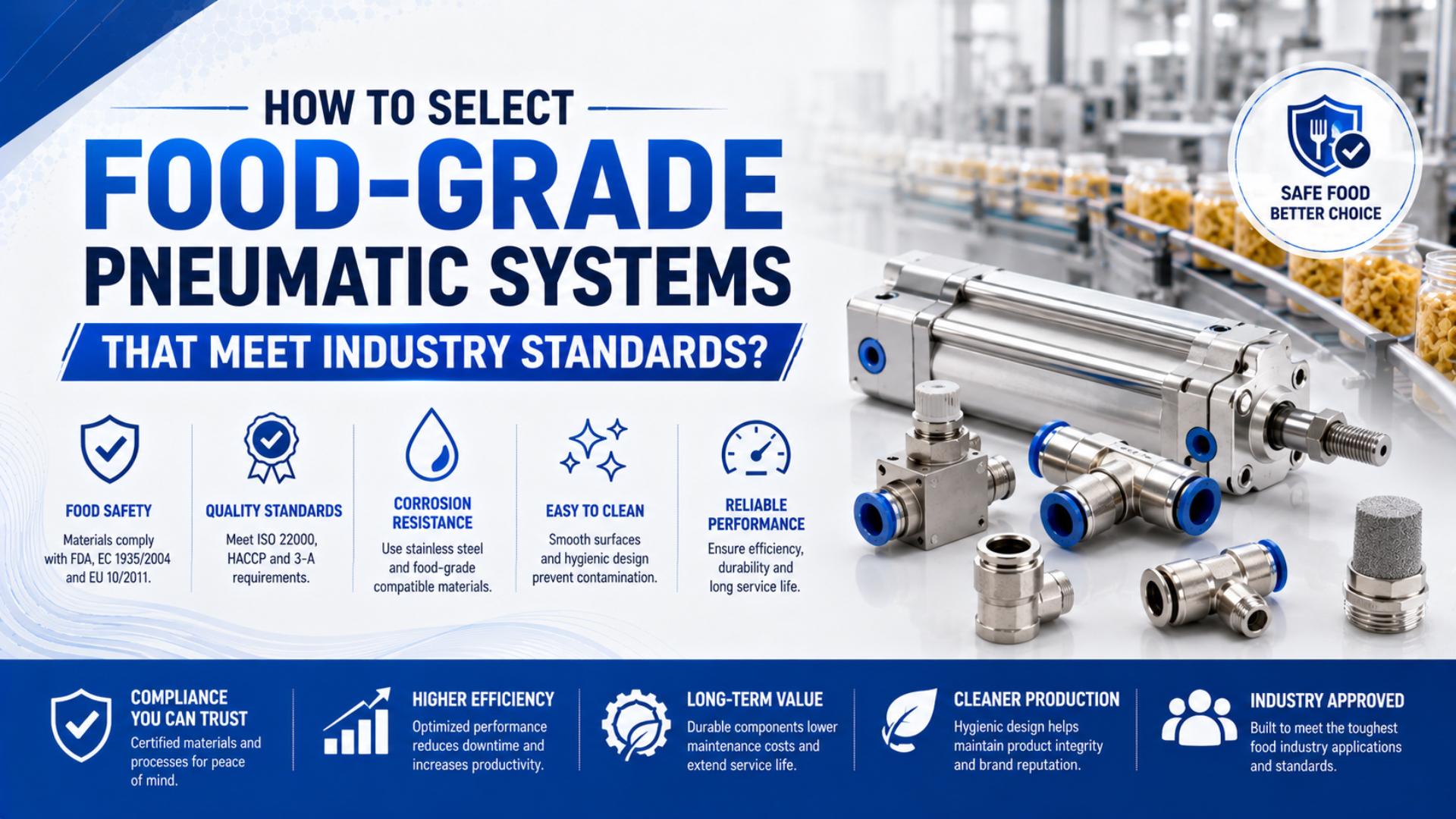
Select a food-grade pneumatic system by mapping every credible contamination path before choosing components. Mark where food, food-contact surfaces, cleaning chemicals, condensate, lubricant, exhaust air, and maintenance tools can meet the system. Then assign the correct regulatory or voluntary standard to each path and require evidence for the exact installed configuration.
There is no single food-grade certificate for a complete compressor-to-actuator system. A stainless cylinder, blue seal, H1 lubricant, IP rating, or ISO 8573-1 class proves only a limited claim. The buyer must connect those claims to the hygiene zone, operating duty, sanitation method, and local regulatory requirements.
The location changes the answer.
Key Takeaways
- Use 4 hygiene zones to separate direct contact, splash, washdown, and protected equipment.
- Section 117.40 covers cleanability, sanitary pneumatic systems, and compressed gas near food.
- ISO 8573-1 classifies particles, water, and oil separately.
- Approve materials, cleanability, air quality, motion performance, and documentation as distinct gates.
What Makes a Pneumatic System Food-Grade?
Section 117.40 contains 7 lettered provisions covering equipment, seams, non-contact equipment, conveying systems, controls, and compressed gas (21 CFR 117.40). A pneumatic system is food-grade only when its installed design can meet the applicable provisions without contaminating food or defeating the plant’s sanitation controls.
Food-grade pneumatic system means the complete air and motion system has been assessed for its intended food, location, cleaning process, operating state, and failure modes. The boundary can include the compressor, dryer, receiver, filters, distribution piping, point-of-use treatment, valves, actuators, fittings, tubing, silencers, sensors, exhaust routing, lubricants, covers, and mounting hardware.
That definition is wider than food contact. Section 117.40(c) requires equipment in food areas that does not contact food to remain clean and sanitary. Paragraph (d) includes pneumatic conveying and manufacturing systems. Paragraph (g) applies when compressed air is mechanically introduced into food or used to clean food-contact surfaces or equipment.
The phrase “food-grade” is not the specification.
Start with three questions:
- Can any system material, lubricant, coating, condensate, or wear debris reach food?
- Can supplied or exhausted air reach exposed food or a food-contact surface?
- Can the installed assembly be cleaned, inspected, drained, serviced, and returned to production without creating a new contamination path?
A component can have valid material evidence and still be unsuitable as installed. A certified seal does not correct a water-trapping mount. A clean air sample at the compressor outlet does not prove air quality at a distant nozzle. Food-grade selection is therefore a path-level decision, not a collection of badges.
Four Hygiene Zones Set the Selection Boundary
Section 117.40 distinguishes food-contact surfaces from non-contact equipment that must remain clean and sanitary (21 CFR 117.40). Dividing that regulatory boundary into 4 practical engineering zones makes pneumatic selection clearer because each zone receives a different combination of material, drainage, ingress, cleaning, air-quality, and documentation requirements.
Hygiene zone is a documented area or exposure category used to assign contamination controls to installed equipment. The four-zone model below is an engineering screening method, not a substitute for the plant’s hazard analysis, jurisdiction, or customer standard.
Location sets the burden of proof.
| Zone | Typical exposure | Pneumatic selection consequence |
|---|---|---|
| 1. Direct contact or direct air | A component surface, conveyed air, or process gas can contact food | Verify every relevant substance and condition of use; eliminate uncontrolled lubricant, exhaust, condensate, and wear paths |
| 2. Open product or splash | Equipment sits above or beside exposed food and may receive product splash | Favor cleanable geometry, controlled drainage, protected seals and fasteners, compatible materials, and routed exhaust |
| 3. Repeated washdown | Equipment does not contact food but receives water, foam, sanitizer, pressure, and temperature cycling | Match the complete assembly to the cleaning recipe, orientation, ingress test boundary, corrosion risk, and inspection method |
| 4. Protected dry area | Equipment is separated from exposed food and routine wet cleaning | Standard industrial components may be acceptable if barriers, air paths, maintenance, and failure effects are controlled |
Do not assign a whole production room one label and stop. For example, a valve island inside a dry enclosure, a cylinder rod entering an open process zone, and an air nozzle directed at a conveyor can occupy different risk paths within the same machine. Mark each boundary on the mechanical and pneumatic drawings.
Which Standard Supports Which Claim?
The 2026 third edition of 3-A General Requirements Standard 00-02 connects more than 80 individual equipment standards (3-A SSI). That breadth does not make 3-A, FDA, EHEDG, ISO 8573-1, or NSF interchangeable. Each source supports a different claim and evidence boundary.
Use the following matrix before writing “meets industry standards” in an RFQ:
A logo is not its scope.
| Framework | What it can support | What it does not prove by itself |
|---|---|---|
| 21 CFR 117.40 | U.S. equipment cleanability, contamination prevention, sanitary pneumatic systems, and compressed-gas duties | A universal certificate for a cylinder, valve, FRL, or complete pneumatic system |
| FDA food-contact authorization routes | Regulatory basis for an identified substance under specifications and conditions of use | Approval of every compound with the same generic name or color |
| 3-A Sanitary Standards | Hygienic design and fabrication criteria within the applicable equipment standard and certification scope | That all stainless components or pneumatic products carry a 3-A Symbol |
| EHEDG certification | Document review and physical testing under a defined equipment class and cleaning method | Suitability outside the certified configuration, class, or installation conditions |
| ISO 8573-1 | Separate compressed-air purity classes for particles, water, and oil at a stated location | One mandatory food-industry class or microbiological acceptance plan |
| NSF H1 or ISO 21469 | Evidence for an identified lubricant intended for incidental product contact | Intentional food addition, unrestricted contact, or complete actuator compliance |
FDA explains that the status of a food-contact material follows each substance reasonably expected to migrate to food. The authorization must be read as identity, specifications, and conditions of use. An effective Food Contact Notification is also tied to the named manufacturer or supplier (FDA).
EHEDG similarly evaluates defined equipment. Its certification process uses document verification and physical testing, with equipment classified for liquid cleaning or dry cleaning and evaluated under the corresponding method (EHEDG).
For actuator-level material and performance checks, use the FDA-compliant actuator selection guide. This article remains at system level: it assigns the right evidence to each contamination path.
How Should You Map Compressed-Air Contamination Paths?
ISO 8573-1:2010 is a 9-page standard that classifies particles, water, and oil separately and identifies additional gaseous and microbiological contaminants (ISO 8573-1). Map air from generation to its final release point because the required purity, sampling location, and treatment train depend on what that air can reach.
Contamination path is a credible route by which air, condensate, oil, particles, microbes, cleaning residue, or component wear can move from the pneumatic system to food or a food-contact surface.
Trace at least these paths:
- compressor intake to compressor discharge;
- aftercooler, receiver, dryer, and central filtration;
- distribution main, branch, drop leg, and point-of-use filters;
- valve supply, pilot air, exhaust, and silencer;
- cylinder rod, wiper, grease, and breather interfaces;
- air knives, nozzles, aeration, conveying, or packaging-gas outlets;
- maintenance bypasses, quick couplings, temporary hoses, and replaced filter elements.
Where should you sample? Use the point that represents the risk.
Do not copy a universal “food-grade class” into every specification. ISO 8573-1 provides a classification structure, while the plant decides the required classes and other contaminants from its hazard analysis. Air driving a guarded cylinder can have a different acceptance boundary from air blown onto a food-contact conveyor.
Use the detailed ISO 8573-1 compressed-air quality guide to define particles, water, oil, sampling points, test methods, monitoring, and response plans without treating a filter model as proof of point-of-use purity.
How Should Components Be Selected by Zone?
Section 117.40 sets separate duties for food-contact surfaces, non-contact equipment, pneumatic systems, and compressed gas (21 CFR 117.40). Select each component against the zone and path it actually occupies. A single machine may legitimately combine hygienic components, protected industrial components, and dedicated air treatment.
| Component group | Questions that control selection | Evidence to request |
|---|---|---|
| Compressor and dryer | What compressor technology, dew point, temperature, and failure alarms support the air-quality target? | Rated performance, maintenance limits, lubricant status where relevant, alarm and verification plan |
| Central and final filters | Which contaminant, flow, pressure, temperature, and change interval applies at the acceptance point? | Grade and housing data, flow performance, differential-pressure limits, certificates where required |
| FRL units | Is lubrication permitted? Can bowls, drains, gauges, and adjustment points survive the zone and cleaning method? | Exact bowl and seal materials, drain design, ingress boundary, lubricant control |
| Valves and manifolds | Can product or washdown reach the spool, exhaust, gasket joints, connectors, or cable entries? | Material list, ingress test scope, exhaust plan, chemical limits, spare-seal identity |
| Cylinders and actuators | Can the rod, carriage, wiper, grease, sensor groove, end-cap joint, or mount create a contamination path? | Materials, seal and lubricant declarations, corrosion limits, cleaning limits, installed orientation |
| Fittings and tubing | Are wetted or exposed materials compatible with food, cleaner, temperature, pressure, and repeated flexing? | Material and compound identity, pressure and temperature ratings, connection and inspection method |
| Silencers and exhaust | Can trapped oil, moisture, particles, or muffler media discharge toward exposed product? | Media and housing data, replacement interval, exhaust routing and failure inspection |
| Sensors, cables, and covers | Do crevices, jackets, connectors, or covers retain water or block cleaning access? | Tested assembly, cable and jacket material, mounting details, chemical and ingress limits |
The zone controls the evidence burden.
Stainless steel is one option, not a system verdict. For example, a protected dry-zone cylinder may not need 316L. A washdown cylinder still needs compatible seals, rod treatment, fasteners, sensor hardware, drainage, and cleaning limits. The stainless steel cylinder washdown guide covers that narrower specification.
Likewise, an IP code describes ingress protection under defined tests. It does not prove cleanability, corrosion resistance, chemical compatibility, drainage, or food-contact status. Use the IP65, IP67, and IP69K valve-manifold guide when checking the tested enclosure boundary.
Cleanability and Chemical Compatibility Are Assembly Properties
The 2026 3-A General Requirements update identifies 5 substantive changes, including clearer seal requirements, tighter CIP gasket-joint criteria, and visible leak-detection paths (3-A SSI). Those changes show why cleanability depends on geometry, joints, drainage, access, and validation, not stainless grade alone.
First separate three sanitation cases:
- External washdown: water, foam, sanitizer, and rinse reach the outside of the pneumatic assembly.
- Clean-in-place process circuit: cleaning fluid circulates through food-contact process equipment without routine disassembly.
- Manual disassembly and cleaning: selected parts are removed, cleaned, inspected, and reassembled under a controlled procedure.
Can cleaner reach the surface and leave it again? Both matter.
Most pneumatic cylinder pressure chambers are not part of a food-product CIP circuit. Do not prescribe process-pipe pulsation limits, riboflavin concentration, ultraviolet wavelength, or annual validation frequency to every actuator. Define the actual sanitation boundary first. If a pneumatic component is exposed only externally, evaluate its exterior geometry, ingress paths, seals, corrosion resistance, drainage, and maintenance procedure.
For each exposed assembly, record:
- cleaner and sanitizer chemical names, concentrations, pH where relevant, and supplier;
- wash, rinse, and sanitation temperatures;
- spray pressure, nozzle distance, direction, contact time, and frequency;
- steam, dry heat, icing, or thermal-shock conditions;
- required disassembly, drain orientation, drying time, and inspection access;
- acceptable swelling, cracking, discoloration, corrosion, lubricant loss, ingress, and functional change.
ATP, riboflavin, microbiological sampling, visual inspection, and borescope examination can support a site validation plan when the method matches the surface and hazard. They do not share one universal acceptance limit. The plant’s food-safety team must define sampling locations, controls, detection limits, pass criteria, corrective action, and revalidation triggers.
Validation should challenge the installed low points and shielded interfaces, not only the easiest polished surface. A horizontal sensor groove, downward cable entry, trapped mounting washer, or damaged rod wiper can control the hygiene result even when the main cylinder body is smooth.
Use the surface topography and bacterial-retention guide for Ra limits, scratches, seams, drainage, ATP boundaries, and installed cleanability validation. For seal chemistry, the pneumatic gasket and seal compatibility guide provides a separate material-screening workflow.
What Evidence Should Suppliers Provide?
FDA describes food-contact authorization through 3 linked elements: substance identity, specifications, and conditions of use (FDA). Apply the same discipline to supplier evidence. Every certificate, declaration, test result, and drawing must identify the exact component, revision, supplier, exposure, and accepted use condition.
Build a compliance matrix with one row per requirement:
A certificate without a model link cannot close a row.
| Evidence group | Minimum content | Common rejection reason |
|---|---|---|
| Intended-use statement | Hygiene zone, food or splash path, sanitation exposure, compressed-air use | Says only “food industry” |
| Product definition | Part number, revision, options, seals, lubricant, sensors, fittings, mounts | Certificate covers a different configuration |
| Material evidence | Exact substance or compound, supplier, regulation or authorization basis, use limitations | Generic “FDA approved material” claim |
| Hygienic-design evidence | Applicable 3-A standard, EHEDG class, certificate number, model scope, installation conditions | Logo shown without scope or current certificate |
| Lubricant evidence | Exact product, H1 registration or ISO 21469 certificate, incidental-contact boundary | “Food-grade grease” without product identity |
| Air-quality evidence | ISO 8573-1 requirement, point, method, condition, result, and response plan | Compressor-room result used for a distant nozzle |
| Washdown or ingress evidence | Tested assembly, orientation, water conditions, accessories, exclusions, chemical limits | IP code presented as chemical or hygiene proof |
| Functional acceptance | Pressure, leakage, force, speed, sensing, fault behavior, and post-cleaning checks | Hygiene changes not tested under load |
| Traceability and change control | Lot or serial identity, record retention, approved substitutions, notification rules | Evidence cannot be linked to delivered units |
NSF states that H1 lubricants are intended for incidental food contact. ISO 21469 certification adds controls for formulation, manufacture, and use, but neither program approves the whole pneumatic component (NSF).
For RFQ, bid comparison, FAT, SAT, and change-control records, use the FDA-compliant pneumatics procurement guide. The pneumatic material traceability guide explains how to connect model, lot, serial, and material-batch identities.
Food-Grade Pneumatic System Selection Checklist
ISO 8573-1 separates compressed-air purity into 3 main contaminant classes, while Section 117.40 divides equipment obligations across 7 lettered provisions (ISO; eCFR). A useful checklist must therefore close both air-path and installed-equipment requirements rather than relying on one food-grade declaration.
Before releasing the purchase order, confirm:
No line should end with “supplier says compliant.”
- The system boundary runs from air generation to every final release, exhaust, rod, carriage, and maintenance interface.
- Each component has a documented hygiene zone and credible contamination paths.
- The applicable jurisdiction, customer standard, 3-A or EHEDG scope, and internal plant requirements are named.
- Food-contact substances are tied to exact identity, supplier, specifications, food type, temperature, time, and repeated-use conditions.
- Compressed-air purity targets name particles, water, oil, other relevant contaminants, sampling points, and test methods.
- Cleaning chemicals, concentrations, temperature, spray conditions, duration, frequency, drainage, and inspection access are specified.
- Materials, seals, lubricants, coatings, cables, sensors, fittings, silencers, and mounting hardware match the exposure.
- Supplier certificates and test reports identify the exact model, revision, options, and tested assembly.
- Functional tests cover pressure, leakage, force, speed, sensing, and fault behavior after representative sanitation exposure.
- FAT, SAT, maintenance, record retention, spare parts, substitution control, and change-notification responsibilities are assigned.
The best commercial comparison is not “food-grade versus standard.” Compare how many uncontrolled paths remain after each supplier’s exceptions are applied. A lower-priced component can be the stronger choice in a protected zone, while a premium hygienic component can still fail approval if its certificate, cable entry, exhaust route, or cleaning limit does not match the installation.
Food-Grade Pneumatic System FAQs
The 9-page ISO 8573-1 standard classifies 3 principal compressed-air contaminants, while 3-A 00-02 supports more than 80 equipment standards (ISO; 3-A SSI). These FAQs explain why neither number creates one universal food-grade pneumatic specification.
Does FDA certify a complete pneumatic system?
No. FDA regulates relevant food-contact substances and establishes equipment and sanitation duties, but it does not issue one universal certificate for a compressor, FRL, valve, cylinder, fitting, or complete pneumatic system. Approval requires substance-specific evidence plus an installed-system review under the intended food, cleaning, air-path, and maintenance conditions.
Is 316L required for every food-grade pneumatic component?
No. Section 117.40 requires suitable, cleanable, corrosion-resistant, and nontoxic food-contact surfaces, but it does not mandate 316L for every pneumatic component. A protected dry-zone actuator and a direct-contact fitting face different requirements. Select material from the food, sanitizer, chloride, temperature, geometry, drainage, wear, and failure conditions.
Does ISO 8573-1 specify one required class for food production?
No. ISO 8573-1 classifies particles, water, and oil separately but does not prescribe one mandatory class for every food application. The plant must set point-of-use limits from its hazard analysis, identify the sampling location and test method, and add microbiological or gaseous-contaminant controls when those risks are relevant.
Can pneumatic cylinders be cleaned by CIP?
Only when the exact cylinder or assembly is designed and approved for the defined CIP boundary. Most pneumatic pressure chambers are not food-process circuits. An externally washed cylinder needs chemical, temperature, spray, drainage, ingress, corrosion, and post-cleaning functional limits. Do not apply process-pipe CIP assumptions to a standard actuator.
What documents should a buyer request?
Request the controlled configuration, material and lubricant declarations, and applicable regulatory basis. Also require certificate scope where claimed, air-quality results, washdown evidence, chemical limits, functional records, lot or serial traceability, approved deviations, spare-part identity, and supplier change-notification commitments.
Sources and technical references
- 21 CFR 117.40 - Equipment and utensils
- FDA - Determining the Regulatory Status of Components of a Food Contact Material
- 3-A SSI - The New General Requirements Standard 00-02
- EHEDG - Why certification is important
- ISO 8573-1:2010 - Compressed air contaminants and purity classes
- NSF - Food-grade lubricants and ISO 21469 certification