

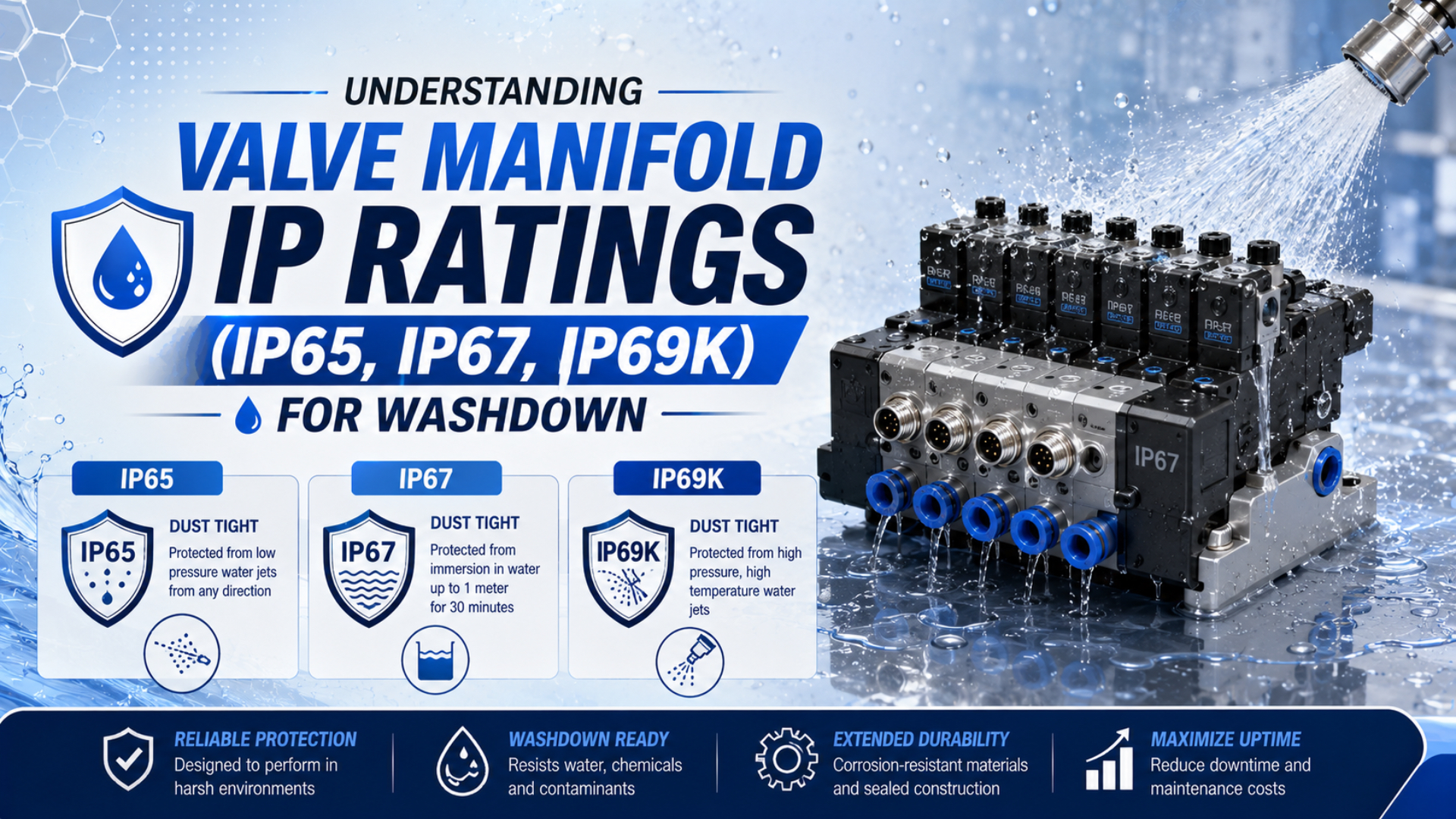
Ingress protection (IP) is a standardized enclosure classification for protection against access, solid foreign objects, dust, and water. A valve manifold IP rating applies that classification to the tested electrical enclosure and configuration. It does not certify the manifold as food-safe, corrosion-proof, chemically compatible, hygienically designed, or suitable for steam sterilization. A reliable washdown specification must match the rating, cited standard, exact manifold configuration, cleaning process, and installation.
That distinction matters because a valve island is more than a housing. Solenoid coils, bus electronics, connectors, cables, blanking plugs, manual overrides, gaskets, mounting interfaces, and exhaust components can all affect the installed result. A high rating printed on a family brochure is useful only when it applies to the complete ordered and assembled unit.
Key Takeaways
- IP65 and IP67 describe different water tests; IP67 should not be assumed to include the IP65 jet test.
- IEC 60529 and ISO 20653 have different scopes, so a specification should name the standard and edition, not only “IP69K.”
- The exact configured assembly owns the rating, including approved connectors, cables, seals, plugs, and installation instructions.
- Chemical resistance, hygienic design, food-contact status, corrosion resistance, and steam compatibility require separate evidence.
What Does an IP Rating Actually Certify?
IEC 60529 classifies degrees of protection provided by enclosures for electrical equipment with rated voltage not exceeding 72.5 kV (IEC, consolidated edition 2.2). The familiar code contains two characteristic numerals:
- The first numeral concerns access to hazardous parts and ingress of solid foreign objects. A first digit of 6 denotes a dust-tight enclosure under the applicable test.
- The second numeral concerns harmful effects caused by water entering the enclosure. A second digit of 5 relates to water jets, 7 to temporary immersion, and 9 to high-pressure, high-temperature water jets under the applicable test method.
The code is an enclosure test classification. It does not describe valve flow, pressure range, temperature range, pneumatic leakage, electrical load, functional safety, corrosion resistance, or cleaning-agent compatibility. Those characteristics still need their own datasheets and acceptance criteria.
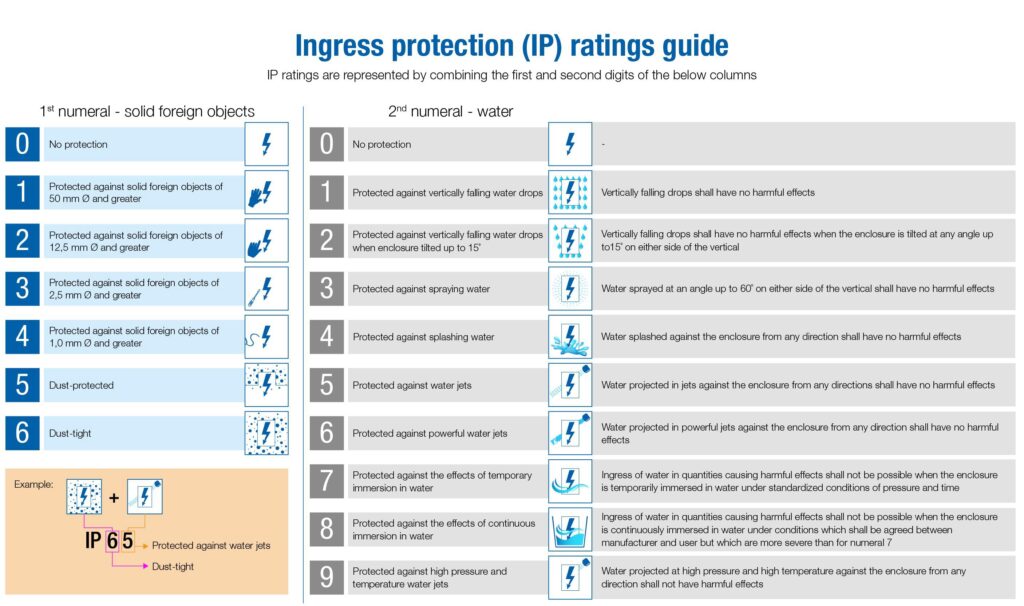
The two numerals address different ingress hazards. Use this chart as an orientation aid and use the cited standard plus the manufacturer’s test record for procurement decisions.
An IP rating also does not promise unlimited exposure. Test conditions are controlled. Real washdown can combine detergent, impact, pressure pulses, hot-to-cold thermal cycling, damaged cables, loose connectors, and spray at distances not represented by a laboratory test.
Treat an IP rating as one verified boundary in a larger environmental specification. It answers, “What enclosure test did this configured product pass?” It does not answer, “Will every part of my installed valve station survive my sanitation procedure?”
For selection, first classify the real water exposure as hose jet, temporary immersion, or close-range high-pressure hot-water cleaning. Next, name the applicable standard and require every exposure that the machine must survive. Then freeze the production configuration, including electronics, connectors, mating cables, blanking plugs, seals, station count, and mounting instructions. Finally, assess detergent compatibility, corrosion, temperature cycling, hygienic geometry, food-contact status, and steam exposure as separate requirements. This four-step method prevents two opposite errors: buying an expensive high-pressure rating that misses the actual immersion risk, and approving a well-sealed enclosure whose cable jacket or elastomer fails in the cleaning chemical. The supplier’s declaration, drawing, bill of materials, and installation manual should all identify the same configuration before the rating is accepted.
Are IP65, IP67, and IP69K Cumulative Ratings?
No. The first digit is the same in all three examples, so each indicates the highest dust-protection numeral. The liquid tests differ.
| Marking | Water exposure represented | What it does not prove |
|---|---|---|
| IP65 | Water jets under the cited standard | Temporary immersion, high-pressure hot-water cleaning, or chemical resistance |
| IP67 | Temporary immersion under the cited standard | The separate IPX5 jet test unless that rating is also declared |
| IP69 or IP69K | High-pressure, high-temperature jet cleaning under the named standard | Immersion, steam sterilization, detergent compatibility, or hygienic design |
A product marked only IP67 has passed the immersion test associated with that marking. It should not automatically be treated as IP65. When both exposures matter, request a dual declaration such as IP65/IP67 and confirm it for the exact part number.
The same rule applies at the upper end. A high-pressure jet rating does not automatically provide an immersion rating. If the washdown area can flood or a manifold can become submerged, specify and verify the immersion requirement separately.
This is why “choose the highest number” is a poor selection method. A beverage filler may need resistance to daily close-range cleaning but never be immersed. A low-mounted valve island near a floor drain may face temporary flooding as well as ordinary hose cleaning. Each exposure needs explicit coverage.
What Is the Difference Between IP69 and IP69K?
The answer depends on the referenced standard. IEC 60529 and ISO 20653 are related IP-code systems, but their scopes are not identical.
- IEC 60529 applies broadly to enclosures for electrical equipment within its stated voltage scope. Its current consolidated publication includes the second-digit 9 test.
- ISO 20653:2023 applies to enclosures of electrical equipment in road vehicles and defines the protection designations, requirements, and tests within that automotive scope (ISO).
- DIN 40050-9:1993-05, historically associated with the IP69K designation, is withdrawn. DIN Media directs users to ISO 20653 instead (DIN Media).
For an industrial valve manifold, do not write “IP69K” in an RFQ without identifying the test standard. Ask whether the manufacturer declares IP69 to IEC 60529, IP69K to ISO 20653, another national adoption, or more than one rating. Record the edition and obtain the product-specific declaration or test evidence.
Some valve-manifold datasheets declare several ratings. For example, Festo publishes configurations with IP65, IP67, and IP69K declarations, demonstrating that suppliers may verify separate exposures for a specific product arrangement (Festo VTUG datasheet). That is stronger evidence than transferring a rating from another size, electrical interface, or connector in the same family.
Does IP69K Mean the Manifold Can Be Steam Sterilized?
No. A high-pressure, high-temperature water-jet test is not a sterilize-in-place qualification. Saturated steam, elevated pressure, long dwell periods, condensate, repeated thermal cycling, and sterilization validation impose different loads.
Do not infer any of the following from IP69 or IP69K alone:
- compatibility with saturated steam;
- continuous operation at the cleaning-fluid temperature;
- resistance to caustic, acidic, chlorine-based, or peracetic cleaning agents;
- a validated microbial reduction;
- suitability for a sterile boundary;
- compliance with a pharmaceutical cleaning or sterilization protocol.
If the manifold will be inside a SIP environment, obtain an explicit temperature-time-pressure rating for every exposed material and component. Confirm whether the product is merely sprayed externally or becomes part of the process boundary. In many machines, the practical solution is to place the valve island outside the SIP zone and route pneumatic connections to components that are specifically designed for that environment.
Which Parts Determine the Installed Valve Manifold Rating?
The rated object is the manufacturer’s tested configuration, not an unconfigured base. A complete review should cover:
- Valve manifold base, end plates, covers, and seals
- Solenoid coils, fieldbus node, I/O modules, and diagnostic electronics
- Power, communication, and sensor connectors
- Approved mating cables and their bend radius, jacket, and gland seals
- Blanking plugs in every unused electrical and pneumatic opening
- Gaskets between modular sections and the allowed number of stations
- Manual overrides, pressure zones, and special-function modules
- Mounting orientation, fastener torque, cable routing, and permitted installation location
A valve terminal may reach its published rating only when all open ports are closed with specified plugs and all connectors are fully seated. An unsealed diagnostic port, a substituted cable gland, or a damaged face seal can turn a catalog rating into a misleading label.
Inspect the pneumatic side as well. IP testing protects electrical equipment against harmful water ingress; it does not prevent wash water from entering an open exhaust or disconnected tube. Use appropriately located exhausts, silencers, tubing, and check devices, while avoiding restrictions that create unacceptable back pressure. The control-valve contamination guide covers particle and water entry paths that an enclosure label cannot eliminate.
In our experience reviewing washdown installations, we treat the connector schedule as part of the valve-manifold bill of materials. We have found that this catches a common documentation gap: the manifold part number is correctly rated, but the mating cable, unused-port plug, or field-installed gland is not documented to the same environmental level.
How Should the Actual Washdown Process Be Documented?
“Daily washdown” is not a test condition. Give suppliers a cleaning envelope that can be compared with their product data:
- maximum nozzle pressure at the point of use;
- water or cleaning-fluid temperature at the nozzle;
- minimum nozzle distance and likely spray angles;
- exposure time per cleaning cycle and cycles per day;
- direct spray, splash, foam, flood, temporary immersion, or condensation;
- detergent and sanitizer trade names, active chemistry, concentration, and pH;
- rinse sequence and contact time;
- ambient temperature before cleaning and the largest thermal step;
- likelihood of tool impact, cable pulling, vibration, or damaged seals;
- installation orientation, drainage, shielding, and ventilation.
Pressure at the pump is not necessarily pressure at the nozzle, and a nominal fluid temperature may differ from the temperature reaching the manifold. Measure or conservatively specify the values at the equipment.
Chemical compatibility must be assessed by exact material. Housing alloys, coatings, labels, connector bodies, cable jackets, potting compounds, elastomers, grease, and adhesives can respond differently to the same sanitizer. Ask the manufacturer for compatibility data for the stated concentration, temperature, contact time, and rinse regime. For related elastomer screening, see the chemical-environment seal guide.
Thermal shock deserves separate attention. Repeated hot cleaning on a cold manifold can create pressure differentials and material movement even when each steady-state temperature seems acceptable. Request the allowed operating and cleaning temperatures, whether the unit may be energized during cleaning, and any required cool-down or inspection procedure.
Do Food and Pharmaceutical Applications Require IP67 or IP69K?
There is no universal rule that every food or pharmaceutical valve manifold must be IP67 or IP69K. The appropriate enclosure rating follows the exposure and risk assessment. Regulatory and hygienic-design obligations are broader.
The US FDA explains that food current good manufacturing practice requirements were modernized from 21 CFR Part 110 into 21 CFR Part 117 in September 2015 (FDA). Part 117 does not turn an IP code into a general food-compliance certificate.
ISO 14159:2002 specifies hygiene requirements for machinery used where hygiene risks to consumers can occur. ISO currently lists that edition as published and under revision (ISO). The scope concerns hygienic machinery design, not merely enclosure ingress.
3-A Sanitary Standards focus on hygienic equipment design and conformance for relevant food-processing equipment. Their requirements address subjects such as materials, construction, cleanability, and inspection; a licensed 3-A Symbol involves evaluation against the applicable standard (3-A SSI). EHEDG guidance and certification similarly address hygienic design questions that an IP test does not resolve.
For food, beverage, or pharmaceutical equipment, verify these items separately:
- Is the manifold in a product-contact, splash, non-product-contact, or protected utility zone?
- Are exposed surfaces cleanable, drainable, and accessible for inspection?
- Are materials and lubricants acceptable for their actual contact category?
- Can housing, labels, seals, cables, and fittings withstand the cleaning chemistry?
- Does the installation create ledges, hollow spaces, trapped liquid, or inaccessible soil?
- What regulatory, customer, 3-A, EHEDG, or internal validation evidence is required?
Stainless steel does not automatically make a valve island hygienic. Surface geometry, joints, fasteners, cable routing, drainage, and installation matter. The stainless-steel cylinder washdown guide applies the same material-versus-configuration distinction to actuators.
How Do You Select a Rating Without Over-Specifying?
Start from exposure, then verify the complete configuration.
| Site condition | Evidence to request |
|---|---|
| Dust plus routine low-pressure hose cleaning | Exact IP65 declaration under the named standard, plus installation conditions |
| Temporary flooding or immersion | IP67 declaration with the applicable depth, duration, and configuration details |
| Close-range high-pressure hot-water washdown | IP69 or IP69K declaration with named standard, plus supplier limits for distance, temperature, pressure, and orientation |
| Cleaning agents or corrosive atmosphere | Separate material and chemical-compatibility evidence |
| Food or hygienic zone | Hygienic-design and material evidence appropriate to the zone |
| Steam or validated sterilization | Explicit SIP or sterilization qualification, not an IP inference |
Higher protection can be appropriate, but it is not the only objective. The selected manifold must still provide the required valve function, flow, pilot pressure, electrical architecture, diagnostics, safety behavior, temperature range, and maintainability. Confirm solenoid details with the OEM replacement compatibility guide.
Where possible, reduce direct exposure by moving the manifold, adding a hygienically designed shield, improving drainage, or routing the cleaning jet. A shield must not trap soil, block ventilation, prevent inspection, or create an uncleanable cavity. Environmental control and product rating should support each other.
What Should Be Included in the RFQ and Acceptance Test?
Send suppliers the full cleaning envelope and request configuration-specific evidence. A useful RFQ includes:
- exact manifold family, valve functions, station count, pressure zones, and accessories;
- required IP code, test standard, edition, and every required exposure rating;
- power, communication protocol, connector type, cable specification, and unused-port closures;
- supply pressure, pilot arrangement, flow, exhaust system, and back-pressure limit;
- operating, storage, media, and cleaning temperature limits;
- measured washdown pressure, temperature, distance, angles, duration, and frequency;
- cleaning chemicals, concentrations, pH, contact time, and rinse procedure;
- corrosion, food-zone, hygienic-design, material, and documentation requirements;
- installation orientation, torque, drainage, shielding, and service access;
- declaration, test report, certificate, drawing revision, and approved bill of materials;
- inspection criteria after installation and after maintenance.
The acceptance test should use the production-intent configuration. Install the specified cables and plugs, energize or de-energize the unit as required by the manufacturer, and follow the relevant test method. After exposure, inspect for water entry, insulation problems, corrosion, pneumatic leakage, connector damage, communication faults, and functional changes. Define pass/fail criteria before testing.
Do not claim a new IP rating from an improvised plant hose test. A site test can demonstrate that an installed unit survived a defined cleaning trial, but certification or declaration to a standard requires the relevant controlled procedure and responsibility.
How Should Washdown Manifolds Be Inspected and Maintained?
There is no universal three-month or annual seal-replacement interval. Base inspection and replacement on the manufacturer’s instructions, cleaning frequency, chemical exposure, observed condition, risk, and site history.
Before cleaning, check that connectors are seated, cables are supported, unused ports are sealed, covers are closed, and visible gaskets are undamaged. After cleaning, look for pooled liquid, lifted labels, cable-jacket cracking, corrosion, loose hardware, cloudy connector windows, intermittent communication, and slow or failed valve operation.
Record the exact configuration and photograph critical connections at commissioning. After any module, valve slice, connector, cable, gasket, or plug is replaced, verify that the replacement is approved and restore the specified torque and assembly procedure. Functional operation alone does not prove that enclosure protection has been restored.
Trend faults by cleaning cycle, chemical batch, and physical location. Failures clustered after hot washdown may indicate thermal cycling; failures near one nozzle may indicate excessive distance or pressure; swollen seals may point to chemical incompatibility. This evidence is more useful than replacing every seal on an arbitrary calendar.
Valve Manifold IP Rating FAQs
Does IP67 include IP65 water-jet protection?
No. IP67 and IP65 use different water tests. A product marked only IP67 should not be assumed to have passed the IPX5 jet test. If both jet exposure and temporary immersion matter, request a dual declaration for the exact configured manifold.
Is IP69K the same as steam or SIP compatibility?
No. IP69 or IP69K addresses a high-pressure, high-temperature water-jet test under the named standard. SIP can involve saturated steam, pressure, longer dwell, condensate, and validation requirements. Obtain explicit steam and sterilization qualification separately.
Does an IP rating prove chemical compatibility?
No. The IP code addresses enclosure protection against access, solid objects, dust, and water within its scope. Cleaning chemicals can attack elastomers, coatings, connectors, cables, labels, grease, and metals. Verify the exact materials against the stated chemistry, concentration, temperature, and contact time.
What must be installed for a valve manifold to retain its IP rating?
Use the manufacturer’s rated configuration: approved modules, seals, mating connectors, cables, covers, and blanking plugs, assembled at the specified orientation and torque. Unused openings, substituted glands, damaged gaskets, or incomplete connectors can invalidate the basis for the published rating.
Can a user upgrade or claim a higher IP rating in the field?
Not by adding sealant, a cover, or a different cable gland alone. Such changes may improve site resistance, but they do not establish a standards-based rating. Use a manufacturer-approved configuration or have the intended assembly evaluated under the applicable test and documentation process.
Sources and technical references
- IEC 60529:1989+A1:1999+A2:2013, Degrees of protection provided by enclosures
- ISO 20653:2023, Road vehicles - Degrees of protection (IP code)
- DIN 40050-9:1993-05 status and replacement notice
- FDA: Current Good Manufacturing Practices for Food
- ISO 14159:2002, Hygiene requirements for the design of machinery
- 3-A SSI: Hygienic equipment design and conformance
- Festo: VTUG valve terminal technical datasheet
- Festo: Food safety and washdown-ready pneumatic solutions