

Choose a stainless steel cylinder for food washdown by specifying the hygiene zone, cleaning method, chemical recipe, temperature, spray pressure, contact time, and frequency before choosing the alloy. Section 117.40 requires food equipment to be adequately cleanable and explicitly includes pneumatic systems in the sanitary-design boundary (eCFR 21 CFR 117.40, accessed 2026).
That requirement does not say every food plant needs a 316L cylinder. A protected dry area, an open splash zone, and a direct product-contact zone create different risks. The correct assembly may use 304, 316L, coated components, special seals, food-grade grease, or a guarded actuator outside the hygiene zone. The cleaning process decides.
Food-washdown cylinder specification means matching the complete actuator assembly to its sanitation duty. The body, rod, fasteners, wiper, piston seals, grease, switches, fittings, tubing, mounting faces, and trapped-liquid paths all count. Stainless steel helps, but it cannot compensate for an uncleanable crevice or an incompatible seal.
Key Takeaways
Food-washdown selection starts with the sanitation process, not an alloy label. Section 117.40 requires cleanable equipment and sanitary pneumatic systems, while 3-A guidance commonly uses 32 microinches, or 0.8 µm Ra, as a product-contact surface benchmark (eCFR, 2026; 3-A SSI, 2026).
- Define the hygiene zone and cleaning recipe before choosing stainless grade.
- Treat IP ratings as ingress tests, not food-safety certificates.
- Match seals and grease to chemistry, temperature, and contact conditions.
- Specify drainage, surface condition, fasteners, switches, and validation documents.
What Makes a Pneumatic Cylinder Suitable for Food Washdown?
Section 117.40 contains three relevant design tests: equipment must be adequately cleanable, non-contact equipment must remain clean and sanitary, and pneumatic systems must be designed for sanitary maintenance. Compressed air mechanically introduced into food, or used to clean food-contact surfaces or equipment, must be treated so it does not contaminate food with unlawful indirect food additives (eCFR, accessed 2026).
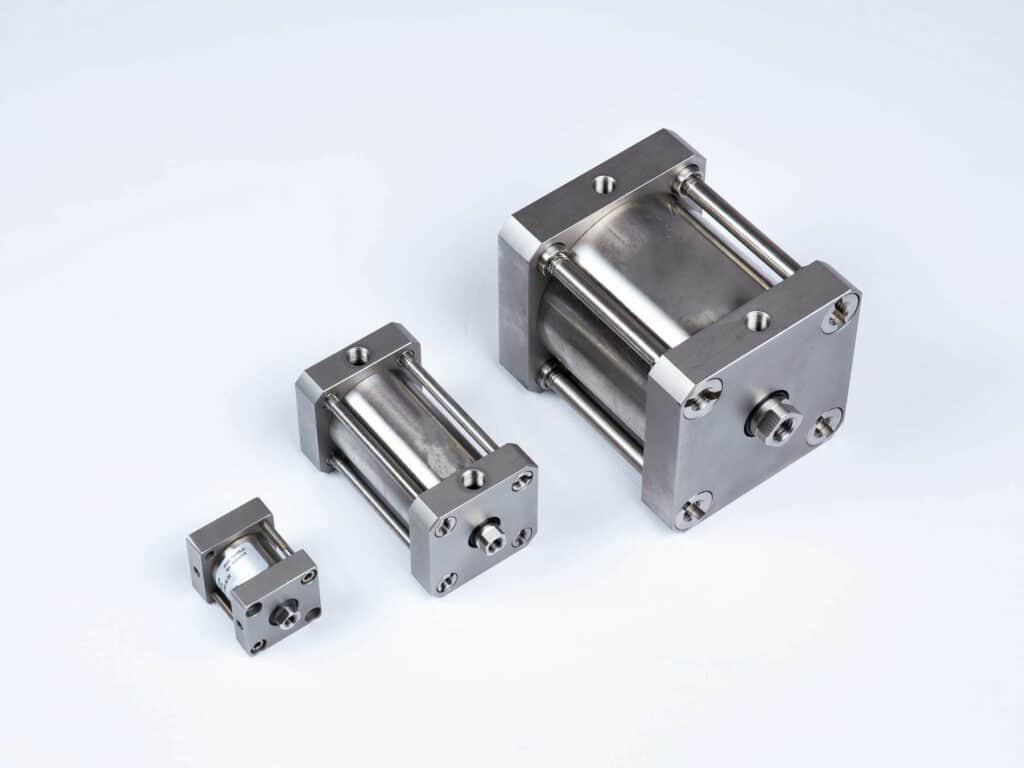
The image above shows stainless construction, but it also shows tie rods, fasteners, end-cap joints, ports, and mounting faces. Each feature needs its own cleanability review. A cylinder is washdown-suitable only when the installed assembly survives the cleaning exposure and can be inspected without hiding residue.
The 2026 revision of the 3-A General Requirements Standard now serves as the foundation for more than 80 equipment standards. It addresses materials, fabrication, drainability, and cleanable construction, but a component does not become 3-A compliant merely because it uses stainless steel (3-A SSI, 2026).
| Specification element | What to document | Why it matters |
|---|---|---|
| Cleaning exposure | Chemical, concentration, temperature, pressure, time, frequency | Defines the material and seal load case |
| Hygiene zone | Product contact, splash, washdown, or protected non-food area | Sets the cleanability and documentation boundary |
| Complete assembly | Cylinder, mount, switch, fitting, tube, fastener, and guard | The weakest exposed part controls suitability |
| Inspection access | Visible joints, removable guards, drain paths, and seal access | Allows sanitation and maintenance teams to verify condition |
Treat the sanitation recipe as an engineering load case. Force and stroke size the motion; cleaning chemistry and geometry size the protection package. If the RFQ says only “stainless” and “IP67,” the supplier still does not know what the cylinder must survive.
Which Hygiene Zone and Cleaning Protocol Apply?
Two current manufacturer examples show why zone classification matters. SMC states that its CG5-S stainless cylinder is intended for water-splash environments and cannot be used in the food zone, while Festo documents a CRDSNU configuration for direct food contact under Regulation (EC) No. 1935/2004 (SMC, 2024; Festo, 2026).
What actually touches the cylinder during sanitation? Record whether the actuator sees mist, direct spray, foam, hot water, steam, sanitizer residue, product splash, or immersion. Then record the nozzle distance, pressure, angle, exposure time, and whether chemicals can pool beneath brackets or inside switch rails.
| Zone | Typical exposure | Cylinder specification focus | Evidence to request |
|---|---|---|---|
| Protected non-food area | Humidity, condensation, occasional wipe-down | Corrosion control, air quality, accessible maintenance | Material list and environmental rating |
| Splash zone | Product splash, water spray, foam, rinse cycles | Smooth exterior, wiper, sealed switch, drainable mount | Cleaning-media limits and ingress test data |
| Washdown zone | Repeated direct spray, chemical cleaning, hot-water cycles | Assembly-level compatibility and protected connections | Test report, seal compound, grease, and cleaning limits |
| Product-contact zone | Direct or incidental food contact | Hygienic geometry and food-contact declarations | Declaration tied to exact material and intended use |
Do not call every wet location a food zone. SMC’s own catalog separates splash service from food-zone use, which is a useful procurement warning. For broader heat, dust, corrosion, and hazardous-area screening, use the environmental actuator selection guide.
When Should You Specify 304 or 316L Stainless Steel?
Outokumpu’s published comparison gives 304L a pitting resistance equivalent, or PRE, of 18 and 316L a PRE of 24. The 316L grade gains its advantage mainly from roughly 2.1% molybdenum, which improves resistance to chloride-driven pitting and crevice corrosion (Outokumpu Prodec datasheet, accessed 2026).
Type 304 is still the most common stainless grade in food and beverage applications (Nickel Institute, accessed 2026). Use it when the cleaning chemistry, temperature, chloride level, drainage, and maintenance history justify it. Upgrade to 316L when chloride or acidic cleaning exposure makes the added molybdenum valuable.
| Condition | 304 may be reasonable | 316L is the stronger starting point |
|---|---|---|
| Cleaning chemistry | Mild, controlled, well-rinsed cleaners | Chloride-bearing or more acidic sanitation cycles |
| Temperature and time | Short exposure at moderate temperature | Longer hot exposure that accelerates localized attack |
| Geometry | Open, drainable, easy to rinse | Crevices, shielded joints, or residue-retaining details remain |
| Documentation | Proven 304 service history in the same process | New process, uncertain chemistry, or higher failure consequence |
Why pay for 316L if sanitizer still sits beneath a bracket? Fix drainage, fastener selection, surface damage, weld cleanup, and rinse practice with the alloy decision. For salt spray, splash-zone, or seawater exposure outside food production, keep that separate and use the marine corrosion-resistant cylinder guide.
Why Do IP Ratings Not Prove Hygienic Design?
Siemens’ 2025 manual describes an IPX9 test using water at about 80°C and 80 bar from four angles for roughly 30 seconds per position, with a nozzle about 125 mm away. Those laboratory conditions are specific and still cannot prove chemical compatibility or cleanability (Siemens SIRIUS ACT manual, 2025).
IEC 60529 classifies enclosure protection against solids and liquids. IPX7 addresses temporary immersion; IPX9 addresses high-pressure, high-temperature water jets. One is not a general upgrade certificate for the other, and neither code confirms food-contact suitability, seal chemistry, surface finish, drainage, grease, or long-term sanitizer resistance (IEC 60529, Edition 2.2, 2013).
Use an IP rating as one line in the evidence package. The useful question is not, “Is this IP67 or IP69?” It is, “Was the exact assembled product tested, and do the stated pressure, temperature, nozzle distance, duration, and chemical limits match our sanitation procedure?”
| Claim on a quotation | What it actually proves | What is still missing |
|---|---|---|
IP67 |
A defined solids and temporary-immersion test | High-pressure spray, hot water, chemicals, and sanitary geometry |
IP69 or IP69K |
A defined high-pressure hot-water ingress test | Seal-media compatibility, food contact, drainage, and service life |
Stainless exterior |
External metal selection | Steel grade, passivation, weld condition, fasteners, and internal parts |
Food grade |
Nothing without a referenced declaration | Exact regulation, material, supplier, configuration, and intended use |
Sensors, valve coils, connectors, cable glands, and fittings need the same check. A cylinder body may survive a rinse while a reed-switch cable or port fitting admits water. If the system also faces heat, dust, or hazardous-area requirements, return to the broader environmental selection checklist before finalizing the actuator.
How Do Surface Finish, Drainage, and Mounting Reduce Residue Traps?
3-A sanitary criteria generally use 32 microinches, or 0.8 µm Ra, as a product-contact benchmark and also require cleanable radii, drainability, and freedom from pits and crevices. Its revised 2026 General Requirements Standard specifies double-seal leak-detection paths of at least 1/8 inch diameter (3-A primer, 2026; 3-A update, 2026).
Ra is useful, but it is not a complete hygiene score. Directional scratches, damaged passivation, pores, weld discoloration, exposed threads, label edges, switch grooves, recessed screws, horizontal ledges, and metal-to-metal crevices can retain soil even when the nominal surface roughness passes.
The old infographic also confused 2B and 2R. A 2B finish is cold rolled, heat treated, pickled, and skin passed. A 2R, or BA, finish is bright annealed in an inert atmosphere and is generally smoother and brighter (worldstainless, accessed 2026). Neither designation guarantees the finished cylinder’s Ra after machining, welding, or assembly.
| Detail | Better washdown specification | Weak specification |
|---|---|---|
| External geometry | Sloped or vertical surfaces with visible drainage | Flat ledges and blind pockets |
| Threads and screws | Covered, sealed, or outside the exposed zone | Open mounting holes and recessed adjusters |
| Brackets | Open profile with inspectable interfaces | Overlapping plates that trap liquid |
| Switches and cables | Sealed device, clean routing, protected connection | Open groove with a low-point cable loop |
| Finish | Measured Ra where required, defect-free surface, documented treatment | “Polished stainless” without a measurement or inspection criterion |
Can the sanitation team see and clean the rear mount without removing the actuator? If not, move the cylinder, change the bracket, add a cleanable guard, or redesign the linkage. Hygiene often improves more from geometry and access than from changing 304 to 316L.
Which Seals, Lubricants, and Air-Quality Controls Belong in the Specification?
For repeated-use rubber in aqueous-food contact, 21 CFR 177.2600 limits total extractives to 20 mg/in² during the first 7 hours and 1 mg/in² during the next 2 hours. Fatty-food tests use different limits, showing why a generic “FDA-approved seal” label is inadequate (eCFR 21 CFR 177.2600, accessed 2026).
Ask for the exact seal compound and supplier declaration. The phrase FDA-conformant under 21 CFR 177.2600 for the stated conditions of use is more useful than FDA approved. FDA explains that a food-contact notification is tied to a named manufacturer or supplier and defined conditions (FDA, accessed 2026).
Then check the sanitation recipe. Trelleborg lists alkali, acid, hypochlorite, peracetic-acid, and peroxide chemistries across CIP and SIP service, while warning that temperature, concentration, exposure time, and the exact compound change performance (Trelleborg, accessed 2026). Would you accept a seal simply because the quotation says EPDM or FKM?
Use the industrial cylinder seal guide to compare seal jobs and failure patterns. If hot water or steam pushes the assembly beyond its catalog limits, use the high-temperature cylinder guide before approving the seal, grease, switch, and tubing package.
Compressed air belongs in the hygiene review too. Section 117.40(g) requires compressed air mechanically introduced into food, or used to clean food-contact surfaces or equipment, to be treated so it does not contaminate food with unlawful indirect food additives. Use the ISO air-quality guide and the pressure-dew-point guide to document particles, water, oil, and condensation risk.
What Failure Modes Should Maintenance Teams Watch?
SMC reports four times better durability for its specific HF2A-CG5 cylinder in water-droplet exposure, but the result applies only to SMC’s stated test conditions and product design. Its catalog also identifies 20, 25, 32, and 40 mm bore options, FKM water-resistant parts, and NSF H1 grease (SMC HF2A-CG5, 2025).
That vendor result is useful as a specification example, not an industry-wide life multiplier. Record the actual failure location and sanitation conditions so the replacement addresses the mechanism rather than repeating the same material label.
| Observed symptom | Likely paths to investigate | Evidence to capture before replacement |
|---|---|---|
| Rust stain at a fastener or bracket | Mixed metals, damaged passivation, trapped liquid | Close photos, fastener grade, cleaning chemical, dwell time |
| Rod-seal leakage after washdown | Wiper damage, swollen seal, scratched rod, pressure washing at the gland | Seal compound, nozzle distance, temperature, rod condition |
| Water beneath switch cover | Wrong ingress rating, cable entry, damaged seal, low-point routing | Switch model, connector, cable path, spray direction |
| Sticky or slow motion after cleaning | Internal water, grease loss, seal friction, contaminated air | Air-quality record, pressure trend, teardown photos |
| Residue around end caps | Crevices, horizontal installation, inaccessible cleaning | Installed orientation, sanitation access, swab or visual record |
Failure location is often more informative than cylinder material. A repeating stain under one clamp points to trapped chemistry; uniform attack across all exposed parts points toward material or cleaning compatibility. Map the pattern before changing the alloy.
How Should the Cylinder Be Inspected and Documented?
ISO 14159:2002 remains the published hygienic-design standard and was last confirmed in 2018. A 44-page Edition 2 draft entered the DIS stage on May 5, 2026, so buyers should cite the current edition while tracking the revision rather than calling the draft effective (ISO 14159, 2026; ISO/DIS 14159, 2026).
Inspection should confirm the installed condition, not only the catalog description. Photograph the cylinder before and after sanitation. Check pits, tea staining, loose fasteners, trapped liquid, torn wipers, cable damage, cracked tubing, seal leakage, switch operation, cushion response, and any residue at interfaces.
Document changes to the cleaning recipe. A new sanitizer, higher concentration, hotter rinse, closer nozzle, or longer foam dwell can invalidate an old material decision even when the cylinder model has not changed. The revision record should connect process changes to component reviews.
For food-contact or validated areas, retain the exact material declaration, seal-compound statement, grease certificate, surface-finish record, ingress test report, and supplier configuration. A certificate for a base material does not automatically cover the assembled cylinder, sensor, fitting, or mount.
Washdown Cylinder Specification Checklist
The 2026 3-A General Requirements revision connects more than 80 equipment standards to a shared hygienic-design baseline. A useful cylinder RFQ should therefore describe the installed system, cleaning process, materials, drainage, and evidence package instead of relying on two shorthand labels such as 316L and IP69 (3-A SSI, 2026).
Make the cleaning protocol a controlled RFQ input. If sanitation changes later, the same field becomes the trigger for an engineering review.
| RFQ field | Information to provide | Supplier evidence to request |
|---|---|---|
| Motion | Bore, stroke, load, pressure, speed, cycle rate, mounting | Sizing calculation and catalog operating limits |
| Hygiene zone | Product contact, splash, washdown, or protected area | Intended-use statement and applicable declaration |
| Cleaning method | Manual, foam, low-pressure rinse, high-pressure wash, CIP, or SIP | Approved method and stated test boundary |
| Cleaning chemistry | Product name, active ingredient, concentration, pH | Written compatibility for body, rod, seals, grease, and plastics |
| Thermal exposure | Water, steam, ambient, and cylinder-body temperatures; dwell time | Temperature limits for every exposed component |
| Materials | Body, rod, caps, fasteners, mount, fitting, and switch housing | Material list and certificates for the quoted configuration |
| Surface and geometry | Ra target, weld condition, thread covers, slope, crevice control | Finish measurement, drawing, and cleaning-access details |
| Ingress protection | Spray pressure, temperature, angle, distance, and duration | Test standard, rating, report, and assembly conditions |
| Pneumatic hygiene | Particle, water, oil, dew-point, and exhaust requirements | Air-treatment plan and maintenance interval |
| Maintenance | Seal access, replacement method, inspection interval, spare kit | Parts list, instructions, and approved cleaning agents |
No Bepto calculator is inserted because this article has no primary calculation task. If your project still needs bore sizing, complete that calculation separately before applying the washdown specification. Send the finished checklist with drawings and cleaning data through the engineering contact page so the quotation can be tied to the real exposure.
FAQs About Stainless Steel Cylinders for Food Washdown
These five answers address the specification shortcuts most likely to cause a washdown failure. They use 21 CFR sanitary-design requirements, IEC ingress classifications, and the current ISO 14159 edition; the proposed 44-page ISO revision reached the DIS stage on May 5, 2026, but is not yet the published standard (ISO, 2026).
Is 316L stainless steel required for every food-washdown cylinder?
No. Outokumpu lists PRE values of 18 for 304L and 24 for 316L, so 316L offers stronger nominal resistance to chloride pitting. The choice still depends on cleaner chemistry, temperature, dwell time, drainage, crevices, and failure consequence; proven mild service may justify 304 (Outokumpu, 2026).
Is an IP67 rating enough for repeated high-pressure washdown?
No. IP67 includes temporary immersion, not the hot, high-pressure spray represented by IPX9. A current Siemens test description uses about 80°C water at 80 bar from four angles for roughly 30 seconds each. Even IPX9 does not prove chemical compatibility, drainage, or food-contact suitability (Siemens, 2025).
Which seal material is best for a food-washdown pneumatic cylinder?
There is no universally best elastomer. Select the exact compound against cleaner, concentration, temperature, exposure time, lubricant, speed, and food-contact duty. For repeated-use rubber, 21 CFR 177.2600 sets different extractive limits for aqueous and fatty foods, so an elastomer family name alone cannot establish compliance (eCFR, 2026).
Can a stainless steel cylinder withstand steam sterilization?
Only when the complete quoted configuration is approved for the actual steam temperature, pressure, duration, and cycle frequency. Stainless steel may tolerate the environment while seals, grease, switches, fittings, or tubing do not. Trelleborg treats SIP as a compound-specific application, not a blanket property of stainless equipment (Trelleborg, 2026).
What documents should I request with a washdown-cylinder quotation?
Request an exact bill of materials, stainless grades, seal-compound and grease declarations, surface-finish evidence, ingress test details, cleaning-media limits, drawings, and maintenance instructions. Where product contact applies, tie every declaration to the supplied configuration and intended use; 3-A guidance commonly uses 0.8 µm Ra as one product-contact benchmark (3-A SSI, 2026).
Sources and Retrieval Notes
The 16 primary or expert sources below, including 21 CFR 117.40 and ISO 14159, were retrieved on July 10, 2026. They define cleanability, food-contact, ingress, and hygienic-design boundaries; dated manufacturer documents supply application-specific examples, not universal service-life forecasts.
- 21 CFR 117.40, Equipment and utensils, retrieved 2026-07-10. Used for cleanability, sanitary pneumatic-system design, and compressed-air treatment requirements.
- FDA, Determining the Regulatory Status of Components of a Food Contact Material, retrieved 2026-07-10. Used to explain why food-contact status must be tied to a material, supplier, and intended use.
- 21 CFR 177.2600, Rubber articles intended for repeated use, retrieved 2026-07-10. Used for the aqueous- and fatty-food extractive limits in the seal chart.
- ISO 14159:2002, Safety of machinery - Hygiene requirements for the design of machinery, retrieved 2026-07-10. Used for the current published hygienic-design standard and its 2018 confirmation status.
- ISO/DIS 14159, Edition 2, retrieved 2026-07-10. Used only to identify the 44-page draft’s DIS status and May 5, 2026 registration date.
- IEC 60529, Degrees of protection provided by enclosures, retrieved 2026-07-10. Used for the scope and edition context of IP classifications.
- Siemens SIRIUS ACT manual, 2025 edition, retrieved 2026-07-10. Used for one current IPX9 laboratory test description.
- Outokumpu Prodec range datasheet, retrieved 2026-07-10. Used for 304L and 316L PRE values and nominal molybdenum content.
- Nickel Institute, Food contact materials, retrieved 2026-07-10. Used for the prevalence of Type 304 in food and beverage applications.
- worldstainless, Surface treatment, retrieved 2026-07-10. Used to distinguish 2B and 2R stainless finishes.
- 3-A SSI, A Primer for 3-A Standards and Practices, retrieved 2026-07-10. Used for the 32 microinch, or 0.8 µm Ra, product-contact benchmark and cleanable-geometry principles.
- 3-A SSI, 2026 General Requirements Standard update, retrieved 2026-07-10. Used for the revised foundation standard, its relationship to more than 80 standards, and double-seal leak-detection pathway guidance.
- Trelleborg, Cleaning in place and sterilization in place, retrieved 2026-07-10. Used for compound-specific CIP and SIP compatibility factors.
- Festo CRDSNU product documentation, March 2026 edition, retrieved 2026-07-10; SMC CG5-S catalog, retrieved 2026-07-10; and SMC HF2A-CG5 catalog, retrieved 2026-07-10. Used as clearly attributed product examples, not universal performance claims.