

Pneumatic cylinder standardization is the controlled reduction of unnecessary cylinder variety across a facility. Standardizing pneumatic cylinders well does not mean installing one model everywhere. It means defining approved platforms, configurable variants, verified cross-references, critical spares, and an exception path for applications that genuinely need something different.
ISO 15552 provides a useful starting point. It covers detachable-mount cylinders from 32 to 320 mm bore at a maximum rated pressure of 1,000 kPa, or 10 bar, and was confirmed as current in 2025 (ISO 15552:2018, confirmed 2025). Yet dimensional compliance alone doesn’t prove equal force, cushioning, sensing, sealing, corrosion resistance, or safety behavior.
That distinction changes the business case. A plant should measure active part numbers, inventory value, emergency purchases, replacement-fit failures, recovery time, and supplier risk before promising savings. The result is a standardization program built on verified site data, not a universal percentage borrowed from another factory.
Key Takeaways
- ISO 15552 covers 32-320 mm bores and 10 bar, but not complete application equivalence.
- Standardize platforms and decision rules, not every cylinder.
- Keep documented exceptions for environment, motion, safety, and compliance.
- Prove value with site baselines, pilot results, and lifecycle cost.
From our analysis of the cited ISO scopes and current manufacturer catalogues, the strongest standard is a decision system. It tells maintenance what can be replaced, engineering what must be recalculated, purchasing what may be dual-sourced, and everyone when an exception needs approval.
What Should Standardizing Pneumatic Cylinders Across a Facility Actually Cover?
ISO 15552 covers 32-320 mm bores at up to 1,000 kPa, or 10 bar, but it standardizes basic, mounting, and accessory dimensions rather than every application detail (ISO 15552:2018, confirmed 2025). A facility should standardize cylinder platforms and approval rules, not force every machine into one model.
Start with interfaces that can be documented and checked. These include cylinder family, bore, stroke, mounting code, installed length, rod end, port arrangement, sensor provision, and accessory pattern. Then keep application variables beside those interfaces: actual pressure, required force, target stroke time, load direction, cushioning demand, side load, temperature, washdown, chemicals, corrosion, and safety function.
What happens if a plant standardizes only by bore and stroke? A replacement may bolt into place and still fail the job. ISO 6432 explicitly leaves manufacturers freedom of design within its 8-25 mm, 10 bar dimensional series (ISO 6432:2015, published 2015). ISO 21287 covers 20-100 mm compact cylinders but excludes adjustable cushioning, which limits where that platform belongs (ISO 21287:2004, confirmed 2023).
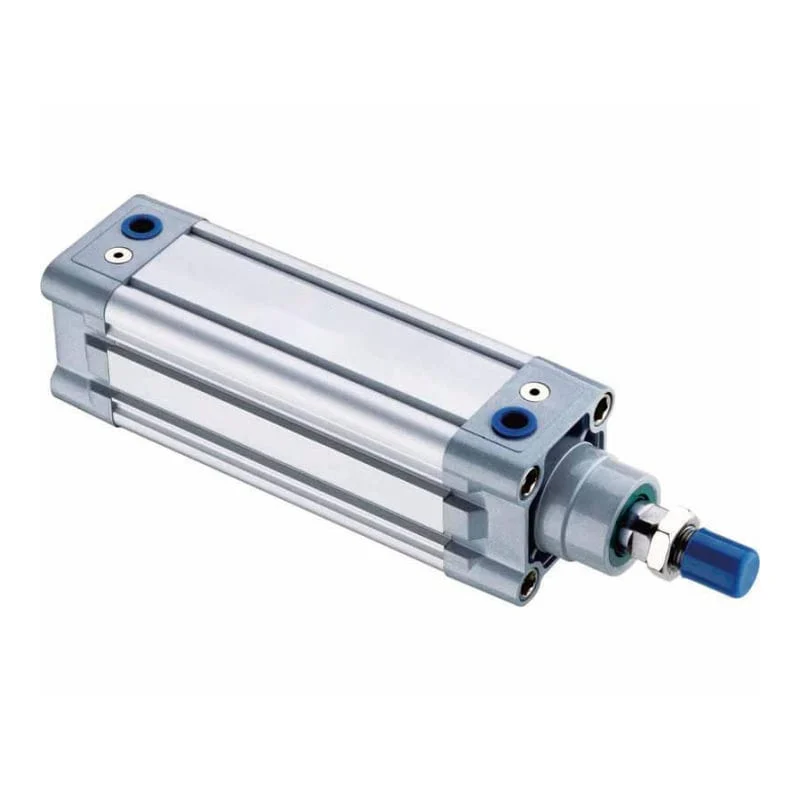
MB Series ISO 15552 tie-rod pneumatic cylinder
The practical rule is simple: standardize what can be verified on a drawing and acceptance sheet. Keep configuration choices visible. A food washdown cylinder, a high-temperature oven cylinder, a rodless transfer axis, and a safety-related holding device shouldn’t disappear into the same generic line item.
What Belongs in the Installed-Base and Criticality Register?
ISO 14224 organizes reliability and maintenance records into three main categories: equipment, failure, and maintenance data (ISO 14224:2016, 2016). Although that standard targets petroleum industries, its three-part logic adapts well to a cylinder register: identify the asset, record what failed, and record what the repair required.
The register should contain one row per installed cylinder position, not one row per part number. Two identical cylinders can carry different risk when one stops a packaging line and the other opens a noncritical access flap. The location, machine function, and production consequence belong beside the hardware specification.
| Data group | Minimum fields | Why it matters |
|---|---|---|
| Asset identity | Site, line, machine, axis tag, drawing number | Finds the installed position again |
| Cylinder interface | Family, bore, stroke, mounting, installed length, rod end, ports | Tests dimensional fit |
| Controls | Valve, tube size, sensors, connector, cushioning, regulator setting | Protects speed and sequence behavior |
| Application | Load direction, dynamic pressure, stroke time, duty cycle, side load | Tests performance equivalence |
| Environment | Temperature, washdown, dust, chemicals, corrosion, cleanroom need | Drives seals, materials, and protection |
| Reliability | Failure mode, event date, repair action, downtime, repeat failure | Separates chronic problems from random events |
| Supply risk | On-hand stock, supplier, lead time, approved alternative, last purchase | Supports spare and sourcing decisions |
| Criticality | Safety effect, quality effect, production loss, fallback method | Sets validation and stock depth |
Don’t begin by deleting duplicate-looking records. First reconcile the register with the shelf, maintenance history, drawings, and current supplier data. A discontinued model may still have a good approved replacement. A common model may hide several sensor or seal suffixes that deserve separate configuration records.
The most useful exception note is short and mechanical: what is different, why the standard platform fails, and what test proves the exception works. A vague note such as “special machine” will not help the next technician or buyer.
Use a system-level maintenance and downtime worksheet for service planning. If the register includes long-stroke carriage axes, connect those records to the rodless-cylinder preventive-maintenance checklist instead of treating them like ordinary rod cylinders.
How Should Applications Be Grouped Without Over-Standardizing?
Parker’s ISO 15552 P1F catalogue spans seven bore sizes from 32 to 125 mm, strokes from 5 to 2,500 mm, and 1-10 bar operating pressure (Parker P1F catalogue, retrieved 2026). Those ranges show why application grouping must use a measured operating envelope, not part-number similarity alone.
Group positions only when they share the same mechanical and operating envelope. Start with cylinder family and mounting, then compare bore, stroke, direction-specific load, point-of-use pressure, target speed, cushion energy, guidance, environment, sensors, and safety role. The old brand comes later.
For example, two 50 mm bore cylinders with the same stroke may still need separate groups when one carries a guided horizontal load and the other controls an unguided vertical load. Their mounting dimensions look alike, but their side-load exposure, retraction demand, failure consequence, and safe acceptance tests do not.
| Grouping gate | Combine positions when | Keep separate when |
|---|---|---|
| Motion | End positions and stroke tolerance match | Mid-stroke control or different endpoints matter |
| Force | One standard bore meets push and pull loads with approved margin | Vertical load, clamp force, or rod-side demand differs |
| Speed | Valve, tubing, exhaust, and stroke-time targets are compatible | One axis needs much higher flow or gentle motion |
| Mounting | The same interface and installed length pass drawing review | Brackets, rod ends, or clearances differ |
| Environment | Seal, temperature, corrosion, and washdown duty match | Food, chemical, cleanroom, or outdoor duty changes |
| Safety | Failure consequence and energy-control method match | Load holding or safety-related behavior is different |
Force is only the first screen. The pressure-and-area force guide explains why retraction force is lower than extension force. An environmental selection review helps separate ordinary factory duty from corrosive, high-temperature, washdown, or hazardous-area exceptions.
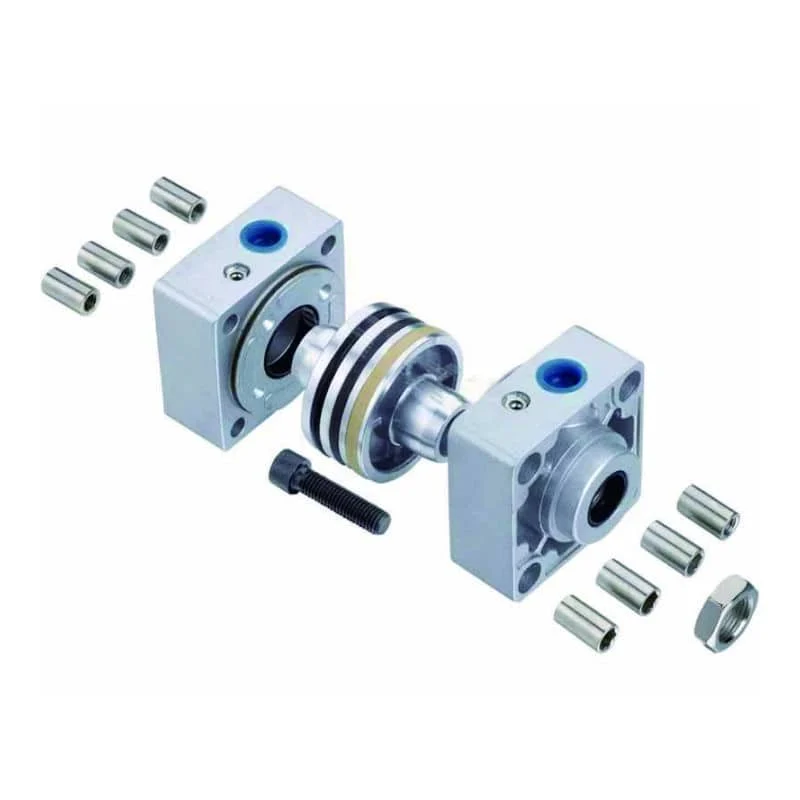
MB Series ISO 15552 cylinder assembly kits
Should every uncommon stroke become an exception? Not necessarily. A configurable standard family can allow several strokes while keeping the same bore, mount, sensors, seal kit, and supplier approval. Standardization removes unmanaged variety; it does not remove legitimate configuration.
Approved Platforms, Configurable Variants, and Engineered Exceptions
In its current product catalogue, SMC’s ISO 15552 CP96 family lists seven standard bore sizes, plus single-rod, double-rod, and non-rotating variants (SMC CP96/CP96SD, retrieved 2026). That variation inside one standard family supports a three-class policy: approved platform, configurable variant, and engineered exception.
An approved platform is a cylinder family with a validated application envelope. A configurable variant is a controlled option inside that envelope, such as an approved stroke, mount, sensor, or seal. An engineered exception is a documented position that falls outside the envelope and therefore needs its own owner, evidence, and review date.
| Governance class | What belongs here | Approval evidence | Spare strategy |
|---|---|---|---|
| Approved platform | Repeated applications inside one validated envelope | Drawing, calculation, machine acceptance record | Stock by critical bore, stroke, and repair kit |
| Configurable variant | Same platform with controlled stroke, sensor, mount, or seal options | Approved option matrix and part-number decoder | Stock common wear parts; order slower variants |
| Engineered exception | Function or environment outside the platform envelope | Named owner, technical reason, test plan, review date | Risk-based dedicated spare or documented contingency |
The exception column matters because ISO families contain real functional differences. Festo’s DSBC ISO 15552 range spans 32-125 mm bores, strokes from 1 to 2,800 mm, and three cushioning systems, with temperature and locking variants (Festo DSBC data sheet, 2024). One mounting pattern can therefore support several very different configurations.
A cross-brand alternative needs its own approval record. Compare the supplier drawing, rod and port interfaces, sensor arrangement, cushioning, seal materials, operating range, force, speed, and acceptance criteria. The ISO 6432 cross-brand replacement checklist shows the level of detail required for one position.
NIST recommends segmenting suppliers by component criticality, identifying secondary or alternative suppliers, using safety stock where justified, and measuring suppliers with scorecards (NIST Supply Chain Management, updated 2025). Dual sourcing is useful only when both sources have passed the same drawing and machine test. Two unverified options are not resilience.
An exception register helps prevent “temporary” substitutions from becoming permanent undocumented standards. Give every exception an owner, reason, affected assets, approved part, validation record, spare decision, and review date.
How Should the Business Case Be Measured?
NIST documents a metrication case in which Caterpillar reduced sheet-steel sizes from 74 to 34 and bar sizes from more than 500 to fewer than 200 (NIST Metrication Case Studies, updated 2025). Those results aren’t cylinder forecasts; they demonstrate why a standardization business case must compare measured variety before and after.
The same NIST page reports that General Motors reduced fan-belt sizes from more than 900 to fewer than 100. These are historical metrication cases, not pneumatic benchmarks. Their value is methodological: count variety, record conversion cost, measure inventory and purchasing effects, and compare the result with the baseline.
Build the facility case from its own records. Use the same time window before and after the pilot, keep conversion costs visible, and separate cash released from inventory from recurring annual savings.
SKU reduction % = (baseline active SKU - approved active SKU) / baseline active SKU x 100
Inventory value change = baseline average inventory value - post-rollout average inventory value
Emergency-purchase change = baseline expedite cost - post-rollout expedite cost
Downtime value change = sum of verified recovery-hour change x approved line value per hour
Net benefit = verified savings - engineering, validation, training, tooling, and conversion costs
Add supplier performance and stockout risk. NIST notes that more than half of a manufacturer’s spending occurs in the supply chain on average, and recommends TCO beyond purchase price (NIST Supply Chain Management, updated 2025). For the wider actuator cost model, use the full actuator TCO worksheet.
Don’t count unused shelf value as savings until the accounting treatment is clear. Some stock will be consumed during transition, some retained as rollback stock, some transferred, and some written off. State each category separately.
How Can the Program Be Piloted Without Disrupting Production?
OSHA says roughly 3 million workers service equipment and that lockout/tagout compliance prevents an estimated 120 fatalities and 50,000 injuries each year (OSHA Lockout/Tagout Fact Sheet, 2022). A cylinder standardization pilot therefore belongs inside planned maintenance and energy-control procedures, never outside them.
Use a five-phase rollout with explicit gates. Start on a representative, recoverable application rather than the easiest axis in the building. The pilot should exercise the drawing review, supplier response, installation, acceptance test, documentation, spare issue, and rollback plan.
| Phase | Main work | Exit gate |
|---|---|---|
| 1. Baseline | Register assets, reconcile stock, rank criticality, record failures and lead times | Data owner signs off the installed-base sample |
| 2. Engineering | Define platform envelopes, variants, exceptions, drawings, calculations, and approved sources | Cross-functional review accepts the candidate matrix |
| 3. Pilot | Replace selected positions during approved maintenance windows and retain rollback stock | Fit, force, speed, leak, sensor, safety, and restart tests pass |
| 4. Controlled rollout | Convert matched positions as maintenance events occur; monitor supply and machine results | Each wave stays inside the accepted risk and performance limits |
| 5. Sustain | Audit new designs, supplier changes, exceptions, stock, and KPI trends | Periodic review closes drift and retires obsolete records |
OSHA requires pneumatic and other hazardous energy to be isolated, stored energy relieved or restrained, and isolation verified before work proceeds (OSHA 1910.147, current regulation). The standard also requires at least annual inspection of energy-control procedures. Standardization doesn’t create an exception to those duties.
Can the plant avoid a production stop entirely? No responsible program should promise that. It can avoid unplanned disruption by converting during approved windows, protecting critical spares, pre-validating drawings, testing off-line where possible, and keeping a rollback path. Production release comes after the acceptance sheet passes, not after the cylinder merely moves once.
Record the first-shift result for critical positions. A cold test may miss heat, sensor repeatability, cushion behavior, fitting movement, or regulator droop. If the pilot changes bore, stroke, tube size, or valve demand, review the point-of-use pressure-drop guidance before expanding the rollout.
A first-shift check determines whether a mechanically correct replacement is operationally acceptable. Keep the result with the asset record so a later buyer or technician can distinguish a validated substitute from a part that merely shares the same nominal dimensions.
Which KPIs Keep the Standard From Drifting?
DOE reports that poorly maintained compressed-air systems can lose 20-30% of air capacity to leaks, while well-maintained systems should stay below 10% (DOE Compressed Air Sourcebook, 2003). Cylinder standardization needs operating KPIs as well as inventory KPIs, or a smaller parts list can still feed an inefficient air system.
Use a compact scorecard that engineering, maintenance, stores, and purchasing can all read. Every metric needs a data owner, baseline period, review frequency, and action threshold.
| KPI | Definition | What it reveals |
|---|---|---|
| Active cylinder SKU count | Distinct approved and legacy cylinder SKUs with live demand | Whether variety is actually falling |
| Platform coverage | Positions served by approved platforms / eligible positions | How much of the installed base is governed |
| Exception count and age | Open exceptions by owner and review date | Where temporary choices are becoming permanent |
| Inventory value by class | Standard, variant, exception, rollback, and obsolete stock | Whether cash is moving or only relabeled |
| Stockout and expedite events | Critical shortages and premium purchases per review period | Whether the spare policy is resilient |
| Replacement-fit failure rate | Rejected installs / attempted standardized replacements | Quality of drawings and cross-references |
| MTTR by failure mode | Diagnose, isolate, replace, test, and restart time | Whether service work is becoming more predictable |
| Dynamic pressure and stroke time | Point-of-use pressure during motion and accepted cycle time | Whether standard cylinders still perform correctly |
| Leakage trend | Verified leak rate or tagged leak volume around converted assets | Whether common hardware improves air-system control |
CAGI says every 2 psig of excess operating pressure increases compressor power by about 1%, and recommends no more than 10% pressure drop from compressor discharge to point of use (CAGI Working With Compressed Air, retrieved 2026). Don’t raise a plant-wide pressure setpoint to rescue one poor standardization choice.
DOE’s leak-program guidance follows a useful control loop: identify, document, prioritize, repair, compare with baseline, and repeat. Apply the same discipline to cylinder exceptions and replacement failures. If one approved platform repeatedly needs adapters, pressure increases, or sensor workarounds, revisit the platform instead of training the site to tolerate the defect.
Conclusion: Standardize the Decision Rules, Not Every Cylinder
ISO 55001:2024 frames asset decisions around three linked dimensions: performance, risk, and expenditure (ISO 55001:2024, 2024). That is the right closing test for pneumatic cylinder standardization. A proposal is sound only when it improves serviceability without trading away machine function, safety, or lifecycle value.
The strategic gain comes from controlled commonality. Build a trustworthy installed-base register, group applications by measured envelopes, define approved platforms and variants, preserve engineered exceptions, validate alternatives, and prove results against the baseline. That makes purchasing simpler without leaving maintenance to discover hidden differences during a breakdown.
Start small, but make the pilot representative. If the drawings, calculations, supplier controls, acceptance test, spare issue, and KPI review all work on one line, the facility has a repeatable system. If they don’t, fix the governance before scaling the parts list.
For a facility-specific cylinder cross-reference review, contact Bepto Pneumatic with the current part numbers, drawings, operating pressure, load, stroke-time target, environment, sensors, and mounting constraints. Those inputs let an application engineer separate suitable platform candidates from positions that should remain engineered exceptions.
FAQs About Pneumatic Cylinder Standardization
ISO 10014:2021 describes a two-step management loop: monitor trends in key performance metrics, then act on the observed results (ISO 10014:2021, 2021). The answers below apply that loop to the questions maintenance, engineering, and purchasing teams usually face during cylinder standardization.
Does ISO 15552 make cylinders interchangeable across brands?
It standardizes basic, mounting, and accessory dimensions for 32-320 mm cylinders up to 10 bar, which reduces interface risk. It does not guarantee equal installed length, ports, sensors, cushioning, seals, temperature range, force, or safety behavior. Approve a cross-brand replacement only after drawing review and machine acceptance testing (ISO 15552, confirmed 2025).
How many standard cylinder families should a facility use?
There is no universal number. Use the fewest platforms that cover eligible applications without creating unsafe or poor-performing substitutions. NIST’s historical cases show why part-count reduction should be measured, but their 74-to-34 steel-size result isn’t a cylinder target. Let the installed-base register and exception analysis set the answer (NIST, updated 2025).
What should happen to existing cylinder inventory?
Classify it as standard, transitional, rollback, exception, transferable, or obsolete. Consume suitable legacy stock through planned work, retain justified critical spares during the pilot, and document any write-off separately. ISO 55001’s performance-risk-expenditure balance supports that lifecycle decision; an immediate shelf purge can create more risk than value (ISO 55001, 2024).
Can standardization be rolled out without production disruption?
It can reduce unplanned disruption, but it cannot promise zero interruption. Use planned maintenance windows, verified drawings, pre-staged parts, acceptance tests, and rollback stock. OSHA includes pneumatic energy in lockout/tagout and estimates compliant controls prevent 120 fatalities and 50,000 injuries annually, so production pressure cannot bypass isolation and verification (OSHA, 2022).
How should standardization savings be calculated?
Compare matched before-and-after periods for active SKUs, average inventory value, expedite cost, stockouts, replacement-fit failures, recovery hours, and supplier performance. Subtract engineering, testing, training, tooling, conversion, and write-off costs. ISO 10014 recommends monitoring KPI trends and acting on observed results, which is safer than publishing a universal savings percentage (ISO 10014, 2021).
Sources and retrieval notes
Retrieval date: 2026-07-10. The NIST metrication cases are historical analogies for measuring variety reduction, not evidence of pneumatic-cylinder savings. ISO 14224 is sector-specific and is used only as an adaptable data-structure reference. Check standards, regulatory, manufacturer, and numerical claims against the linked sources before applying them to a standardization program.
- ISO 15552:2018, Pneumatic fluid power - Cylinders with detachable mountings, 32-320 mm bore series, 10 bar maximum rated pressure, and dimensional-interchangeability scope; confirmed 2025.
- ISO 6432:2015, Pneumatic fluid power - Single rod cylinders, 8-25 mm bore series, 10 bar scope, and manufacturer design freedom; published 2015.
- ISO 21287:2004, Pneumatic fluid power - Compact cylinders, 20-100 mm compact series and no adjustable cushioning; confirmed 2023.
- ISO 14224:2016, Collection and exchange of reliability and maintenance data, equipment, failure, and maintenance data categories; petroleum-sector scope noted.
- ISO 55001:2024, Asset management system requirements, lifecycle balance among performance, risk, and expenditure.
- ISO 10014:2021, Guidance for realizing financial and economic benefits, KPI trend monitoring and improvement action.
- Parker P1F ISO 15552 Technical Catalogue, bore, stroke, pressure, temperature, cushioning, and variant data.
- Festo DSBC ISO 15552 Data Sheet, June 2024, bore, stroke, cushioning, locking, and environmental variants.
- SMC CP96/CP96SD ISO Cylinder Catalogue, live catalogue, standard and non-rotating variants.
- NIST Metrication Case Studies, updated 2025, Caterpillar and General Motors part-variety cases.
- NIST Supply Chain Management, updated 2025, supplier segmentation, alternatives, safety stock, scorecards, and TCO.
- OSHA Lockout/Tagout Fact Sheet, December 2022, pneumatic energy and injury-prevention estimates.
- OSHA 29 CFR 1910.147, hazardous-energy isolation, stored-energy control, verification, and annual procedure inspection.
- DOE Improving Compressed Air System Performance, 2003, leak ranges, baselining, repair tracking, and pressure-drop guidance.
- CAGI Working With Compressed Air, excess-pressure energy effect and 10% pressure-drop guidance.
- AutomationDirect video, How to Select a Pneumatic Cylinder, published 2021-04-16; 145,252 views when retrieved.