

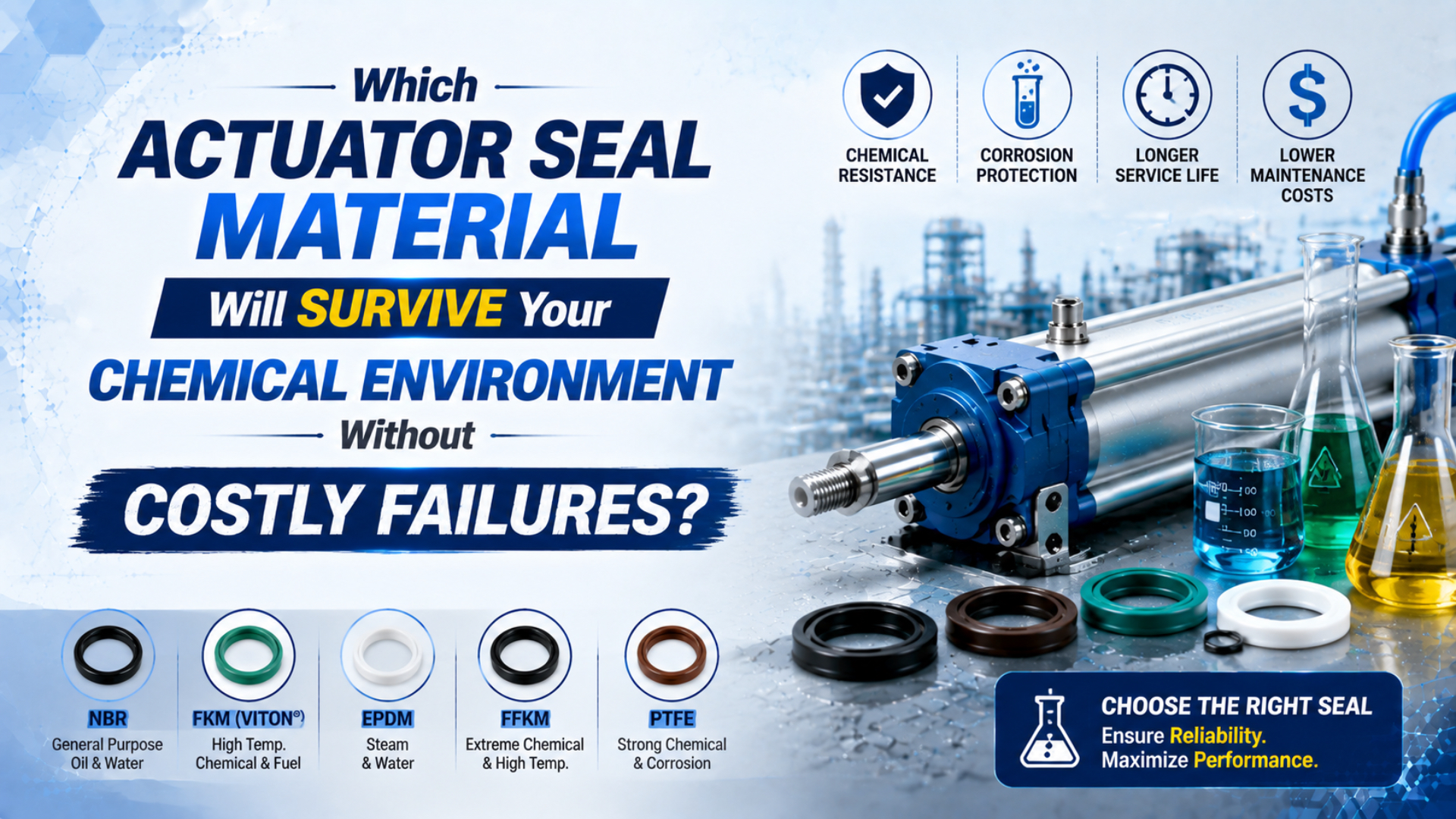
No actuator seal material survives every chemical environment. Choose the exact compound only after defining the chemical, concentration, temperature, exposure route, contact time, seal motion, and lubricant. NBR, EPDM, FKM, FFKM, polyurethane, and PTFE are screening families. None of those names is a complete purchasing specification.
Chemical compatibility is the ability of a specified compound to retain the properties needed for sealing after the stated chemical exposure. It doesn’t mean the material is unaffected, and it doesn’t predict service life unless the test conditions and acceptance limits represent the real application.
This guide assumes you already know the seal position and dimensions. If you need to verify the profile, groove, rod, bore, installation, and complete cylinder acceptance, use the pneumatic cylinder seal compatibility guide. Here, the narrower question is chemical survival: what touches the seal, how to shortlist compounds, and what evidence should approve one.
Key Takeaways
- Festo says chemical resistance depends on chemical type, concentration, exposure time, and temperature.
- Specify a supplier compound code, not only NBR, EPDM, FKM, or FFKM.
- Use charts to reject poor candidates, then test the actual fluid and exposure cycle.
- Treat safety and regulatory requirements as pass-fail gates, not weighted cost factors.
What Chemical Exposure Must You Define?
Festo identifies four variables that strongly affect chemical resistance: chemical type, concentration, exposure time, and temperature. A usable actuator record adds three more: exposure route, seal motion, and lubricant. Without those seven inputs, a supplier can offer only a general material suggestion, not an application approval (Festo, accessed July 17, 2026).
Start with the chemical identity. Record the trade name, supplier, safety data sheet, constituents, concentration range, water content, and relevant contaminants. “Acid,” “solvent,” “coolant,” and “caustic cleaner” are not specific enough. Two products in the same broad class can produce very different swelling, extraction, or hardness changes.
Next, document the complete exposure sequence. Production fluid may be mild while the cleaning cycle supplies the highest concentration or temperature. Rinse water can dilute one chemical, carry residue into another, or leave a seal wet during a long shutdown. Include start-up, production, cleaning, sterilization, rinse, maintenance, and idle periods.
| Exposure input | What to record | Why it changes selection |
|---|---|---|
| Chemical | Product and chemical names, supplier, formulation or SDS | Material charts are indexed by a defined medium, not a nickname |
| Concentration | Normal, maximum, dilution method, mixture and residue | Resistance can change as concentration changes |
| Temperature | Continuous, peak, cleaning, cold start, shutdown soak | Chemistry, stiffness, friction and compression set change with heat |
| Contact time | Continuous, intermittent, splash, dwell and rinse duration | Short splash and continuous immersion are different tests |
| Exposure route | External washdown, airborne vapor, internal air or direct contact | Different seals and actuator parts enter the boundary |
| Motion | Static, reciprocating or rotary, speed, cycles and dwell | Swell or softening that passes statically can fail dynamically |
| Lubricant | Grease, compressor oil, assembly aid and cleaning residue | The lubricant and chemical can affect the same compound together |
Don’t forget mixtures. A compatibility chart for pure chemical A cannot approve chemical A mixed with cleaner B, process residue, compressor oil, or corrosion inhibitor. Ask the chemical supplier whether the formulation or additive package can change without notice, and set a review trigger when it does.
The first material decision may be to remove the seal from the exposure. A shield, rod boot, remote linkage, isolated air supply, drain, or relocated actuator can turn continuous contact into controlled splash or eliminate it. That design change is often more reliable than searching for an increasingly exotic elastomer.
Why Do Chemical Compatibility Charts Disagree?
Parker’s handbook uses four numbered compatibility ratings plus an insufficient-data category. Trelleborg uses A, B, C, U, and an insufficient-information mark. The scales differ, and both apply to documented material-medium pairs under stated assumptions. Neither scale promises installed actuator life (Parker, Trelleborg, accessed July 17, 2026).
Charts disagree for legitimate reasons. One may refer to a base polymer family while another reports a proprietary compound. Test temperature, concentration, exposure time, hardness, cure system, and measured property can also differ. A static suitability rating may not cover a moving rod or piston seal.
From our analysis of the Parker, Trelleborg, and DuPont guides, the recurring documentation gap is the missing link between a broad family rating and the actual supplier compound. Record that gap instead of filling it with an assumption.
Use every chart as a filter with four questions:
- Does the row identify the exact chemical and concentration?
- Does the column identify a material family or a supplier compound code?
- What temperature, duration, and test method produced the rating?
- Is the rating meant for screening, static use, dynamic use, or a finished product?
An empty cell does not mean compatible. Parker marks insufficient data separately, which is the correct engineering interpretation: more evidence is needed. A “fair” or “limited” rating may justify a controlled static test, but it should not silently become approval for a high-cycle dynamic seal.
Trade names create another trap. Viton is a Chemours brand covering multiple FKM technologies and grades. Kalrez identifies DuPont FFKM parts, not every FFKM compound. Chemraz is a different supplier’s FFKM family. Put the manufacturer, product or compound code, hardness, and seal profile on the drawing or purchase order.
DuPont’s chemical resistance guide contains ratings for more than 1,000 chemicals, while its Kalrez application guide asks for temperature and pressure and compares products for 11 standard O-ring groove designs. That workflow confirms that even FFKM needs grade-level and application-level selection (DuPont, accessed July 17, 2026).
Material Families Only Form the Shortlist
Parker publishes different maximum temperatures for the same family in mineral oil, water, and air. Its table also separates conventional FKM, specialized FKM, and FFKM. The comparison below therefore describes screening tendencies, not guaranteed limits. The exact supplier compound remains the unit of approval (Parker O-Ring Handbook, accessed July 17, 2026).
| Material family | Why it may enter the shortlist | Common reasons to reject or escalate | Required next evidence |
|---|---|---|---|
| NBR | Mineral oils, many lubricants, economical general pneumatic service | Ozone, weather, high heat, many polar solvents and cleaners | Exact compound, oil additives, temperature and dynamic test |
| EPDM | Water, weathering, ozone, aqueous cleaners and selected steam duty | Mineral oils, fuels and many hydrocarbons | Cleaner formulation, steam cycle, grease compatibility and grade |
| FKM | Heat, oil, fuel, hydrocarbons and selected acids | Many amines, ketones, some alkalis, low temperature and grade-specific steam limits | FKM type, cure, exact chemical rating and cold-start behavior |
| FFKM | Broad chemical resistance and high-temperature grades | Cost, low-temperature limits, compression set and grade-specific media gaps | Supplier grade, pressure, temperature, exposure and groove data |
| FEPM | Selected steam, amine, base and sour-gas duties | Low-temperature limits and compound-specific gaps | Exact grade, gas pressure, decompression and temperature data |
| PTFE or filled PTFE | Broad chemical resistance and low sliding friction | Poor elastic recovery, cold flow and leakage without an energizer | Filler, energizer, groove, surface finish, pressure and speed |
| Polyurethane | Wear, tear and extrusion resistance in compact dynamic seals | Hydrolysis, heat and chemistry that vary by polyurethane type | Polyester or polyether grade, humidity, fluid and temperature test |
Could one table still identify a winner? No. Trelleborg’s guide rates conventional FKM as unsuitable for some chemicals where a specialized FKM receives a better rating. In other rows, EPDM or NBR may outperform conventional FKM. The actual chemical row and compound column matter more than a broad premium-to-standard ranking.
FFKM is not a universal default. It may be justified when a specific grade covers several severe media or when contamination and downtime make a validated compound economical. It can be unnecessary in ordinary compressed-air service, and the wrong grade can still fail low-temperature, steam, amine, compression-set, or rapid-decompression requirements.
PTFE also needs careful wording. Its broad chemical resistance doesn’t make it an elastomer substitute. A PTFE dynamic seal usually needs an elastomeric or spring energizer and a compatible groove. The energizer can become the chemical weak point, while surface finish and low-pressure sealing still control performance.
Chemical Attack Produces Predictable Actuator Failure Modes
ASTM D471 measures changes including mass, volume, dimensions, tensile strength, elongation, and hardness after liquid exposure. Those properties connect chemistry to actuator behavior: swelling can raise friction, shrinkage can reduce contact, and strength loss can damage a moving lip even when the sample still looks intact (ASTM D471, accessed July 17, 2026).
| Chemical effect | What happens to the material | Likely actuator symptom |
|---|---|---|
| Swelling | Fluid enters the polymer and increases dimensions | High breakaway pressure, slow motion, binding or extruded seal lips |
| Shrinkage or extraction | Fluid removes constituents or the seal contracts after drying | Reduced squeeze, internal bypass or external leakage |
| Hardening | Elastic recovery falls and the lip becomes less conformable | Cold leakage, cracking, poor sealing after dwell |
| Softening | Modulus and extrusion resistance fall | Rolled, nicked or extruded seals and debris in the bore |
| Tensile or elongation loss | The compound tears at lower strain | Lip fracture during cycling or installation |
| Compression-set increase | The seal doesn’t recover after prolonged squeeze | Leakage after shutdown, temperature cycling or pressure change |
| Permeation | Molecules pass through the material without obvious surface damage | Odor, contamination, pressure loss or blistering after decompression |
Temperature can accelerate several mechanisms, but a universal “every 10 degrees doubles the reaction” rule is not a seal-life model. Different reactions, materials, fluids, diffusion limits, pressure, and mechanical wear can control the result. Use the supplier’s test data or a validated project model instead.
Dynamic service adds friction, shear, repeated deformation, lubrication-film changes, and fresh surface exposure. That does not justify a universal multiplier between static and dynamic life. It means the final test must reproduce the seal profile, motion, pressure, surface, lubricant, and chemical sequence.
What should maintenance photograph? Record overall swell or shrinkage, tacky or softened surfaces, hard glossy areas, cracks, blisters, discoloration, extrusion, and chemical deposits. Measure parts before cleaning away evidence. Then compare the failed lot with an unused retained sample when available.
In our experience reviewing replacement requests, a chemically resistant seal is often blamed or upgraded before anyone checks whether the chemical corroded the rod, removed grease, or softened the scraper. Chemical attack and mechanical damage can reinforce each other. The industrial cylinder seal guide helps map the symptom back to the affected seal position.
External Washdown, Internal Air, and Direct Contact Need Different Decisions
Festo offers different cylinder options for acids, alkalis, moisture, dry running, particles, and high temperature. SMC likewise warns that seal life can change sharply with the exact splash liquid brand and additives. Their model-level cautions show why exposure route must shape the solution (Festo, SMC, accessed July 17, 2026).
External washdown or splash
The wiper, exposed rod, rod seal, end cap, fasteners, sensors, and cable jackets enter the chemical boundary. A compatible internal piston seal doesn’t protect a corroding rod. Check drainage, crevices, rod orientation, cleaning pressure, rinse completeness, and whether a boot or shield traps fluid.
Contaminated compressed air
Oil carryover, condensed water, compressor intake vapor, cleaning aerosol, and pipe residue reach internal piston and rod seals. The chemical source may be upstream, so changing the external wiper won’t correct it. Review filtration, drying, compressor lubricant, intake location, and the ISO compressed-air quality classes.
Direct process contact
Standard pneumatic cylinders are not automatically process-wetted devices. Direct chemical entry can expose seals, lubricant, bore, ports, valves, exhaust, and downstream air equipment. Confirm that the exact actuator is designed and documented for that boundary. Otherwise isolate the process from the actuator rather than choosing a seal alone.
CIP, SIP, and cleaning transitions
Cleaning can combine temperature, concentration, steam, oxidizers, acids, alkalis, and long dwell. Record the sequence, not just the strongest chemical. In hygiene-critical service, also verify the exact compound’s regulatory documentation, lubricant status, traceability, and extractables requirements for the application. A polymer family is not a blanket food or pharmaceutical approval.
A seal upgrade can move the failure instead of removing it. FFKM may survive while the grease washes out, the rod pits, the scraper softens, or a valve O-ring fails. Treat connected fittings and tubing as part of the exposure boundary; the chemical-resistant pneumatic fitting guide covers those interfaces.
How Should You Test the Exact Compound and Fluid?
ISO 1817:2024 compares rubber properties before and after liquid exposure. ASTM D471 includes mass, volume, dimensional, hardness, tensile, and elongation changes, but warns that accelerated tests may not directly predict finished-part performance. Use immersion to compare compounds, then reproduce the compressed and dynamic seal conditions (ISO, ASTM, accessed July 17, 2026).
Build the test in three stages:
- Material screening: Test traceable specimens of each exact compound in the actual chemical, concentration, temperature, duration, and sequence. Include controls and an unused retained sample.
- Compressed-seal evaluation: Expose the seal in a representative gland and measure recovery or sealing-force loss after the stated dwell and temperature cycle.
- Dynamic verification: Cycle the real profile against the specified rod or bore finish with actual pressure, speed, lubricant, dwell, and chemical exposure. Measure leakage, friction, wear, and dimensional stability.
Define acceptance limits before starting. The seal supplier or responsible materials engineer should state which changes in volume, hardness, tensile strength, elongation, compression set, leakage, or friction are acceptable. A universal swell percentage cannot account for every groove fill, lip geometry, and dynamic clearance.
Use the real mixture whenever practical. If cleaner A can meet residue B during transition, test the sequence or mixture identified by the process owner. Include the maximum approved concentration and temperature. If the formulation changes, repeat the review rather than assuming the old approval remains valid.
Static immersion is useful, but it can’t reproduce everything. A sample may look sound after soaking yet produce stick-slip, abrasion, extrusion, lubricant loss, or leakage during cycling. Conversely, discoloration alone may not be the controlling failure. Measure the properties that affect the seal’s job.
Document the chemical lot, compound lot, specimen dimensions, equipment, calibration, exposure conditions, observations, measurements, and deviations. Keep failed and retained samples. That evidence lets engineering distinguish chemistry from installation damage when the machine returns from service.
How Should You Write the RFQ and Cost Comparison?
ASTM D471 describes liquid-exposure results as comparative evidence and cautions against direct service-life prediction. The same boundary applies to cost: don’t assign a five-year life from a chart. Compare candidates using real kit, labor, downtime, inspection, and validated-trial data, while keeping safety and compliance as mandatory gates (ASTM D471, accessed July 17, 2026).
From our work on replacement requests, the omitted input is often the cleaning concentration, exposure route, or seal position rather than the polymer name. Put those conditions next to the actuator drawing so the supplier reviews the same boundary the machine will see.
The RFQ should name the application boundary. Include:
- actuator manufacturer, complete model, revision, seal position and drawing
- process chemical, cleaner, rinse, lubricant and compressed-air contaminants
- concentration, mixture, temperature, pressure, contact route and dwell
- static or dynamic duty, speed, cycles, stroke and dormant periods
- rod or bore material, surface finish, groove and existing seal profile
- required compound documentation, regulatory declarations and traceability
- material-test method, dynamic trial and project acceptance limits
- requested supplier compound code, exclusions and change-notification policy
Ask the supplier to distinguish data for the base polymer, proprietary compound, finished seal, and complete actuator option. If the chart gives only a family-level rating, record it as screening evidence. Don’t convert it into a warranty statement.
| Cost and release input | Candidate A | Candidate B | Evidence owner |
|---|---|---|---|
| Exact compound and seal profile | Seal supplier | ||
| Chemical rating and stated test condition | Materials engineer | ||
| Dynamic trial and accepted interval | Reliability and maintenance | ||
| Seal kit and required actuator modification | Purchasing and engineering | ||
| Planned labor and production interruption | Operations | ||
| Inspection and spare-stock requirement | Maintenance | ||
| Safety, hygiene and regulatory status | Pass or fail | Pass or fail | Responsible compliance function |
The best-value material is not automatically the cheapest elastomer or the most expensive FFKM. It is the least costly traceable compound that passes the chemical, temperature, dynamic, safety, and validation gates with an acceptable maintenance interval. A candidate without those records is still a trial material.
For replacement work, link this chemical record to the full seal compatibility and cylinder acceptance worksheet. If the rod, bore, groove, or seal profile is unknown, resolve that mechanical boundary before approving a compound.
Actuator Seal Material FAQs: What Should Buyers Ask?
DuPont’s application guide uses temperature, pressure, industry, and 11 standard O-ring groove designs to narrow FFKM product selection. That level of detail explains the recurring answer below: identify the exact chemical and exact compound, then verify the dynamic seal under representative conditions (DuPont, accessed July 17, 2026).
Which actuator seal material is best for acids and alkalis?
There is no single best family for all acids and alkalis. Chemical identity, concentration, oxidizing behavior, temperature, water content, exposure time, motion, and compound formulation can change the result. Screen the exact chemical against supplier compounds, then test the selected material in the real process and cleaning sequence before release.
Is FFKM universally compatible with industrial chemicals?
No. FFKM offers broad resistance, but grades differ in low-temperature flexibility, steam, amines, compression set, rapid gas decompression, and other media-specific behavior. Select a named supplier grade using the actual chemical, concentration, temperature, pressure, groove, and dynamic duty. Broad family resistance cannot approve the finished actuator seal.
Can FKM replace NBR without changing anything else?
Not automatically. The compounds can differ in hardness, friction, low-temperature flexibility, compression behavior, lubrication needs, and chemical resistance. Confirm the exact seal profile, groove, surface finish, lubricant, pressure, speed, and supplier approval. Then measure breakaway pressure, leakage, wear, and motion stability in a controlled dynamic trial.
How should a new cleaning chemical be tested?
Screen exact compounds first, then test traceable specimens in the real cleaner, concentration, temperature, dwell, rinse, and residue sequence. Measure agreed ISO 1817 or ASTM D471 property changes. Follow with a compressed-gland or dynamic seal test because static immersion alone cannot reproduce friction, cycling, wear, and leakage.
What information belongs in a chemical-service seal RFQ?
Provide the actuator model and drawing, seal position, process and cleaning chemicals, concentrations, mixtures, temperature, pressure, exposure route, contact time, motion, speed, cycles, lubricant, rod or bore finish, regulatory needs, and acceptance plan. Require the supplier’s exact compound code, test basis, exclusions, traceability, and change-notification policy.
Sources and technical references
- Parker O-Ring Handbook, compound properties and chemical compatibility ratings, accessed July 17, 2026.
- Festo: Pneumatic cylinders and chemicals, model-specific chemical-service options and limits, accessed July 17, 2026.
- SMC water-resistant cylinder guidance, splash-liquid and seal-selection cautions, accessed July 17, 2026.
- ISO 1817:2024, effect-of-liquids test methods for rubber, accessed July 17, 2026.
- ASTM D471, comparative testing of rubber exposed to liquids, accessed July 17, 2026.
- DuPont Chemical Resistance Guides, elastomer and Kalrez product screening, accessed July 17, 2026.
Choose the exposure boundary first, then the compound. A defensible specification names the chemical mixture, exact compound, contact sequence, temperature, motion, lubricant, test method, and acceptance limit. If those inputs are incomplete, send the application record through the technical contact page before approving a seal kit or replacement actuator.