

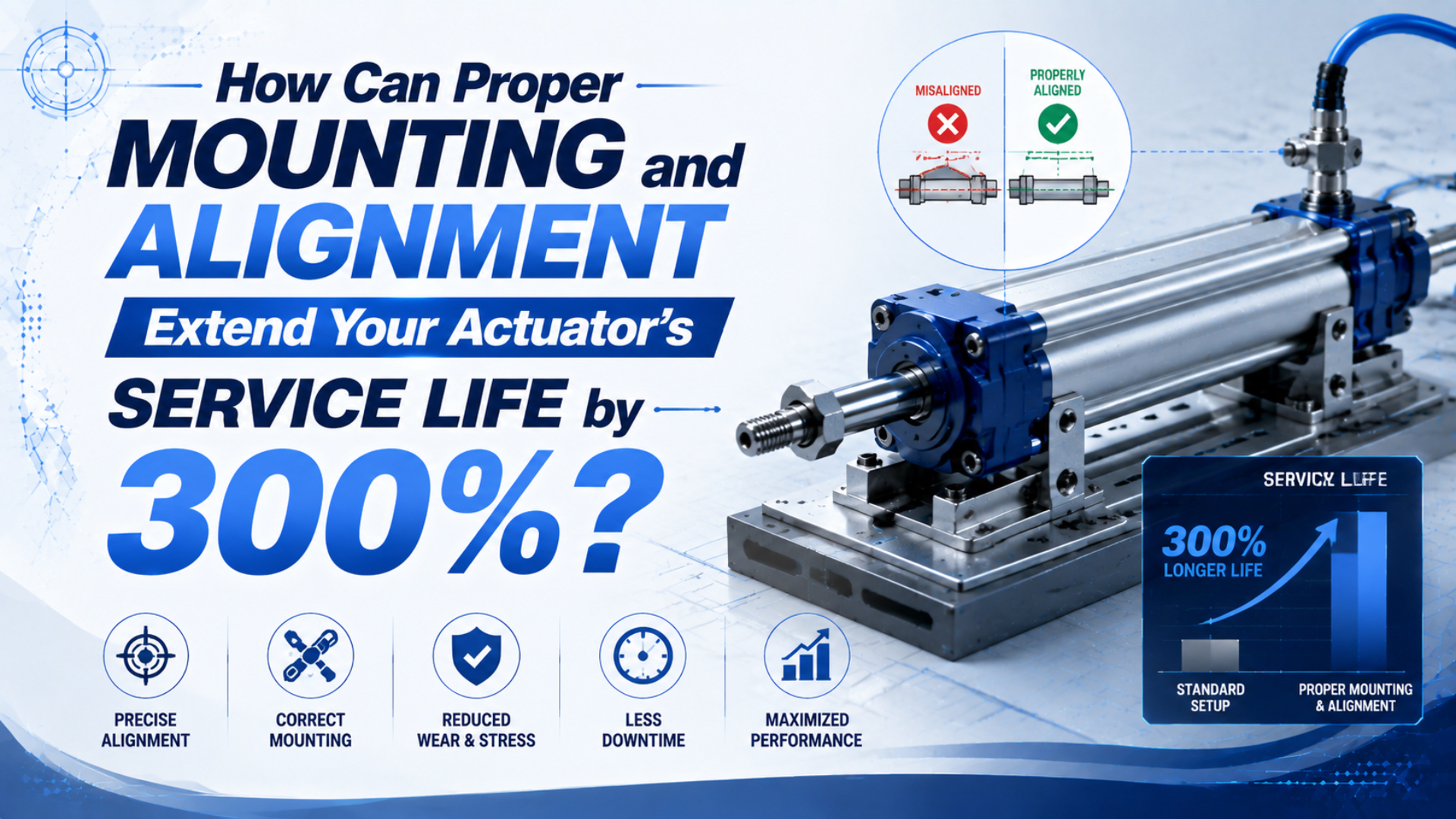
No published pneumatic-cylinder standard guarantees a universal 300% service-life extension. ISO 15552 standardizes basic and mounting dimensions rather than installed life (ISO 15552:2018, confirmed 2025).
Proper mounting can still prevent an actuator from spending every cycle fighting its own frame, guide, or tooling. Proving the improvement requires comparable records from the same machine and duty.
Parker instructs installers to check piston-rod alignment in 2 positions, fully extended and fully retracted, because improper alignment causes excessive rod-gland or cylinder-bore wear (Parker Cylinder Safety Guide, retrieved 2026-07-17). That is the practical starting point: control the load path, then verify motion rather than relying on a generic tolerance.
Key Takeaways
- No standard promises 300% longer actuator life; matched duty and failure records must prove that result.
- Parker requires checks at 2 stroke positions.
- Match the mount to the real motion, release unwanted constraint at the load connection, then commission the complete zone at low speed before production release.
This guide focuses on installation acceptance.
For failure mechanisms, use the linear-actuator side-loading guide. For retrofit architecture, see the side-load mitigation guide.
Model-specific surface, support, and torque details belong in the rodless-cylinder mounting guide.
Can Proper Mounting Really Extend Actuator Life by 300%?
Parker names 2 mandatory alignment positions but publishes no universal service-life multiplier (Parker Cylinder Safety Guide, retrieved 2026-07-17). Proper mounting can remove a dominant wear mechanism, yet a 300% improvement is credible only when the original installation was misaligned and the before-and-after duty and failure criteria are comparable.
Service life is the result, not an installation setting. Air quality, cycle rate, temperature, speed, cushioning, lubrication policy, contamination, payload, hose forces, guide condition, seal material, and maintenance all remain in the failure chain. Correcting alignment won’t rescue an undersized guide or an actuator that repeatedly hits an uncontrolled stop.
In our experience, the most useful life discussion begins with a failure definition and an operating record, not a percentage. Hours alone can hide a large change in cycle count, stroke, speed, or payload.
Accumulated cycles or travel, paired with the same leakage, clearance, or repeatability limit, creates a much stronger comparison.
The percentage also needs a defined denominator. For example, extending life from 2 years to 8 years is a 300% increase, while moving from 3 years to 10 years is about a 233% increase. Mixing those cases under one headline creates apparent precision without a controlled comparison.
A defensible life-improvement claim needs four matched records:
- The same actuator family and seal system.
- Matched stroke, mounting orientation, payload, and control profile.
- Comparable cycles, speed, pressure during motion, temperature, air quality, maintenance state, and production schedule across both observation periods.
- A written end-of-life criterion plus installation measurements showing the changed alignment, mount geometry, guide connection, torque, and loaded deflection.
If those records don’t exist, describe the result as reduced avoidable wear, not a guaranteed life multiplier. A service-life comparison is a matched before-and-after record that uses the same duty variables and end-of-life criterion.
Which Mounting Style Matches the Motion Path?
Parker groups roughly 20 common single-rod mounting styles into 3 force-transfer families: fixed centerline, pivot, and fixed non-centerline mounts (Parker Pneumatic Actuator Products, retrieved 2026-07-17). Select the family from the driven member’s real path before choosing bolt locations or trying to correct alignment with shims.
Use a fixed centerline mount when the load moves on a straight, well-guided path and the reaction can pass close to the actuator axis. Head or cap flanges and centerline lugs can work well here, provided the supporting structure remains rigid under push and pull. The load connection still needs to accommodate the actual assembly tolerances.
Choose a pivot mount when the mechanism travels through an arc. Clevis and trunnion arrangements let the cylinder body change angle in one plane. Parker requires the trunnion bearings to be aligned and rigid so the pins aren’t subjected to bending, while the rod-end pivot pin must remain parallel to the trunnion axis (Parker Cylinder Safety Guide, retrieved 2026-07-17).
Side and foot mounts transfer force away from the cylinder centerline. The frame must resist the resulting moment, and the mounting details need the manufacturer’s keys, dowels, or pilots where specified. A thick-looking plate isn’t proof of stiffness. If indicator readings move when the payload accelerates, the structure has changed the alignment seen by the actuator.
| Machine motion | Suitable mounting approach | Installation question |
|---|---|---|
| Straight, guided translation | Fixed centerline mount | Does the load reaction remain close to the actuator axis? |
| Rotation through one defined plane | Clevis or trunnion pivot mount | Are both pivot axes parallel and free through the whole arc? |
| Straight motion from an offset base | Side or foot mount with rated load restraint | Can the frame carry the eccentric reaction without twisting? |
| Externally guided rodless motion | Model-approved carrier or floating connection | Can the actuator transmit thrust without becoming a second rigid guide? |
The mount answers how the body reacts force. It doesn’t decide whether the cylinder or carriage may guide the payload.
That separate load-capacity decision belongs to the exact actuator and guide data.
How Should You Establish the Installation Datum?
Parker’s 2-position check covers fully retracted and fully extended geometry, while its fixed-mount guidance recommends connecting the piston rod in the retracted position to help establish alignment (Parker Cylinder Safety Guide, retrieved 2026-07-17). Treat those positions as minimum checkpoints, then add mid-stroke and loaded readings when the frame or guide can deflect.
Start by identifying the machine’s primary guide datum. The rail, bearing system, or mechanism that controls payload motion should define the path. The actuator supplies force along that path. If both the guide and actuator are bolted as independent precision locators, their manufacturing tolerances can oppose each other and create binding.
Installation alignment is the measured relationship among the actuator force axis, the guided motion path, and the load connection across the complete stroke. It isn’t established by making mounting faces look parallel at one position.
Mount the body loosely enough to measure before final tightening. Bring the guided load to the connection without using the rod, carrier, or fasteners as a lever. If tightening a bolt changes the dial-indicator reading, coupling position, or manual breakaway force, the joint is storing deflection rather than preserving alignment.
Record alignment at retracted, mid-stroke, and extended positions with the same indicator location and sign convention. Repeat the readings unloaded and with the production payload when permitted.
A constant offset points toward assembly position; a changing offset points toward angular error, rail geometry, or structural deflection.
From our work, changing readings under payload are more useful than an unloaded visual check. They show whether the frame, bracket, or guide shifts after the axis is assembled, which is exactly when a nominally aligned installation can begin applying a repeated side reaction.
For mechanically jointed rodless cylinders, SMC warns that an unsuitable mounting surface can twist the cylinder tube and cause seal-band detachment, dust-band damage, air leakage, or malfunction (SMC MY1B catalog, 2025, retrieved 2026-07-17). Use the selected series’ mounting and support values rather than transferring a figure from another actuator architecture.
How Do You Prevent Over-Constraint at the Load Connection?
SMC’s MY1B guidance preserves freedom in 2 transverse directions, identified as the floating Y and Z axes, when a rodless cylinder connects to an external guide (SMC MY1B catalog, 2025, retrieved 2026-07-17). The purpose is to transmit thrust while preventing small guide-to-actuator discrepancies from becoming continuous bearing and seal loads.
Over-constraint is the condition created when 2 or more rigid locators demand slightly different motion paths. A self-aligning or floating connection reduces that conflict; it is not a payload support.
The external guide still carries payload weight, process force, pitch, roll, yaw, and dynamic reaction.
SMC’s current floating-joint catalog illustrates why accessory limits must remain model-specific: its KJ rod-end product lists a 19° allowable inclination, while the floating-joint families cover different bore ranges and duties (SMC Floating Joints and Rod Ends, retrieved 2026-07-17). One accessory’s articulation isn’t a universal cylinder-misalignment allowance.
Festo separates 3 connection functions in its DSBC accessory data: the FK self-aligning rod coupler accommodates radial and angular deviation, KSG addresses radial deviation, and the rod clevis swivels in one plane (Festo DSBC Catalog, 2026, retrieved 2026-07-17). Select by the mismatch that must be released.
Use these checks before accepting the connection:
- Isolate the machine, secure the load, remove pressure, and confirm the guide can complete its permitted travel without the actuator connection.
- Reconnect without pulling the axes together.
- Check the floating element at both ends and mid-stroke, recording its neutral position and remaining movement in each permitted direction.
- Observe hose and cable forces through the motion zone.
- Finally, run the permitted low-speed test and confirm that the coupling never reaches an articulation or travel stop under the production payload.
What if the connection sits against one side of its available float at every position? It isn’t compensating anymore. Reposition the actuator or guide so the joint has usable movement in both directions.
For force-and-moment diagnosis, follow the rodless-cylinder load-capacity guide rather than converting axial thrust into a guessed side-load percentage.
Commission the Axis in Measured Stages
Parker’s OSP-P instructions specify 2 hand-operated strokes without air pressure before slow pressurization, followed by a full moving-zone check at low speed (Parker OSP-P Operating Instructions, 2020, retrieved 2026-07-17). That sequence is model-specific, but its logic is broadly useful: find mechanical resistance before stored pneumatic energy can hide or amplify it.
Only trained personnel working under the machine’s energy-control procedure should perform commissioning. Secure suspended loads, remove residual pressure, verify guarding, and keep people outside the motion zone.
Manual travel is not appropriate until the machine-specific risk assessment says it is safe.
Use a staged acceptance sequence:
- Identify the assembly. Record every component and drawing revision.
- Inspect the unpowered load path. Check fastener seating, mount contact, pivot freedom, hose routing, guide condition, stop position, and the coupling’s neutral position.
- Complete permitted manual travel. Compare resistance at retracted, mid-stroke, and extended positions.
- Pressurize gradually. Use the specified soft-start method.
- Run the entire zone at low speed. Watch for collision, stick-slip, bolt movement, changing clearance, hose pull, frame deflection, and inconsistent sensor operation.
- Apply production duty. Repeat the geometry and motion checks with the real payload and speed.
- Tune end control. Verify moving mass and velocity against the configured cushion, shock absorber, guide, and stop data. The pneumatic-cylinder cushioning guide covers that separate calculation.
SMC’s CYB rodless-cylinder manual offers another useful diagnostic: compare the minimum pressure required for smooth full-stroke operation before and after connecting the real load and guide. An unexpected increase can indicate added guide or misalignment resistance, but it isn’t a substitute for mechanical measurements (SMC CYB Operation Manual, 2026, retrieved 2026-07-17).
The best acceptance baseline combines geometry and behavior. Indicator readings tell you where the axis sits; low-speed pressure and motion observations tell you how hard the system works to follow that path. Either measure alone can miss load-induced deflection or a joint that only binds near one end.
In our experience, this paired baseline is also easier for maintenance teams to reuse. A future technician can repeat the same readings and motion checks without reconstructing the original installer’s assumptions.
Installation Acceptance Record
ISO 15552 covers interchangeable mounting dimensions for pneumatic cylinders with 32 to 320 mm bores at a maximum rated pressure of 1,000 kPa, but it doesn’t certify a machine’s installed alignment (ISO 15552:2018, confirmed 2025, retrieved 2026-07-17). The acceptance record must therefore connect the exact component identity to measured geometry, loaded motion, and release criteria.
An installation acceptance baseline is the approved set of component identities, geometry readings, motion observations, and operating conditions captured before production release. It gives later troubleshooting a known reference instead of a memory of how the axis once looked or sounded.
For drawing approval, factory inspection, and FAT requirements that occur before site installation, use the separate custom pneumatic-cylinder lifecycle guide. This article begins at the machine interface and follows the evidence needed to release and later reassess the installed axis.
| Record item | Minimum information | Why it matters |
|---|---|---|
| Component identity | Manufacturer, full model, bore, stroke, guide, mount, coupling | Connects limits and instructions to the installed hardware |
| Duty | Payload, orientation, speed, cycle rate, pressure during motion, temperature | Makes future comparisons meaningful |
| Geometry | Datum, load offset, retracted/mid/extended readings, unloaded and loaded values | Shows offset, angular error, and structural movement |
| Fastening | Bolt specification, supplier torque, key/dowel details, final witness marks | Records how reaction force is restrained |
| Connection | Joint model, neutral position, remaining float or articulation | Confirms compensation remains available |
| Commissioning | Manual-travel result, soft-start setting, low-speed result, production-speed result | Separates mechanical resistance from dynamic behavior |
| End control | Cushion setting, shock absorber, external stop, acceptance evidence | Prevents impact from being mistaken for alignment wear |
| Release decision | Accepted limits, approver, date, follow-up trigger | Makes the installation auditable |
Don’t invent a universal recheck calendar. Reinspect after a collision, bearing or seal replacement, mount loosening, guide adjustment, payload change, unexplained pressure increase, new leakage pattern, or visible witness-mark movement. For stable machinery, use the actuator and machine manufacturer’s maintenance interval plus condition data from the acceptance baseline.
The Acceptance Decision
An installation should not be released merely because it completes 1 powered cycle. Parker checks alignment at 2 end positions and its OSP-P procedure adds 2 unpressurized hand strokes plus low-speed travel through the whole motion zone (Parker Cylinder Safety Guide; Parker OSP-P Instructions, retrieved 2026-07-17). Release only after geometry, freedom, dynamic behavior, and records agree.
Proper mounting doesn’t create infinite actuator life. It removes avoidable internal loads and gives maintenance teams a baseline for detecting change. If service life later improves from 2 years to 8 years under a comparable duty and failure definition, the records can support a 300% increase. Until then, treat 300% as a result to prove, not a promise to print on an installation checklist.
Actuator Mounting and Alignment FAQs: What Should You Check?
SMC lists a 19° allowable inclination for its current KJ rod-end product, while Parker requires alignment checks at 2 cylinder positions (SMC; Parker, retrieved 2026-07-17). Those numbers answer different questions, which is why each mount, joint, guide, and acceptance step must follow its own documented limit.
Can a floating joint replace an external guide?
No. A floating joint transfers actuator force while absorbing specified offset or parallelism error. It doesn’t support payload weight or guide moments. SMC instructs MY1B users to preserve floating freedom in the Y and Z directions when connecting an external guide, so the guide still needs its own load and moment verification.
Should alignment be checked with the actuator retracted or extended?
Check both. Parker explicitly requires piston-rod alignment verification in the fully retracted and fully extended positions. Add a mid-stroke measurement when a long frame, guide, or mounting plate may change shape between the ends. Use the same datum, indicator position, and sign convention so the readings remain comparable.
Can mounting bolts pull the actuator into alignment?
They shouldn’t. If tightening the bolts changes alignment, manual resistance, or the floating joint’s neutral position, the fasteners are storing structural deflection. Reposition or shim the mounting surfaces using the approved design, then apply the component manufacturer’s fastener specification and torque. Don’t substitute a generic torque percentage.
What proves a 300% service-life improvement?
Comparable before-and-after records prove it. Keep the same duty definition, actuator family, payload, speed, environment, and failure criterion, then compare accumulated cycles, travel, or operating time. Also document the installation correction. Without that evidence, state that alignment reduced an avoidable wear mechanism rather than claiming a universal percentage.
When should actuator alignment be rechecked?
Use the machine and actuator manufacturer’s interval, then add condition-based checks after collisions, guide work, seal or bearing replacement, payload changes, loose witness marks, new leakage, or rising operating pressure. Compare the new measurements with the accepted retracted, mid-stroke, extended, unloaded, and loaded baseline instead of relying on visual judgment alone.
Sources and technical references
- Parker, Cylinder Mounting Accessories and Cylinder Safety Guide, alignment positions, mounting recommendations, and wear consequences. Retrieved 2026-07-17.
- Parker, Pneumatic Actuator Products, Catalog 0900P, mounting-style force-transfer groups. Retrieved 2026-07-17.
- Parker, OSP-P Operating Instructions, manual travel, soft-start, low-speed, and commissioning instructions. Retrieved 2026-07-17.
- SMC, MY1B Mechanically Jointed Rodless Cylinder Catalog, mounting contact, tube-twist precautions, and external-guide discrepancy absorption. Retrieved 2026-07-17.
- SMC, CYB Operation Manual, misalignment compensation and minimum operating-pressure diagnostic. Retrieved 2026-07-17.
- SMC, Floating Joints and Rod Ends, accessory families, bore ranges, and KJ inclination data. Retrieved 2026-07-17.
- Festo, DSBC Standards-Based Cylinder Catalog, self-aligning coupling, radial compensator, and clevis functions. Retrieved 2026-07-17.
- ISO, ISO 15552:2018, basic, mounting, and accessory dimensions for interchangeable pneumatic cylinders. Confirmed 2025; retrieved 2026-07-17.
Author and company information is available on the About page. Readers can submit source corrections or technical questions through Contact.