

Chemical processing plants should choose corrosion-resistant pneumatic fittings by defining the exposure path first, then validating the body, gripping parts, seal, lubricant, tube, thread, pressure, and temperature as one connection. A fitting that carries clean instrument air but receives an occasional external splash needs a different approval path from a connection that actually carries acid, solvent, chlorine-bearing fluid, or another process chemical.
There is no universally “chemical-proof” fitting. The same material can perform well at one concentration and temperature, then corrode, swell, permeate, or crack when either condition changes. The plant specification therefore needs a compatibility envelope and documented acceptance criteria, not a broad label such as 316L, Hastelloy, PTFE-lined, or chemical resistant.
Key Takeaways
ISO 14743:2020 covers complete push-in connector assemblies with thermoplastic tube from 3 to 16 mm outside diameter. That assembly scope is the central lesson for chemical plants: material approval must include every pressure-retaining, tube-retaining, and sealing interface rather than the visible fitting body alone.
- Classify internal media and external exposure separately.
- Record chemical identity, concentration, temperature, pressure, and exposure duration.
- Approve the metal, seal, tube, lubricant, and thread sealant as one assembly.
- Keep generic pneumatic fittings out of process-chemical service unless the complete connection is qualified for it.
- Use condition-based inspection and documented management of change.
How Should a Chemical Plant Classify Fitting Exposure?
ASME B31.3-2024 lists six broad fluid categories within its process-piping scope, including raw or finished chemicals, gas, air, water, refrigerants, and cryogenic fluids. Before choosing a fitting, decide whether the connection belongs to a machinery pneumatic circuit, a process-piping system, or both.
Use four exposure classes:
| Exposure class | What passes through the fitting? | What reaches the outside? | Selection consequence |
|---|---|---|---|
| A: Protected instrument air | Clean compressed air | Dry indoor atmosphere | Standard pneumatic fitting may be adequate if pressure, temperature, and tube requirements are met |
| B: Externally exposed pneumatic connection | Compressed air | Chemical vapor, splash, washdown, salt, or condensate | External materials, crevices, threads, tube jacket, and mounting metals need compatibility review |
| C: Process-media connection | Acid, base, solvent, oxidizer, or mixed process fluid | Process atmosphere or secondary containment | Use a plant-approved process connection qualified under the applicable piping code and service specification |
| D: Cross-boundary or unknown service | Air during normal operation, possible process ingress during failure or cleaning | Variable | Treat the credible worst case as a design input and require process-safety review |
This classification prevents a dangerous shortcut. A stainless push-in fitting approved for compressed air does not become a process-chemical fitting because its body resists an external splash. Conversely, a process-grade alloy body can still fail as a pneumatic connection when its seal, tube retention, thread, or proof-pressure data do not match the circuit.
For the general stainless-body, collet, tube, and thread checks that apply across industries, use the stainless steel pneumatic fitting guide. This article adds the chemical-plant boundary between ordinary pneumatic service and process-media service.
Why Are Chemical Name and Material Grade Not Enough?
Haynes plots C-276 corrosion behavior with iso-corrosion lines at 0.1 and 0.5 mm per year across multiple acid concentrations and temperatures. Its data show why “sulfuric acid compatible” is incomplete: a defensible material decision needs the chemical, concentration, temperature, contaminants, aeration, flow condition, and expected exposure time.
Build a compatibility envelope with these inputs:
- Exact chemical identity: Include trade-name ingredients, cleaning agents, catalyst residues, and likely contaminants.
- Concentration range: Record startup, normal, cleaning, upset, and shutdown values, not only the nominal recipe.
- Temperature range: Include ambient, process heat, steam cleaning, exothermic upset, and cold-start conditions.
- Pressure and vacuum: Check normal, transient, proof-test, trapped-liquid, and vacuum conditions.
- Exposure mode: Continuous immersion, intermittent splash, vapor, condensate, washdown, or permeation through tube.
- Oxidizing or reducing character: Alloy rankings can change when the chemical environment changes.
- Mechanical condition: Vibration, residual stress, repeated disconnection, thread engagement, and unsupported tube loads matter.
Laboratory corrosion data are screening evidence, not a universal guarantee. Haynes states that its C-276 values come from reagent-grade laboratory solutions and encourages field testing before industrial use. Real streams may contain chlorides, solids, oxidizers, reducing agents, or heat-transfer effects that move the result outside a handbook table.
Our team analyzed the manufacturer data against the same seven inputs. We found that the chemical name alone never defines a complete pneumatic connection because elastomers and thermoplastic tubes can respond differently from the metal body.
Material Selection Is an Evidence Problem
Haynes International reports more than 50 years of chemical-process experience for C-276 and publishes concentration-temperature corrosion data. That evidence supports shortlisting the alloy for difficult service, but it does not approve every fitting geometry, seal, tube, thread, or process stream made from C-276.
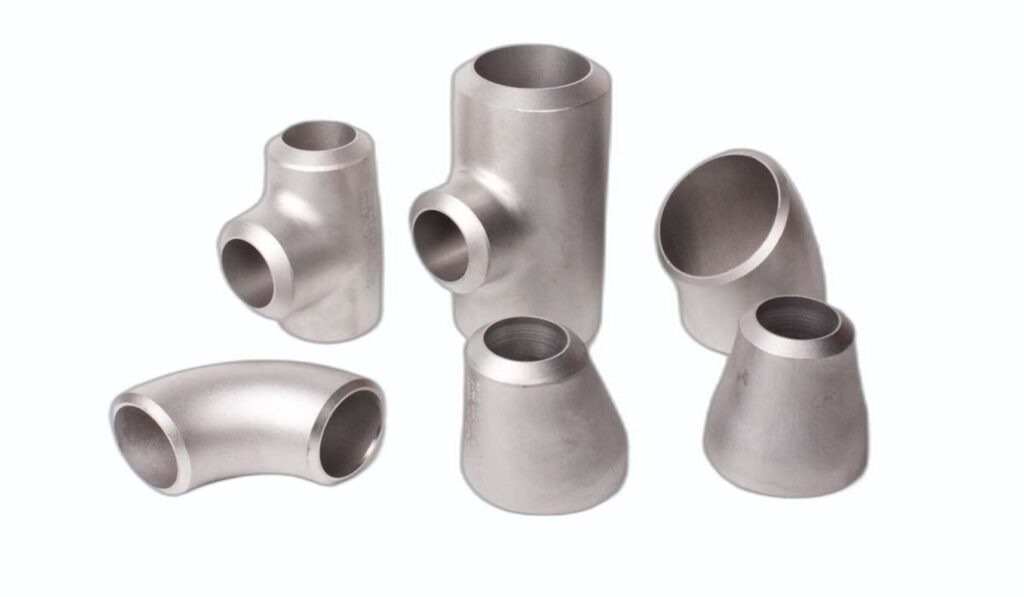
Use material names as candidates:
| Candidate material | Where it may enter the shortlist | What still needs proof |
|---|---|---|
| 316L stainless steel | External washdown, selected chemicals, humid or chloride-bearing plant areas | Chemical-specific corrosion data, crevice conditions, SCC risk, collet and mating-metal grades |
| C-276 nickel alloy | Severe mixed acids, chloride-bearing solutions, pitting or crevice risk | Concentration-temperature data, product form, fitting manufacture, seal, thread, field exposure |
| Alloy 625 or another nickel alloy | Selected high-temperature, chloride, or oxidizing duties | Exact corrosion curve and stress condition; do not substitute from alloy family name |
| PTFE or PFA component | Chemically resistant liner, tube, seal element, or wetted component | Pressure rating, cold flow, permeation, mechanical retention, temperature, cleanliness |
| FFKM, FKM, EPDM, NBR, or other elastomer | Seal selected around a named media envelope | Compound-specific compatibility, compression set, temperature, decompression, lubricant |
Chemours describes PTFE fluoropolymers as chemically inert across a broad material temperature range of about -200°C to 260°C. A finished fitting assembly can have a much narrower limit because threads, inserts, seals, tube support, pressure, permeability, and repeated thermal cycling remain design constraints.
From our analysis, the strongest supplier comparison is not a universal “excellent/good/poor” matrix. It is a row-by-row evidence table containing the exact chemical, concentration, temperature, corrosion rate or compatibility rating, test method, product form, and exclusions.
How Should Seals and Tubing Be Matched to the Chemical?
Parker’s O-Ring Handbook explains that both chemical properties and physical working conditions are essential to elastomer selection; its aging examples use exposures such as 70 hours or 7 days at material-specific temperatures. A generic FKM, EPDM, or NBR label therefore cannot replace the exact compound and media-compatibility record.
Elastomer compatibility means the seal retains acceptable volume, hardness, tensile properties, compression behavior, and sealing force after exposure. Permeation means molecules pass through a polymer even when the material shows no obvious surface damage. Compression set means an elastomer does not fully recover after prolonged compression, reducing its ability to maintain contact pressure.
Check these interfaces separately:
- Tube-to-collet interface: Chemical swelling or softening can change outside diameter and reduce retention.
- Tube-to-O-ring interface: Scratches, hardening, permeation, or dimensional change can create a leak path.
- O-ring-to-lubricant interface: A compatible elastomer may still react poorly to assembly lubricant or cleaning residue.
- Thread-sealant interface: Paste, tape, or pre-applied sealant must tolerate the media and temperature without contamination or loss of seal.
- Metal-to-polymer support: PTFE and other fluoropolymers need mechanical support appropriate to pressure, creep, temperature, and cycling.
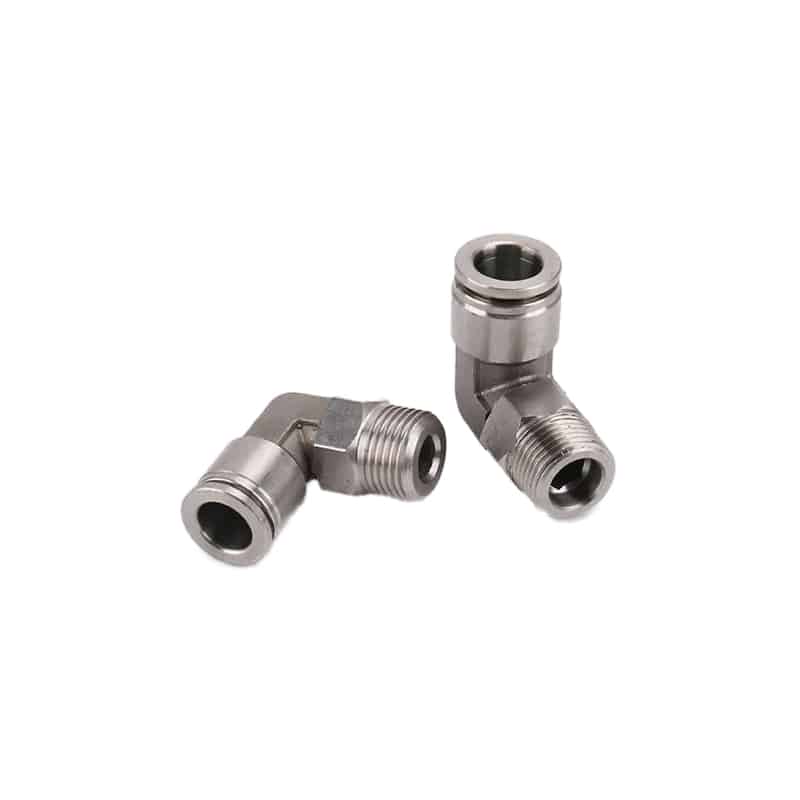
SMC’s KQG2 stainless push-in documentation lists several permitted tube families but also makes chemical concentration and temperature part of compatibility review and says its reference table is not a guarantee. Use only the tube materials, dimensions, pressure-temperature limits, and installation method approved for the exact fitting family.
If compressed-air contamination is attacking seals internally, the material upgrade may be treating the symptom. Review particle, water, and oil classes in the ISO compressed-air quality guide before changing every external fitting.
Which Fitting Design Fits Each Chemical-Plant Boundary?
ASME B31.3-2024 covers materials, components, design, fabrication, assembly, examination, inspection, and testing for process piping. A connection that carries hazardous process fluid should follow the plant’s applicable piping code and service specification; a catalog pneumatic push-in fitting should not be substituted without documented qualification for that duty.
Use the connection type that matches the boundary:
| Duty | Suitable starting point | Main review |
|---|---|---|
| Protected machinery air | Approved push-in, threaded, or compression pneumatic fitting | Pressure, flow, tube, thread, installation, machine safety |
| Pneumatic air with external chemical splash | Corrosion-resistant pneumatic family with compatible tube and seal | External surfaces, crevices, drainability, mating metals, cleaning chemistry |
| Analyzer or instrument line carrying process sample | Plant-approved instrumentation or process connection | Piping class, material traceability, process pressure, examination, leak testing |
| Continuous chemical transfer | Process-piping fitting, welded system, or qualified mechanical connection | Applicable code, joining method, corrosion allowance, inspection, containment |
| Frequent disconnection | Purpose-qualified coupling with controlled isolation | Trapped pressure, spill control, seal replacement, misconnection prevention |
Smooth surfaces and fewer crevices help external cleaning, but they do not prove process compatibility. Redundant seals also need a defined function; two incompatible seals are not safer than one qualified seal. Ask how the connection retains the tube, where pressure acts, what happens after seal damage, and how the joint is inspected.
For threaded pneumatic ports, identify the exact standard before applying sealant or torque. The NPT thread guide explains why NPT, BSPT/R, BSPP/G, and metric interfaces are not interchangeable.
Failure Mechanisms That Change the Material Decision
AMPP documents stress corrosion cracking in 316 stainless chemical-process piping and defines SCC as the combined action of tensile stress and a corrosive environment. Material loss may be small before cracking, so a clean-looking surface cannot rule out a serious compatibility problem.
Distinguish the mechanism before specifying a replacement:
| Failure mechanism | Typical evidence | Selection response |
|---|---|---|
| Uniform corrosion | General wall loss or discoloration | Compare corrosion rate at actual concentration and temperature |
| Pitting | Deep localized cavities, often with chlorides | Review alloy resistance, deposits, oxidizing conditions, and surface condition |
| Crevice corrosion | Attack beneath clamps, threads, seals, or deposits | Change geometry, drainage, cleaning, and alloy, not only body grade |
| Stress corrosion cracking | Fine branching cracks under applied or residual stress | Review alloy-environment-stress combination and remove stress concentrators |
| Galvanic corrosion | Preferential attack at dissimilar-metal wet joints | Isolate metals, improve drainage, change material pairing |
| Elastomer swelling or extraction | Seal softening, growth, shrinkage, or loss of strength | Change exact compound and verify lubricant and cleaning agents |
| Tube permeation or embrittlement | Odor, vapor transfer, cracking, hardening, dimensional change | Change tube material, wall, routing, support, or connection system |
Do not respond to every leak by tightening the thread. A damaged tube end, incompatible O-ring, SCC, dissolved sealant, or externally corroded mating port needs a different corrective action. If the symptom is low downstream pressure rather than visible damage, separate leakage from flow restriction with the pressure-drop troubleshooting guide.
How Should Chemical-Plant Fittings Be Maintained Safely?
OSHA 29 CFR 1910.147 addresses hazardous-energy control during servicing, including pneumatic energy and stored or residual energy. Before inspecting or disconnecting a fitting, isolate the supply, relieve trapped pressure, restrain hazardous motion, and verify the site’s zero-energy condition.
Set inspection frequency from exposure and consequence, not an arbitrary weekly or annual schedule. Useful triggers include a new chemical recipe, concentration change, higher cleaning temperature, altered sanitizer, repeated tube removal, vibration change, nearby spill, visible deposit, seal discoloration, unexplained odor, pressure decay, or corrosion at a mating component.
Use this inspection sequence:
- Confirm the catalog number and approved media envelope.
- Check the tube, collet, seal area, thread, support, and adjacent metal separately.
- Look beneath labels, clamps, guards, and horizontal surfaces where liquid collects.
- Record the location and morphology of damage before cleaning it away.
- Replace parts with the approved complete configuration and perform the specified leak or pressure test.
- Escalate recurring or mechanism-uncertain damage to materials and process-safety specialists.
When the process chemistry changes, repeat the compatibility review. A management-of-change record should connect the new chemical and conditions to body, seal, tube, lubricant, thread sealant, piping class, inspection plan, and spare-part number. Do not assume that a fitting approved for the previous formulation remains acceptable.
What Should the RFQ and Acceptance Plan Include?
Haynes publishes C-276 corrosion results across multiple acid concentrations and temperatures and distinguishes 0.1 from 0.5 mm/year iso-corrosion lines. That level of specificity is the model for an RFQ: suppliers need a defined chemical and operating envelope, while purchasers need evidence tied to the exact catalog number and product form.
Include these fields:
- Exposure class: protected air, external splash or vapor, process media, or cross-boundary service.
- Chemical names, concentrations, contaminants, pH where useful, and safety data sheets.
- Normal, cleaning, startup, shutdown, and upset temperatures.
- Minimum, normal, maximum, vacuum, transient, and test pressures.
- Body, collet, spring, washer, seal, lubricant, tube, thread sealant, and mating-port materials.
- Tube outside diameter, wall, tolerance, hardness, bend radius, support, and reconnection expectations.
- Thread standard, nominal size, engagement method, seal location, torque instructions, and mating material.
- Applicable machine-safety, process-piping, plant, and jurisdiction requirements.
- Required material certificates, compound declarations, drawings, test reports, traceability, and change notification.
- Acceptance test, inspection interval, spare-part plan, and rejection criteria.
At receipt, match the catalog suffix to the drawing and documentation. During installation, record the tube specification, insertion or assembly method, support, tightening method, and test result. For a critical chemical boundary, approval should come from the responsible plant engineer rather than from a generic compatibility chart.
For application-review context, see About Bepto Pneumatic. Project teams can send the exposure envelope, photos, drawings, and existing part numbers through the contact page before requesting a material substitution.
FAQs About Corrosion-Resistant Fittings in Chemical Plants
ISO 14743 covers complete push-in assemblies using thermoplastic tube from 3 to 16 mm outside diameter, but chemical plants often need a broader process decision. These answers keep pneumatic-component selection separate from process-piping approval and avoid treating a body alloy as proof for the entire connection.
Is 316L stainless steel suitable for sulfuric acid?
Sometimes, but chemical name alone is insufficient. Concentration, temperature, aeration, contaminants, flow, crevices, and stress can change corrosion behavior. Use published corrosion data for the exact condition and verify the complete fitting, including seals and tube. Severe or uncertain service may require another alloy and field testing.
Is Hastelloy C-276 always the safest fitting material?
No. C-276 has strong chemical-process history and broad resistance, yet it still needs concentration-temperature review, correct product form, suitable fabrication, compatible seals, and applicable code approval. It can also be unnecessary for external splash where a less costly, fully qualified stainless assembly already meets the exposure envelope.
Can PTFE make a pneumatic fitting universally chemical resistant?
No. PTFE has broad chemical resistance, but a fitting also contains pressure-retaining geometry, supports, threads, tube-retention parts, and sometimes other seals or lubricants. Pressure, temperature, cold flow, permeation, cycling, and mechanical loads can limit the assembly even when the PTFE component remains chemically stable.
Can a stainless push-in fitting carry process chemicals?
Only when the exact complete assembly is approved for the named process fluid and operating conditions under the plant’s applicable piping and safety requirements. A compressed-air rating or stainless body description is not enough. Many process duties need a qualified instrumentation or process-piping connection instead.
Which seal is best for acids, bases, and solvents?
There is no single best elastomer. FKM, EPDM, NBR, FFKM, PTFE, and other materials respond differently to chemicals, concentration, temperature, decompression, lubricant, and cleaning. Use compound-specific compatibility data and confirm the seal’s mechanical performance in the exact gland and fitting family.
How should a plant investigate repeated fitting leaks?
First isolate energy and preserve evidence. Check whether leakage originates at the tube surface, collet, O-ring, thread, mating port, or corroded body. Record chemical and temperature changes, then inspect for swelling, cracks, pitting, deposits, side load, or wrong thread engagement before choosing a replacement material.
Sources and Retrieval Notes
- ISO 4414:2010, Pneumatic fluid power safety requirements, accessed 2026-07-14. Used for machinery pneumatic-system scope and safety context.
- ISO 14743:2020, Push-in connectors for thermoplastic tubes, accessed 2026-07-14. Used for complete-assembly scope and 3 to 16 mm tube range.
- ASME B31.3-2024, Process Piping, accessed 2026-07-14. Used to distinguish process-piping duties from machinery pneumatic connections.
- Haynes International, HASTELLOY C-276, accessed 2026-07-14. Used for alloy history, composition, corrosion curves, laboratory limits, and field-test caution.
- Parker O-Ring Handbook, accessed 2026-07-14. Used for elastomer selection and media-compatibility limits.
- Chemours, Teflon fluoropolymer chemical and thermal resistance, accessed 2026-07-14. Used for PTFE material properties without extending them to complete fitting approval.
- SMC KQG2 stainless one-touch fittings, accessed 2026-07-14. Used for tube, chemical-compatibility, installation, and product-family limitations.
- AMPP, Stress Corrosion Cracking, accessed 2026-07-14. Used for SCC mechanism and chemical-process examples.
- OSHA 29 CFR 1910.147, Control of hazardous energy, accessed 2026-07-14. Used for stored pneumatic energy during servicing.