

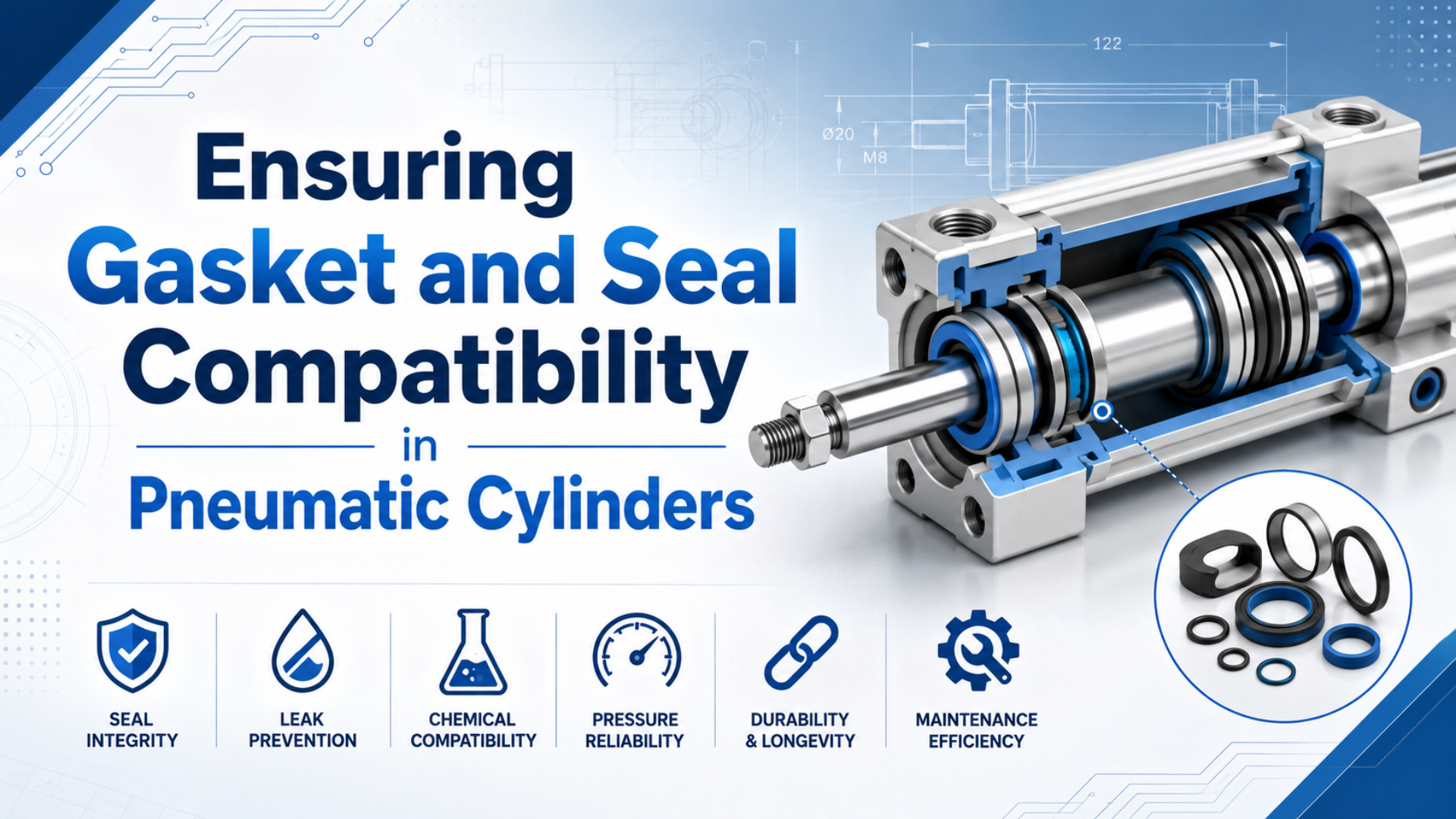
Pneumatic cylinder seal compatibility begins with a traceable compound and profile. Dimensions, lubricant, mating surfaces, and exposure conditions must also work together. A family name such as NBR, FKM, EPDM, polyurethane, or PTFE is not an approval. ISO 3601-5:2015 says the required physical properties and test methods should be agreed. The equipment user and seal supplier share that decision (ISO 3601-5, 2015; retrieved 2026-07-10).
Key Takeaways
- Agree material properties and tests under ISO 3601-5.
- Treat Parker’s four ratings plus
Xas screening evidence, not a service-life forecast.- Approve the complete cylinder only after safe isolation, traceable parts, controlled assembly, leakage checks, unloaded and loaded motion, sensors, cushioning, temperature, and an authorized production release.
Material compatibility is the ability of a specified seal compound to retain the required properties after contact with the actual medium at the stated concentration, temperature, and exposure time.
Service-condition compatibility means the material and seal profile match the job. Groove, surface, pressure, motion, lubricant, and contamination controls must support them.
Acceptance evidence is the documented result of identity, inspection, leakage, motion, sensing, cushioning, and load checks completed before normal production resumes.
The wrong question is, “Which rubber is best?” A better question starts with traceable specifics. Can this documented compound survive the stated medium and temperature? Does the chosen profile fit the motion, lubricant, groove, and surface? Will the assembly pass the cylinder’s acceptance test? That turns material shopping into an engineering decision.
Color is not a material specification.
In our experience, cylinder seal-kit reviews go wrong earliest at the first handoff. The failed seal position becomes one vague line. The exact exposure gets lost with it. Separating those facts usually exposes the real gap: unknown material, rod damage, an omitted cleaner, or a static chart applied to a dynamic lip.
This guide focuses on compatibility verification before a seal-kit replacement. The related industrial cylinder seal guide explains what rod seals, piston seals, wipers, wear rings, static O-rings, and rodless seal bands do. The high-temperature pneumatic-cylinder guide covers the wider actuator package when heat affects grease, sensors, guides, mounting, and tubing as well as seals.
The Five Compatibility Gates
ISO 3601-5:2015 is a 13-page material specification for industrial O-rings, and it requires users and suppliers to agree on physical properties and test methods. That makes five evidence gates useful for a cylinder replacement: medium, temperature, motion, hardware, and verification (ISO 3601-5, 2015; retrieved 2026-07-10).
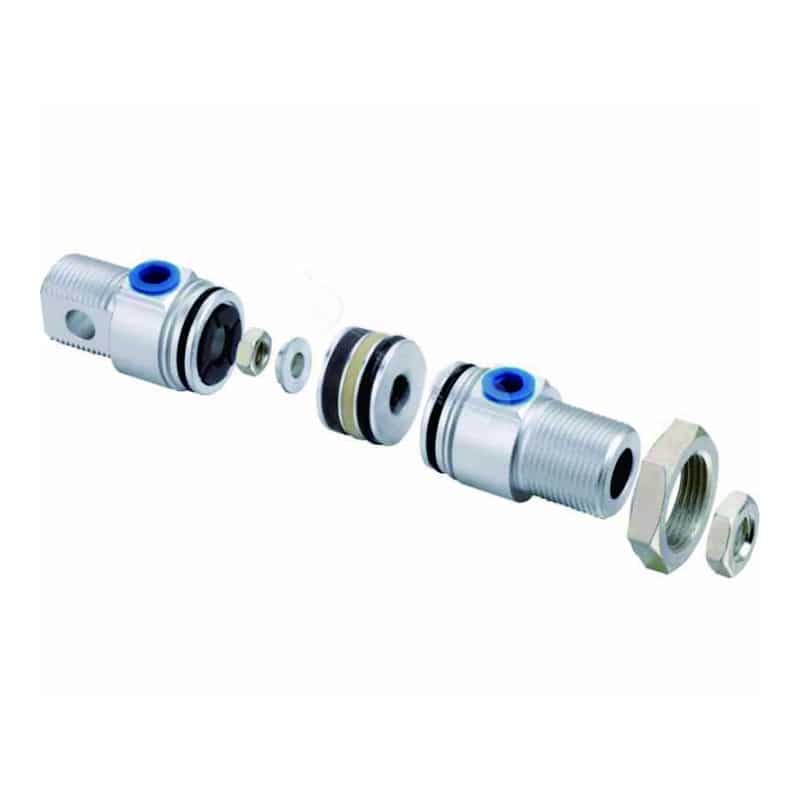
The five gates prevent a common shortcut: choosing a replacement by polymer name while leaving the exposure, seal position, hardware, and verification method undefined.
| Gate | Evidence required before approval | Reject or escalate when |
|---|---|---|
| 1. Medium | Exact chemical or product name, concentration, mixtures, cleaning sequence, lubricant, water, and compressed-air contaminants | The medium is described only as “oil,” “solvent,” “cleaner,” or “air” |
| 2. Temperature | Normal, peak, startup, shutdown, washdown, and body temperature at the seal location | Only room temperature or a generic material limit is available |
| 3. Motion | Static or dynamic position, pressure direction, speed, stroke frequency, dwell, friction, and expected lubrication film | A static compatibility rating is being applied to a moving rod or piston without review |
| 4. Hardware | Full cylinder code, seal profile, groove dimensions, squeeze, clearance, rod and bore condition, surface finish, and installation method | Parts are matched by color, approximate diameter, or catalog family alone |
| 5. Verification | Agreed material tests, assembly controls, leak limits, motion checks, loaded trial, and release authority | Production is expected to become the first uncontrolled test |
Would you approve a bearing using only its color and base metal? A seal deserves the same discipline. Two black O-rings can use different polymers, cure systems, fillers, hardness values, and supplier compounds. They can react differently even when they share the same nominal material family.
How Should Chemical Exposure Be Screened?
ASTM D471-16a(2021) identifies more than six result groups for rubber exposed to liquids, including changes in mass, volume, dimensions, tensile strength, elongation, and hardness. It produces comparative evidence, not a direct prediction of installed service life (ASTM D471, 2021; retrieved 2026-07-10).
Start with the actual exposure record. Use the chemical’s trade name and safety data sheet when available. Add concentration, temperature, contact time, whether exposure is continuous or intermittent, and whether two cleaners are used in sequence. Include compressor lubricant, assembly grease, thread compounds, washdown water, process vapors, and product residue. A seal can see several media during one shift. Festo’s chemical-cylinder guidance makes three variables explicit: concentration, residence time, and temperature affect cylinder durability. It also warns that chemical attack can damage seals and corrode the piston rod, creating a mechanical nick that then cuts the seal (Festo, “Pneumatic cylinders and chemicals”, retrieved 2026-07-10). Chemistry and hardware damage can therefore reinforce each other.
Use compatibility charts as filters
Parker’s O-Ring Handbook assigns four numbered compatibility ratings and an X for insufficient data. Rating 2 is usually limited to static consideration, while rating 3 is doubtful even there. That structure is useful because it prevents “not listed” from being read as “safe” (Parker O-Ring Handbook, retrieved 2026-07-10).
Would a rating of 1 approve the complete cylinder? No. The chart addresses a compound-medium pairing. It does not inspect the rod, groove, seal lip, surface finish, speed, pressure direction, or lubricant. It also cannot know whether the exposure temperature matches the table conditions.
From our analysis of the cited compatibility sources, the safest use of a chart is to eliminate poor candidates and identify what needs supplier review. It should never be converted into a service-life promise.
A chemical chart answers a narrower question than most maintenance teams ask of it. It can reject an obvious mismatch or identify candidates for review. It cannot approve a repair. Approval belongs to the exact compound, finished seal, cylinder interface, exposure profile, and acceptance evidence together.
How Do Temperature and Motion Change Material Choice?
ASTM D573-04(2025) evaluates changes in vulcanized rubber after elevated-temperature air exposure and warns that laboratory results may not correlate exactly with service performance. Treat heat-aging data as comparative evidence, not a universal cylinder temperature rating (ASTM D573, 2025; retrieved 2026-07-10).
Temperature changes chemistry, stiffness, compression set, friction, and lubricant behavior. Record continuous and peak temperature at the seal location. Include cold startup, hot washdown, shutdown soak, and rapid transitions. Ambient air can differ from the rod gland or end cap near ovens, steam, or hot cleaning water. Motion changes the decision again. A static end-cap O-ring can tolerate swelling that would make a moving rod seal stick. A dynamic lip must retain its edge and lubrication film while sliding. It also needs stable contact stress across the rod or bore. Pressure reversal changes the failure mode. So can dwell, short strokes, or dry air, even when the medium stays the same. For example, an FKM compound may screen well against a cleaner. It can still be the wrong rod seal. The supplier must also validate cold-start flexibility, lip friction, groove support, and the assembly lubricant.
| Material family | Useful screening question | What still needs proof |
|---|---|---|
| NBR | Does the exact compound match the lubricant, temperature, and ozone exposure? | Compound code, hardness, low- and high-temperature behavior, dynamic friction |
| EPDM | Is water, steam, or cleaning chemistry more important than oil resistance? | Lubricant compatibility, compound grade, pressure and motion limits |
| FKM | Is the required chemical and heat resistance supported for this exact medium and temperature? | Low-temperature flexibility, dynamic friction, compound-specific compatibility |
| FFKM | Does the severity justify a specialist compound and its cost? | Seal position, compression behavior, availability, complete application test |
| Polyurethane | Are wear and extrusion the main concerns, and is hydrolysis or chemistry controlled? | Grade, humidity, temperature, lubricant, clearance, speed |
| PTFE-based profile | Is low friction or chemical resistance needed beyond a standard elastomer? | Energizer, groove, surface finish, installation tooling, leakage expectation |
Trelleborg’s O-ring learning module separates mechanical, temperature, and chemical properties. Its layout lesson then covers housing and surface finish. That split is useful. Material selection and interface design are connected. Neither substitutes for the other (Trelleborg O-Ring e-learning, retrieved 2026-07-10).
For a heat-dominated application, use the high-temperature cylinder review instead of copying a generic elastomer limit. Contaminants in the air supply require a separate check. Use ISO compressed-air purity classes when water, particles, or oil can reach the cylinder.
Which Seal Position and Hardware Details Matter?
Trelleborg lists seven common elastomer families on its O-ring product page, but availability across seven families does not make the profiles interchangeable. Static O-rings and gaskets seal fixed joints. Piston and rod seals move against the bore or rod. Wipers exclude debris; wear rings guide the load (Trelleborg Elastomeric O-Ring, retrieved 2026-07-10).
Identify the failed position before discussing material. In a pneumatic cylinder, “gasket” often refers loosely to a static seal between fixed faces. The moving positions are usually purpose-designed piston or rod seals. A wiper excludes contamination, and a wear ring guides the piston or rod. Replacing all of them with visually similar rings ignores their different jobs.
Inspect the interface, not only the old seal
| Interface | Evidence to record | Failure that a new material cannot fix |
|---|---|---|
| Rod | Diameter, straightness, corrosion, scratches, coating, finish, seal travel | A nick or pit that cuts every new rod seal |
| Bore or profile | Scoring, corrosion, roundness, finish, contamination, lubricant film | A damaged pressure path or worn guide surface |
| Groove | Diameter, width, depth, corner condition, squeeze, stretch, fill | Wrong dimensions or a sharp edge that pinches the seal |
| Clearance | Pressure, extrusion gap, backup-ring requirement, guide condition | Side load or worn guidance that opens the gap |
| Seal profile | Static or dynamic job, lip direction, energizer, pressure direction | Reversed lip, wrong cross-section, or unsupported profile |
| Assembly path | Lead-in chamfer, ports, threads, tools, cleanliness, lubricant | Cuts, twist, contamination, or incompatible assembly grease |
Trelleborg’s failure guide links chemical degradation to an incompatible chemical or thermal environment. It separately links cuts and nicks to sharp gland edges, wrong sizing, low-modulus material, and contamination (Trelleborg Technical Support, retrieved 2026-07-10). Those are different causes. A polymer upgrade won’t remove a burr.
Check the honed cylinder-tube guide when bore finish or scoring is involved. Use the pneumatic sealing-system diagnostic guide when the leak path is still uncertain.
Which Tests Actually Verify Compatibility?
ISO 19973-3:2015 measures pneumatic-cylinder reliability in cycles or kilometres and provides test procedures for single- and double-acting piston-rod cylinders under defined operating conditions. It evaluates the complete cylinder, not just an immersed material coupon (ISO 19973-3, 2015; confirmed 2021, retrieved 2026-07-10).
Choose a test that matches the question. ASTM D471 compares rubber response to liquids. ASTM D573 compares heat-aging effects in air. ISO 3601-5 defines industrial O-ring material specifications. ISO 19973-3 addresses complete-cylinder reliability. ISO 10099 covers final examination and acceptance criteria for double-acting, single-rod pneumatic cylinders. One method cannot stand in for the other four.
| Question | Appropriate evidence | What it does not prove by itself |
|---|---|---|
| Does a rubber candidate change in the actual liquid? | ASTM D471 with agreed liquid, temperature, time, specimens, and measured properties | Installed seal life or complete-cylinder reliability |
| Does heat in air change the rubber’s physical properties? | ASTM D573 with an agreed compound comparison | Chemical resistance or a universal service-temperature limit |
| Does an industrial O-ring compound meet agreed material requirements? | ISO 3601-5 plus supplier compound documentation | Suitability of an unknown lip seal or damaged cylinder interface |
| Does the assembled rod cylinder meet a reliability test plan? | ISO 19973-3 with defined conditions and reporting | Suitability outside the test conditions or after an uncontrolled repair |
| Does a finished double-acting, single-rod cylinder pass final checks? | ISO 10099 and manufacturer acceptance limits | Long-term compatibility with an untested chemical exposure |
ASTM D471 explicitly says its controlled accelerated testing may not directly correlate with actual part performance because service conditions vary widely. That warning is the reason to document the real medium and exposure, define changes that matter, then connect material evidence to an assembled-cylinder test. A universal “30-day immersion” or “one-million-cycle” pass rule is not defensible without the governing specification, exact conditions, samples, measurements, and acceptance limits. Our team analyzed the five cited methods and found that they answer five different questions: liquid response, heat aging, O-ring material specification, cylinder reliability, and final functional acceptance. Combining their names into one generic “compatibility test” would erase those boundaries.
Test the combination.
The strongest compatibility record is a chain, not one certificate. It begins with traceable material identity, adds exposure evidence, confirms the groove and moving surfaces, controls assembly, and ends with an acceptance test on the installed function. Each link answers a different failure question. Missing links remain visible instead of being hidden behind the word “compatible.”
How Should You Install and Accept the Seal?
OSHA 29 CFR 1910.147 defines pneumatic energy as an energy source and requires hazardous-energy control during servicing. Before opening a cylinder, trained personnel must isolate the machine, control stored energy, restrain the load, and verify the isolation (OSHA 1910.147, current text retrieved 2026-07-10).
Use the cylinder manufacturer’s repair instruction, service kit, lubricant, torque values, and cleanliness requirements. Protect seal lips from threads, keyways, cross holes, sharp ports, and unchamfered edges. Don’t use a screwdriver as a seal tool. Don’t mix an unidentified old seal with a new kit and assume the material pair is compatible. Record the package label and compound or kit code before assembly. Add the batch or lot when supplied. Keep the profile orientation and storage status in the same record. Confirm that the assembly lubricant is allowed for both the seal and the process. Food and pharmaceutical service requires a separate review. The same applies to oxygen-enriched or validated environments. Material approval and lubricant approval are separate decisions.
Build an acceptance sequence
- Identity: verify the cylinder and kit codes.
- Low-risk initial test: pressurize according to the manufacturer procedure, watch for abnormal movement, and inspect each external leakage path before increasing duty.
- Functional test: cycle no-load motion, then check stroke time, friction, breakaway, end positions, sensors, cushions, and pressure during movement under documented conditions.
- Loaded and process test: restore the approved load in a protected test state, confirm product or machine quality, inspect temperature and leakage after stabilization, and define who can release production.
- Follow-up inspection: recheck after an agreed cycle count or elapsed period chosen from local risk, duty, and failure history, not from a universal internet interval.
ISO 10099:2001 specifies final functional tests for double-acting single-rod pneumatic cylinders. The standard was confirmed in 2023 (ISO 10099, 2001; retrieved 2026-07-10). Use it with the cylinder manufacturer’s limits and the machine’s own safety and quality requirements.
Slow or erratic motion after the seal repair belongs back in the pneumatic-cylinder fault tree. The same is true of weak motion. A valve restriction, pressure drop, side load, damaged guide, or exhaust problem can survive a perfect seal replacement. For recurring work, connect the acceptance record to the rodless-cylinder preventive-maintenance checklist.
A Seal Compatibility Worksheet
ISO 3601-5:2015 calls for agreed physical properties and test methods. The equipment user and seal supplier share that decision. The worksheet converts the requirement into five documented gates plus one approval record. It doesn’t rely on color, generic polymer names, or memory (ISO 3601-5, 2015; retrieved 2026-07-10).
| Decision field | Record this evidence | Approval question |
|---|---|---|
| Cylinder identity | Manufacturer, complete code, bore, stroke, revision, seal-kit number | Is the kit traceable to this exact variant? |
| Seal identity | Position, profile, compound code, hardness, supplier, lot or batch | Is the material a specified compound rather than a guessed family? |
| Medium | Chemical or product name, concentration, mixture, lubricant, grease, cleaners, air contaminants | Has every normal and cleaning exposure been screened? |
| Temperature | Normal, peak, cold start, hot shutdown, washdown, measurement location | Are compound and finished-seal limits valid at the real interface? |
| Motion and pressure | Static or dynamic, direction, pressure, spikes, speed, dwell, cycles, lubrication | Does the evidence cover the actual seal job? |
| Hardware | Groove, squeeze, fill, clearance, rod, bore, finish, guides, installation path | Can the interface support the chosen profile without damage or extrusion? |
| Material evidence | Compatibility rating, supplier data, ASTM D471/D573 results where applicable | Does the evidence use the exact compound and relevant conditions? |
| Assembly control | Isolation, cleanliness, tools, lubricant, orientation, torque, installer | Can another trained person reproduce the work? |
| Acceptance | Leak limit, motion, load, sensors, cushions, temperature, quality, release owner | Has the complete function passed before production release? |
| Follow-up | Inspection trigger, responsible owner, failure signs, retained samples or photos | Will early degradation be detected before repeat damage? |
The approval rule is simple. Pass all five compatibility gates and the installed-function test. If the medium is unknown, obtain the chemical identity. If the compound is unknown, obtain traceable supplier data. If the rod, bore, groove, or guide is damaged, correct the hardware. If no meaningful acceptance limit exists, define it before installation. Compatibility is not proven by a clean first cycle; it is supported by a traceable evidence chain whose boundaries match the real machine.
FAQs About Gasket and Seal Compatibility
Parker’s compatibility table uses four numbered ratings plus X for insufficient data, while ISO 3601-5 requires agreed material properties and test methods. The five answers below keep screening charts separate from final cylinder approval (Parker O-Ring Handbook, retrieved 2026-07-10; ISO 3601-5, 2015).
Is NBR always compatible with ordinary compressed air?
No. ISO 3601-5 specifies standard industrial O-ring materials but still requires users and suppliers to agree on properties and test methods. NBR compatibility depends on the exact compound, lubricant, ozone, water, temperature, seal position, pressure, speed, groove, and surface. “Compressed air” alone is not a complete exposure specification.
Can a chemical compatibility chart replace application testing?
No. Parker’s chart has four numbered ratings plus X for insufficient data, and ratings 2 and 3 already carry static-seal cautions. ASTM D471 says accelerated liquid testing provides comparative evidence and may not directly predict service performance. Use charts to screen compounds, then verify the exact seal and installed function.
What should be measured after a liquid-immersion test?
ASTM D471 includes changes in mass, volume, dimensions, tensile strength, elongation, and hardness among its result groups. Select the properties and acceptance limits before testing. A sample that looks intact can still have changed enough to alter squeeze, friction, extrusion resistance, or dynamic sealing in a pneumatic cylinder.
Does FKM always outperform EPDM in a pneumatic cylinder?
No. Festo notes that chemical concentration, residence time, and temperature affect cylinder durability. FKM and EPDM cover different exposure needs, and the exact compounds matter. Lubricant, water, cleaning chemistry, low-temperature flexibility, dynamic friction, pressure, groove design, and supplier test data can reverse a generic material-family preference.
When should the complete cylinder be tested instead of only the seal material?
Test the complete cylinder whenever the decision depends on leakage, friction, motion, sensing, cushioning, load performance, or reliability. ISO 19973-3 expresses pneumatic-cylinder life in cycles or kilometres, while ISO 10099 covers final functional examination for double-acting, single-rod cylinders. Material-coupon data cannot prove those assembled functions.
Research method and retrieval notes
-
Evidence boundary. Avoid unsupported percentages, costs, universal material limits, fixed immersion periods, and generic cycle claims; check standards and manufacturer claims against official pages. Review completed 2026-07-10.
-
ISO 3601-5:2015. Industrial O-ring material specifications and the requirement for agreed physical properties and test methods. Confirmed in 2021 and under review in 2026. Retrieved 2026-07-10. https://www.iso.org/standard/62902.html
-
ASTM D471-16a(2021). Comparative evaluation of rubber exposed to liquids, including mass, volume, dimensional, tensile, elongation, and hardness changes. Retrieved 2026-07-10. https://store.astm.org/standards/d471
-
ASTM D573-04(2025). Elevated-temperature air-oven aging for comparative changes in vulcanized-rubber physical properties. Retrieved 2026-07-10. https://store.astm.org/d0573-04r25.html
-
ISO 19973-3:2015. Reliability testing and reporting for single- and double-acting pneumatic cylinders with piston rods. Confirmed in 2021. Retrieved 2026-07-10. https://www.iso.org/standard/62572.html
-
ISO 10099:2001. Final functional examination and acceptance criteria for double-acting, single-rod pneumatic cylinders. Confirmed in 2023. Retrieved 2026-07-10. https://www.iso.org/standard/30054.html
-
OSHA 29 CFR 1910.147. Hazardous-energy control used for the pneumatic servicing boundary. Current text retrieved 2026-07-10. https://www.osha.gov/laws-regs/regulations/standardnumber/1910/1910.147
-
Parker O-Ring Handbook. Compound compatibility rating scale and application cautions. Retrieved 2026-07-10. https://www.parker.com/content/dam/Parker-com/Literature/O-Ring-Division-Literature/ORD-5700.pdf
-
Festo, Pneumatic cylinders and chemicals. Concentration, residence time, temperature, corrosion, and seal-damage considerations for chemical exposure. Retrieved 2026-07-10. https://www.festo.com/ie/en/e/blog/in-practice/pneumatic-cylinders-and-chemicals-id_1518109
-
Trelleborg O-Ring e-learning and technical support. Material, layout, surface, assembly, and failure-mode distinctions. Retrieved 2026-07-10. https://www.trelleborg.com/tr-tr/seals/resources/e-learning/o-rings and https://www.trelleborg.com/en/inthegroove/products-and-solutions/technical-support
Product and compound examples are screening evidence, not universal material or cylinder ratings. The exact supplier specification and the installed application remain controlling.