


Pneumatic cylinder contamination in a woodworking plant is rarely solved by changing one seal. The reliable fix is to identify whether the damaging material comes from the room, the compressed-air supply, or the maintenance process, then control each confirmed path. This anonymized case shows that diagnostic sequence without publishing customer names or unsupported commercial figures. The source case described repeated seal damage near cutting and edge-processing equipment. For example, fine dust accumulated around exposed piston rods, motion became inconsistent, and replacement cylinders developed the same symptoms. Instead of treating every failure as a defective cylinder, the maintenance team separated external dust exposure from internal air-quality problems and service contamination.
The failure pattern repeated.
Because the public case evidence does not include auditable work-order records, this article does not publish customer identity, model codes, or commercial figures. Treat the case as a diagnostic sequence, not as a named-customer performance claim.
Key Takeaways
- OSHA lists 15 mg/m³ total dust and 5 mg/m³ respirable dust limits for nuisance dust.
- Capture wood dust at the machine before upgrading cylinder seals.
- Inspect rod protection and compressed-air quality as separate failure paths.
- Verify the repair with repeatable maintenance records, not estimated savings.
What Was the Pneumatic Cylinder Contamination Problem?
The immediate problem was repeat dust ingress at exposed cylinder rods. OSHA lists an 8-hour limit of 15 mg/m³ for total nuisance dust and 5 mg/m³ for its respirable fraction, while NIOSH recommends 1 mg/m³ for wood dust (OSHA Woodworking eTool, accessed 2026).
Those occupational exposure values do not set a cylinder’s mechanical tolerance. However, they show why “the shop looks clean” is not a useful test. Fine airborne material can settle on rods and enter the gland long before a visible chip jams the machine. Cutting, sanding, routing, and edge-processing zones deserve separate observation because their dust clouds and extraction performance differ. Initial inspection found three recurring clues: a dust ring outside the wiper, lengthwise marks on exposed rods, and heavier deposits near the cutting plume. Internal leakage was not assumed. For instance, technicians recorded the failed direction, rod position, dust location, shift, machine state, and time since cleaning.
Location changed the diagnosis.
In our experience, the dust pattern usually tells more than the damaged seal. Material packed outside the wiper points toward environmental ingress. In contrast, clean external surfaces with contamination downstream of the filter point suggest the air supply or dirty branch piping. Similarly, a seal damaged immediately after service raises a third possibility: contamination introduced during handling.
How Did We Separate Wood Dust From Dirty Compressed Air?
The team used two diagnostic branches because ISO 8573-1 classifies compressed-air purity by three main contaminant groups: particles, water, and oil. Importantly, purity can be specified or measured at different system locations, so a clean compressor-room reading does not prove clean air at the cylinder (ISO 8573-1:2010, 2010).
External contamination was checked with the machine stopped under its approved energy-control procedure. Technicians cleaned a defined rod area, ran a controlled production interval, and inspected the wiper, rod, nearby guard, and dust plume again. They also compared cylinders upstream and downstream of the cutting station. A location-dependent pattern supported an environmental path. Point-of-use checks addressed the internal path. Specifically, the team inspected drains and filter bowls, recorded pressure dew point when test equipment was available, and sampled for particles and oil at the affected branch. They compared the result with the site’s ISO target rather than calling a filter “0.01 micron” and assuming the system was clean.
Accordingly, that distinction changed the repair.
External contamination is material that reaches the rod or wiper from the machine environment. Compressed-air contamination is unwanted particles, water, or oil carried inside the pneumatic circuit. Service-introduced contamination is material admitted while a port, tube, valve, or cylinder is open during maintenance.
| Evidence | External dust path | Compressed-air path | Service-introduced path |
|---|---|---|---|
| Deposit location | Outside wiper, exposed rod, guard | Ports, downstream tubing, valve or exhaust | Fresh contamination after repair |
| Pattern by machine area | Worse near saw, sander, router or edgebander | Similar across equipment on one branch | Follows a maintenance event |
| Useful test | Clean-and-observe inspection | ISO 8573 point-of-use sampling | Review cleaning and assembly controls |
| Common wrong conclusion | “The cylinder seal is poor” | “The compressor gauge looks normal” | “The new seal kit was defective” |
Consequently, this split prevents an expensive loop. A better wiper cannot correct condensate or oil carried through the air line. A finer filter cannot stop ambient wood dust from coating an exposed rod. The repair has to match the contamination path.
The Corrective Action Plan
The first corrective action was source capture. In a controlled table-saw evaluation, NIOSH reported that an auxiliary local exhaust hood reduced wood-dust emissions by more than 90% (NIOSH, Control of Wood Dust From Table Saws, 1996). That evidence supports improving extraction before enclosing every cylinder.
Plant engineers reviewed hood position, duct condition, airflow indication, and performance during production. As a result, direct dust jets were redirected away from piston rods. Where practical, cylinders moved behind existing guards or rotated so debris did not settle on the extended rod. Any enclosure remained accessible and could not create a hidden dust pocket. Compressed-air work started with a written point-of-use target. ISO 8573-1 does not prescribe one filter stack for every machine. Therefore, particle, water, and oil classes should reflect the valve, actuator, process risk, climate, and pipe condition. Filters, dryers, drains, and coalescing elements can then be selected against that target. For more detail, see the ISO air-quality guide.
Air quality remained a separate branch.
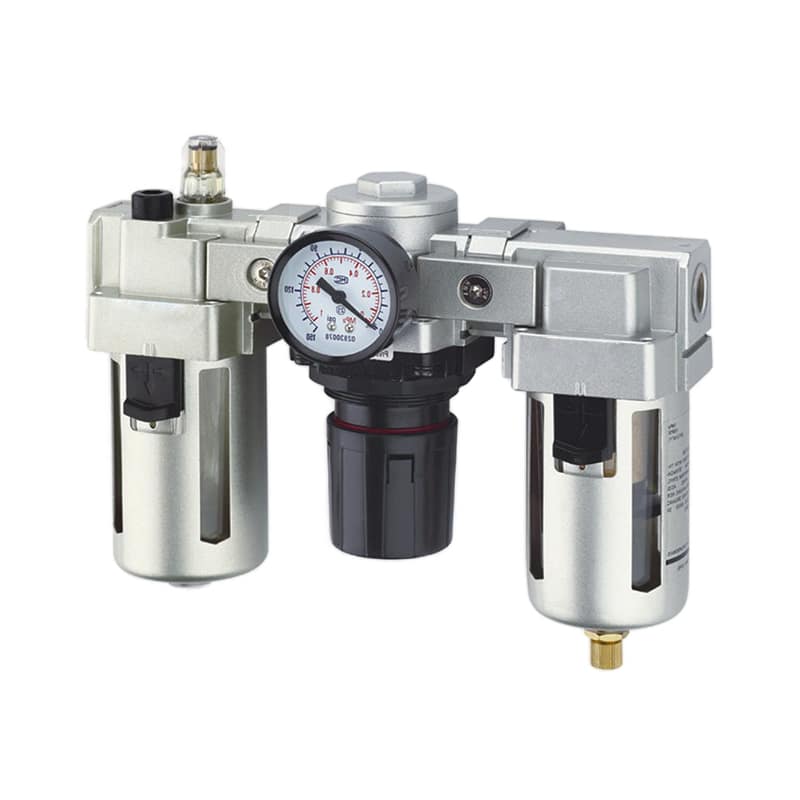
Do not add activated carbon as a default stage for abrasive wood dust. Activated carbon is useful when oil vapor, odor, or a process requirement justifies it, but each element still needs adequate flow, differential-pressure monitoring, drainage, and a service interval. The coalescing-filter guide explains the oil-aerosol role separately.
How Should Cylinder Hardware Change in a Dusty Area?
Cylinder protection should match the exposure pattern. Festo lists a hard wiper option for 32 to 63 mm DSNU cylinders, while its bellows documentation says the cover protects three parts: the piston rod, seal, and bearing (Festo, Round cylinders DSNU, 2021).
This baseline ISO-profile cylinder image is useful as a reference, not as proof of environmental suitability. That said, bore, stroke, mounting dimensions, and pressure rating do not describe the wiper, scraper, bellows, rod finish, or resistance to a direct dust plume. Those details must appear in the replacement specification.
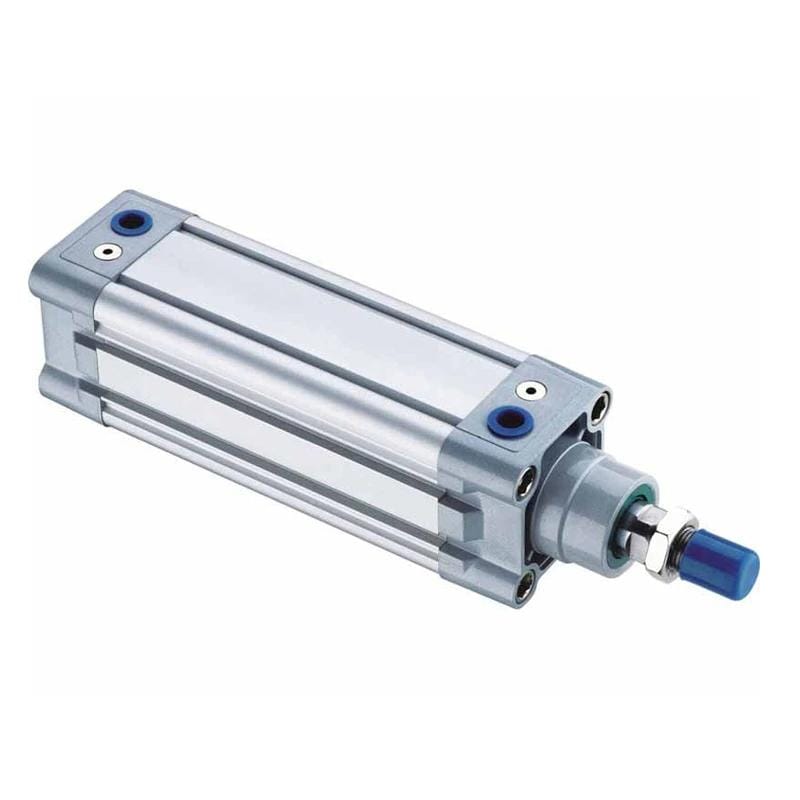
For loosely adhering dry dust, a purpose-designed wiper and hard, smooth rod surface may be enough when extraction is effective. For example, a bellows kit adds a physical barrier where the rod remains exposed. Festo cautions that its breathing path must prevent unwanted media from entering. A cover is an engineered component, not a loose sleeve. Particles that adhere strongly may need a scraper designed for that duty. Parker describes seal-and-wiper combinations for dirt-prone environments and warns that sharp installation edges can damage the sealing lip (Parker, Pneumatic Seals, accessed 2026). Material, groove, rod finish, speed, and temperature still have to match. The cylinder-seal guide separates wipers from pressure seals.
A catalog bore is not an environment rating.
Maintenance Rules That Prevent Repeat Contamination
Cleaning practice can either remove or redistribute wood dust. A NIOSH health-hazard evaluation recommended two alternatives to dry compressed-air cleaning: portable vacuuming and wet methods, while warning that blowing machinery or work areas can resuspend dust (NIOSH Health Hazard Evaluation 82-377-1376, accessed 2026).
Revised service rules were simple: isolate hazardous energy; vacuum the work zone; cap open ports; clean parts on a protected surface; inspect the rod before installing a seal kit. OSHA 29 CFR 1910.147 applies where unexpected startup or stored-energy release can injure a worker. Accordingly the plant’s validated procedure must control pneumatic pressure and suspended loads (OSHA 1910.147, accessed 2026). Meanwhile, filter bowls and automatic drains received condition checks instead of calendar-only replacement. Differential pressure; drain operation; condensate appearance; and point-of-use results were recorded together. A new filter can plug quickly if the upstream pipe contains years of rust; scale; oil; or water.
Clean service work matters.
Static control also stopped being treated as a universal dust-repellent coating. Bonding; grounding; and charge control may matter after a site-specific risk assessment. Nevertheless they do not replace source capture; housekeeping; rod protection; or air-quality verification. Our pneumatic troubleshooting guide keeps pressure; flow; leakage; and mechanical faults in separate test branches.
How Did We Verify That the Repair Worked?
Verification used operating records rather than a single clean inspection. DOE notes that leaks may waste 20% to 30% of compressor output in poorly maintained systems, while proactive programs can reduce leakage below 10% (DOE, Improving Compressed Air System Performance, 2003).
Our team analyzed a baseline before changing hardware. It included failure dates, station, rod condition, filter differential pressure, drain findings, point-of-use air results, dynamic pressure, labor hours, and confirmed parts cost. Subsequently, the same fields were collected at the same machine state.
| Verification metric | Baseline question | Acceptance evidence |
|---|---|---|
| Repeat failure | How many confirmed contamination failures occurred per operating interval? | No recurrence through the agreed observation window |
| Rod and wiper | Is a dust ring, scratch, or packed debris returning? | Clean inspection with no progressing rod damage |
| Air quality | What are particle, water, and oil results at the machine? | Meets the written point-of-use target |
| Pressure | Does dynamic pressure collapse during the affected stroke? | Stable readings within the machine requirement |
| Air treatment | Are drains working and differential pressure controlled? | Logged readings inside component service limits |
| Maintenance burden | What labor and parts were tied to confirmed failures? | Lower verified cost using the same accounting boundary |
From our analysis, the accounting boundary matters. Production value, maintenance spending, lost capacity, and avoided safety risk are different quantities. Adding them without defining overlap can double-count the benefit. Therefore, a defensible ROI uses confirmed cash costs and a documented observation period, then reports production capacity separately.
Thus, no calculator card is inserted because the case does not provide pressure-decay volume, leak size, measured airflow, compressor specific power, or operating hours. Inventing those inputs would make the number look precise without making it reliable.
What Results Can This Case Support?
An HSE circular-saw demonstration balanced 930 m³/h of extraction, with 130 m³/h at the top guard and 800 m³/h below the table. It reported average dust below half the applicable exposure limit and more than 100 times better control than cutting without effective extraction (HSE video, 2014).
That result is not a universal airflow setting. Notably, HSE explains that each saw needs its own optimum flow. Instead, the transferable result is the control sequence: capture the dust, shield the rod, specify point-of-use air quality, correct cleaning practices, and verify the same metrics before and after the work. Avoid exact savings, percentage improvements, named-customer claims, or special cylinder-series claims without auditable records. In this anonymized case, “solved” means the plant closed the identified contamination paths and used repeat inspections plus operating records to confirm that the failure pattern did not return during the agreed observation window.
No percentage was assumed.
Would a better cylinder alone have produced the same outcome? Probably not. The decisive change was treating the cylinder as one part of a dust-control and compressed-air system. In other words, the plant gained a clean baseline and named acceptance criteria instead of another unexplained replacement.
FAQs About Pneumatic Cylinder Contamination
Wood-dust control starts with measurable exposure and source capture. Specifically, OSHA lists 15 mg/m³ total dust and 5 mg/m³ respirable dust as 8-hour nuisance-dust limits. NIOSH recommends 1 mg/m³ for wood dust (OSHA Woodworking eTool, accessed 2026). Cylinder protection is an additional reliability layer.
How can I tell whether wood dust is entering through the rod seal?
Clean a defined rod and wiper area; run a controlled interval; then inspect the deposit pattern again. Dust packed outside the wiper; progressive rod scratches; and heavier damage near the cutting plume support external ingress. Compare another cylinder on a cleaner part of the same air branch before blaming internal air quality.
Does a 0.01 micron filter guarantee contamination-free compressed air?
No. ISO 8573-1 classifies three groups separately: particles, water and oil. Purity can be specified at different system locations. Therefore a filter rating does not prove pressure dew point; oil content; downstream-pipe cleanliness; drain performance; or point-of-use particle counts. Write the required class and verify it at the machine.
Should every woodworking cylinder use a bellows cover?
No. Use bellows where exposure, rod travel and access justify them. For example, a purpose-designed wiper may be sufficient when extraction and guarding control loose dry dust. Bellows must breathe correctly; remain inspectable; and avoid interference throughout the stroke. The configured cylinder manufacturer should approve the combination.
Can maintenance personnel clean the machine with compressed air?
Treat that practice as a dust-control and safety decision, not a convenience. NIOSH has advised against compressed-air cleaning that redistributes wood dust and recommends vacuum or wet methods where appropriate. Follow local regulations, combustible-dust controls, equipment instructions, and the plant’s energy-isolation procedure before cleaning or servicing machinery.
How long should the plant monitor the repair?
Monitor through at least the former repeat-failure interval and one planned maintenance cycle, then continue trending. Record operating hours or cycles, not calendar time alone. Keep the machine state, inspection method, and cost boundary consistent so a longer production run cannot be mistaken for a reliability improvement.
Sources and Retrieval Notes
-
OSHA, eTool: Woodworking - Production - Wood Dust, retrieved 2026-07-10. Exposure limits and source-control context.
-
ISO, ISO 8573-1:2010 Compressed air - Part 1: Contaminants and purity classes, retrieved 2026-07-10. Air-purity groups and measuring-point context.
-
NIOSH, Control of Wood Dust From Table Saws, retrieved 2026-07-10. Auxiliary-hood result.
-
NIOSH, Health Hazard Evaluation Report No. 82-377-1376, retrieved 2026-07-10. Cleaning guidance.
-
Festo, Round cylinders DSNU, retrieved 2026-07-10. Wiper and bellows details.
-
Parker, Pneumatic Seals, retrieved 2026-07-10. Seal-and-wiper selection.
-
DOE, Improving Compressed Air System Performance: A Sourcebook for Industry, retrieved 2026-07-10. Leak-loss ranges.
-
OSHA, 29 CFR 1910.147, retrieved 2026-07-10. Hazardous-energy control.
-
HSE video, How to improve dust control at circular saw benches, retrieved 2026-07-10. Metadata and availability verified.
-
RS Engineering Insights, 5 SURPRISING Troubleshooting Tips for Pneumatic Systems, retrieved 2026-07-10. Metadata and availability verified.