

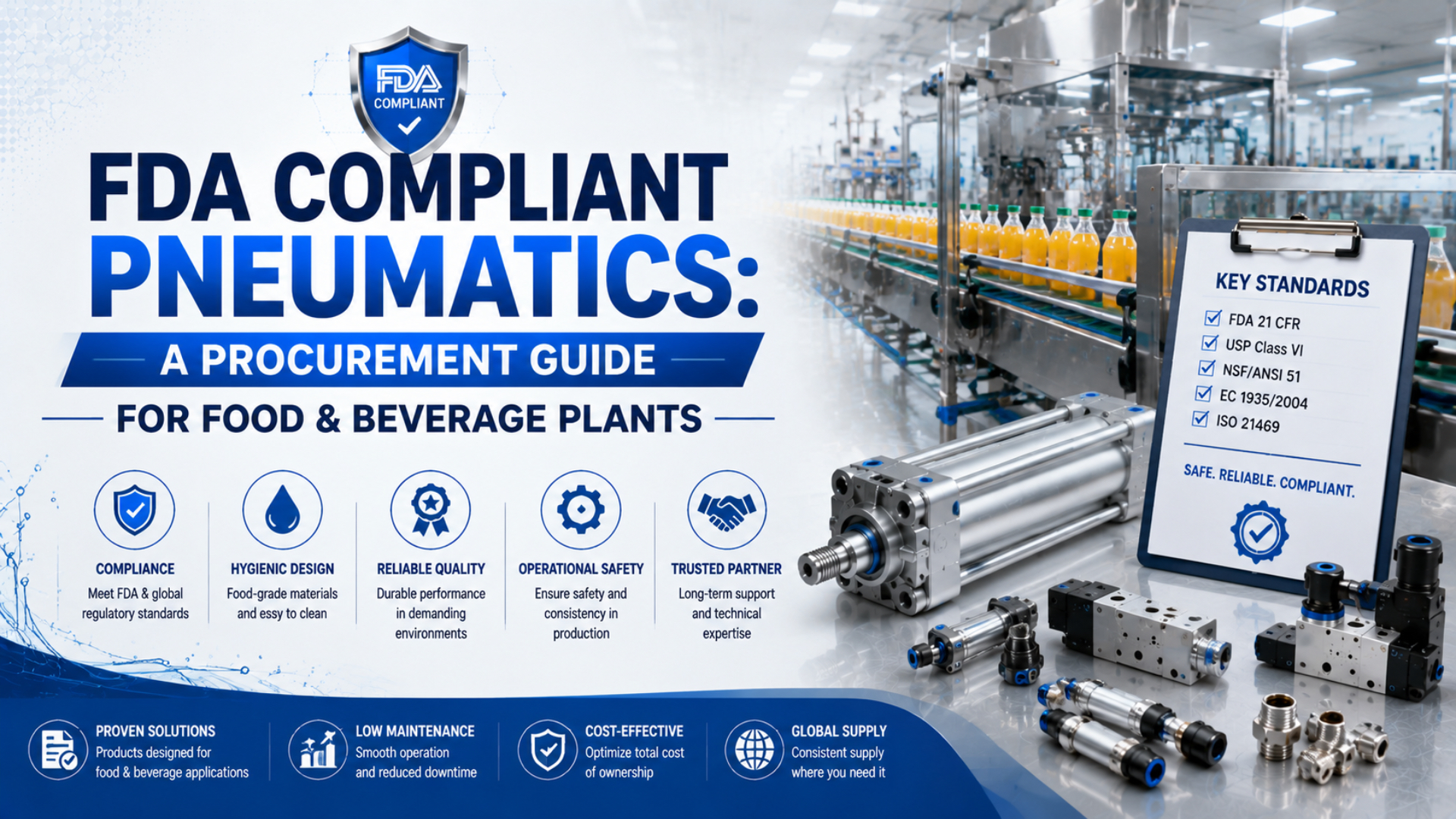
Procure FDA compliant pneumatics by defining the exact installation and contamination paths before requesting quotations. Then require evidence for each relevant material, lubricant, coating, seal, fitting, and accessory under its intended conditions of use. The final approval must cover both regulatory evidence and the installed machine’s cleanability.
The phrase “FDA compliant pneumatic component” is industry shorthand, not the name of a universal FDA certificate. FDA guidance ties food-contact status to the identity and specifications of each substance, its supplier, and its conditions of use. Section 117.40 separately addresses cleanable equipment, contamination from lubricants, sanitary pneumatic systems, and compressed gas used around food (FDA, 2026; 21 CFR 117.40, 2026).
This distinction changes the buyer’s job. A stainless cylinder with blue seals and H1 grease may be appropriate for one guarded packaging station and unsuitable for another machine where product, sanitizer, or exhaust can reach a food-contact surface. The purchase file must explain why the exact supplied configuration is acceptable in the exact installation.
Key Takeaways
- Define food exposure, cleaning exposure, and compressed-air use before selecting components.
- Ask for substance-specific evidence, not a generic “FDA approved” brochure.
- Treat NSF H1 registration, an IP rating, and a stainless grade as separate evidence with separate limits.
- Record every supplier exception and close it before purchase-order release.
- Keep hygiene acceptance, pneumatic performance, and change control as distinct approval gates.
What Does FDA Compliant Mean in a Purchase Order?
In a purchase order, FDA compliant should mean that the supplier has identified the exact items that could affect food and has supplied a valid regulatory basis for their intended use. It should not mean that FDA has certified the complete cylinder, valve, fitting, or air-preparation assembly.
FDA explains that a food-contact material inherits its status from each substance reasonably expected to migrate to food. A substance may rely on an applicable regulation, GRAS status, a prior sanction, a Threshold of Regulation exemption, or an effective Food Contact Notification. An FCN is specific to the listed manufacturer or supplier and conditions of use, so a similar compound from another source is not automatically covered (FDA, 2026).
FDA compliant pneumatics are therefore pneumatic components whose credible food-contact and contamination-path materials have a documented basis for the stated use, and whose installed configuration can be kept clean and sanitary under the plant’s operating and sanitation procedures. This is an approval conclusion for a defined application, not a permanent property of a product family.
Section 117.40 gives the equipment-level boundary. Equipment must be adequately cleanable, must avoid adulterating food with lubricants or other contaminants, and must withstand its intended environment and cleaning procedures. Non-contact equipment in food areas must still be capable of being kept sanitary. Pneumatic conveying and manufacturing systems are explicitly included, while compressed air introduced into food or used to clean food-contact equipment must be treated to avoid unlawful indirect additives.
The buyer should also confirm jurisdiction. FDA regulates many food-processing facilities, while USDA’s Food Safety and Inspection Service has primary roles for many meat, poultry, and processed egg operations. Customer standards, state requirements, GFSI-recognized schemes, 3-A practices, and EHEDG guidance may add obligations, but they should be named separately instead of being presented as FDA rules.
What Must the User Requirement Specification Define?
The user requirement specification should describe the real exposure before it names a preferred material or certification. At minimum, it should define where the component sits, what can reach it, what could escape from it, how it will be cleaned, and what pneumatic performance must remain after sanitation controls are installed.
Begin with an intended-use statement that both engineering and food safety can approve:
The actuator will operate above an open beverage-filling conveyor. It will not intentionally contact product. Product splash and daily alkaline foam cleaning can reach the actuator, mount, sensor, fitting, and tubing. Any lubricant release, seal fragment, retained liquid, or exhaust path that could return to the product zone must be controlled.
That paragraph is more useful than “Zone 2, food grade.” Zone labels differ among companies and hygienic-design systems. FDA rules do not create a universal one-meter boundary around exposed food, nor do they mandate one component certificate for every splash area. Describe the physical path first, then map it to the plant’s zoning terminology.
Record the following inputs for each installation:
| Requirement field | What procurement should record | Why the supplier needs it |
|---|---|---|
| Regulatory scope | FDA, USDA/FSIS, customer standard, 3-A, EHEDG, or other named program | Prevents one declaration from being stretched across different schemes |
| Product exposure | Direct contact, incidental contact, splash, aerosol, protected, or remote | Defines which materials and failure paths need evidence |
| Food type | Aqueous, acidic, fatty, dairy, alcoholic beverage, dry solid, or other defined product | Food-contact authorizations can depend on the food type |
| Temperature and time | Production, pasteurization, sterilization, cleaning, and storage conditions | Conditions of use can limit a material authorization |
| Sanitation recipe | Chemical, concentration, temperature, pressure, time, frequency, rinse, and dry | Screens alloy, seal, lubricant, label, cable, and coating compatibility |
| Compressed-air use | Actuation only, product contact, blow-off, conveying, or cleaning | Determines whether point-of-use air treatment needs separate review |
| Mechanical duty | Load, stroke, speed, pressure range, side load, cushioning, and cycle rate | Confirms that hygiene features do not hide an undersized actuator |
| Maintenance method | Access, disassembly, lubricant control, seal change, and post-maintenance sanitation | Defines the lifecycle contamination controls |
FDA publishes food-type and use-condition tables for Food Contact Substance notifications. They distinguish acidic, fatty, dairy, beverage, and dry-food categories as well as hot-fill, sterilization, refrigerated, frozen, and cooking conditions (FDA, 2026). A supplier declaration should match the relevant conditions rather than state “suitable for all foods.”
How Should Buyers Build the Evidence Matrix?
Build the evidence matrix by tracing each credible contamination path to the exact purchased item, material, supplier, and document. Separate direct product contact from incidental migration, external washdown exposure, internal compressed-air exposure, and abnormal events such as seal damage or maintenance errors.
Use one matrix row per item instead of one row per generic material family:
| Path item | Exact identification | Evidence basis | Conditions and limitations | Buyer disposition |
|---|---|---|---|---|
| Rod wiper | Supplier, compound code, drawing revision | Applicable regulation, FCN, or other stated basis | Food type, temperature, repeated-use limits | Accept, clarify, test, or reject |
| Internal grease | Product name, formulation owner, application location | 21 CFR basis and current NSF H1 registration when claimed | Incidental contact only, minimum necessary amount | Accept with leakage control |
| External coating | Coating system, substrate, cure, supplier | Declaration for the stated exposure or confirmation that no food path exists | Cleaner compatibility and damage inspection | Accept with installation condition |
| Fitting seal | Exact O-ring compound and fitting model | Compound declaration for intended use | Pressure, temperature, cleaner, and replacement control | Accept only with traceable spare |
| Sensor and cable | Model, jacket material, connector, ingress evidence | Hygienic-zone and washdown evidence, not assumed food contact | Orientation, chemical list, cleaning method | Guard, relocate, or approve |
This approach prevents a common substitution error. A supplier may provide a declaration for a base polymer while the purchased seal contains fillers, colorants, processing aids, or a different compound source. For repeated-use rubber articles, 21 CFR 177.2600 specifies permitted substance categories and limitations; it does not turn the names EPDM, FKM, silicone, or NBR into universal approvals (21 CFR 177.2600, 2026).
What Must an RFQ Require From the Supplier?
The RFQ should require configuration-specific evidence before the buyer treats a bid as technically complete. Every document must identify the supplied model, revision, option, material or compound, document owner, applicable conditions, and expiry or revision status where relevant. Generic brochures should remain reference material, not approval evidence.
Make these items explicit purchase-order deliverables:
- Full model code, dimensional drawing, revision, options, and approved equivalents.
- Bill of materials for components in the defined contact or contamination paths.
- Supplier declarations tied to exact material or compound codes and intended conditions.
- Seal and wiper compound identification, including replacement-kit traceability.
- Lubricant product name, application location, quantity-control method, and current registration when NSF H1 is claimed.
- Stainless grades, coatings, surface-finish locations, weld treatment, and passivation requirements where specified.
- Ingress test standard, tested configuration, mounting orientation, accessories included, and exclusions.
- Chemical-compatibility limits for the actual cleaner, concentration, temperature, and exposure time.
- Installation, cleaning, inspection, relubrication, seal replacement, and end-of-life instructions.
- A supplier notification commitment for material, formulation, source, process, or design changes.
NSF describes H1 lubricants as products intended for incidental food contact. Its registration program reviews formulation and labeling, while ISO 21469 certification is a separate program covering hygiene requirements for lubricant manufacture and use (NSF, 2026). Ask for the current product and registration number instead of accepting “food-grade grease.”
Section 178.3570 permits specified lubricants on food-processing machinery subject to ingredient and use limitations. It requires the amount used to be the minimum necessary for the technical effect (21 CFR 178.3570, 2026). H1 evidence therefore belongs beside leakage prevention, application quantity, maintenance, and contamination-path controls.
For broader actuator-selection questions, use the existing guide to selecting FDA-compliant actuators. The present guide focuses on what procurement must request, compare, accept, and preserve after the technical concept has been chosen.
How Should Competing Bids Be Compared?
Compare bids with a requirements-and-deviations register, not with a single compliant or noncompliant checkbox. A lower-priced bid may be complete, while a higher-priced bid may hide unapproved substitutions. Score each requirement by evidence quality, technical fit, sanitation fit, exception status, and lifecycle support.
Use four evidence states:
- Compliant as offered: The exact configuration and evidence meet the stated requirement without a qualification.
- Conditionally acceptable: The product can meet the requirement after a documented guard, relocation, cleaning limit, or test.
- Open deviation: Evidence is missing, expired, generic, or inconsistent with the intended use.
- Rejected: The product, material, or supplier limitation conflicts with a mandatory requirement.
In my experience with application reviews, every supplier exception should become a controlled engineering decision rather than an email clarification. The exception needs a named owner, the affected contamination path, the compensating control, the verification method, and the condition that would reopen the decision. This keeps an accepted compromise from turning into an undocumented assumption.
Do not award points merely because a bid contains more certificates. A mill certificate confirms the composition and traceability of a metal batch, but it does not prove cleanable geometry. An NSF H1 listing supports a lubricant claim, but it does not certify the actuator. An IP test addresses water ingress under stated test conditions, but it does not establish chemical resistance or microbial cleanability.
The IP rating guide for washdown valve manifolds explains how to read the test boundary. The guides to stainless cylinders for food washdown and surface topography in hygienic cylinder design cover alloy, drainage, crevice, and surface-finish questions in more detail.
Require the supplier to rewrite vague claims into auditable statements:
| Vague claim | Procurement clarification |
|---|---|
| “FDA approved seals” | Identify the exact compound, supplier, regulatory basis, food type, temperature, time, and repeated-use limitations. |
| “316L food-grade construction” | List which parts are 316L, which are not, and how joints, fasteners, sensors, and fittings are cleaned. |
| “IP69K washdown safe” | State the test standard, tested assembly, orientation, water conditions, excluded accessories, and chemical limits. |
| “Food-grade lubricant” | Provide product name, NSF category and registration when claimed, application point, quantity control, and leakage response. |
| “Direct replacement” | Confirm dimensions, ports, mount, load capacity, speed, cushioning, sensor behavior, materials, and cleaning restrictions. |
How Should FAT and SAT Close the Purchase?
FAT and SAT should close separate hygiene, documentation, and motion-performance requirements. A component can complete its stroke yet retain sanitizer, or look clean while stalling at minimum plant pressure. Each acceptance line needs an owner, test method, result, evidence location, and open-action status.
At FAT, confirm the model code, materials, options, markings, document revisions, approved lubricant, seal kit, fittings, sensors, and build drawing. Demonstrate rated motion with the specified load, minimum supply pressure, intended speed controls, cushioning, and guarding. Record leakage, cycle time, end-position behavior, and any assembly difference from the approved bid.
At SAT, inspect the installed contamination paths. Verify access, drainage, mounting orientation, fastener exposure, cable routing, fitting interfaces, guards, exhaust routing, and nearby surfaces. Apply a representative sanitation cycle where practical, then inspect for retained liquid, damaged labels, coating attack, seal swelling, sensor faults, or water ingress.
Compressed-air quality requires its own acceptance record when air can reach food or food-contact equipment. Section 117.40(g) defines the contamination outcome but does not prescribe one universal ISO 8573-1 class. The plant should specify point-of-use particles, water, oil, microbiological controls, sampling location, and monitoring method for the application. The existing ISO 8573-1 air-quality guide provides the class structure.
Change Control After Handover
Approval must remain linked to the exact configuration after handover. A replacement seal, alternate grease, new sanitizer, revised cleaning temperature, substitute fitting, changed material source, or modified guard can invalidate part of the original reasoning even when the machine still cycles normally.
Create a controlled baseline containing:
- Approved model code, drawing, bill of materials, and supplier declarations.
- Food-contact and contamination-path matrix with accepted conditions.
- Cleaning procedure and chemical-compatibility limits.
- FAT and SAT reports, photographs, and unresolved concessions.
- Approved spare-part numbers and lubricant products.
- Inspection intervals and rejection criteria based on the actual duty.
- Supplier change-notification agreement and internal reapproval route.
When a change notice arrives, compare it with the baseline at substance, component, and installed-system levels. A new seal supplier may affect the food-contact basis. A new sanitizer may affect corrosion, swelling, ingress, and grease retention. A relocated actuator may create a new splash or exhaust path. Close each affected review before releasing the change.
Condition-based maintenance is more defensible than a universal replacement interval. Set inspection and replacement criteria around leakage, surface damage, corrosion, seal condition, retained residue, sensor integrity, cleaning exposure, cycle count, and manufacturer limits. The original claim that every compliant cylinder lasts four or five years cannot support a procurement decision.
Which Procurement Claims Should Trigger a Hold?
Place the bid on hold when a claim cannot be tied to the exact product and intended use. The objective is not to punish short supplier answers. It is to prevent an ambiguous statement from becoming an undocumented assumption that survives into validation, maintenance, and inspection records.
Common hold points include:
- “FDA certified cylinder” without a defined certificate issuer, scope, product code, and use condition.
- “All seals are FDA approved” without exact compound identifiers and supplier evidence.
- A declaration for raw resin presented as proof for a finished elastomer compound.
- NSF H1 wording without the lubricant product name or current registration.
- A food-contact declaration that omits food type, temperature, duration, or repeated-use limits.
- An IP rating without the test standard, tested assembly, orientation, or accessory scope.
- A stainless-steel claim that does not identify grades for rods, caps, fasteners, mounts, and fittings.
- A surface-finish value with no measurement location, method, or acceptance record.
- A certificate issued to another manufacturer without a valid traceability chain.
- A supplier refusing to notify the buyer about formulation, source, or design changes.
- “Direct replacement” based only on bore and stroke.
- Guaranteed service life, savings, or contamination-risk reductions without a defined duty and evidence.
The correct disposition is not always rejection. A protected actuator outside the product area may need only a documented barrier and maintenance control. A washdown limitation may be solved by relocation. Missing evidence may be supplied before purchase-order release. What matters is that the final condition is written, owned, verified, and preserved.
A Defensible Procurement Decision
A defensible purchase is a traceable chain from intended use to evidence, installed verification, and controlled maintenance. It does not depend on a polished stainless appearance, a blue seal, an FDA logo, or a broad supplier letter. Procurement should release the order only after mandatory deviations have named dispositions.
Use this final release checklist:
- The intended use and regulatory scope are approved by engineering and food safety.
- Every credible contamination path has an owner and disposition.
- Material and lubricant evidence identifies exact products, suppliers, and use limitations.
- Cleaning, ingress, chemical, and compressed-air requirements are separately defined.
- Bid exceptions are closed or accepted through documented concessions.
- FAT and SAT criteria cover hygiene, documentation, and loaded motion.
- Spare parts and maintenance products preserve the approved configuration.
- Supplier and internal change-control responsibilities are written into the handover file.
FDA describes an inspection as an official onsite examination of a facility’s compliance, and notes that it is a snapshot in time (FDA, 2026). A controlled procurement record provides the longer history: why the component was selected, what evidence supported it, how it was installed, and what changed afterward.
FDA Compliant Pneumatics FAQs
These answers address the approval boundaries that most often create procurement gaps. They separate complete-component claims from substance evidence, incidental-contact lubricant registration from direct contact, and water-ingress tests from hygienic design. Apply each answer to the exact configuration and intended use rather than treating it as a universal product verdict.
Does FDA certify complete pneumatic components?
No universal FDA certificate covers a complete pneumatic cylinder, valve, fitting, or FRL assembly. Buyers must verify the regulatory basis of relevant substances under their intended conditions and separately confirm that the installed equipment can be cleaned, maintained, and operated without contaminating food.
Is 316L stainless steel required for every food application?
No. FDA regulations do not prescribe 316L for every pneumatic component in a food plant. Select the alloy from the actual product, cleaner, chloride, temperature, drainage, crevice, and failure conditions. A protected dry installation may have different needs from a direct-contact or repeated-washdown area.
Does NSF H1 registration allow direct food contact?
No. NSF H1 applies to lubricants used where incidental food contact may occur. It does not authorize intentional addition or unrestricted contact. Verify the exact registered product, application location, quantity control, leakage path, maintenance method, and any ingredient or use limitations that apply.
Is IP69K enough to approve a component for food washdown?
No. An IP69 or IP69K result addresses water ingress under defined test conditions. It does not prove chemical compatibility, corrosion resistance, drainability, cleanability, food-contact status, or installed service life. Compare the tested configuration and conditions with the plant’s actual sanitation procedure.
What changes require the pneumatic component to be reviewed again?
Review changes to seal compounds, lubricants, coatings, material sources, fittings, sensors, guards, cleaning chemicals, wash temperature, component location, exhaust routing, compressed-air use, and maintenance procedures. Reapprove the affected evidence and installation controls before releasing the changed configuration.
Sources and Retrieval Notes
The primary sources below were retrieved on July 26, 2026. FDA and eCFR sources define the U.S. regulatory boundaries used in this guide. NSF is cited only for its H1 registration and ISO 21469 program. Internal articles provide additional engineering context and do not replace application-specific approval.
- 21 CFR 117.40, Equipment and utensils. Equipment cleanability, contamination prevention, food-contact surfaces, sanitary pneumatic systems, and compressed-gas requirements.
- FDA, Determining the Regulatory Status of Components of a Food Contact Material. Substance identity, specifications, conditions of use, supplier-specific FCNs, and supplier guaranties.
- FDA, Food Types & Conditions of Use for Food Contact Substances. Food categories and processing or storage conditions used in food-contact notifications.
- 21 CFR 177.2600, Rubber articles intended for repeated use. Permitted substance categories, formulation limitations, and repeated-use extractive requirements.
- 21 CFR 178.3570, Lubricants with incidental food contact. Ingredient, limitation, minimum-use, and incidental-contact provisions.
- NSF, Food-grade lubricants and ISO 21469 certification. H1 registration scope and the separate ISO 21469 certification program.
- FDA, Inspection Basics. Purpose and scope of FDA facility inspections.