

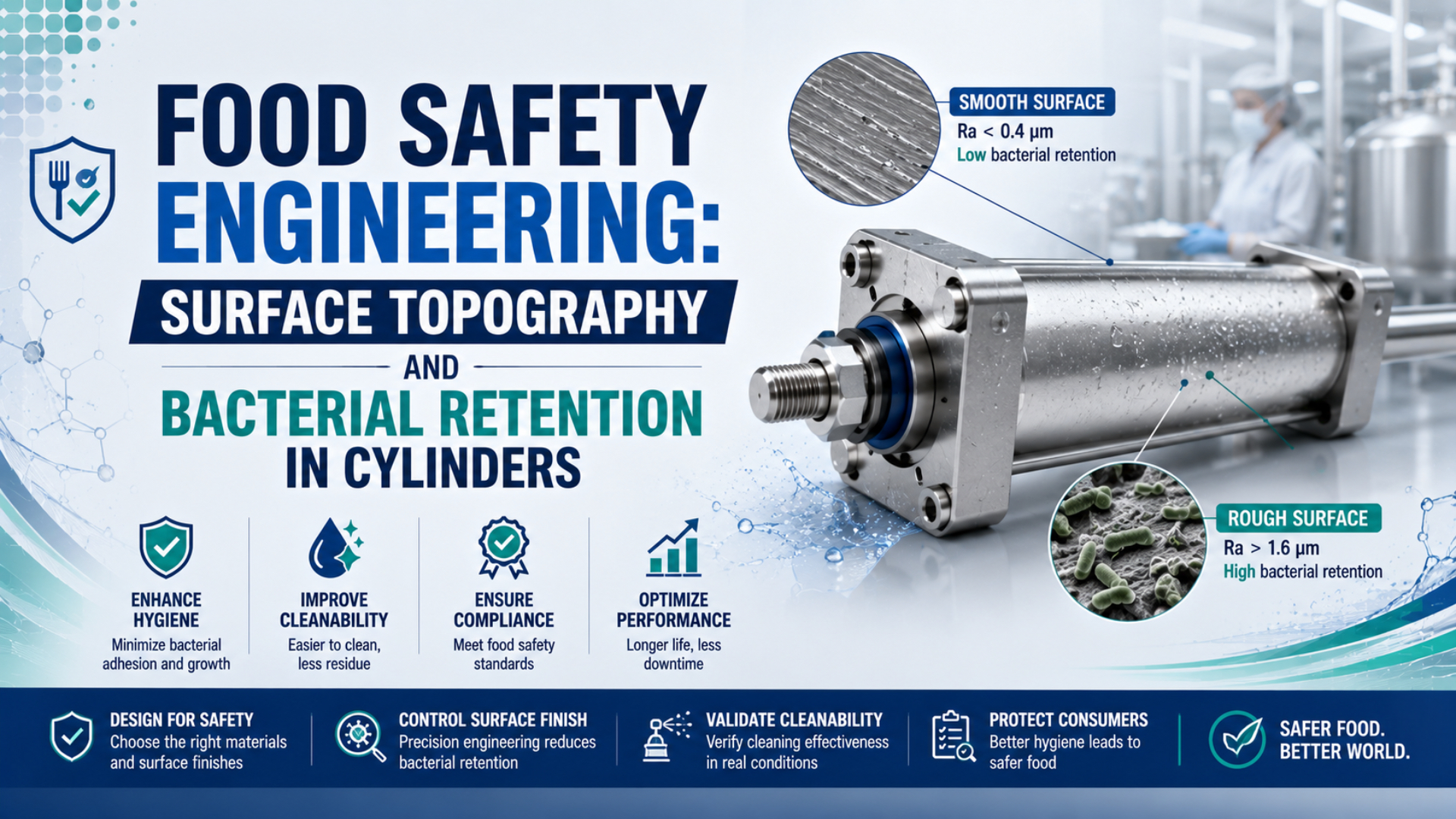
Surface topography affects whether soil can be seen, reached, removed, and verified on a pneumatic cylinder, but Ra alone cannot predict bacterial retention. A food-safety specification must combine measured roughness with defect limits, joint geometry, drainage, material compatibility, hygiene-zone classification, and a cleaning-validation method tied to the installed machine.
A controlled Listeria study compared mechanically polished and electropolished stainless steel over Ra values from about 0.16 to 0.69 µm. It found no significant correlation between Ra and initial attachment or 48-hour biofilm formation (Rodriguez, Autio, and McLandsborough, 2008). That result does not make finish irrelevant. It shows why a single average cannot stand in for the whole surface.
This article therefore treats the cylinder as part of a hygienic system. For material selection and cleaning-chemical exposure, use the separate stainless steel cylinder washdown guide. Here the narrower question is how to inspect topography, locate retention features, and prove that cleaning works.
Key Takeaways
The commonly cited 3-A benchmark is 32 microinches, or 0.8 µm Ra, for product-contact surfaces, but the same guidance also requires freedom from pits, folds, cracks, and crevices plus suitable drainage and inspection access (3-A SSI, accessed 2026).
- Use Ra as one controlled parameter, not a bacterial-count forecast.
- Inspect scratches, seams, fasteners, sensor grooves, wipers, mounts, and low points.
- Separate product-contact, splash, and non-contact risks before writing limits.
- Validate cleaning on the installed assembly with site-specific acceptance criteria.
What Does Ra Reveal About Bacterial Retention?
In the 2008 Listeria study, surface groups between approximately 0.16 and 0.69 µm Ra produced no significant difference in initial adhesion, and biofilm results were not significantly correlated with Ra (Journal of Food Protection, 2008). Ra is a manufacturing measurement, not a microbiological conversion table.
Ra reduces a filtered two-dimensional profile to the arithmetic mean of its absolute height deviations. It does not report where a valley occurs, whether a scratch is directional, how wide a pit is, or whether a joint shelters residue from the cleaning jet. ISO 21920-2 defines profile texture terms and parameters, while ISO 21920-3 defines the specification operator needed to state them consistently (ISO 21920-2, 2021; ISO 21920-3, 2021).
Two surfaces can therefore share the same Ra and behave differently during cleaning. One may contain many shallow machining marks; another may have a mostly smooth field interrupted by a narrow, deep defect. Their average can match even though the isolated defect creates the harder inspection and soil-removal problem.
The same caution applies to bacterial size comparisons. A statement such as “the groove is larger than a bacterium” does not predict retained CFU after a wash. Attachment also changes with the organism, conditioning film, surface chemistry, time, temperature, flow, and cleaning process. For the measurement distinction between Ra and other profile parameters, see the Ra versus Rz engineering guide.
Which Parts of a Pneumatic Cylinder Belong in the Hygiene Risk Assessment?
Section 117.40 requires even non-food-contact equipment in processing areas to remain clean and sanitary, and it explicitly includes pneumatic and automated systems in the design boundary (eCFR 21 CFR 117.40, current 2026). Risk depends on the installed location, not the component label.
Start by assigning the actuator and each exposed accessory to the plant’s hygiene zones. A cylinder behind a cleanable guard above wrapped product does not need the same evidence as an actuator positioned where an open product can contact its exterior. Product splash, condensate, aerosol, foam, rinse water, and maintenance tools can also create indirect transfer routes.
The assessment must follow the whole assembly:
| Cylinder location or feature | Retention or transfer concern | Engineering response |
|---|---|---|
| Barrel and end-cap joint | Capillary gap, damaged coating, pooled rinse | Use a sealed, inspectable transition and verify drainage |
| Rod and wiper interface | Reciprocating path can move soil across the wiper | Keep outside the product zone where possible; define inspection and replacement |
| Rodless-cylinder sealing band or carriage | Long slot, cover strip, guide recess, moving contact | Review the exact architecture; “no exposed rod” is not proof of hygiene |
| Switch groove and sensor | Recessed fasteners, cable trap, hidden back surface | Use a cleanable cover or relocate the sensing package |
| Mounting bracket | Overlapping plates and horizontal ledges | Use open geometry with visible, drainable interfaces |
| Ports, fittings, and tubing | Threads, disconnected caps, low cable or tube loops | Select cleanable fittings and route away from collection points |
| Exhaust air and lubricant | Possible chemical or particulate transfer | Apply the site’s air-quality and incidental-contact controls |
Does the design allow sanitation staff to see the back of the bracket and the underside of the switch? If not, an excellent barrel finish cannot rescue the inaccessible assembly. The FDA-compliant actuator selection guide provides the wider regulatory screen; this inspection focuses on retention paths.
Which Surface Features Matter Beyond Average Roughness?
The 3-A primer pairs its general 0.8 µm Ra benchmark with requirements addressing pits, folds, cracks, crevices, radii, drainage, accessibility, and the intended cleaning method (3-A SSI, accessed 2026). That list is more useful than treating one profilometer reading as a hygiene certificate.
Inspect surface condition at the scale relevant to cleaning and maintenance. A stylus trace may miss a defect located between sample paths. Visual inspection may miss a narrow gap beneath a fastener. Neither method alone proves that a cleaning solution reaches the feature with enough mechanical action and then drains away.
Use four complementary controls:
- Texture control: State the parameter, limit, filter, evaluation length, trace direction, instrument, and sampling plan. “Polished” is not a measurable acceptance criterion.
- Defect control: Reject pits, laps, cracks, open seams, burrs, coating holidays, raised labels, and damaged weld cleanup in the defined hygiene area.
- Geometry control: Make joints visible, seal unavoidable interfaces, cover or eliminate exposed threads, and avoid ledges or pockets that retain liquid.
- Process control: Confirm that cleaning media, temperature, impingement, exposure time, rinse, and drainage reach the installed surface.
Electropolishing may improve a particular stainless surface, but it is not automatically superior in every microbiological test. The 2008 study found no significant sanitation advantage over mechanically finished samples within its tested range. Specify the result required from the finished part, then verify it, instead of using a process name as a substitute for evidence.
How Should Engineers Write a Verifiable Surface-Finish Specification?
ISO 21920-3:2021 specifies the complete operator for profile-based surface-texture specifications, replacing the idea that a bare Ra number fully defines the measurement (ISO 21920-3, 2021). A useful cylinder drawing must tell manufacturing and inspection teams how, where, and under what conditions to measure.
Define the hygiene boundary on the drawing first. Then state which faces are product contact, splash exposed, or non-contact. Do not copy a product-contact limit onto every internal cylinder component without analyzing whether that component is exposed, cleanable, lubricated, or even compatible with the same measurement method.
A build-ready note should cover:
| Drawing or RFQ field | Minimum information |
|---|---|
| Surface parameter | Ra and any additional parameter needed for the failure mode |
| Numerical limit | Maximum value and units, tied to the applicable standard or plant rule |
| Measurement operator | Filter, cutoff, evaluation length, and instrument class |
| Sampling location | Named surfaces, number of traces, direction, and exclusion zones |
| Defect acceptance | Pits, scratches, seams, burrs, discoloration, coating damage |
| Surface process | Mechanical finish, passivation, electropolishing, or coating when required |
| Geometry | Drainage, joint treatment, fastener condition, radius, and access |
| Records | Calibration status, inspection report, lot/serial traceability, and deviation approval |
Be careful with conversion language. Thirty-two microinches is approximately 0.8 µm, while 16 microinches is approximately 0.4 µm. Those values are surface-finish units, not bacterial dimensions or guaranteed log reductions. If a customer requests 0.4 µm, record whether that limit comes from a specific customer standard, product-contact risk assessment, or certificate scope.
For a cylinder barrel’s internal sealing surface, friction and seal wear may require different texture parameters from the external hygienic surface. Do not merge those functions. The internal cylinder-barrel Ra and Rz guide addresses sealing performance, while the external specification here addresses cleanability and transfer risk.
How Do You Validate Cleanability on the Installed Machine?
EHEDG states that most closed equipment must pass at least three CIP cleanability tests after design review before certification eligibility (EHEDG certification process, accessed 2026). The broader lesson is that drawings and Ra reports precede validation; they do not replace it.
Write a protocol around the actual soil, surface, cleaner, concentration, temperature, time, mechanical action, rinse, and drying condition. Include the worst credible cylinder position. A retracted rod, extended rod, carriage end position, or shielded mounting face may produce different exposure and drainage.
Use a layered verification method:
- Pre-clean inspection: Record damage, residue, pooled liquid, loose seals, and inaccessible features.
- Defined soil challenge: Use a representative product residue or approved surrogate applied consistently to named sampling sites.
- Controlled cleaning cycle: Log chemical concentration, temperature, pressure or flow, exposure time, nozzle position, and rinse.
- Immediate verification: Use visual inspection and the plant’s validated rapid method where appropriate.
- Microbiological confirmation: Use organism-specific or indicator testing when the hazard analysis and validation plan require it.
- Repeatability check: Repeat enough cycles to capture normal variation rather than accepting one favorable result.
ATP is a rapid hygiene-screening tool, not a direct bacterial count. RLU values depend on the instrument, swab chemistry, sampled area, soil, and procedure. A universal “less than 10 RLU” limit cannot be transferred from another plant or device without validation. Define baseline, alert, action, retest, and corrective-action rules for each sampling point.
What happens if the result fails? The protocol should distinguish recleaning from redesign. Repeated failure at a hidden bracket interface may justify moving the actuator or changing the mount. A rising trend at the wiper may trigger inspection and replacement. A one-time operator miss calls for a different response.
What Should an Existing Cylinder Hygiene Audit Record?
Section 117.40 requires equipment to be installed so cleaning and maintenance can reach the equipment and adjacent spaces (eCFR, current 2026). An audit should therefore inspect the installed interfaces, not only the cylinder’s catalogue photograph or material declaration.
Begin with a clean, locked-out machine and the sanitation team’s normal access tools. Photograph each defined sampling location consistently. Record cylinder position, guard condition, lighting, and whether inspection required disassembly. Do not open a pressure-retaining actuator merely to claim sanitation access; internal maintenance must follow the manufacturer’s safe service instructions.
Use this field sequence:
- Trace potential transfer from actuator to open product, product-contact surface, packaging, or operator tool.
- Inspect barrel, caps, rod or sealing band, carriage, switches, ports, fittings, brackets, guards, and surrounding structure.
- Mark residue shadows, water lines, corrosion, coating damage, loose seals, adhesive labels, and inaccessible overlaps.
- Measure specified surfaces using the documented texture operator, not an unspecified handheld reading.
- Observe a complete cleaning cycle for reach, coverage, drainage, and post-rinse pooling.
- Compare rapid-test and microbiological trends by location rather than averaging the entire machine.
- Assign each finding to clean, repair, relocate, redesign, or validate further.
Do not automatically replace a standard cylinder with a rodless design. A rodless unit removes an exposed piston rod but may introduce a long sealing slot, carriage interfaces, guide recesses, or cover bands. Compare exact architectures. For maintenance planning after the hygienic risk is controlled, use the rodless-cylinder preventive checklist.
Which Supplier Evidence Supports a Food-Safety Decision?
3-A states that its standards are voluntarily applied and that authorization to display the 3-A Symbol requires licensing and third-party verification (3-A SSI primer, accessed 2026). A supplier’s phrase “designed to 3-A principles” is not the same as a certificate for the quoted model. Confirm the scope of every declaration.
Match each claim to its evidence:
| Supplier claim | Evidence to request | What the evidence does not prove |
|---|---|---|
Ra ≤ 0.8 µm |
Surface report with locations, operator, instrument, and acceptance | Absence of pits, cleanable joints, or bacterial reduction |
316L stainless steel |
Material certificate tied to named components | Seal compatibility, finish, drainage, or washdown life |
FDA compliant seals |
Exact compound declaration and intended-use basis | Compliance of the complete cylinder or direct-contact suitability |
IPX9 or IP69K |
Actual test standard, specimen configuration, pressure, temperature, duration | Hygienic geometry, chemical resistance, or microbiological cleanability |
EHEDG certified |
Current certificate, type, exact model and size, seal variants | Suitability outside the certificate scope |
3-A compliant |
Applicable standard, current authorization, exact equipment scope | Automatic acceptance of unrelated accessories or installation details |
Electropolished |
Process specification plus final measured surface evidence | A universal bacterial-retention reduction |
IEC 60529 classifies protection provided by electrical enclosures against access, solids, and water and defines IPX9; it is not a hygienic-design standard (IEC 60529, Edition 2.2). Do not attribute an IP69K claim to IEC 60529 without checking the supplier’s actual cited standard. Treat ingress evidence as one input for switches, connectors, and related enclosures. The IP65, IP67, and IP69K guide explains the same boundary for pneumatic manifolds.
For elastomers, cleaning chemicals can change swelling, hardness, compression set, and extractables. Record the exact compound, not only “EPDM” or “FKM,” and review it against concentration, temperature, exposure time, lubricant, and product-contact conditions. The actuator seal chemical-compatibility guide provides the next screening step.
Engineering Decision: Ra Is One Control, Not the Hygiene Verdict
ISO 14159 applies hygiene requirements to machinery where consumer risks can occur, while Section 117.40 requires cleanable equipment and sanitary pneumatic systems (ISO 14159, 2002; eCFR, current 2026). Together they support a system-level decision rather than a surface-number shortcut.
Use Ra to control a defined manufacturing process. Use defect criteria to reject isolated damage. Use hygienic geometry to remove sheltered interfaces and liquid traps. Use material and seal evidence to survive the sanitation recipe. Finally, validate cleaning on the installed machine and trend the named sampling points.
That approach changes the procurement question. Do not ask, “Is this a food-grade cylinder?” Ask which surfaces are exposed, what limits apply, how they were measured, what can retain soil, which certificate covers the exact configuration, and how the plant will prove repeatable cleaning. Those questions produce an auditable specification.
Surface Topography and Cylinder Hygiene FAQs
The 3-A general benchmark of 32 microinches, or 0.8 µm Ra, appears alongside defect, drainage, access, and cleaning-method criteria, not as a standalone microbiological guarantee (3-A SSI, accessed 2026). These answers preserve that boundary for common engineering questions.
Does Ra below 0.8 µm guarantee low bacterial retention?
No. A Listeria study covering about 0.16 to 0.69 µm Ra found no significant correlation between Ra and attachment or 48-hour biofilm formation. Ra remains useful for finish control, but cleanability also depends on defects, profile shape, material chemistry, soil, organism, cleaning conditions, drainage, and access.
Is an electropolished cylinder always easier to sanitize?
No. Electropolishing can modify roughness, surface chemistry, and defect condition, but the finished result and installed geometry control performance. In the cited Listeria study, electropolished samples did not show a significant sanitation advantage over mechanically finished samples. Specify measurable finished-part criteria and validate the actual cleaning cycle.
Can ATP testing replace microbiological validation?
No. ATP provides a rapid cleanliness signal, not an organism count or species identification. RLU depends on the instrument, swab, sampled area, residue, and procedure. Establish site-specific baseline, alert, action, retest, and corrective-action rules, then use microbiological methods where the hazard analysis or validation plan requires them.
Does IP69K make a pneumatic cylinder hygienic?
No. IEC 60529 defines IPX9; a supplier using IP69K must identify the actual test standard and configuration. Either way, a water-ingress test does not certify surface finish, drainage, food-contact materials, chemical compatibility, or microbiological cleanability. Assess the cylinder joints, mounts, sensors, fittings, seals, sanitation media, and access separately.
Are rodless cylinders inherently more hygienic than rod-style cylinders?
No. Removing an exposed rod can eliminate one transfer path, but a rodless design may add a sealing slot, band, carriage, or guide recess. Compare the exact installed architectures by hygiene zone, accessible surface area, drainage, seal interfaces, cleaning coverage, and validation results rather than choosing by actuator category alone.
Sources and Retrieval Notes
- U.S. Electronic Code of Federal Regulations. 21 CFR 117.40, Equipment and utensils. Accessed 2026-07-23.
- 3-A Sanitary Standards, Inc. A Primer for 3-A Sanitary Standards and 3-A Accepted Practices. Accessed 2026-07-23.
- EHEDG. Everything you want to know about certification. Accessed 2026-07-23.
- ISO. ISO 14159:2002, Safety of machinery: Hygiene requirements for the design of machinery. Accessed 2026-07-23.
- ISO. ISO 21920-2:2021, Surface texture: Profile: Terms, definitions and surface texture parameters. Accessed 2026-07-23.
- ISO. ISO 21920-3:2021, Surface texture: Profile: Specification operators. Accessed 2026-07-23.
- IEC. IEC 60529, Degrees of protection provided by enclosures. Accessed 2026-07-23.
- Rodriguez, A., Autio, W. R., and McLandsborough, L. A. Effect of surface roughness and stainless steel finish on Listeria monocytogenes attachment and biofilm formation. Journal of Food Protection, 2008. Accessed 2026-07-23.