

Select an actuator by proving the compliance of the exact installed configuration, not by accepting a broad “FDA approved” label. Define every possible food-contact path, obtain material and lubricant declarations for the stated conditions of use, verify hygienic installation and washdown limits, then test force, speed, cushioning, and repeatability under the real load.
The FDA does not issue one universal certificate for a pneumatic actuator. Its guidance explains that food-contact status depends on each substance, its identity and specifications, the intended use, and any limitations. Section 117.40 separately requires food equipment to be adequately cleanable and pneumatic systems to be maintained in a sanitary condition (FDA, 2026; 21 CFR 117.40, 2026).
This turns actuator selection into two linked approvals. The hygiene review establishes whether the materials, geometry, installation, and maintenance controls can prevent contamination. The engineering review proves the actuator can still complete the motion after those restrictions, covers, seals, cleaning cycles, and mounting changes are applied.
Key Takeaways
- Section 117.40 covers cleanability, sanitary pneumatic systems, and compressed gas (eCFR, 2026).
- Map every credible contact path before choosing a product.
- Tie declarations to exact compounds, suppliers, and use conditions.
- Approve hygiene evidence and loaded motion performance separately.
What Does “FDA-Compliant Actuator” Actually Mean?
FDA guidance gives food-contact materials a three-part evidence boundary: substance identity, specifications, and conditions of use. It also notes that a Food Contact Notification is effective only for the listed manufacturer or supplier. A declaration for a resin or elastomer therefore cannot automatically cover every actuator built with that material (FDA, 2026).
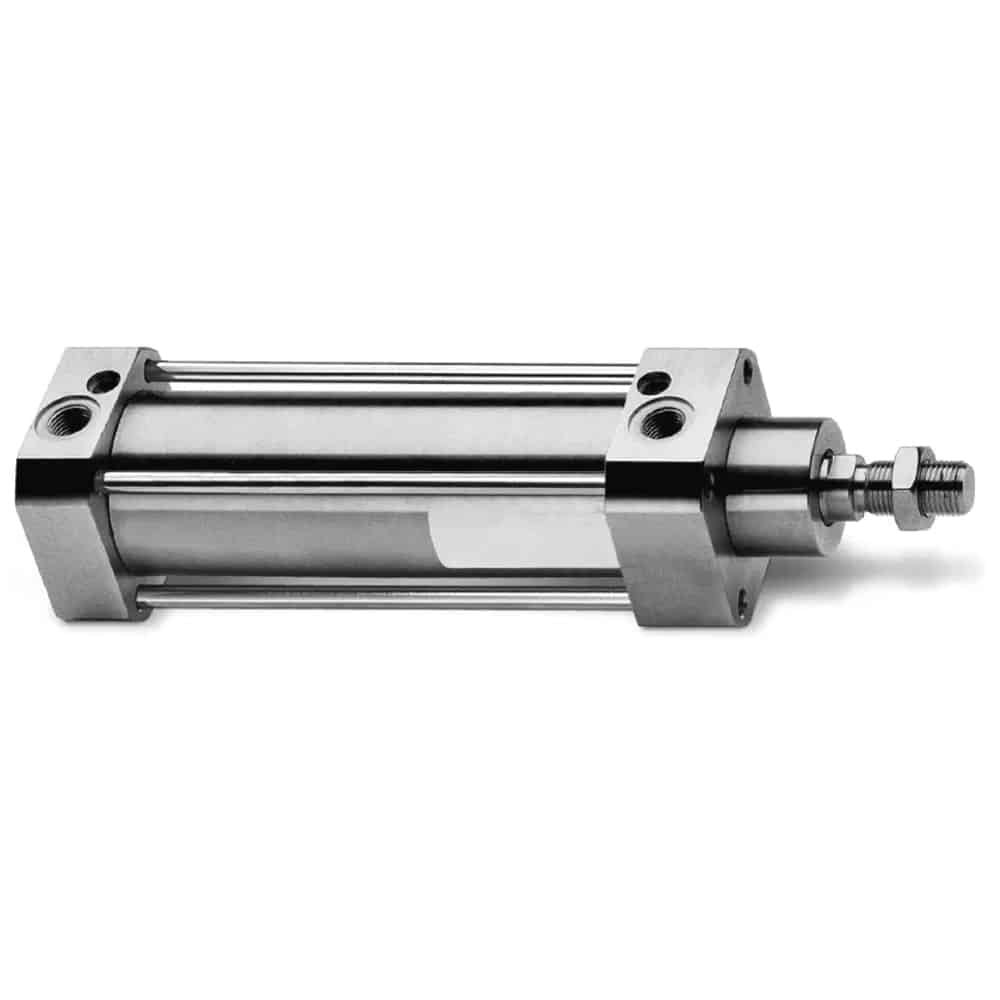
FDA-compliant actuator means an exact installed configuration whose credible food-contact and contamination-path components have a documented regulatory basis for the stated use. The complete machine must also meet the cleanability and sanitary-operation duties that apply to its installation. A polished cylinder cannot establish either conclusion by appearance. Would you approve the same configuration without its material declarations?
Start with the path, not the catalog badge:
- Identify what could reach food during production, cleaning, maintenance, or failure.
- List the exact material, seal compound, lubricant, coating, adhesive, and supplier in that path.
- Match each declaration to the food type, temperature, contact duration, and repeated-use condition.
- Review joints, fasteners, drainage, guards, fittings, sensors, and cable entries for cleanability.
- Record how the installed assembly will be inspected, cleaned, and replaced without creating a new hazard.
The declaration boundary and the hazard boundary are not always the same. A rod seal may never touch food during normal motion, yet damaged sealing can release grease or allow wash water into a place that later drains toward product. Include credible abnormal conditions instead of reviewing only steady-state contact.
Which Exposure and Contact Paths Apply to the Installed Actuator?
Two current catalogs show why the exact application statement matters. SMC describes a stainless cylinder with NSF H1 grease and 304 stainless external parts, yet states that it cannot be used in the food zone. Festo documents a CRDSNU configuration for direct food contact under European Regulation 1935/2004 (SMC, 2026; Festo, 2026).
Those examples do not make one product universally suitable and the other unsuitable. Instead, they show that “stainless” and “food-grade grease” are incomplete claims. The application statement, exact configuration, market-specific regulatory basis, and intended contact conditions must line up. A European food-contact declaration is useful evidence, but it is not a generic U.S. FDA certificate for the whole actuator.
Avoid treating a generic Zone 1 to Zone 4 chart as law. Facilities use different zoning systems. Describe the physical exposure in the user requirement specification and let the food-safety team map it to the plant’s terminology.
| Installed condition | Credible contamination path | Selection response | Evidence to retain |
|---|---|---|---|
| Direct product contact | Actuator surface or component touches food | Prefer avoiding the contact; if unavoidable, specify cleanable product-contact construction | Exact food-contact declarations, drawings, surface and cleaning limits |
| Incidental contact | Lubricant or component may contact food during normal operation | Limit quantity and migration path; use a declared material for the stated use | Compound or lubricant declaration and conditions of use |
| Product splash | Food reaches the actuator but does not intentionally return to product | Prevent retention and return flow; make surfaces visible and drainable | Material list, cleaning method, installation drawing |
| Direct washdown | Water, foam, sanitizer, or hot spray reaches the assembly | Validate ingress and chemical resistance for the actual cleaning recipe | Test scope, media limits, seal data, connector ratings |
| Protected non-food area | Guarding separates the actuator from product and sanitation | Verify the barrier, drainage, maintenance access, and failure path | Risk assessment, guard design, inspection method |
A guarded standard actuator outside the hygiene area can be safer and easier to validate than a premium cylinder placed above exposed food. The guard must not trap soil, obstruct inspection, or route leakage toward product. For a broader review of heat, dust, corrosion, and hazardous locations, use the environmental actuator selection guide.
How Should You Audit Materials, Seals, and Lubricants?
For repeated-use rubber in contact with aqueous food, 21 CFR 177.2600 limits total extractives to 20 mg/in² during the first seven hours and 1 mg/in² during the next two hours. Fatty-food conditions use different tests and limits, proving that an elastomer family name is not a compliance statement (21 CFR 177.2600, 2026).
Ask for the exact EPDM, FKM, silicone, polyurethane, or other compound, including manufacturer and grade. Pigments, fillers, curing agents, and processing aids can change the regulatory status and chemical behavior. A declaration should identify the governing regulation or notification, intended food types, temperature, duration, and repeated-use limitations.
Apply the same discipline to lubricant claims. NSF H1 is a registration category for lubricants used where incidental food contact may occur. It does not authorize deliberate or unrestricted direct contact. By contrast, NSF’s ISO 21469 certification is a separate hygiene-management and production standard, not another name for H1 registration (NSF, 2026).
| Supplier claim | What to request next | Procurement decision |
|---|---|---|
| “FDA seal” | Exact compound, supplier declaration, regulation, food type, temperature, and time | Reject the shorthand until the use condition is traceable |
| “Food-grade grease” | Product name, NSF category and registration, SDS/TDS, application quantity | Confirm H1 is appropriate for only incidental contact |
| “316L construction” | Bill of materials for body, rod, fasteners, ports, mount, and sensor hardware | Check whether the claim covers all exposed metal |
| “Chemical resistant” | Concentration, temperature, contact time, cycle count, and approved media list | Compare with the actual sanitation recipe |
Neither 316L nor any other alloy is universally required by FDA for pneumatic actuators. Type 304 may be adequate in a mild, well-drained area; 316L provides better nominal resistance to chloride-driven pitting. Cleaning chemistry, temperature, crevices, surface damage, and failure consequence decide whether the upgrade is justified. The detailed food-washdown stainless cylinder guide covers that physical specification problem.
Seal selection also affects leakage, friction, low-speed stability, and service life. Review the exact compound against the cleaner as well as the food-contact basis. The pneumatic seal compatibility guide provides a useful mechanical and chemical screening sequence.
Hygienic Design Goes Beyond Stainless Steel
The 2026 3-A General Requirements Standard 00-02 connects more than 80 equipment standards through a common foundation for materials, fabrication, installation, and cleaning. A component may display the 3-A Symbol only when it falls under an applicable standard, has current authorization, and satisfies independent verification requirements (3-A SSI, 2026; 3-A Symbol, 2026).
Stainless grade answers a corrosion question. Hygienic design asks whether soil can reach, remain on, and be removed from the installed equipment. Review rod-end threads, tie rods, end-cap seams, switch channels, labels, adjustment screws, port adapters, cable glands, overlapping brackets, hollow guards, and horizontal ledges.
The commonly cited 0.8 µm Ra surface value is a product-contact benchmark, not a universal pass mark for every external actuator surface. Roughness does not describe pits, scratches, weld discoloration, radii, crevices, drainage, or cleaning access. Require a measured location and acceptance method when surface finish matters.
ISO 14159:2002 remains the published international hygienic-design standard after confirmation in 2018. ISO/DIS 14159 is a draft replacement under development in 2026, so specifications should cite the current published edition unless the project deliberately adopts draft provisions (ISO 14159, 2026; ISO/DIS 14159, 2026).
In our experience, the most useful installation drawing is often the sanitation view rather than the motion view. It shows the nozzle approach, liquid low points, rear-mount access, cable routing, and whether a mechanic can see the rod seal. For example, one hidden bracket overlap can retain cleaner even when every exposed metal part has the requested alloy certificate.
What Does an IP Rating Prove About Food Safety?
IEC 60529 Edition 2.2 classifies enclosure protection against solid objects and water. It does not evaluate food-contact migration, sanitizer compatibility, residue retention, microbial cleanability, drainage, lubricant suitability, or long-term cylinder life. An IP rating is therefore one test result inside the evidence file, not a hygienic-design certificate (IEC 60529, 2013).
Ask whether the exact actuator assembly was tested, including switches, connectors, cable glands, fittings, and adjustment covers. Then compare the test water temperature, pressure, nozzle distance, angle, duration, and mounting orientation with the sanitation standard operating procedure. IP69 is an ingress classification, not a claim that an attached sensor, connector, or untested accessory shares the same protection.
| Claim | Supports | Does not establish |
|---|---|---|
| IP67 | Defined protection against dust and temporary immersion | High-pressure hot spray or chemical compatibility |
| IP69 or IP69K | Defined protection against high-pressure, high-temperature water jets | Food contact, cleanability, drainage, or sanitizer life |
| Corrosion-resistant exterior | A selected material or coating on stated parts | Assembly-wide metallurgy or hygienic geometry |
| Washdown suitable | Only what the vendor’s stated test and media list cover | Suitability for an unlisted cleaner or hotter, longer cycle |
Chemical exposure can change seals and cable jackets without causing immediate water ingress. Add a coupon, soak, or representative assembly test when the vendor lacks data for the exact cleaner. Inspect swelling, hardness, cracking, mass change, surface damage, leakage, and motion after repeated cycles.
Performance Verification Under the Sanitation Load Case
SMC warns that stainless cylinders can weigh 1.5 to 3 times as much as comparable aluminum products. That added mass can affect mounting deflection, vibration, and guide loads even when bore and stroke remain unchanged. Hygienic upgrades must therefore be included in the mechanical load case, not added after sizing (SMC, 2026).
Build the performance requirement from measured or bounded inputs. Avoid a universal “3:1 safety factor” because friction, orientation, pressure stability, external moments, and failure consequence differ. Specify the minimum available pressure at the actuator during peak plant demand, not only compressor receiver pressure.
| Performance input | Define in the RFQ | Acceptance evidence |
|---|---|---|
| Load and orientation | Moving mass, gravity direction, friction, tooling, and process force | Force margin at minimum pressure |
| Stroke and end position | Working stroke, overtravel, stop design, and position tolerance | Repeatability over a defined cycle sample |
| Cycle profile | Extend time, dwell, retract time, cycles per minute, and shifts | Temperature and timing stability at duty |
| Side and moment load | Offset, guide arrangement, alignment tolerance, and impact | Guide or bearing calculation and wear inspection |
| Speed control | Meter-out arrangement, valve and tube size, cushioning, and stop energy | Loaded speed and end-impact test |
| Sanitation condition | Wet/dry state, temperature, cleaner residue, guard and boot friction | Pre-clean and post-clean performance comparison |
Calculate theoretical cylinder force from pressure and effective piston area, then derate it for the real mechanical and pressure conditions. The pneumatic force-factor guide explains the force margin, while the bore-size guide shows why increasing bore can change both air demand and speed behavior.
An acceptance test should use the supplied actuator, mounting hardware, sensors, flow controls, guarding, and sanitation protection. Run it at the minimum specified pressure with the maximum credible load. Record cycle time, end-position repeatability, pressure at the actuator, leakage, cushion behavior, mounting movement, and sensor operation before and after representative cleaning cycles.
Keep hygiene acceptance and motion acceptance as separate lines in the test record. A cylinder can pass its stroke-time test while trapping sanitizer, or pass a washdown inspection while stalling at low plant pressure. Requiring both signatures prevents one successful test from hiding the other failure mode.
Supplier Evidence for the Compliance File
The 3-A Symbol program uses current certificates and independent Third Party Verification rather than self-applied wording. FDA likewise recommends obtaining a guaranty from the supplier when a food-contact substance’s regulatory status matters. The evidence file should therefore identify the exact purchased configuration and document owner, not collect anonymous brochures (3-A Symbol, 2026; FDA, 2026).
Make the following package a purchase-order deliverable before final acceptance:
- Full model code, revision, options, and dimensional drawing.
- Bill of materials for every exposed or contamination-path component.
- Food-contact declarations tied to exact materials, suppliers, and conditions of use.
- Seal compound identification and chemical-compatibility limits.
- Lubricant product, NSF category and registration where claimed, and application location.
- Ingress test standard, report scope, mounting orientation, and excluded accessories.
- Stainless grades, coatings, surface-finish locations, weld treatment, and passivation where specified.
- Approved cleaning media, concentration, temperature, pressure, exposure time, and frequency.
- Installation, inspection, maintenance, seal-replacement, and end-of-life instructions.
- Current 3-A authorization or other certificate only when the vendor claims it for the exact product.
Red flags include “FDA approved stainless steel,” “all seals are food grade,” “IP69 means hygienic,” and a certificate that names a raw material but not the supplied compound or assembly. For example, a rubber-family brochure cannot replace the declaration for the actual seal compound. Ask the supplier to rewrite each claim as a traceable statement: what item, which regulation or test, whose material, under what conditions, and for which model revision?
Use a final requirements matrix to close the purchase:
| Requirement | Supplier submittal | Engineering verification | Food-safety verification | Status |
|---|---|---|---|---|
| Contact-path materials | BOM and declarations | Configuration matches drawing | Intended use and limitations accepted | Open/Pass/Fail |
| Cleanability | Geometry and installation details | Access, drainage, and guarding checked | Sanitation method approved | Open/Pass/Fail |
| Washdown survival | IP and chemical data | Representative cycle completed | Cleaner and residue controls accepted | Open/Pass/Fail |
| Motion performance | Load and operating data | Loaded FAT/SAT completed | No hygiene control defeated | Open/Pass/Fail |
| Maintenance | Seal kit and procedure | Safe replacement demonstrated | Post-maintenance sanitation defined | Open/Pass/Fail |
The file should remain linked to change control. A new sanitizer, higher wash temperature, replacement seal, alternate lubricant, modified bracket, or revised actuator model can change the conclusion even when the machine function appears unchanged.
FDA-Compliant Actuator FAQs: What Should Buyers Ask?
Five questions close the most common evidence gaps under 21 CFR 117.40, which separately addresses cleanability, food-contact surfaces, sanitary pneumatic systems, and compressed gas. They distinguish material status from whole-machine design and ingress testing from chemical durability. Use the answers as RFQ gates for the exact installation (eCFR, 2026).
Does the FDA certify complete pneumatic actuators?
Not through one universal actuator certificate. FDA food-contact status is tied to individual substances, their specifications, suppliers, intended uses, and limitations. The machine must also satisfy applicable sanitary-design and cleanability duties. Ask for configuration-specific declarations and a documented hazard-path review instead of accepting a generic “FDA approved actuator” statement.
Is 316L stainless steel required for every food application?
No. FDA regulations do not make 316L a universal actuator requirement. It offers stronger nominal resistance to chloride pitting than 304, but the correct choice depends on cleaner chemistry, temperature, drainage, crevices, and failure consequence. A protected dry location may need neither a full 316L assembly nor direct-contact construction.
Does NSF H1 grease permit direct food contact?
No. NSF H1 addresses lubricants used where incidental food contact may occur. It does not authorize intentional addition or unrestricted direct contact. Confirm the registered product, how much is applied, where it can migrate, and whether the actuator design limits that path under normal use, cleaning, seal wear, and maintenance.
Is IP69 enough to approve an actuator for washdown?
No. IP69 or IP69K supports a defined hot, high-pressure water-ingress test. It does not prove sanitizer compatibility, residue-free geometry, drainage, food-contact suitability, or service life. Verify the exact tested assembly and accessories, then compare the test conditions and approved chemical list with the plant’s actual sanitation procedure.
Can a standard actuator be used behind a guard outside the hygiene zone?
Sometimes. A properly designed barrier can remove the direct contact and washdown paths, making a standard actuator reasonable. The guard must be cleanable, drainable, inspectable, and resistant to the sanitation environment. The risk assessment must also address rod penetration, leakage, maintenance access, fasteners, and where trapped liquid could travel.
Sources and technical references
The primary sources below were retrieved on July 17, 2026. Regulations and standards define the compliance boundaries; manufacturer catalogs are used only as named examples of application claims and performance constraints.
- 21 CFR 117.40, Equipment and utensils. Cleanability, installation, food-contact surfaces, sanitary pneumatic systems, and compressed-gas requirements.
- FDA, Determining the Regulatory Status of Components of a Food Contact Material. Substance identity, specifications, conditions of use, supplier-specific notifications, and guaranties.
- 21 CFR 177.2600, Rubber articles intended for repeated use. Compound and use-condition requirements, including extractive limits.
- NSF, Food-grade lubricants and ISO 21469 certification. H1 incidental-contact registration and the separate ISO 21469 certification program.
- 3-A SSI, General Requirements Standard 00-02 and 3-A Symbol certificates. Hygienic-design foundation and certificate boundaries.
- ISO 14159:2002 and ISO/DIS 14159. Current published hygienic-design standard and draft revision status.
- IEC 60529. Scope of enclosure ingress-protection classifications.
- SMC CG5-S catalog and Festo CRDSNU documentation. Exact-product examples showing why food-zone and material claims require configuration context.