


Pneumatic gripper lifting capacity is the greatest workpiece mass that satisfies every verified force, finger, jaw, part, handling-axis, and safe-state limit. Calculate it from the force available at each real contact point, not from cylinder bore alone. Then check gravity, acceleration, moments, minimum pressure, part variation, and air-loss behavior.
The catalog definition matters. SMC’s MHL2 catalog reports effective gripping force as the thrust of one finger, while SCHUNK defines gripping force on the referenced PZN-plus page as the arithmetic sum of the individual jaw forces at distance P (SMC MHL2 catalog, retrieved 2026; SCHUNK PZN-plus, retrieved 2026). Normalize that definition before entering any force into a worksheet.
Key Takeaways
- Start with catalog force at the actual pressure, grip direction, and finger position.
- Calculate required force per jaw from mass, acceleration, friction, jaw count, and a documented safety factor.
- Check moments and air-loss behavior separately. A larger force margin cannot make an unsafe circuit fail-safe.
Catalog Grip Force Is the Correct Starting Point
SMC states that its MHL2 gripping-force tables represent the thrust of one finger when every finger and attachment contacts the workpiece. The same catalog requires the gripping point to remain inside the force-curve range for the selected pressure (SMC MHL2 catalog, retrieved 2026).
The familiar piston equation is still valid inside the actuator:
It does not, by itself, give the force at the workpiece. Seals, guides, wedges, racks, pinions, toggles, and angular linkages sit between the piston and the finished fingers. The contact point may also be tens or hundreds of millimeters from the base jaw.
Keep three force levels separate:
| Force level | What it describes | Suitable sizing use |
|---|---|---|
| Piston force | Pressure acting on effective piston area | Internal mechanism check when manufacturer data requires it |
| Base-jaw force | Output at the gripper’s jaw reference | Comparing gripper bodies under the stated catalog convention |
| Contact force | Force at the actual finger contact point | Workpiece slip and lifting-capacity calculation |
Vendor conventions are not interchangeable. SMC reports one-finger thrust for MHL2. SCHUNK’s referenced PZN-plus page reports the arithmetic sum of the jaw forces, while a current Festo datasheet explicitly lists 79 N per gripper jaw at 0.6 MPa for one model (Festo parallel-gripper datasheet, 2026). Write “per jaw” or “total” beside every imported value.
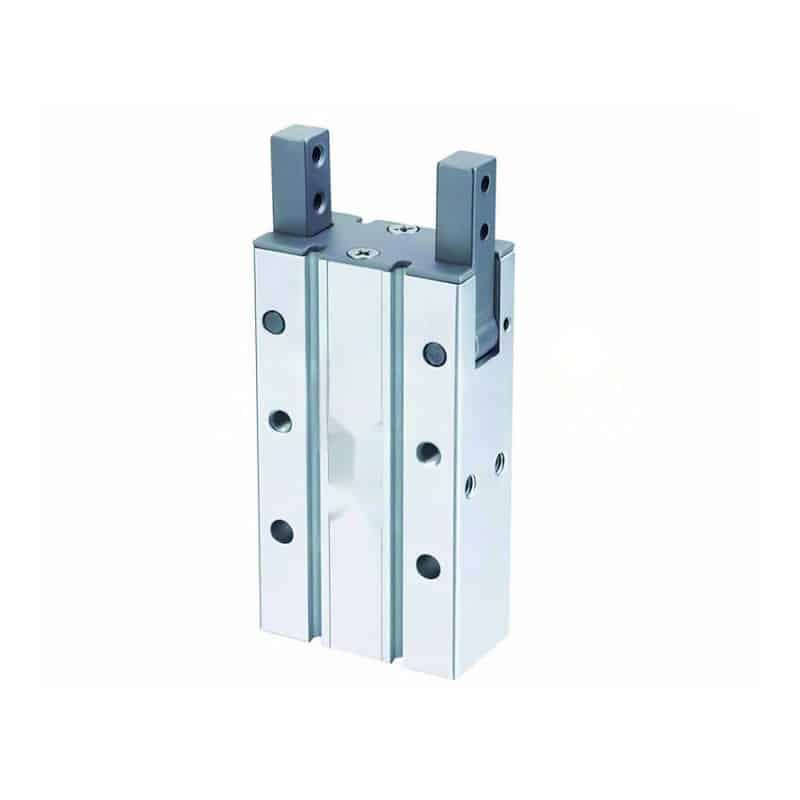
An angular gripper makes the limitation easy to see: piston travel becomes jaw rotation, so the contact force changes with mechanism geometry and finger position. A parallel gripper has a different transmission, but the same rule applies. The parallel-gripper mechanism guide explains those force definitions in more detail.
In our experience, the first line of the worksheet should identify the catalog convention, not the cylinder bore. We record whether the curve gives force per jaw or total force, whether it applies while opening or closing, its reference pressure, and the distance from the jaw datum to the contact point. This small discipline catches many otherwise invisible input errors.
How Do You Calculate Required Force Per Jaw for a Vertical Friction Grip?
NIST gives standard gravitational acceleration as 9.80665 m/s². For a symmetric vertical friction grip, the required force per load-sharing jaw follows directly from mass, upward acceleration, friction, jaw count, and the chosen safety factor (NIST Guide to the SI, accessed 2026).
Where:
| Symbol | Meaning | Unit or constraint |
|---|---|---|
| Total supported mass, including the part and anything carried with it | kg | |
| Standard gravitational acceleration | 9.80665 m/s² | |
| Worst upward acceleration relative to the gripper | m/s² | |
| Documented safety factor for the defined load case | dimensionless | |
| Conservative friction coefficient at the real interface | dimensionless | |
| Number of jaws that actually share the load | count | |
| Minimum normal contact force required from each jaw | N per jaw |
This equation is for a friction grip with the slip direction parallel to the contact surfaces. It assumes the jaws share the load. If one finger contacts first, the part is off-center, or a tolerance stack prevents equal contact, do not count every jaw as fully load-sharing.
For a 2 kg part accelerated upward at 3 m/s², with two load-sharing jaws, , and :
The selected gripper must provide at least 85.4 N per jaw at the real finger position and minimum dynamic pressure. It must also pass the separate moment, surface-pressure, and safe-state checks below.
The inverse equation estimates the mass supported by a known available force per jaw:
This result is a force-based capacity, not the gripper system’s final rated payload. The lowest permitted result from force, jaw loading, part strength, finger strength, handling-axis payload, safe-state behavior, and the machine risk assessment governs.
How Do Acceleration, Orientation, and Friction Change the Result?
SCHUNK calculates the recommended workpiece mass on the referenced PZN-plus page using a static-friction coefficient of 0.1 and a safety factor of 2 against slip under gravity. That is a transparent model-specific assumption, not a universal coefficient for every pad and workpiece (SCHUNK PZN-plus, retrieved 2026).
Acceleration belongs inside the load equation. Do not multiply the answer by a generic “dynamic derating factor” when the machine’s acceleration is known. For vertical upward motion, use . During downward deceleration, the gripper may experience the same effective direction because the part’s inertia still tends to slip relative to the fingers.
Review the complete motion profile:
- Normal production: use the highest acceleration during pick, transfer, and placement.
- Emergency stop: calculate or measure the worst credible deceleration and check whether the part can enter a safeguarded area.
- Rotation: resolve gravity and inertial acceleration into the potential slip directions at the worst orientation.
- Vibration or impact: treat uncertain peaks as a measurement and risk problem, not as permission to select an arbitrary multiplier.
Friction is often the least certain input. Surface finish, coatings, oil, coolant, dust, moisture, pad wear, temperature, contact pressure, and part-to-part variation can all change the interface. Use the lowest value demonstrated for the allowed production condition. If that value is unavailable, test representative worst-case parts rather than copying a coefficient from a generic table.
A form-fit finger that captures a shoulder, groove, bore, or edge follows a different load path. Friction may no longer be the primary retention mechanism, but the finger must then be checked for bearing stress, bending, release clearance, tolerance, and impact. Do not claim the friction equation proves a captured part is safe.
The vertical lifting cylinder guide uses the same load logic for linear axes. The gripper calculation adds a contact interface and divides the required normal force among the jaws.
Why Do Finger Length and Jaw Moments Set a Second Capacity Limit?
SMC warns that operating beyond the gripping-point range shown on its MHL2 curves can apply an excessively unbalanced load to the fingers or guide, loosen the fingers, and shorten service life. Available grip force and permitted jaw loading must therefore be checked together (SMC MHL2 catalog, retrieved 2026).
A contact force acting at a projected distance produces a jaw moment:
Here, is the relevant contact-force component and is the perpendicular distance from the manufacturer’s jaw datum to the line of action. Additional offsets can create moments about more than one axis. Use the exact coordinate system and simultaneous-load rules in the selected model’s datasheet.
The numbers are model-specific. For example, one Festo datasheet published in 2026 lists 79 N closing force per jaw at 0.6 MPa, a maximum static jaw force of 500 N, and maximum static moments of 35 N·m about each listed axis (Festo parallel-gripper datasheet, 2026). Those values illustrate why grip force and structural limits appear as separate specifications; they must not be copied to another gripper.
Use this two-column check during selection:
| Slip calculation | Structural calculation |
|---|---|
| Force available at actual grip point | Permitted finger projection |
| Required force per jaw | Finger mass and inertia |
| Conservative friction coefficient | , , and jaw loads |
| Gravity and acceleration | , , and jaw moments |
| Safety factor for the load case | Manufacturer simultaneous-load rule |
A longer finger can fail the selection twice: the force curve may show less available grip at that distance, and the same contact force creates a larger guide moment. Applying one blanket percentage to nominal grip force does not test either limit.
We found that asking for the finished finger drawing before accepting a force result prevents a second class of error. A catalog body number without the contact distance, finger mass, offsets, and fastener layout is not enough to reproduce the moment check.
How Should Minimum Pressure and Air-Loss Behavior Be Checked?
The MHL2 force charts show separate curves from 0.2 to 0.6 MPa, demonstrating that available grip force depends on pressure as well as contact distance. Select from the curve at the lowest pressure expected while the jaws are holding the moving load, not from a static gauge at the compressor (SMC MHL2 catalog, retrieved 2026).
Measure pressure close to the gripper during the worst simultaneous-demand event. During commissioning, we found that a regulator can show the normal set pressure while a restrictive valve, small tube, clogged silencer, or shared branch reduces chamber pressure during closure or transfer. The compressed-air pressure-drop guide covers the upstream diagnosis.
Do not assume grip force scales perfectly with regulator pressure unless the manufacturer’s data supports interpolation. Use the catalog curve or selection software for the exact model, direction, and grip point. Then confirm the result on the assembled machine.
Air loss is a separate state, not another term in the friction equation. A spring-assisted gripper, trapped-pressure circuit, mechanical latch, or secondary support may retain the part, but each has limits. Zimmer describes a pressure-safety valve that traps compressed air after a supply drop and maintains gripping force with spring-assisted grippers (Zimmer pressure safety valve, retrieved 2026). Leakage and finite spring force still have to be considered.
ISO 4414:2010 remains the published international standard for pneumatic-system safety and addresses significant pneumatic hazards on machinery. ISO 12100:2010 provides the wider risk-assessment and risk-reduction method, although ISO lists it as under revision in 2026 (ISO 4414, confirmed current 2021; ISO 12100, accessed 2026).
A normal industrial pneumatic gripper should never be treated as personnel-hoisting equipment. Define the safe outcome for an emergency stop, supply loss, hose failure, valve de-energization, sensor fault, gradual pressure decay, and restart. If a dropped part can reach people, guarding or a mechanically independent retention method may be necessary.
Worked Example: True Lifting Capacity
SCHUNK’s published workpiece-mass convention shows why capacity must include stated assumptions: its referenced calculation uses friction coefficient 0.1, safety factor 2, and gravity. Changing friction, acceleration, or the force definition changes the result even when the catalog grip-force number stays the same (SCHUNK PZN-plus, retrieved 2026).
For example, assume the selected manufacturer’s curve gives 120 N available per jaw at the actual 80 mm grip point and the minimum measured pressure. This is an illustrative worksheet input, not a rating for a named gripper.
| Input | Value | Evidence required |
|---|---|---|
| Available force per jaw | 120 N | Exact model curve, direction, pressure, and grip point |
| Load-sharing jaws | 2 | Finished-finger contact review |
| Minimum friction coefficient | 0.25 | Worst-condition interface test |
| Upward acceleration | 4.0 m/s² | Motion profile or measurement |
| Safety factor | 2.5 | Documented risk and design rule |
| Finger projection | 80 mm | Finished drawing and catalog datum |
The force-based mass is:
Now check the jaw moment associated with 120 N acting 80 mm from the datum:
If the exact gripper’s permitted moment or combined-load rule does not allow 9.6 N·m, the design fails even though the friction equation gives 1.74 kg. The remedy might be shorter fingers, a different contact position, lighter tooling, form-fit geometry, external guidance, or a larger gripper. It is not enough to relabel 1.74 kg as the system rating.
The final working-load limit is the lowest verified limit:
This minimum-of-limits method is the practical meaning of “true lifting capacity.” It exposes the controlling constraint instead of hiding unrelated mechanisms inside one derating percentage.
What Validation Tests Should Be Completed Before Release?
ISO 12100 requires a documented process for hazard identification, risk estimation, risk reduction, and verification across relevant machine life-cycle phases. ISO 4414 applies that safety context to pneumatic systems and components used on machinery (ISO 12100, accessed 2026; ISO 4414, confirmed current 2021).
Complete the calculation before testing, but do not stop there. Commission the assembled gripper, fingers, valve, tubing, sensors, handling axis, and real workpieces as one system.
| Validation condition | What to record | Failure indication |
|---|---|---|
| Minimum dynamic pressure | Pressure at the gripper during the worst demand event | Force or closure margin disappears |
| Worst motion profile | Acceleration, deceleration, orientation, and cycle timing | Slip, rotation, bounce, or delayed seating |
| Part variation | Minimum/maximum size, finish, contamination, and temperature | Unequal contact or lower friction |
| Finger loading | Deflection, fastener condition, jaw forces, and moments | Permanent movement, looseness, or excessive deflection |
| Fault states | Air loss, power loss, valve state, sensor fault, and restart | Uncontrolled release or hazardous motion |
| Endurance evidence | Inspection interval and acceptance limits | Declining force, wear, leakage, or jaw play |
Use the manufacturer’s specified test and maintenance procedures. A generic “150% proof test” is not a substitute for model instructions, application standards, fatigue review, or a machine risk assessment. Testing must also be arranged so a failed part cannot strike personnel or damage adjacent equipment.
Record the catalog revision, force convention, model and option code, finger drawing, grip point, minimum pressure, friction evidence, motion profile, calculation version, test results, and approved load. That record makes later finger, pad, valve, speed, and workpiece changes reviewable instead of relying on an unexplained number in a PLC comment.
For cycle-time context, link this force review with the pneumatic gripper pick-and-place guide. Faster motion changes the acceleration input and can move the application outside its previously verified envelope.
FAQ: Pneumatic Gripper Lifting Capacity
SMC reports MHL2 force as one-finger thrust, while SCHUNK’s referenced PZN-plus convention uses the sum of individual jaw forces. The five questions below prevent that definition mismatch from entering calculations and separate friction capacity from structural and air-loss checks (SMC, 2026; SCHUNK, 2026).
Can I use pressure times piston area to rate a finished pneumatic gripper?
No. Pressure times piston area gives theoretical actuator force. The gripper’s transmission, friction, opening or closing direction, finger position, and guide loading change the force available at the part. Use the manufacturer’s effective grip-force curve for the exact model, pressure, direction, and contact distance.
What friction coefficient should I use for a pneumatic gripper calculation?
Use the lowest coefficient demonstrated for the permitted production condition, including finish, oil, coolant, dust, moisture, temperature, pad wear, and part variation. SCHUNK’s referenced workpiece-weight figure uses 0.1, but that is a disclosed product-calculation assumption, not a universal value for every interface.
How many jaws belong in the lifting-capacity formula?
Count only jaws proven to share the normal load. A symmetric two-jaw grip may use , but tolerance, misalignment, off-center parts, or one finger contacting first can invalidate equal sharing. Three jaws should not automatically be counted as three equal contributors without geometry and contact verification.
Does a larger safety factor make a pneumatic gripper safe after air loss?
No. A safety factor increases the calculated force reserve for a defined load case. It does not create stored energy, stop leakage, change a valve’s fail position, or add mechanical retention. Analyze supply loss separately and verify the spring, trapped-pressure device, latch, support, guarding, and restart behavior used by the machine.
Can I use a catalog’s recommended workpiece weight as universal lifting capacity?
No. Recommended mass is valid only under its published assumptions. Confirm whether force means per jaw or total, then check friction, gravity, acceleration, finger position, pressure, moments, orientation, and safety factor. Recalculate whenever the fingers, pads, part, motion profile, supply condition, or gripper option changes.
Sources and technical references
- SMC Corporation, “MHL2 Series Parallel Type Air Gripper: Wide Type,” retrieved 2026-07-17: https://www.smcworld.com/catalog/en/rotary_airchuck/MHL2-E/6-3-p0497-0513-mhl2_en/data/6-3-p0497-0513-mhl2_en.pdf
- SCHUNK, “PZN-plus 100-2 Universal Gripper,” retrieved 2026-07-17: https://schunk.com/se/en/gripping-systems/centric-grippers/pzn-plus/pzn-plus-100-2/p/000000000000303412
- Festo, “Parallel Gripper Datasheet, product 3361480,” dated 2026-04-13 and retrieved 2026-07-17: https://ftp.festo.com/Public/PNEUMATIC/SOFTWARE_SERVICE/DataSheet/EN_GB/3361480.pdf
- Zimmer Group, “Pressure Safety Valve,” retrieved 2026-07-17: https://www.zimmer-group.com/en-us/products/components/handling-technology/2-jaw-parallel-grippers/individualizations/pressure-safety-valve
- ISO, “ISO 4414:2010 Pneumatic fluid power, General rules and safety requirements for systems and their components,” retrieved 2026-07-17: https://www.iso.org/standard/44790.html
- ISO, “ISO 12100:2010 Safety of machinery, Risk assessment and risk reduction,” retrieved 2026-07-17: https://www.iso.org/standard/51528.html
- NIST, “Guide to the SI, Appendix B.9,” retrieved 2026-07-17: https://www.nist.gov/pml/special-publication-811/nist-guide-si-appendix-b-conversion-factors/nist-guide-si-appendix-b9
- SMC Corporation of America, “JMHZ2 UR Certified Air Gripper” video, retrieved 2026-07-17: https://www.youtube.com/watch?v=7EqDNHlctUk