

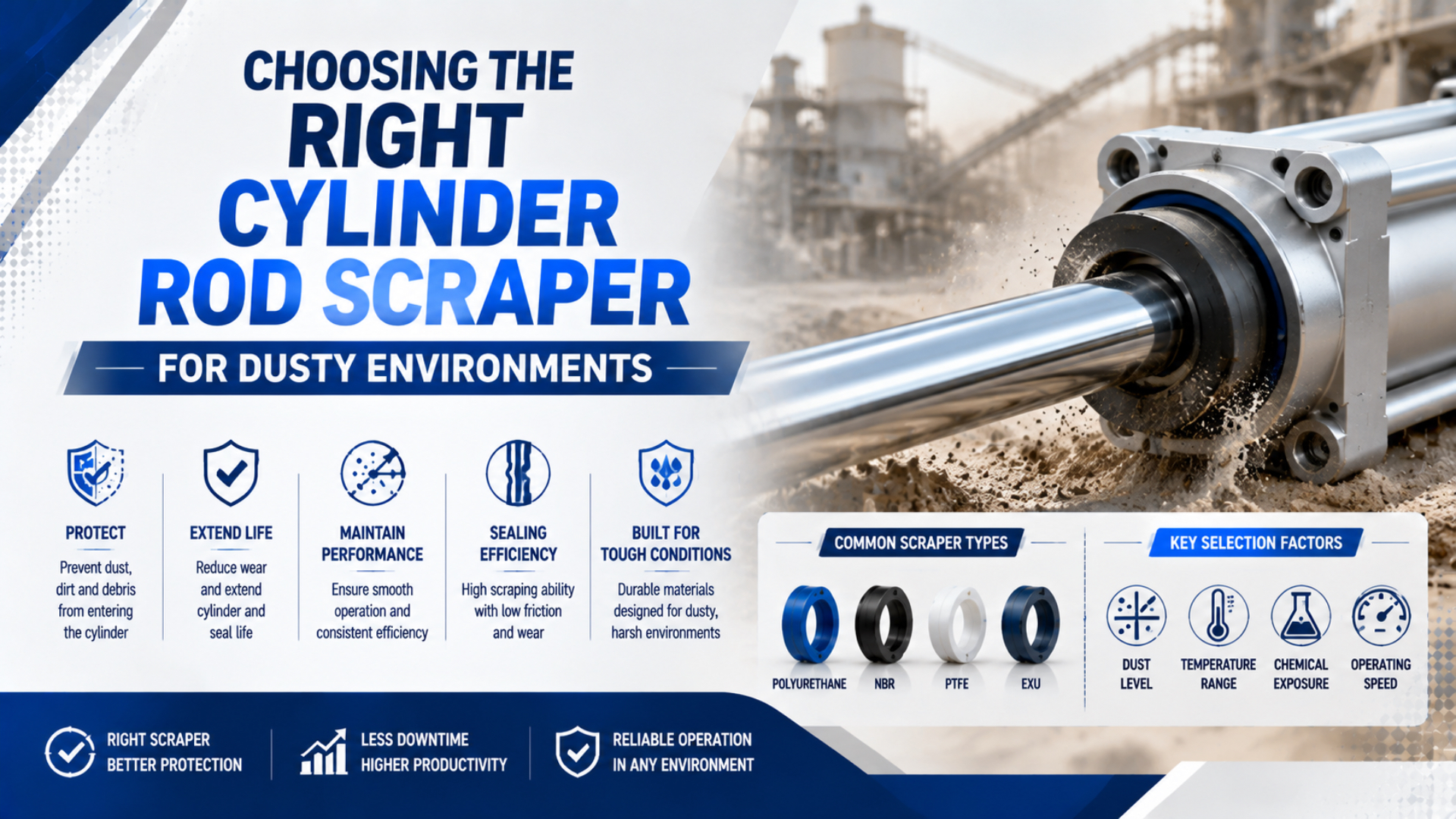
Choose a cylinder rod scraper by matching a documented wiper profile to the actual contaminant, rod and housing. Particle size alone is not enough. Moisture, shape, hardness, adhesion, exposure direction, rod finish, speed, lubricant and installation dimensions can change whether a scraper excludes debris or turns trapped material into an abrasive contact.
A label is only a starting point; approval needs the exact profile, compound and test conditions.
Key Takeaways
- SMC qualifies one dust-resistant option for 20 to 100 μm powder and explicitly excludes weld spatter.
- ISO 6195 standardizes selected wiper housings, not cross-brand scraper performance.
- Match the complete profile and compound, not a material name alone.
- Replace scrapers from condition and model instructions, not a universal cycle count.
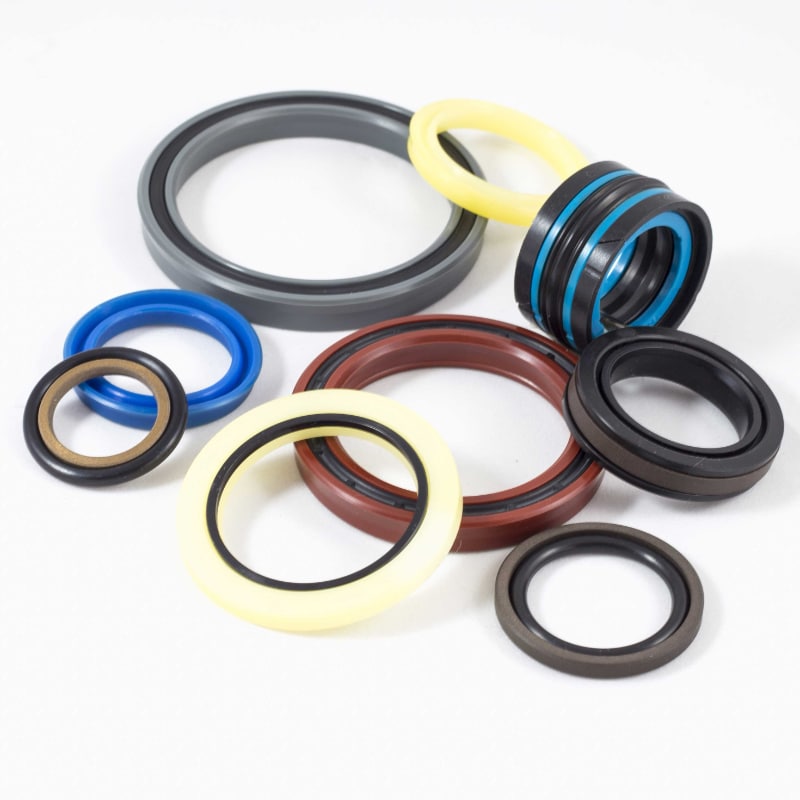
Similar-looking rings may perform different functions. Confirm the section drawing before substitution.
What Should You Identify Before Choosing a Cylinder Rod Scraper?
Start with the contaminant and exposure mechanism, not the scraper material. SMC qualifies its XC4 dust-resistant cylinder option for powder particles from 20 to 100 μm and excludes weld spatter, showing that even a heavy-duty scraper has a defined challenge rather than universal dust protection (SMC XC4, accessed 2026).
Record what reaches the rod during production, cleaning and shutdown; dry powder behaves differently from damp cement or sharp chips. One machine may face several exposures during a shift.
Use these contaminant groups as an investigation guide:
| Observed exposure | Primary concern | Evidence to collect before selection |
|---|---|---|
| Fine dry powder | Transport under a thin rod film or through an imperfect lip contact | Particle-size distribution, exposure direction, concentration and ingress evidence |
| Abrasive grit or chips | Lip cutting, rod scoring and debris trapped at the contact | Particle shape, hardness, chip dimensions, rod coating and post-run inspection |
| Damp or sticky dust | Buildup that lifts the lip or blocks debris escape | Moisture source, adhesion, approved cleaner and drainage path |
| Coolant or chemically contaminated dust | Compound swelling, hardening or lubricant loss | Chemical identity, concentration, temperature and exposure duration |
| Weld spatter or hot particles | Thermal and impact damage beyond ordinary powder exclusion | Particle temperature, impact path, guard design and a specifically qualified product |
External dust also needs to be separated from supply-air contamination. Dirt concentrated on the outside of the wiper points toward the machine environment, while residue across several devices on one branch suggests an internal air-quality problem. The dusty-factory contamination-control guide explains how to investigate those paths separately.
Instead of asking which material is hardest, ask how the contaminant crosses the boundary; map residue at full extension and after retraction before cleaning, then compare the exposed rod with material recovered behind the wiper. A one-sided plume suggests a different corrective action from full-circumference contamination; sample moist deposits separately, preserve representative debris when composition is uncertain, distinguish an airborne challenge from material deposited during dwell, note whether washdown or condensation changes adhesion, record the process event and cylinder position associated with each observation, and turn the observed path into testable requirements for profile geometry, compound compatibility, guarding and ingress validation.
Which Scraper Profile Fits the Contaminant?
ISO 6195:2021 covers wiper-ring housings for rod diameters from 4 to 450 mm, but it does not give one profile a universal exclusion rating. Profile selection still depends on the retention method, wiping edge, rod contact, lubricant transport and the contaminant challenge (ISO 6195, accessed 2026).
A single-acting wiper normally removes contamination as the rod retracts; combined profiles may also retain pressure. Rigid reinforcement can retain a profile in an open housing, but it does not prove resistance to impact or hot spatter.
Compare profiles by function:
- Wiping edge: Declared debris.
- Housing retention: Is the profile held by an undercut, cover, press fit or rigid reinforcement?
- Outer-diameter sealing: Can moisture or contamination bypass the profile around its housing?
- Lubricant transport: Determine whether the lip retains the rod film required by the selected cylinder or strips enough lubricant to change drag and wear.
- Pressure behavior: Is pressure allowed behind the wiper, vented, or prohibited by the product design?
- Debris escape: Can removed material leave the contact zone without packing against the lip?
More lips are not automatically better. Additional contact can alter exclusion, drag and lubricant transport, so the comparison belongs in supplier test data. The wiper-ring exclusion and rod-drag guide explains how to separate wiper drag from total cylinder friction.
Reduce bulk exposure before asking the scraper to handle every particle. For example, a guard may intercept a plume, while a rod boot can block deposited debris if its stroke and compressed length are suitable. Check the rod-boot compression-ratio guide before adding a bellows.
How Should Rod Scraper Material Be Selected?
Material limits belong to a named compound and profile. Parker rates its pneumatic A2 wiper up to 2 m/s with several NBR, FKM and polyurethane compounds, while Trelleborg lists its polyurethane AWSW scraper up to 1 m/s and from -40°C to +80°C (Parker A2; Trelleborg AWSW, accessed 2026).
Those figures make a generic material table unsafe: polyurethane does not identify a formulation or approved medium, while PTFE does not define its filler or energizer. Shore hardness alone cannot predict complete lip behavior.
Build the material review around the real failure mechanisms:
| Selection question | Why it matters | Required evidence |
|---|---|---|
| Will the compound swell, shrink or harden? | Chemical change alters contact and retention | Compatibility data for the exact contaminant, cleaner and lubricant |
| Can the lip tolerate the surface speed and duty? | Repeated sliding produces heat and wear | Profile-specific speed, temperature and duty limits |
| Will moisture attack the compound or housing? | Water can cause hydrolysis, corrosion or trapped contamination | Humidity, washdown and drainage limits |
| Does the profile require initial grease? | Dry assembly can damage the lip or disrupt intended film control | Approved grease, quantity and assembly procedure |
| Is the rod coating compatible with the contact? | Roughness, coating damage and embedded debris affect both surfaces | Rod material, coating, finish and inspection criteria |
Parker requires initial lubrication for its A2 wiper, and Trelleborg specifies initial grease for AWSW in oil-free air. Follow both the cylinder and wiper instructions; confirm that cleaners will not remove or contaminate the required film.
What Must Match Before You Replace the Existing Scraper?
ISO 6195 spans 4 to 450 mm rod diameters and standardizes selected housing dimensions and tolerances, not complete replacement interchangeability. Two cylinders can share an external mounting standard yet use different internal grooves, wiper profiles, seal stacks and installation methods (ISO 6195, accessed 2026).
Start with the complete cylinder identity:
- Cylinder identity.
- Bore, stroke, rod diameter and rod-end configuration.
- Original wiper or seal-kit part number.
- Measured groove diameter, width, depth, lead-in geometry and retention method compared with the proposed profile drawing and its tolerances.
- Wiper section drawing and installed orientation.
- Rod material, coating, surface-finish requirement and hardness.
- Operating speed, pressure, temperature, orientation and cycle profile.
Rod diameter alone cannot approve a replacement. A ring may pass over the rod yet be loose in the housing or unable to retain lubricant; consult the industrial cylinder seal-types guide before replacing a combined pressure seal and wiper.
Dimensional and functional fit are separate approvals: record the removed profile before measurement changes it, compare its section with the proposed drawing, and identify the rod-contact and housing-retention features. Next review lubrication, chemical resistance and allowable speed; include the groove lead-in, outer-diameter sealing path, any permitted pressure behind the wiper, rod runout and the function of adjacent seals, then use a sample installation to confirm seating and orientation while reserving dust-exclusion approval for an operating challenge with a declared contaminant, exposure method, duration and inspection boundary, or the neatly installed part may still fail in service.
Rod and Scraper Inspection Before Installation
Parker permits up to 2 m/s for the A2 wiper but still requires suitable compound selection and initial lubrication. A speed rating therefore cannot approve installation on a scored rod, damaged groove or incompatible grease; the complete interface must meet the selected product instructions (Parker A2, accessed 2026).
Before disassembly, isolate pressure and stored mechanical energy. Record the cylinder orientation, rod position and the clock position of any one-sided wear. Photograph deposits before cleaning because the track can help distinguish external ingress from misalignment, side loading or a localized rod defect.
Inspect four areas:
- Rod: Inspect the complete contact track.
- Wiper: Check for cuts, hardening, swelling, permanent deformation, a lifted edge and loss of housing retention.
- Housing: Record burrs, corrosion, packed debris and damage, then confirm any required pressure-relief or vent path remains open.
- Seal stack and guide: Determine whether rod-seal leakage, guide wear, side load or misalignment is loading or pressurizing the wiper rather than treating every mark as a scraper failure.
Use the exact product’s surface-finish and damage limits; a universal Ra value cannot classify every scratch. Compare the measured rod with the manufacturer requirement and repair it when the stated limit is exceeded.
During installation, remove sharp edges and burrs without changing the groove geometry. Use the specified installation tool and protect the lip from threads, keyways and sharp rod ends. Apply only the approved assembly lubricant. Confirm orientation before pressing the profile into place, then verify that it is fully seated and not twisted.
Test first at controlled speed and pressure, checking motion, leakage, wiper retention and lubricant film. A new wiper cannot correct a bent rod or worn guide; use the dynamic-versus-static cylinder seal guide if friction changes after service.
When Should a Cylinder Rod Scraper Be Replaced?
ISO 19973-3 reports pneumatic cylinder reliability in cycles or kilometres under declared test conditions; it does not prescribe a universal scraper replacement interval. Maintenance should therefore combine manufacturer instructions, observed condition, machine risk and service history rather than using one cycle or calendar limit for every application (ISO 19973-3, accessed 2026).
Replace the scraper when inspection shows lost function, such as a cut edge, deformation, swelling, hardening, loose retention or contamination beyond the accepted boundary. Rising drag or leakage requires a wider investigation because the guide and pressure seal may also be involved.
Build a condition record:
| Record | What to trend | Selection consequence |
|---|---|---|
| External exposure | Contaminant type, deposition location, moisture and cleaning events | Confirms whether the challenge has changed |
| Wiper condition | Edge damage, contact track, retention and embedded debris | Shows whether the profile still performs its exclusion function |
| Rod condition | Scratches, coating loss, corrosion and position of damage | Identifies whether a new wiper needs rod repair first |
| Motion behavior | Breakaway, running drag, speed stability and position-dependent force | Separates contact problems from flow or guide problems |
| Internal evidence | Material behind the wiper, rod-seal leakage and guide wear | Indicates whether contamination crossed the boundary |
Set inspection frequency from the rate of change. Start with shorter intervals after commissioning, then extend them only when exposure, wiper condition, rod condition and motion remain stable. Identical rod diameters do not justify identical maintenance calendars.
A Defensible Rod Scraper Selection Record
SMC’s XC4 evidence applies to 20 to 100 μm powders and excludes weld spatter, while ISO 6195 covers housing dimensions rather than performance. A defensible selection record must therefore connect the actual contaminant to an exact profile, compound, groove and validation method instead of relying on a heavy-duty label (SMC; ISO, accessed 2026).
The final record should contain:
- Cylinder identity.
- Original and proposed wiper part numbers with section drawings.
- Contaminant description, particle range, moisture, chemistry and exposure direction.
- Rod material, coating, hardness and finish requirement together with the inspection instrument, sampling positions, recorded values and disposition of any scratch, corrosion or coating defect.
- Groove dimensions, retention method, orientation and installation procedure.
- Speed, pressure, temperature, duty and lubricant policy.
- Supplier validation conditions plus accepted ingress, drag, leakage and wear limits.
- Initial inspection interval and the evidence required to extend it.
A useful RFQ separates catalog envelope from application proof: operating limits define where the profile may run, while a named contamination test shows what it excluded. Neither substitutes for the groove drawing or installed validation; attach the cylinder revision and removed-part identification; provide the contaminant source and physical form; describe how material reaches the rod during motion and dwell; state the speed and temperature at the seal; identify every cleaner and lubricant; request the supplier’s challenge material, particle range, exposure method, test duration and inspection boundary; define acceptable ingress, drag, leakage and wear before the test begins; retain the approved part number and evidence with the machine maintenance record so a later replacement is checked against the same functional requirement during repeat ordering and future failure investigations.
Cylinder Rod Scraper FAQs
ISO 6195 covers wiper housings for 4 to 450 mm rods, while ISO 19973-3 reports cylinder life under declared conditions in cycles or kilometres. These standards support dimensional and reliability evidence, but neither creates a universal scraper type, interchangeability rule or maintenance interval (ISO 6195; ISO 19973-3, accessed 2026).
Is a rod scraper the same as a rod seal?
Usually not. A scraper or wiper removes outside contamination from the retracting rod, while the rod pressure seal retains compressed air. Combined seal-and-wiper profiles also exist. Identify the section drawing and part number before diagnosing leakage or substituting parts because one ring may perform both functions in a specific cylinder.
Does a double-lip scraper always exclude fine dust better?
No. An additional lip changes contact, lubricant transport, drag and debris storage, but its benefit depends on the complete profile and test conditions. Ask for the contaminant, particle range, rod, groove, speed, cycles and ingress result. A double-lip label alone cannot prove better exclusion in the installed application.
Can ISO 6195 prove that scrapers from different brands are interchangeable?
No. ISO 6195 standardizes selected wiper-ring housing dimensions and tolerances. It does not make every profile, compound, rod finish, retention method or seal-stack function identical. Verify the cylinder revision, original part number, groove drawing, rod specification and replacement profile before approving a cross-brand substitution.
Should a rod boot replace a heavy-duty scraper?
Not automatically. A boot can reduce bulk contamination reaching the rod, but it introduces compressed-length, extension, speed, temperature, drainage and inspection requirements. The scraper still controls the rod interface on many designs. Use both only when the cylinder and boot suppliers approve the combined arrangement for the full stroke and environment.
How often should a cylinder rod scraper be replaced?
Use manufacturer instructions, condition evidence, machine risk and service history rather than a universal cycle count; replace a scraper that is cut, swollen, deformed, loose or no longer excluding the declared contaminant. Investigate the rod, guide and pressure seal when drag or leakage changes at the same time.
Sources and technical references
- ISO 6195:2021, cylinder-rod wiper-ring housing dimensions and tolerances.
- ISO 19973-3:2015, pneumatic piston-rod cylinder reliability testing and reporting.
- SMC XC4 Dust-Resistant Cylinder, product-specific powder range and heavy-duty scraper evidence.
- Parker Pneumatic Seals Catalog, A2 pneumatic wiper compounds, speed and installation guidance.
- Trelleborg Pneumatic Seals Catalog, AWSW scraper profile, compound and operating limits.