

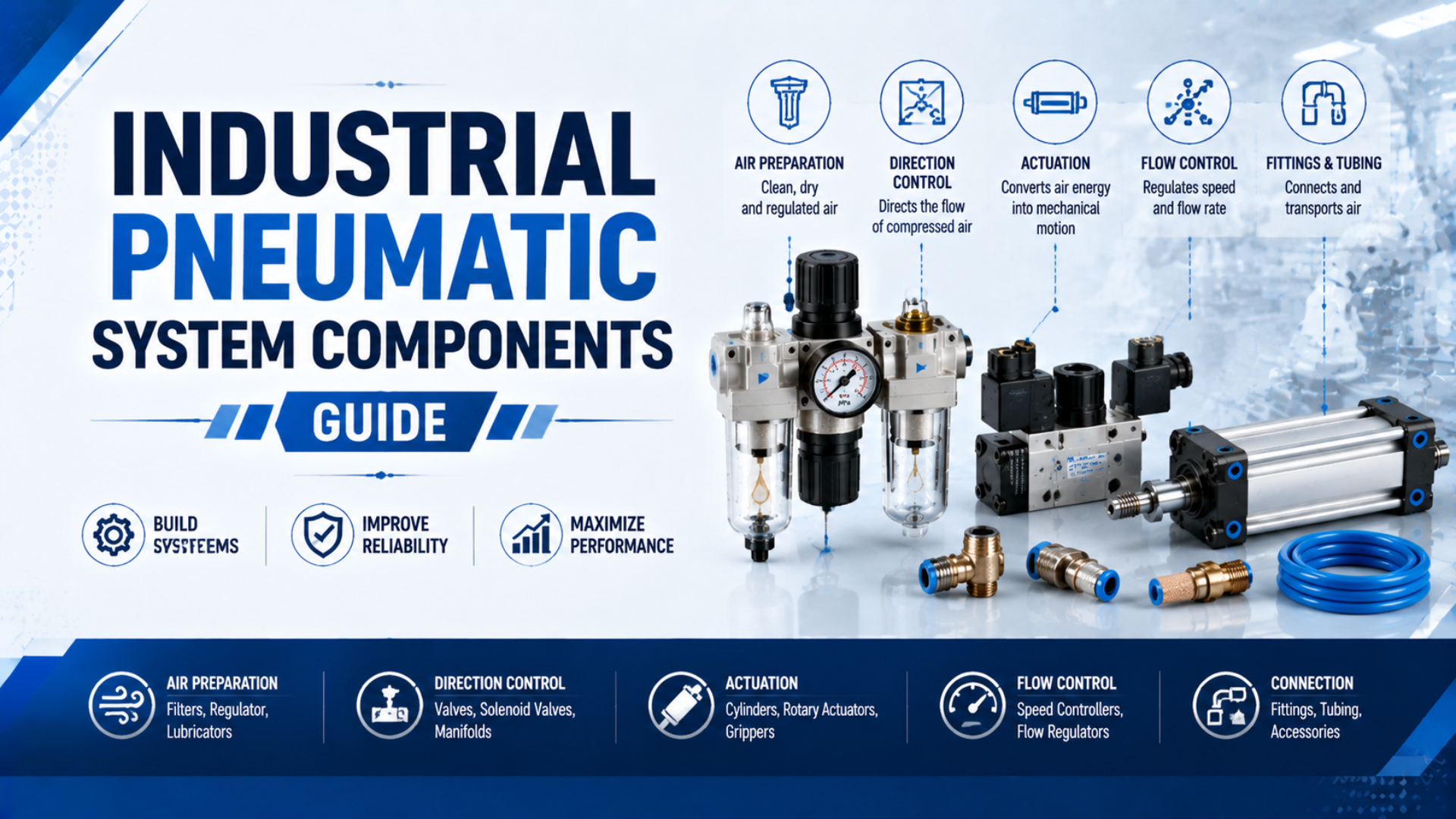
Industrial pneumatic system components are the hardware that prepares compressed air, controls its pressure and flow, converts it into motion, and reports machine state. A useful component map separates the plant compressed-air supply from the pneumatic equipment installed on an individual machine. That boundary makes sizing, troubleshooting, safety review, and purchasing much clearer.
The chain is only as capable as its most restrictive or least controlled interface. A correctly sized cylinder can still move slowly when the valve, tubing, fitting, or exhaust path is restrictive. A clean air supply can still create a hazard when stored energy, unexpected movement, or an unsuitable control architecture hasn’t been addressed.
Key Takeaways
- ISO 8573-1 separates air purity into particle, water, and oil classes.
- Plant-air equipment and machine pneumatics have different design boundaries.
- Valves, conductors, actuators, sensors, and exhaust must be sized as one path.
- A replacement needs interface evidence, not a matching catalog description.
In this guide
- Functional Layers of an Industrial Pneumatic System
- Air Preparation Needs a Purity and Pressure Specification
- How Do Directional, Flow, and Pressure Valves Divide Responsibilities?
- Which Actuator Matches the Motion and Load?
- Conductors and Exhaust Complete the Flow Path
- How Should Sensors and Machine Control Be Integrated?
- The Component Selection Data Set
- How Do You Diagnose a Pneumatic System by Layer?
- What Belongs in a Pneumatic Component RFQ?
- Industrial Pneumatic System FAQs
Functional Layers of an Industrial Pneumatic System
ISO 4414:2010 applies to pneumatic systems used on machinery, but explicitly excludes compressors, factory distribution, gas bottles, and receivers. That creates two practical engineering boundaries: the plant compressed-air supply and the machine pneumatic circuit. Both matter, yet each has different owners, measurements, and acceptance criteria (ISO 4414:2010).
That distinction changes the questions.
The plant side generates, stores, treats, and distributes compressed air. It can include compressors, aftercoolers, separators, dryers, receivers, main headers, drains, and plant-level monitoring. The machine side begins at a defined connection and includes isolation, point-of-use preparation, pressure control, valves, conductors, actuators, sensors, exhaust treatment, and control logic.
This boundary doesn’t mean the two sides can be designed independently. The plant connection must provide the machine’s required flow at an acceptable pressure and air-quality class under peak demand. The machine must not rely on an assumed header pressure that disappears when neighboring equipment cycles.
At the machine inlet, define the connection, minimum dynamic pressure, maximum pressure, required flow, air purity, isolation method, residual-pressure behavior, and measurement point. Those values create a contract between facilities and machine engineering.
In system reviews, I found that assigning each requirement to an interface owner prevents a common diagnostic loop. Facilities can prove what reaches the machine boundary. Machine engineering can then prove what the valve and actuator receive. Without that split, both teams may measure a different pressure and conclude that the other side is at fault.
For a deeper plant-side treatment, see How Proper Compressed-Air System Design Improves Industrial Efficiency.
Air Preparation Needs a Purity and Pressure Specification
ISO 8573-1 defines three primary compressed-air purity dimensions: particles, water, and oil. A filter-regulator-lubricator label doesn’t state the achieved class for any of them. Select each treatment stage from the required point-of-use purity, inlet conditions, flow, pressure drop, drain method, and maintenance plan (ISO 8573-1:2010).
A particulate filter removes solids and some bulk liquid according to its documented grade and efficiency. A coalescing filter targets fine liquid aerosols and must be selected with the required upstream protection and downstream air-quality target. A dryer controls water vapor and pressure dew point. Those functions aren’t interchangeable. A regulator reduces and stabilizes downstream pressure within its flow characteristics. ISO 6953-1:2024 identifies supplier-literature requirements for compressed-air regulators and filter-regulators. Its scope reaches rated inlet pressure up to 2,500 kPa for regulators and up to 1,600 kPa for filter-regulators, but an actual product may have lower limits (ISO 6953-1:2024).
Check more than the adjustment range:
- inlet and outlet pressure limits;
- relieving or non-relieving behavior;
- flow at the required outlet pressure;
- pressure drop and regulator droop;
- filter grade and documented efficiency;
- bowl, seal, and drain compatibility;
- ambient and media temperature;
- access for element and bowl service.
Lubrication is an application decision, not an automatic FRL stage. Many current pneumatic components are factory lubricated for life. One SMC cylinder instruction states that its non-lube type can operate without additional lubrication and that lubrication must continue once it has been started because new oil displaces the original lubricant (SMC cylinder lubrication guidance).
That instruction is product-specific, but the selection lesson is general. Check every downstream component before adding a lubricator. Oil mist can be unsuitable for clean processes, measurement devices, some seal systems, and exhaust environments.
Should treatment be centralized or installed at the point of use? It depends on contaminant sources, pressure-drop budget, branch duty, service ownership, and the required purity at the machine. The centralized versus point-of-use regulator guide develops that comparison.
How Do Directional, Flow, and Pressure Valves Divide Responsibilities?
A 5/2 directional valve has five ports and two switching positions; a 5/3 valve adds a third state. Those numbers describe port and position count, not the center function, flow capacity, actuation method, or safety performance. ISO 1219-1 supplies the symbol rules used to document the actual function (ISO 1219-1:2012).
Directional valves connect and block flow paths. A 3/2 valve often controls a single-acting actuator, pilot signal, or blow-off function. A 5/2 valve commonly reverses a double-acting actuator. A 5/3 valve can have closed, exhaust, or pressure center behavior, but the complete symbol and manufacturer data must define which one. Don’t treat a center condition as a guaranteed mechanical brake. Air is compressible, valves and actuators have leakage, and external loads can move the mechanism. If a stopped load can create a hazard, specify the safety function, load-holding method, fault response, and validation separately. A stopped spool is not a brake.
Flow-control valves set restriction, usually to manage actuator speed. Meter-out control is common for double-acting cylinders because it restrains exhaust flow and can give more stable motion. Meter-in control suits selected loads and circuits, but it can allow an overrunning load to accelerate. The load direction and failure behavior decide the arrangement.
Pressure-control components have different jobs:
| Component | Primary function | Selection question |
|---|---|---|
| Pressure regulator | Reduce and stabilize downstream pressure | What flow and droop are acceptable at the load? |
| Relief valve | Limit pressure by exhausting above a set condition | What relieving capacity and response are required? |
| Pressure-reducing valve | Maintain a lower branch pressure | How will upstream and downstream variation affect it? |
| Soft-start or dump valve | Control pressurization or release stored pneumatic energy | What restart and residual-pressure behavior is safe? |
| Check valve | Permit flow in one direction | Is trapped pressure intended and how is it released? |
| Pilot-operated check valve | Hold a branch until pilot release | What leakage, pilot ratio, and load behavior apply? |
A valve’s port thread doesn’t establish its useful flow. Compare the manufacturer’s flow or sonic-conductance data at the actual pressure conditions, then include fittings, manifolds, silencers, and tubing in the same pressure-drop review. The Cv and valve-flow guide explains why a coefficient must travel with its pressure and gas-flow assumptions.
Valve islands reduce individual wiring and supply connections, but they also create shared supply and exhaust paths. Confirm simultaneous demand, common exhaust capacity, fieldbus behavior, manual overrides, diagnostics, fault isolation, and replacement strategy. For the switching mechanism itself, see How Solenoid Valves Work in Pneumatic Control Systems.
Which Actuator Matches the Motion and Load?
ISO 6432 covers single-rod cylinders from 8 to 25 mm bore, while ISO 15552 covers detachable-mount cylinders from 32 to 320 mm bore. Both are 1,000 kPa, or 10 bar, dimensional series. These standards support defined interfaces; they don’t select the actuator or guarantee cross-brand functional equivalence (ISO 6432; ISO 15552).
Start with the required motion, not the familiar product family:
Force alone is not enough.
| Motion task | Candidate actuator | Checks that decide suitability |
|---|---|---|
| Linear push or pull | Rod cylinder | force, stroke, rod loading, mounting, cushioning |
| Long linear travel in limited space | Rodless cylinder | carriage load, guide moments, sealing concept, support spacing |
| Guided linear motion | Guided cylinder or pneumatic slide | allowable forces and moments, guide life, deflection |
| Limited-angle rotation | Vane or rack-and-pinion rotary actuator | torque, angle, inertia, backlash, end-stop energy |
| Pick and place | Parallel or angular gripper | grip force, jaw geometry, friction, moment, part variation |
| Flexible or compliant motion | Bellows or air muscle in suitable applications | force curve, control range, fatigue, restraint |
A standard rod cylinder transmits axial force through its rod. Side loading creates seal, bearing, rod, and alignment problems, so an external guide may be required. Long compression strokes also need a rod-buckling check. A nominal bore and stroke don’t establish either condition. A rodless cylinder packages travel more efficiently because it has no extending piston rod. That doesn’t make every rodless product suitable for side load. Basic mechanically coupled and magnetically coupled designs can require external guidance. Guided versions publish their own allowable load and moment diagrams.
The decision between rod and rodless architectures is developed in Rodless vs. Standard Cylinders. For the operating mechanism, see What Is a Rodless Cylinder?.
Rotary actuators and grippers also need dynamic checks. Static torque or grip force is only the starting point. Review inertia, angular acceleration, stop energy, pressure at the actuator, external moments, jaw length, friction variation, loss-of-pressure behavior, and cycle life.
When I compare actuator options, I found that the mounting and load path eliminate more candidates than nominal force does. A product can meet the calculated force and still fail the application because the machine applies an unapproved moment, the guide is undersized, or the load becomes uncontrolled after pressure loss.
Use the Pneumatic Cylinder Force Calculator for a preliminary push and pull check. It doesn’t replace the manufacturer’s load, buckling, cushioning, or mounting limits.
Conductors and Exhaust Complete the Flow Path
The U.S. Department of Energy reports that leaks can waste 20-30% of a compressor’s output in poorly maintained compressed-air systems. Fittings and tubing therefore affect more than installation convenience. Their leakage, internal diameter, length, bends, and restrictions influence energy use, dynamic pressure, actuator speed, and repeatability (DOE compressed-air sourcebook).
Size conductors from peak branch flow and the permitted pressure loss, not from cylinder port size alone. A large cylinder port connected through a long small-bore tube still has limited flow. Push-in fittings can have internal passages smaller than the tube’s nominal outside diameter.
Check these interfaces as one path:
- valve outlet and manifold gallery;
- fitting minimum internal passage;
- tube or hose inside diameter;
- total length and number of bends;
- flow-control and check-valve restriction;
- actuator port and internal cushioning path;
- exhaust fitting, silencer, and shared exhaust manifold.
Exhaust restriction is easy to miss. A silencer contaminated with oil or dust can raise back pressure and slow an actuator even when inlet pressure looks normal. A shared valve-island exhaust can also become restrictive when several cylinders move together.
Exhaust is part of the circuit.
Material selection needs actual environment and compatibility data. Polyurethane tubing is flexible and suits many moving installations. Nylon can offer different pressure, temperature, chemical, and moisture characteristics. Stainless fittings may help in corrosive or washdown environments, but thread, seal, tube, and enclosure requirements still need independent verification.
Routing matters. Protect tubes from abrasion, sharp bends, heat, weld spatter, chemical exposure, and uncontrolled movement. Provide strain relief near moving axes and enough service access to replace a fitting without disturbing unrelated circuits.
For line sizing, the Compressed Air Pressure Drop Calculator can compare tube diameter, length, flow, and inlet pressure. Confirm the final selection with component data and a dynamic pressure measurement at the machine.
How Should Sensors and Machine Control Be Integrated?
Safety-related sensing and machine control require more than ordinary component signals. ISO 13849-1:2023 applies to high-demand and continuous-mode systems across electrical, pneumatic, hydraulic, mechanical, and software technologies. A cylinder switch doesn’t become a safety device merely because the PLC reads it; the complete safety function needs a defined architecture and validation (ISO 13849-1:2023).
A signal is evidence, not certainty.
Ordinary cylinder switches provide position evidence for sequence control. They can confirm that a piston entered a sensing zone, but they don’t directly prove load position, clamp force, valve state, or safe isolation. Mechanical play, magnet position, switch hysteresis, mounting movement, wiring faults, and overtravel all affect what the signal means. Pressure switches and transducers answer another question: what pressure exists at the measurement point? They don’t prove usable flow. A branch may show adequate static pressure and still collapse dynamically when a valve opens. Place sensors where their reading can distinguish plant supply, regulated machine pressure, actuator-port pressure, and trapped pressure.
For each signal, define:
- measured condition and physical location;
- normal and fault ranges;
- switching point, hysteresis, and response time;
- electrical output, connector, and diagnostic coverage;
- reaction to open circuit, short circuit, and loss of supply;
- commissioning and proof-test method;
- whether the function is operational, quality-related, or safety-related.
The PLC sequence should match the pneumatic state model. Account for valve switching time, pressure buildup, actuator travel, workpiece variation, and sensor delay. Avoid timers that mask a slow or leaking circuit. A timeout should create a diagnostic event with enough context to locate the failed layer.
Safety-related functions need a risk assessment and the appropriate machinery standard. Examples can include prevention of unexpected startup, controlled energy isolation, load holding, pressure monitoring, and safe exhaust. Component selection follows the required function; a familiar valve or dual sensor arrangement isn’t evidence of achieved performance.
The Component Selection Data Set
A complete component data set extends beyond four catalog fields. ISO 4414 addresses system design, construction, modification, installation, adjustment, operation, maintenance, cleaning, reliability, energy efficiency, and environmental concerns. That breadth means the engineering input must cover duty, interfaces, hazards, environment, commissioning, and service (ISO 4414:2010).
Collect the operating profile before choosing part numbers:
| Input group | Required data | Why it changes selection |
|---|---|---|
| Motion and load | force, mass, direction, stroke, speed, acceleration, moments | sets actuator architecture and dynamic limits |
| Pressure and flow | minimum dynamic inlet pressure, maximum pressure, peak flow, simultaneous demand | sizes preparation, valves, manifolds, and conductors |
| Cycle | cycles per minute, dwell, continuous time, expected life | affects heat, wear, cushioning, and reliability |
| Air quality | particle, water, oil class at the point of use | selects dryer, filter, coalescer, and materials |
| Environment | temperature, washdown, corrosion, dust, cleanroom, explosive atmosphere | changes seals, housing, ingress protection, approvals |
| Control | voltage, logic, fieldbus, response, diagnostics | selects valves, switches, connectors, and architecture |
| Safety | hazards, safe state, stored energy, restart behavior, required validation | defines isolation, dump, holding, monitoring, and control |
| Interfaces | mounting, ports, tube, cable, envelope, service clearance | determines physical interchange and maintainability |
Use minimum dynamic pressure, not only the regulator’s unloaded gauge reading. Record pressure during the highest-flow machine state. Do the same for cycle time, temperature, and voltage when several outputs switch together. Air consumption is relevant to compressor and energy planning, but it doesn’t select every component by itself. Peak flow controls transient pressure loss and motion speed. Average consumption controls longer-term capacity and operating cost. Keep those two quantities separate.
Environmental labels need evidence. “Food grade,” “cleanroom,” “outdoor,” and “high temperature” are not complete specifications. Name the applicable material, lubricant, emissions, corrosion, washdown, ingress, temperature, chemical, and regulatory requirements.
In procurement reviews, I found that one missing machine state causes more ambiguity than one missing nominal dimension. The RFQ may list pressure, bore, and stroke yet omit that three axes move simultaneously. That missing state changes valve, manifold, tubing, and plant-flow requirements at once.
How Do You Diagnose a Pneumatic System by Layer?
DOE guidance says a well-maintained compressed-air system should target leakage below 10%, while poorly maintained systems may lose 20-30% of air capacity. Leak repair matters, but troubleshooting must also separate supply, treatment, control, conductors, actuation, sensing, and exhaust so one symptom isn’t mistaken for another (DOE compressed-air sourcebook).
Start with a repeatable failing machine state. Record the product, load, cycle step, commanded outputs, sensor states, regulator setting, and ambient conditions. A random check during idle may hide the pressure or exhaust problem that appears only under simultaneous demand.
Use this sequence:
-
Verify the plant-to-machine boundary. Measure dynamic inlet pressure while the failing motion occurs. Compare it with the agreed minimum and observe neighboring demand.
-
Check preparation and regulation. Inspect differential pressure, filter condition, drains, regulator droop, pressure dew point where relevant, and evidence of oil or water.
-
Confirm the command and valve state. Verify voltage at the coil, connector condition, manual-override position, pilot pressure, spool response, and PLC command.
-
Measure pressure near the actuator. Compare both ports during motion. A large loss between valve and actuator points to the conductors, controls, or fittings.
-
Inspect exhaust. Test for a restricted silencer, shared exhaust bottleneck, frozen exhaust, or an unsuitable flow-control setting.
-
Separate load from pneumatic performance. Disconnect or safely unload the mechanism when permitted. Check alignment, guides, binding, cushion adjustment, and external forces.
-
Validate sensing and timing. Confirm physical position, switch zone, wiring, signal timing, and timeout logic. Don’t assume a PLC bit proves the commanded movement occurred.
What if supply pressure is correct at idle but drops during motion? The system has a dynamic flow problem, not simply a regulator-setting problem. Possible causes include inadequate plant supply, an undersized machine inlet, filter loading, regulator droop, small tubing, restrictive valves, shared manifold demand, or excessive leakage.
Build a baseline after commissioning. Record machine-inlet pressure, regulated pressure, actuator-port pressures for critical axes, representative cycle times, leakage test conditions, and filter status. Later troubleshooting becomes a comparison against a known good state rather than a search for a universal “normal” value.
What Belongs in a Pneumatic Component RFQ?
Standards-based cylinders still need a product-specific comparison. ISO 15552 standardizes mounting-related dimensions for 32-320 mm cylinders at a maximum rated pressure of 10 bar, yet it doesn’t define every port, seal, sensor, cushion, material, or performance option. A replacement RFQ must verify both interface and function (ISO 15552:2018).
Include the complete installed identity:
- manufacturer, full part number, series, and catalog revision;
- nameplate and installation photographs;
- controlled drawing and critical measured dimensions;
- mounting, rod or carriage, port, connector, and cable interfaces;
- accessories that remain on the machine.
Then add the application duty:
- minimum and maximum pressure at the component;
- required flow, speed, force, torque, or grip force;
- load direction, external forces, moments, and inertia;
- stroke, angle, cycle rate, dwell, and expected life;
- temperature, media, air quality, corrosion, washdown, and cleanliness;
- valve state on power loss and intended safe state;
- sensing, diagnostics, manual override, and fieldbus requirements.
Request a deviation table. The supplier should identify every difference rather than hiding it behind “equivalent” or “compatible.” Review overall dimensions, mounting centers, ports, flow, pressure limits, materials, seals, sensors, cushioning, environmental ratings, and maintenance parts. Dimensional interchangeability is narrower than functional equivalence. A cylinder can share an ISO mounting pattern and still require different fittings, sensors, cushion settings, rod accessories, or control timing. A valve can share a manifold interface while having a different center function or electrical pinout.
Define first-article acceptance before ordering production quantity. Appropriate checks can include drawing inspection, leakage, pressure response, travel, force or torque, cycle time, sensor operation, end impact, temperature, safe-state behavior, and a guarded machine trial.
Finally, freeze the approved evidence. Record the original part, proposed part, drawings, datasheets, deviations, acceptance limits, test results, approver, and revision. That package is the cross-reference. A spreadsheet row or matching photograph isn’t enough.
Industrial Pneumatic System FAQs: What Should Engineers Verify?
Five recurring questions define the practical component boundary. ISO 4414 covers machine pneumatic hazards and reliability, while ISO 8573-1 separates air purity into three contaminant categories. The answers below distinguish architecture, air preparation, actuator selection, valve capacity, and replacement evidence instead of relying on universal catalog rules (ISO 4414; ISO 8573-1).
What are the main components of an industrial pneumatic system?
The machine circuit normally includes an isolation and energy-release function, point-of-use air preparation, pressure and flow controls, directional valves, tubing and fittings, actuators, sensors, exhaust treatment, and control logic. The upstream compressor, dryer, receiver, and factory distribution belong to the connected plant-air system and need a defined interface with the machine.
Does every pneumatic system need an FRL unit?
Every system needs air treatment and pressure control appropriate to its requirements, but not every machine needs a combined filter-regulator-lubricator. Specify particle, water, and oil purity, dynamic pressure, flow, drainage, and component lubrication policy. Many current components are factory lubricated and may not need continuous oil mist.
How do I choose between a rod cylinder and a rodless cylinder?
Choose from installation envelope, stroke, force, load path, external guidance, allowable moments, speed, cushioning, environment, and failure behavior. Rodless cylinders save installation length on long travel, but their side-load capacity depends on the exact guide design. Rod cylinders may need a buckling check and external guidance.
Can valve size be selected from the port thread?
No. Port thread confirms a connection interface, not usable flow. Check the manufacturer’s flow data at the actual inlet and outlet pressures, then include manifold galleries, fittings, tube inside diameter, flow controls, actuator ports, and exhaust silencers. Validate the selected path with dynamic pressure and cycle-time measurements.
Can a standards-based component replace another brand directly?
Only after interface and duty verification. Standards such as ISO 6432 and ISO 15552 define selected cylinder dimensions within their scopes, but manufacturers retain freedom over many functional details. Compare drawings, ports, seals, sensors, cushioning, ratings, materials, safe-state behavior, and maintenance parts, then approve a tested first article.
Sources and technical references
- ISO 4414:2010, pneumatic system rules and safety requirements
- ISO 8573-1:2010, compressed-air contaminants and purity classes
- ISO 6953-1:2024, regulator and filter-regulator supplier data
- ISO 1219-1:2012, fluid-power graphical symbols
- ISO 6432:2015, 8-25 mm single-rod cylinder dimensions
- ISO 15552:2018, 32-320 mm detachable-mount cylinder dimensions
- ISO 13849-1:2023, safety-related control-system design
- U.S. Department of Energy compressed-air sourcebook
- SMC non-lube cylinder lubrication guidance