

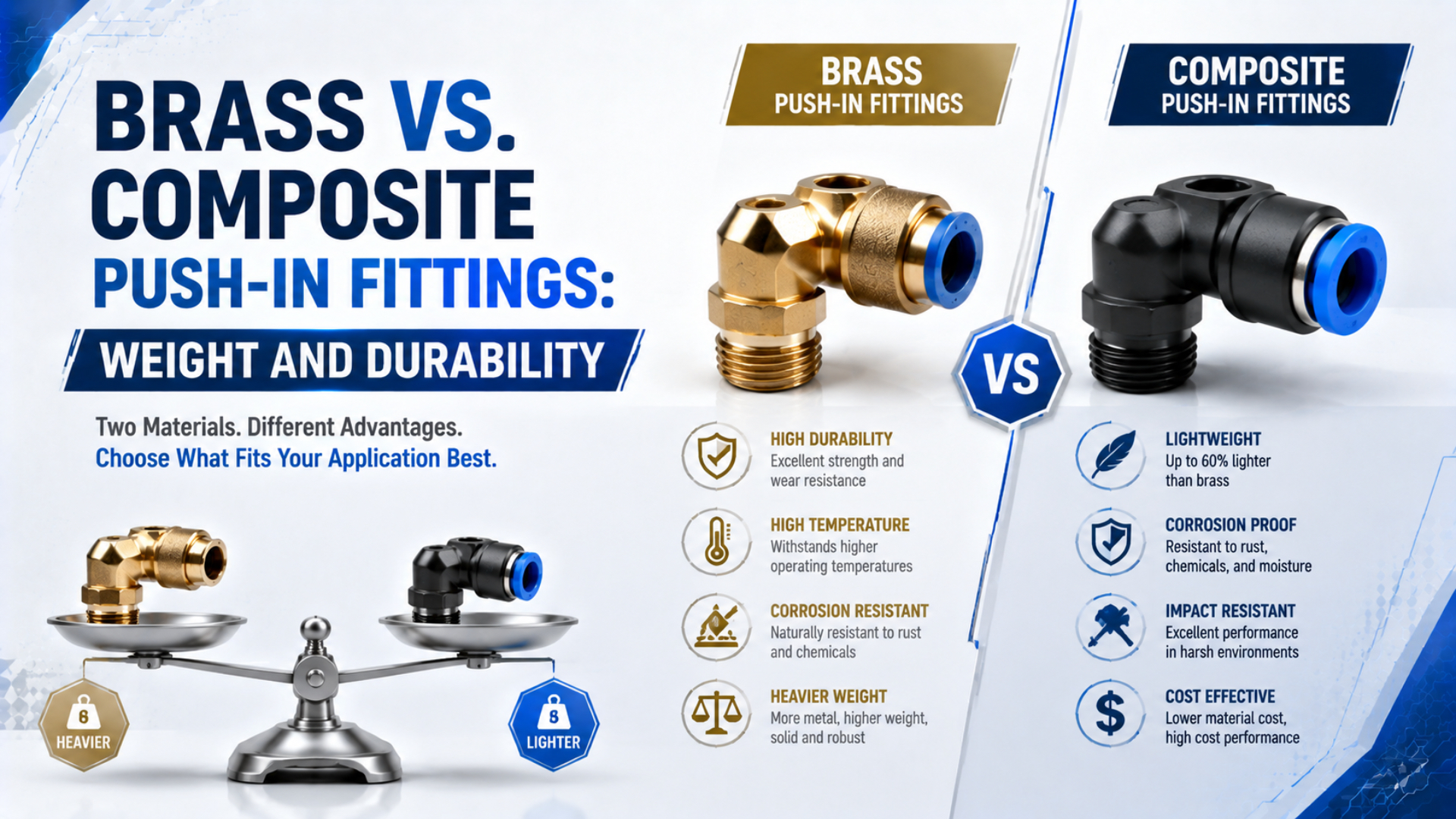
Composite push-in fittings can reduce machine mass, but “composite” rarely means an all-plastic connector, and brass is not automatically more durable in every environment. A typical composite design combines a polymer housing with a brass threaded stud, stainless tube gripper, and elastomer seal. The correct choice therefore comes from the exact assembly rating, tube compatibility, chemical exposure, installation load, and consequence of leakage.
A push-in fitting is a connector that grips and seals an inserted tube without a separate compression nut. The most useful comparison is one complete part number against another, with the same tube outside diameter, thread, geometry, medium, pressure, temperature, and test requirement. ISO 14743 reinforces this complete-assembly view.
Key Takeaways
- Compare complete fittings by exact part number. Body material alone does not establish mass, pressure rating, temperature limit, or service life.
- A catalog pair with the same 8 mm tube and G1/4 elbow interfaces weighs 23 g for a PBT/brass design and 25.3 g for a nickel-plated-brass design. That is about 9% for those two products, not a universal material percentage.
- Composite fittings may still contain brass, stainless steel, POM, and NBR. Each constituent and interface can become the limiting element.
- Brass resists impact and thread abuse well, but ammonia-bearing environments and some aqueous conditions can cause stress-corrosion cracking or dezincification.
- Polymer performance depends on the exact resin grade, reinforcement, UV stabilization, moisture, temperature, chemical, and sustained stress.
- Use the lowest pressure and temperature rating among the fitting, tube, seal, valve, and connected component.
- Vibration failures are often installation-system failures: unsupported tube mass, side load, poor tube cuts, incomplete insertion, or repeated tube motion.
- Calculate total cost from verified replacement and downtime data. Do not assume that either material always has the lower lifecycle cost.
What Does “Brass vs. Composite” Actually Compare?
ISO 14743:2020 covers requirements and test methods for complete push-in connector assemblies used with thermoplastic tube from 3 to 16 mm outside diameter. That scope is important: retention, sealing, tube behavior, pressure, and installation act together, so a body-material label cannot qualify the connection by itself (ISO 14743).
A “brass fitting” may include a nickel-plated brass body, stainless retaining claw, polymer release ring, NBR or FKM tube seal, and a separate thread seal. A “composite fitting” commonly replaces only part of that metal body with PBT or another engineered polymer. The threaded stud often remains nickel-plated brass because it must carry tightening load and seal against the port.
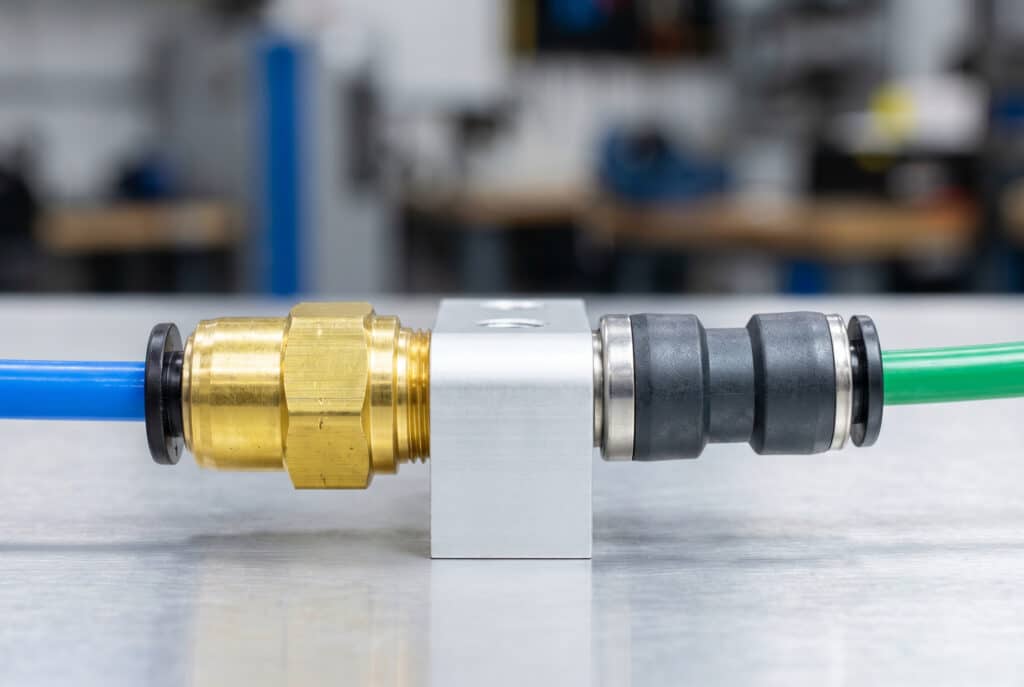
A visual material comparison is useful, but the catalog bill of materials and exact rating identify what each fitting can actually do.
This changes the engineering question. Instead of asking whether brass or polymer is “stronger,” map every required function to its actual component:
The assembly view also prevents a common procurement error: accepting a supplier’s body-material statement as a complete material declaration. Request the housing, threaded insert, retaining element, release ring, all seals, surface treatment, and approved tube specification.
How Much Weight Can a Composite Fitting Save?
Festo lists its QSL-G1/4-8 elbow, with a PBT housing and nickel-plated-brass stud, at 23 g. Its similarly interfaced NPQM-L-G14-Q8-P10 nickel-plated-brass elbow is 25.3 g. Both accept 8 mm tube and use a G1/4 male thread, but their nominal bores and ratings differ (Festo QSL; Festo NPQM).
For those two catalog parts, the composite-bodied product is 2.3 g lighter, or about 9.1% relative to the 25.3 g brass product. This is an illustrative BOM comparison, not a controlled material experiment. The products do not have identical internal geometry, full-temperature pressure rating, or envelope, so the percentage must not be generalized.
Assembly mass can be screened from component density and volume:
where is total fitting mass, is the density of component , and is that component’s solid volume. This relation is derived directly from the definition of density. It explains why a lower-density housing does not produce the same percentage reduction in total mass when the stud, gripper, and seal remain unchanged.
Use supplier mass values whenever available. If a moving manifold uses 60 fittings, the example difference would remove 138 g. Whether that matters depends on where the fittings sit relative to the moving-axis center of mass and how much the tubes, valves, manifold, gripper, payload, and cable carrier already weigh.
For a defensible weight comparison:
- Match tube outside diameter, thread form and size, shape, number of ports, and mounting features.
- Record each exact part number and catalog revision.
- Compare nominal flow area or bore and all operating ratings, not mass alone.
- Multiply unit mass by the actual quantity on the moving assembly.
- Recalculate axis inertia or robot payload with the fittings at their real locations.
- Weigh samples when supplier catalog values are absent.
Which Parts Determine Push-in Fitting Durability?
Festo’s QSL data identifies a PBT housing, nickel-plated-brass stud, POM release ring, NBR tube seal, and high-alloy-stainless retaining claw. That material stack demonstrates why durability must be allocated by failure mode: the housing does not perform the seal’s job, and the metal stud does not guarantee tube retention (Festo QSL).
| Failure observation | Likely interfaces to inspect | Evidence needed before changing material |
|---|---|---|
| Leakage at the tube | Tube cut, tube OD, seal, insertion depth, scratches | Approved tube list, cut quality, insertion mark, leak location |
| Leakage at the thread | Port face, thread form, seal ring or sealant, torque | Drawing, mating-port condition, torque record |
| Tube pull-out | Retaining claw, tube hardness, tube surface, side load | Retention test, tube specification, routing and support |
| Cracked housing | Impact, overtightening, chemical attack, hot-moist aging | Fracture location, exposure history, torque, resin grade |
| Corroded metal | Alloy, plating damage, condensate, chemical or chloride deposit | Material declaration, concentration, temperature, exposure time |
| Intermittent motion-related leak | Unsupported tube, rotating elbow, vibration, worn seal | Motion video, support spacing, cycle count, tube condition |
A brass housing generally tolerates wrench contact and local impact better than a thin polymer housing, while a well-designed polymer body can avoid external metal corrosion and reduce mass. Neither statement proves service life. Wall thickness, molding quality, residual stress, brass alloy, plating thickness, seal compound, tube movement, and exposure still govern.
The most reliable field diagnostic is to separate the leak path from the material label. Apply leak-detection fluid or an instrumented pressure-decay test to determine whether leakage originates at the tube interface, body joint, or thread. Replacing a composite housing with brass will not correct a scratched tube or incompatible NBR seal.
Push-in Fitting Pressure and Temperature Ratings
Parker publishes 20 bar maximum working pressure for both its LF 3000 technical-polymer/nickel-plated-brass/NBR family and its LF 3200 nickel-plated-brass/NBR family. Their stated temperature bands are -20°C to 80°C and -15°C to 80°C respectively. Those series data directly contradict a universal “composite equals low pressure” rule (Parker Legris catalog).
Other exact products show a different tradeoff. The Festo PBT/brass QSL elbow is rated from -0.95 to 6 bar across its complete temperature range, with a temperature-dependent maximum up to 14 bar and ambient range of -10°C to 80°C. The brass-housing NPQM elbow lists -0.95 to 16 bar across its range and -20°C to 70°C. The higher pressure rating comes with a lower upper ambient temperature for that particular pair.
These examples support three rules:
- Do not transfer a rating from one fitting family, size, thread, seal, or tube to another.
- Read pressure and temperature together. A headline maximum pressure may apply only over part of the temperature range.
- Keep the circuit below the lowest applicable rating, including tube, fitting, valve port, manifold, seal, and connected actuator.
Also distinguish gauge pressure, vacuum capability, proof pressure, burst pressure, and working pressure. ISO 4399 defines preferred nominal pressures for pneumatic connectors but does not replace the manufacturer’s product-specific limit (ISO 4399:2019).
Chemical and Corrosion Compatibility
US National Bureau of Standards guidance documents ammoniacal stress-corrosion cracking in high-zinc brass when the required environment and stress are present. An EPA materials guide describes dezincification as zinc loss that leaves a porous copper residue with little mechanical strength. Brass therefore should not be described as universally corrosion-proof (NBS stress-corrosion guidance; EPA materials guide).
Polymer is not universally chemical-proof either. Celanese’s PBT technical manual shows chemical response changing with reagent, concentration, temperature, and exposure time, and cautions that a specific part in a specific environment requires actual testing. BASF separately offers hydrolysis-resistant PBT grades because hot moisture can damage standard PBT polymer chains (Celanese PBT manual; BASF Ultradur HR).
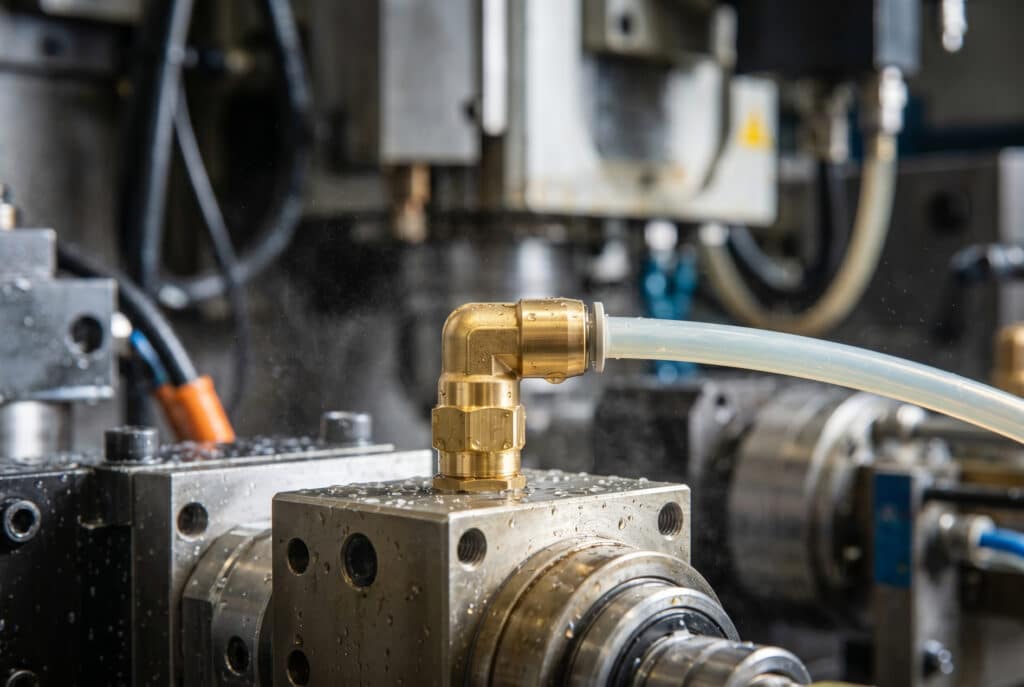
Wet machining may favor a robust metal body, but the exact brass alloy, plating, seal, tube, coolant chemistry, concentration, and cleaning process still control compatibility.
Before approving either material for coolant, detergent, sanitizer, solvent, oil mist, outdoor exposure, or washdown, document:
- chemical name and formulation, not only a trade category such as “cleaner”;
- concentration, temperature, exposure duration, and rinse/dry cycle;
- whether the exposure is internal medium, external splash, vapor, or immersion;
- resin grade and reinforcement, brass alloy and plating, seal compound, and tube material;
- UV exposure, ozone, hot moisture, chlorides, ammonia or amines;
- test method, acceptance criteria, and inspection interval.
For severe chemicals, hygienic zones, or aggressive washdown, compare a documented stainless series as a third option. Our guide to stainless steel pneumatic fittings explains why 316L body material still must be checked together with the collet, seal, tube, surface, and cleaning declaration.
Does Brass Always Handle Vibration Better?
ISO 14743 includes complete-connector performance requirements rather than granting vibration immunity to a material category. Field reliability still depends on tube retention, routing, support, insertion, and local loads. A rigid brass body may survive external impact better, yet extra unsupported mass can also increase cyclic load at a small port or moving tube connection (ISO 14743).
Common vibration-related mechanisms include:
- a long tube span applying bending moment to an elbow;
- a tight bend trying to rotate a swivel body continuously;
- a tube rubbing against sheet metal and carrying scratches into the seal;
- repeated relative movement between tube and fitting;
- a fitting used as a structural tube support;
- a threaded port loosened by poor torque or an unsuitable sealing method;
- a tube that was cut obliquely or never inserted to the specified depth.
Support the tube so the fitting sees pneumatic connection loads, not cable-management loads. Keep the tube within its minimum bend radius, allow controlled strain relief on moving axes, and place clamps so they do not force the tube sideways at the collet. Follow the fitting maker’s torque and tube-preparation instructions.
If failures repeat, mark the tube at full insertion, record video of the moving route, and inspect the removed tube under magnification. A circumferential gripper mark, axial scratch, oval tube, swollen surface, or hardening can identify a mechanism more reliably than the fitting’s body color.
When Should You Choose Composite, Brass, or Stainless Steel?
The Parker and Festo examples show overlapping rather than absolute capability: some mixed polymer/brass and brass families share pressure limits, while other exact brass parts extend pressure or temperature. Selection should therefore use application gates in priority order, with mass and purchase price considered only after safety, compatibility, and rating requirements pass (Parker; Festo).
Choose a composite-bodied fitting when the exact series meets the full pressure, temperature, medium, and environmental specification, and when measured machine-level mass or compact routing creates value. Typical candidates include valve islands, moving end effectors, and dense clean-air assemblies, but only within the published product limits.
Choose brass when the exact series provides the needed thread robustness, impact tolerance, pressure rating, temperature band, or installation familiarity, and the brass alloy, plating, and seals are compatible with the environment. Brass is often practical inside industrial machinery, but chemical and wet-service evidence remains necessary.
Choose stainless steel when chemical, chloride, washdown, hygiene, high temperature, or documentation requirements exceed the qualified brass and composite options. Stainless is not an automatic answer; the exact alloy, seal, collet, tube, surface, and crevice design still require review.
How Should Total Cost Be Compared?
Neither ISO 14743 nor the cited manufacturer catalogs provide a universal service-life multiplier or lifecycle-cost advantage for one body material. A valid total-cost model therefore needs your purchase records, change time, verified failure mode, downtime consequence, inspection effort, inventory policy, and observed service interval for each exact fitting in the same duty.
Start with a controlled trial rather than an assumed percentage. Install traceable samples in matched positions, record fitting and tube part numbers, preserve removed parts, and classify every event by leak path. A “composite failure” caused by an unsupported tube must not be counted as proof that a brass body is economically superior.
Use these cost elements:
| Cost element | Required input | Avoid |
|---|---|---|
| Acquisition | Quoted unit price, quantity, freight, minimum order | Unverified “OEM savings” percentage |
| Installation | Assembly time, tooling, torque control, tube preparation | Assuming all geometries install equally |
| Failure | Confirmed leak path and mechanism, affected quantity | Counting every pneumatic leak against body material |
| Downtime | Actual stopped minutes and validated burden rate | Applying one dramatic event to every machine |
| Inventory | Stocking level, commonality, shelf conditions, obsolescence | Treating the lowest unit price as lowest inventory cost |
| Qualification | Samples, tests, documentation and engineering time | Omitting approval cost from a supplier change |
If pressure loss or undersized flow is the real concern, evaluate the full flow path rather than changing housing material. Our guides to proper fitting selection and hose and fitting size effects cover bore, restriction, tube length, and cylinder-speed interactions.
What Should Be Included in an RFQ and Acceptance Plan?
ISO 14743 provides a useful complete-assembly framework, while the Festo and Parker examples show that ratings and material stacks differ by family. An RFQ should therefore identify the service conditions and required evidence, then let suppliers propose exact part numbers. “8 mm composite elbow” is not a qualification specification (ISO 14743).
Include:
- fitting shape, tube outside diameter and permitted tube specification;
- thread standard, size, sealing method, mating-port material and available wrench clearance;
- operating, peak and proof-test pressure, including vacuum if applicable;
- minimum and maximum medium and ambient temperature;
- internal medium and all external chemicals with concentration and exposure cycle;
- vibration, tube motion, moving-axis mass target, bend radius and support arrangement;
- required housing, stud, gripper, release-ring and seal materials;
- corrosion, food-contact, cleanroom, PWIS, RoHS or other declarations actually required;
- lot traceability, catalog revision, dimensional drawing and change-notification terms;
- acceptance tests for leakage, retention, pressure, temperature, chemistry and endurance;
- sample quantity and failure-analysis responsibilities.
At incoming inspection, verify part identity and material declaration, inspect molding and plating surfaces, check thread gauges where risk justifies it, and run the approved leak/retention sample plan. During assembly, control tube cut, insertion depth, routing, thread torque, and stored-energy isolation. These controls usually produce more reliable outcomes than a blanket rule favoring one body material.
Frequently Asked Questions
ISO 14743 treats the tube and connector as a complete assembly, and current Festo and Parker catalogs show overlapping polymer/brass and brass capabilities. The answers below therefore avoid universal pressure, temperature, weight, and lifetime claims. Always return to the exact fitting series, approved tube, environment, and installation instructions (ISO 14743).
Are composite push-in fittings always lower pressure than brass fittings?
No. Parker lists 20 bar maximum working pressure for both its LF 3000 technical-polymer/nickel-plated-brass family and LF 3200 nickel-plated-brass family. Other product pairs differ. Compare the exact series, size, seal, tube, medium, pressure-temperature curve, and applicable safety factor.
How should brass and composite fitting weight be compared?
Match tube outside diameter, thread, geometry, port count, mounting features, and flow requirement, then use exact catalog mass or weigh samples. The Festo 8 mm/G1/4 elbow examples are 23 g and 25.3 g, but differing nominal bores and ratings mean their 9.1% difference is illustrative rather than universal.
Can brass and composite fittings be mixed in one pneumatic circuit?
Yes, if each exact fitting and tube combination is rated for its local pressure, temperature, medium, environment, and mechanical load. Keep thread standards and tube specifications controlled, and do not assume that mixing materials resolves galvanic, chemical, sealing, or maintenance risks.
Which fitting material is best for washdown or chemical exposure?
There is no material-only answer. Specify the chemical, concentration, temperature, exposure time, rinse cycle, and internal versus external contact. Check the housing, stud, plating, gripper, seal, and tube. Severe service may justify a documented stainless series, but it still needs complete-assembly compatibility.
What should be included in a push-in fitting RFQ?
State the exact interfaces and duty: tube OD and material, thread, pressure, temperature, medium, external chemicals, vibration, movement, mass target, required declarations, traceability, and acceptance tests. Ask the supplier to identify every critical component material and the exact catalog revision supporting the proposed part number.
Sources and Retrieval Notes
- ISO 14743:2020, Pneumatic fluid power, push-in connectors for thermoplastic tubes, accessed 2026-07-27. Used for scope, tube outside-diameter range, and the complete-assembly qualification framework.
- ISO 4399:2019, Fluid power systems and components, connectors and associated components, nominal pressures, accessed 2026-07-27. Used to distinguish nominal-pressure standardization from product-specific working ratings.
- Festo QSL-G1/4-8 datasheet, accessed 2026-07-27. Used for the 23 g mixed PBT/brass elbow, component materials, pressure, and temperature data.
- Festo NPQM-L-G14-Q8-P10 datasheet, accessed 2026-07-27. Used for the 25.3 g nickel-plated-brass elbow, pressure, and temperature data.
- Parker Legris low-pressure connection solutions catalog, accessed 2026-07-27. Used for LF 3000 and LF 3200 material stacks and series-level working limits.
- US National Bureau of Standards, Stress Corrosion Cracking Control Measures, accessed 2026-07-27. Used for the conditions associated with ammoniacal stress-corrosion cracking in high-zinc brass.
- US EPA, Paints and Protective Coatings for Wastewater Treatment Facilities, accessed 2026-07-27. Used for the dezincification mechanism and resulting porous copper residue.
- Celanese polyester technical manual, accessed 2026-07-27. Used for PBT chemical-compatibility variables and the need for part-specific testing.
- BASF Ultradur HR, PBT for hot and humid environments, accessed 2026-07-27. Used for the effect of hot moisture and grade-specific hydrolysis resistance.