

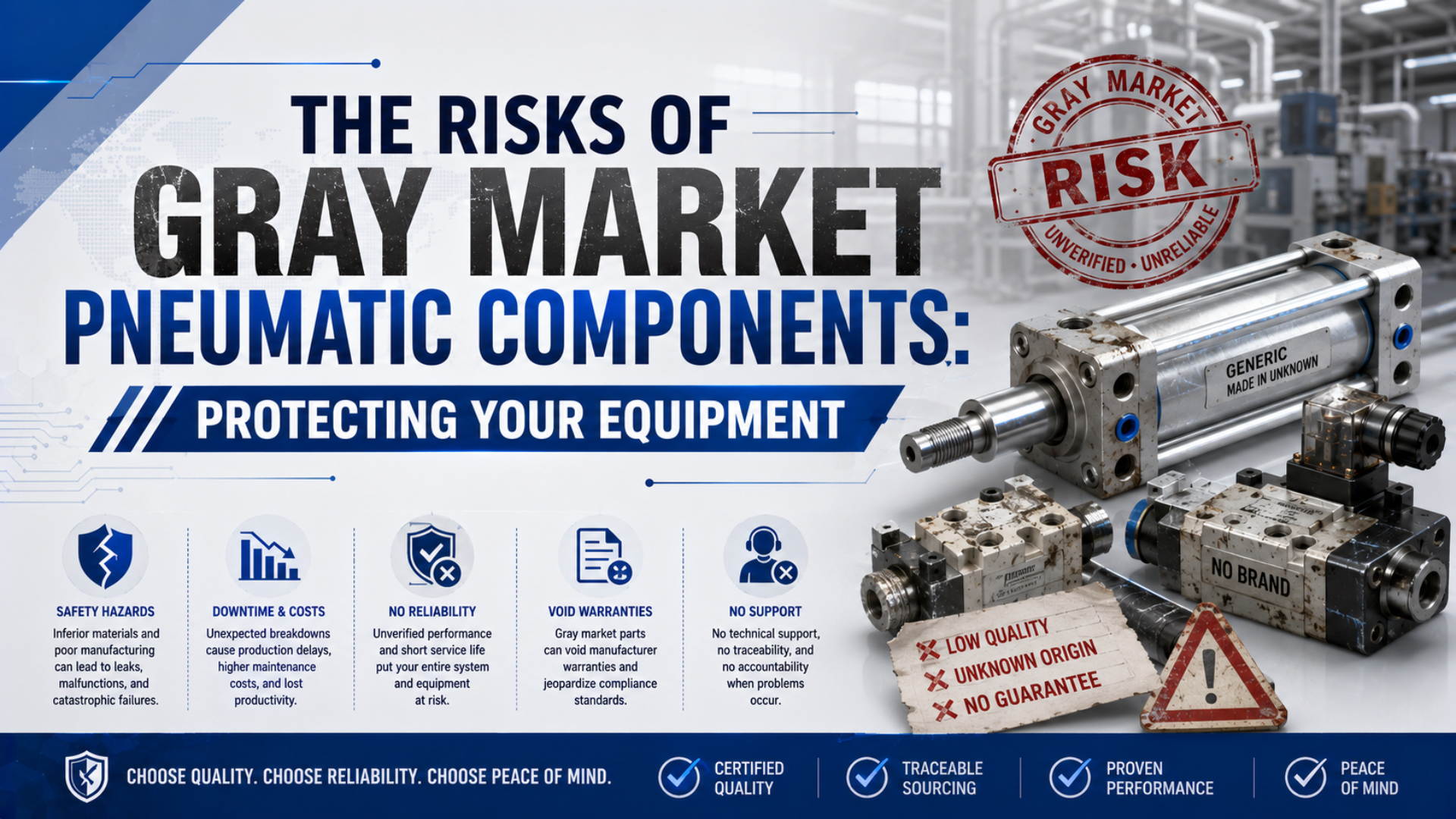
Gray-market pneumatic components are genuine branded products sold outside the trademark owner’s intended channel. That definition does not prove that a particular valve, cylinder, sensor, or seal is unused, correctly stored, supported in your market, or suitable for the machine. It also does not make an independent replacement brand a gray-market product.
The practical response is a three-gate control: verify product identity and provenance before purchase, inspect the received item against the order and application, then document release for the intended duty. If evidence is missing, quarantine the component. A low price is not an authentication method.
Key Takeaways
- CBP distinguishes genuine gray-market goods from counterfeit goods.
- Treat authenticity, channel authorization, condition, and application suitability as separate questions.
- Collect provenance before purchase; packaging and appearance alone cannot authenticate a component.
- Quarantine suspect parts until quality, engineering, and purchasing agree on release or rejection.
Gray market describes a distribution-channel condition. Counterfeit describes a false product or trademark representation. Independent alternative describes a different manufacturer selling under its own identity. Provenance is the documented history connecting the component, seller, shipment, and receiving record.
This article focuses on procurement evidence and incoming control. For the separate cost decision between original and replacement sources, use the OEM versus aftermarket rodless-cylinder TCO review.
What Is a Gray-Market Pneumatic Component?
U.S. Customs and Border Protection separates two product identities: gray-market goods carry a genuine trademark applied with the rights holder’s approval, while goods bearing counterfeit marks are not genuine. CBP also calls gray-market goods parallel imports or diverted goods (CBP Customs Directive 2310-008A, accessed July 26, 2026).
That distinction prevents several purchasing mistakes. A genuine cylinder intended for another region may have different packaging, documentation, port options, sensor compatibility, or local support arrangements. A used actuator sold as new is a condition-disclosure problem. A fake nameplate is a counterfeit problem. An independent manufacturer’s compatible cylinder is a separate product that must be qualified on its own drawings and performance evidence.
The legal position also varies by location. WIPO explains that parallel imports are genuine products and that their legality depends on the importing jurisdiction’s national, regional, or international exhaustion regime (WIPO, Entering Foreign Markets, accessed July 26, 2026). Therefore, “gray market is legal” is not a safe global statement.
The useful model has two axes, not one. The first asks whether the product identity is authentic. The second asks whether the sales channel and support path are recognized for the destination market. A third check, condition, determines whether the item is new, stored surplus, returned, repaired, or used.
Provenance Connects the Component to the Purchase Record
NIST describes supply-chain risk across seven lifecycle stages: design, development, distribution, deployment, acquisition, maintenance, and destruction. Its examples include counterfeits, unauthorized production, tampering, theft, and poor manufacturing practices (NIST Cybersecurity Supply Chain Risk Management, updated July 24, 2026). The framework covers operational technology as well as information technology.
For a pneumatic component, provenance connects the physical item to a credible purchase and support record. Useful records may include the manufacturer, complete part number, configuration code, lot or serial identifier where one exists, seller, invoice, delivery date, and receiving inspection. Not every commodity fitting will have a serial number. A supplier’s inability to provide one is not proof of fraud when the manufacturer never assigned one.
Why is the record important? Consider a cylinder with the correct bore and stroke but an undocumented port thread. A forced adapter can damage the port before the authenticity question is ever resolved. The cylinder port-thread guide explains why NPT, BSPT, and parallel G threads need different sealing and engagement decisions.
Traceability also helps after receipt. NIST says product pedigree and provenance data make it easier to assess risk and verify supply-chain events (NIST supply-chain traceability meta-framework, updated February 4, 2025). That record supports targeted containment if a batch, seller, or configuration later becomes suspect.
What Evidence Should You Request Before Placing the Order?
ISO and IAF guidance describes four basic external-provider controls: maintain approved-provider information, place orders against defined criteria, monitor provider performance, and verify that specified requirements were met. It also warns that an approved-provider list alone may be insufficient for critical components (ISO 9001 Auditing Practices Group, External Providers, 2016).
Build the evidence request around the component and its consequence of failure:
| Evidence | What to request | What it can establish | What it cannot establish alone |
|---|---|---|---|
| Seller identity | Registered business name, physical address, invoice issuer, contact and return location | Who accepted the commercial obligation | Product authenticity |
| Channel status | Manufacturer distributor listing or written confirmation for the destination market | Recognized sales relationship on the verification date | Condition of the individual item |
| Product identity | Full part number, option string, photos of the actual label and packaging | Configuration to compare with the manufacturer catalog | Internal condition or storage history |
| Provenance | Purchase records, lot or serial data where assigned, chain-of-custody documents | Traceable path between identifiable parties | Correct application sizing |
| Condition | Written declaration of new, surplus, returned, repaired, or used status | Seller’s represented condition | Actual seal or lubricant condition without inspection |
| Support terms | Written warranty provider, duration, exclusions, RMA route and shipping responsibility | The contractual support path offered for this sale | A universal manufacturer warranty |
| Technical evidence | Current datasheet, drawing, declarations and test records required by the application | Whether the offered configuration can be reviewed | Installed-machine performance |
Ask for these items before payment, not after a failure. Keep screenshots or exported copies of distributor-locator results because channel relationships can change. When the seller claims “manufacturer warranty,” ask which legal entity will process the claim and where the written terms apply.
Price belongs in the commercial comparison, but it is weak identity evidence. A high price can accompany a misrepresented part; a low price can reflect liquidation, regional pricing, old inventory, incomplete accessories, or a legitimate independent design. Investigate the explanation and documents rather than applying a universal discount threshold.
A seller certificate is strongest when it joins three records: the seller named on the invoice, the exact product identifiers on the received item, and the purchase or custody path. A generic PDF with no order, lot, or model reference is marketing collateral, not item-level provenance.
How Should Incoming Inspection Screen a Suspect Component?
Parker’s O-Ring Handbook places elastomers into three age-resistance groups under ARP 5316 guidance and states that storage conditions are more important than time alone. It also notes that ARP 5316 is a recommended practice, not a universal mandatory standard (Parker O-Ring Handbook, ORD 5700, accessed July 26, 2026).
That makes a blanket “pneumatic seals expire after two to five years” rule indefensible. Storage temperature, ozone, light, humidity, deformation, contamination, packaging, elastomer family, lubricant, and manufacturer instructions all affect the review. An old date code can trigger investigation, but it does not calculate remaining service life.
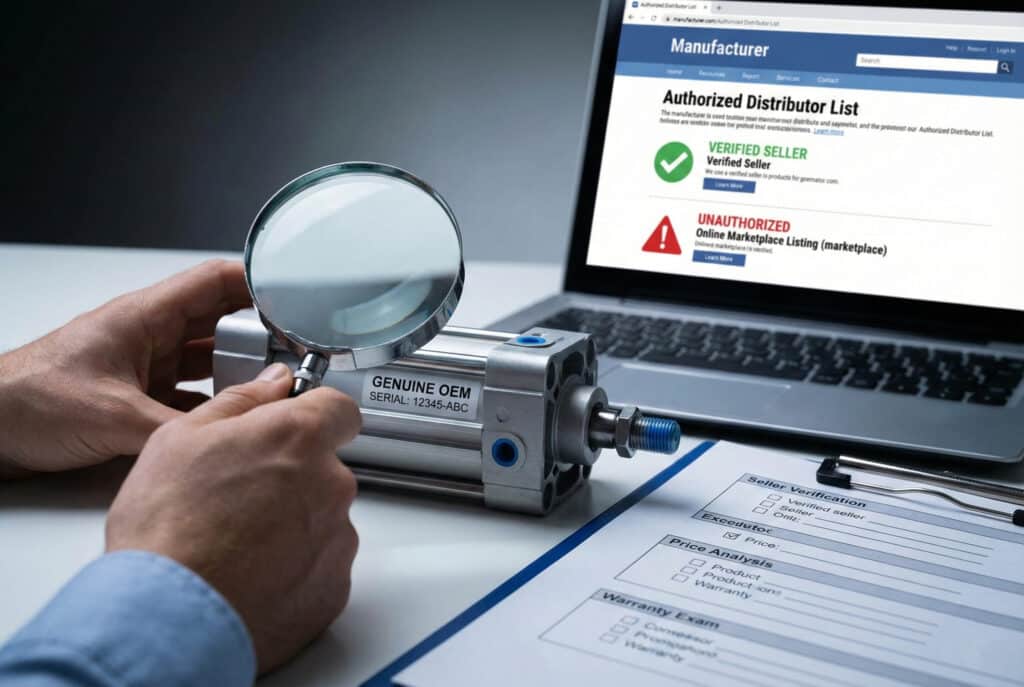
Use a receiving plan scaled to risk:
- Preserve evidence before opening. Photograph every side of the package, labels, seals, damage, and shipping documents. Record the purchase order and receiving date.
- Match identities. Compare the invoice, package, nameplate, model code, options, lot or serial identifiers, and quantity. Record discrepancies without altering the labels.
- Inspect condition. Look for opened packaging, corrosion, damaged threads, tool marks, contaminated ports, aged grease, mismatched fasteners, repainted surfaces, or evidence of prior installation.
- Check configuration. Verify bore, stroke, port standard, voltage, connector, sensor type, mounting pattern, materials, pressure range, and environmental options against current manufacturer data.
- Measure critical interfaces. Confirm mounting centers, rod or carriage interface, ports, and sensor positions. Use the ISO 6432 replacement workflow as a model for disciplined interface measurement when that cylinder family applies.
- Run a controlled functional check. Follow the manufacturer’s instructions. Depending on the component, verify switching, leakage, stroke, cushioning, pressure response, or valve operation behind guarding and within rated conditions.
- Record disposition. Release, restrict to a defined noncritical trial, return, or quarantine. The receiver should not silently place a discrepant item into normal spares.
Packaging quality, logo color, label font, and serial-number format can identify anomalies. They cannot authenticate a component by themselves. Counterfeiters can copy visual features, and genuine regional packaging can differ. When maintenance evidence points to contamination rather than sourcing, use the cylinder contamination-analysis guide to preserve and interpret deposits.
What Should You Do When Product Identity or History Is Uncertain?
CBP describes three identifier types it may share with a rights holder when investigating suspected counterfeit imports: serial numbers, universal product codes, and stock-keeping unit numbers. The agency uses those identifiers as evidence for expert review, not as automatic proof (CBP IPR Interim Final Rule, April 24, 2012).
Stop installation when a discrepancy could affect safety, regulatory obligations, machine damage, or traceability. Tag and physically segregate the component. Preserve packaging, labels, photographs, correspondence, invoices, and test results. Don’t grind off markings, disassemble beyond the approved inspection plan, or return the part before deciding which evidence must be retained.
Route the case through purchasing, quality, engineering, and legal or brand-protection contacts as appropriate:
- Purchasing confirms the seller, order terms, represented condition, return rights, and payment record.
- Quality controls quarantine, evidence preservation, nonconformance, supplier corrective action, and disposition approval.
- Engineering compares the exact configuration with the application and defines any safe test.
- Manufacturer or trademark owner may confirm distributor status or inspect identifiers, but confirmation services vary by product and region.
- Legal, compliance, or insurance specialists review contract and jurisdiction-specific consequences. Technical staff should not promise that coverage or warranty is automatically valid or void.
Do not install a suspect item on a safety-related function merely because a bench test passed. A short test cannot reconstruct material pedigree, long-term storage, internal wear, change history, or every failure mode. If the component has already been installed, assess whether the machine should be stopped safely, record the exposure period, inspect affected equipment, and evaluate other inventory from the same source.
Are Authorized Distributors the Only Defensible Source?
Parker groups authorized-channel value into three areas: product availability, productivity support, and trusted services. Festo likewise lists three official-partner benefits: quick product access, simpler procurement, and application-specific solutions (Parker Authorized Distributors; Festo Official Partners, accessed July 26, 2026).
An authorized source can simplify access to genuine products, current configuration data, local inventory, engineering support, returns, and warranty processing. Those are real benefits. They still do not remove the buyer’s duty to specify the correct part, inspect shipping damage, verify the application, and follow installation instructions.
Other sourcing routes can also be defensible when they are described honestly and qualified to the application’s risk:
- Independent manufacturer: The product carries its own brand and documentation. Verify dimensions, ratings, materials, sensors, service parts, change control, and acceptance testing. Don’t call it “genuine OEM.”
- Documented surplus: The seller discloses source, age, condition, packaging, storage, completeness, and support limitations. Use only when the evidence and intended duty justify release.
- Repaired or remanufactured component: The seller discloses the prior condition, work scope, replaced parts, test criteria, warranty provider, and remaining configuration limitations. Never accept used or repaired equipment represented as new.
- Broker or marketplace: Apply enhanced provenance and inspection controls. The platform’s presence, reviews, or payment service does not establish manufacturer authorization.
ISO 9001 does not create a universal “authorized distributor only” rule. The ISO/IAF guidance instead asks whether controls are proportional to component risk and whether the supplier can consistently meet the specification. A safety-related valve, hygienic actuator, or production-critical rodless axis may justify stricter sourcing rules than a noncritical workshop fitting.
The decision is not OEM versus cheap. It is supported evidence versus unresolved uncertainty.
Documenting the Final Purchase Decision
NIST’s traceability work identifies three linked needs: capturing product pedigree, recording supply-chain events, and making the information verifiable. A pneumatic purchase record should therefore connect the approved requirement, seller evidence, received item, inspection result, and final disposition (NIST supply-chain traceability meta-framework, 2024).
Keep one compact decision file for each risk-significant purchase:
- machine or spare-parts application;
- component criticality and consequence of failure;
- approved manufacturer, model, configuration and revision;
- seller identity and verified channel status, if claimed;
- represented product condition;
- provenance documents and unresolved gaps;
- required technical, regulatory and contract evidence;
- incoming-inspection and functional-test results;
- deviations, concessions and approvers;
- release restrictions, monitoring and recall location;
- warranty and RMA route;
- linked inventory locations and installed asset.
If cost remains the deciding factor after technical release, compare the same time horizon and the same local downtime assumptions. The risk-adjusted cylinder TCO worksheet covers that calculation. Don’t import its costs from another plant.
For parts already in service, connect sourcing records with the pneumatic actuator maintenance checklist. If inspection shows wear rather than an identity problem, the repair-versus-replace decision guide provides the next engineering branch.
Provenance has operational value only when it survives receiving. A perfect quotation file that cannot be linked to the physical item in stores is not traceability. Apply a receiving identifier that joins the purchase record, inspection result, inventory location, and eventual machine installation.
Gray-market risk cannot be reduced to one seller label. Separate identity, channel, condition, support, and application suitability; then scale the evidence to the consequence of failure. When a required link is missing, quarantine first and resolve it in writing.
Siyu Wang prepared this application-focused guide for Bepto Pneumatic. Technical and legal-boundary claims were checked against the government, standards, and manufacturer sources below. For an application-specific component review, use the contact page and provide the exact model, duty, environment, seller evidence, and machine interface.
Gray-Market Pneumatic Component FAQs
CBP distinguishes two fundamentally different cases: genuine products moving through parallel channels and non-genuine products bearing counterfeit marks. The five answers below preserve that distinction while addressing condition, warranty, independent alternatives, and release control (CBP Customs Directive 2310-008A, accessed July 26, 2026).
Does an unauthorized seller automatically mean the pneumatic component is counterfeit?
No. CBP defines gray-market goods as genuine goods moving through a parallel or diverted channel, while counterfeit-marked goods are not genuine. An unauthorized seller increases the need to verify provenance, condition, support, and destination-market compatibility, but seller status alone does not prove whether the individual component is authentic.
Does a gray-market pneumatic part automatically void the machine warranty?
No universal answer applies. Warranty effect depends on the written machine and component terms, applicable law, the sales route, and the relationship between the part and the claimed failure. Obtain written guidance from the responsible warranty provider before installation; don’t rely on a seller’s verbal assurance or a generic online statement.
Is an independent replacement manufacturer part of the gray market?
Not when it sells products under its own identity rather than presenting them as diverted OEM goods. The replacement still needs supplier qualification and application validation. Verify drawings, ratings, materials, ports, sensors, support, change control, and acceptance tests instead of assuming that either “alternative” or “OEM” proves suitability.
Can packaging and serial numbers prove that a cylinder or valve is genuine?
They can support screening, but they are not conclusive alone. Compare all assigned identifiers across the item, package, invoice, and provenance records, then ask the manufacturer or rights holder what verification it offers. Some pneumatic products have no serial number, and copied labels can appear convincing.
What should I do with a suspect pneumatic component already in inventory?
Segregate and tag it, preserve packaging and purchase records, record every identifier, and stop uncontrolled installation. Quality, purchasing, and engineering should evaluate provenance, configuration, application consequence, and any safe test. Document release, restricted trial, return, rejection, or reporting rather than leaving the part in ordinary stock.
Sources and technical references
- U.S. Customs and Border Protection, Customs Directive 2310-008A. Distinguishes genuine gray-market goods from counterfeit-marked goods and describes restricted parallel imports. Accessed July 26, 2026. https://www.cbp.gov/sites/default/files/documents/2310-008a_3.pdf
- World Intellectual Property Organization, Entering Foreign Markets. Explains parallel importation, genuine goods, and jurisdiction-dependent exhaustion regimes. Accessed July 26, 2026. https://www.wipo.int/en/web/business/international-markets
- NIST Cybersecurity Supply Chain Risk Management. Lifecycle supply-chain risk framing for ICT and operational technology. Updated July 24, 2026. https://csrc.nist.gov/Projects/cyber-supply-chain-risk-management
- NIST supply-chain traceability meta-framework announcement. Explains product pedigree, provenance, and verifiable supply-chain event data. Updated February 4, 2025. https://www.nist.gov/news-events/news/2024/10/nist-introduces-meta-framework-strengthen-supply-chain-traceability
- ISO 9001 Auditing Practices Group, External Providers. Risk-based supplier, procurement, specification, monitoring, and supply-chain audit guidance. Published 2016. https://committee.iso.org/files/live/sites/tc176/files/documents/ISO%209001%20Auditing%20Practices%20Group%20docs/Auditing%20to%20ISO%209001%202015/APG-ExternalProviders2015.pdf
- Parker O-Ring Handbook, ORD 5700. Storage-condition and elastomer-age-control guidance, including the scope of ARP 5316. Accessed July 26, 2026. https://www.parker.com/content/dam/Parker-com/Literature/O-Ring-Division-Literature/ORD-5700.pdf
- Parker Authorized Distributors. Describes authorized-channel inventory, engineering access, and service support. Accessed July 26, 2026. https://discover.parker.com/parker-authorized-distributors
- Festo Official Partners. Describes official partner product access, procurement, local technical advice, and application support. Accessed July 26, 2026. https://www.festo.com/hk/en/e/support/find-your-sales-partner-id_35195