

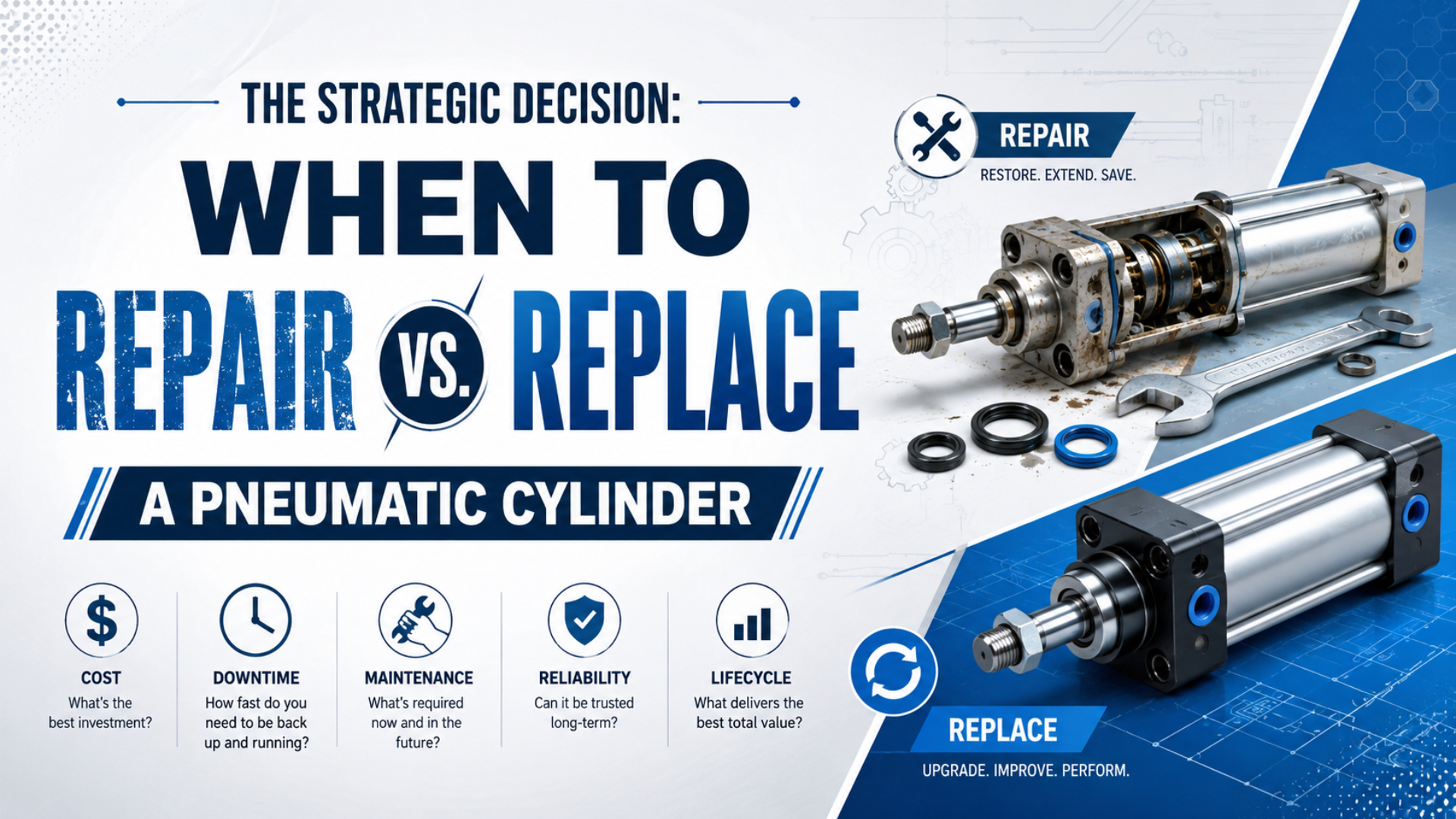
A pneumatic cylinder should be repaired when the fault is confined to documented service parts and inspection shows that the pressure boundary, load path, mounting, and control interfaces can be restored safely. Replace it when structural damage, an unsupported variant, repeated failure, or the required downtime makes a verified repair impractical. The repair vs. replace decision should not use a universal age or cost-percentage rule. ISO 19973-1:2015 says pneumatic-component life varies and requires statistical interpretation of reliability results (ISO 19973-1, 2015; retrieved 2026-07-10).
Key Takeaways
- Repair only documented wear parts.
- Replace damaged pressure boundaries or unsupported variants that lack a verifiable test route.
- DOE reports 20-30% leakage in poorly maintained systems; compare repair and replacement over one period using plant-specific downtime, energy, qualification, repeat-failure, and restart-risk inputs.
Repairable condition means the documented service parts can be replaced while the cylinder’s primary surfaces and interfaces remain within an approved return-to-service path.
Replacement trigger means damage, missing support, safety exposure, or local cost prevents a controlled repair and verified restart.
Verified restart means the machine has passed isolation release, leakage, motion, sensing, cushioning, load, and product-quality checks before normal production resumes.
Repairability is not a property of the component name alone. It is an approved process for one model and failure mode within one operating context. A seal kit on the shelf proves only that parts exist. It does not prove the barrel and rod can return to service. The guide and cushion need separate checks. So do the sensors, mounting, and machine safety function.
Parts availability is not proof.
From our analysis of the cited manufacturer documents, the decisive difference is not calendar age. It is whether the exact model has an approved service route and whether inspection leaves a testable pressure boundary and load path.
This guide stays focused on the failed cylinder already on the machine. The separate cylinder and electric-actuator maintenance guide handles the technology-level comparison. Replacement sourcing is another decision. Use the OEM versus aftermarket rodless-cylinder TCO review after replacement has been selected.
What Should You Check Before Opening a Pneumatic Cylinder?
OSHA 29 CFR 1910.147 requires hazardous-energy procedures to be inspected at least annually. Its definition of an energy source explicitly includes pneumatic energy. Start the decision only after trained personnel isolate the machine and relieve stored pressure. Restrain the load. Verify de-energization (OSHA 29 CFR 1910.147, current text retrieved 2026-07-10).
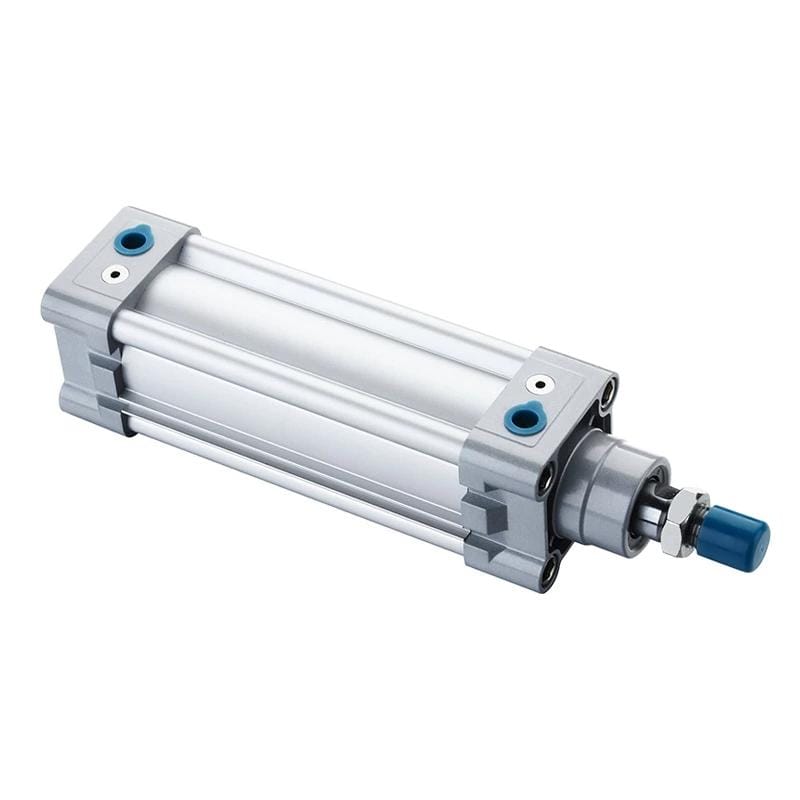
Do not loosen a port or end cap to “see what happens.” Tie rods and carriage hardware stay untouched too. The same rule covers cushions, sensors, and mounting bolts. OSHA requires hazardous stored or residual energy to be relieved. It may also need disconnection or restraint. Parker’s OSP-P instructions add product-level cautions. Depressurize slowly. Secure parts that can fall. Lower a vertical piston before depressurization (Parker OSP-P Maintenance Instructions, retrieved 2026-07-10).
Can the plant prove that the axis is pressure-free and the load cannot move? If not, the cost comparison has not started. Safety isolation is the first decision gate.
Safety comes first.
Record the failure before disturbing it
Capture the nameplate, model code, bore, stroke, mounting, rod or carriage orientation, sensor positions, port threads, regulator setting, dynamic pressure, cycle rate, load, and environment. Photograph external leakage points and physical damage. Record whether the fault appears on extension, retraction, dwell, or end-of-stroke.
A slow stroke does not automatically condemn the cylinder. The restriction may be in a valve, silencer, tube, fitting, regulator, or undersized branch. Check the pressure-drop troubleshooting guide before paying for a cylinder that cannot correct an upstream flow problem.
Separate machine faults from cylinder faults
Confirm alignment, side load, loose mounting, damaged guides, hard-stop position, cushion adjustment, sensor timing, air quality, and exhaust restriction. A new cylinder installed into the same misalignment or contaminated air supply can fail for the same reason. That is replacement without root-cause correction.
ISO 4414:2010 covers pneumatic-system safety and reliable operation. It treats maintenance and energy efficiency as system concerns rather than isolated cylinder concerns (ISO 4414, 2010; confirmed 2021). Follow the fault path through the valve and tubing. Include the load and guide. Then check the controls and cylinder.
Which Cylinder Conditions Usually Favor Repair?
Festo’s 56-page DSBC instruction requires preparatory work and a visual inspection. It also requires variant identification and model-specific parts data. Repair is justified only when wear is confined to documented service parts. Primary load-bearing surfaces must still meet manufacturer requirements (Festo DSBC Repair Instructions, retrieved 2026-07-10).
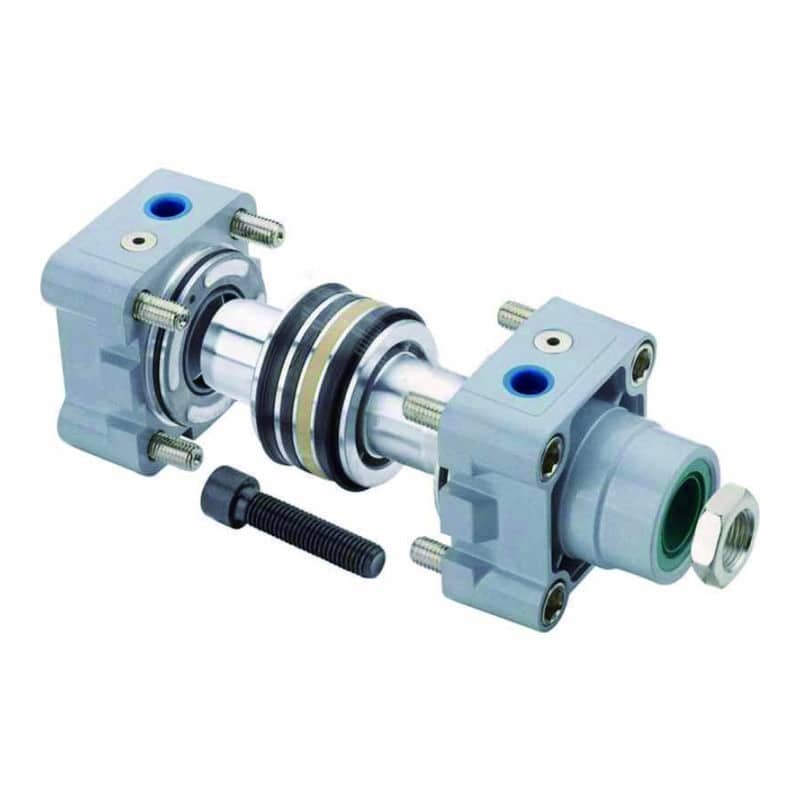
Repair is usually defensible when all of the following are true:
- The exact model is traceable, its current repair instruction and exploded drawing are available, and the fault is limited to seals, scrapers, wear rings, approved bearings, bands, or other listed wear parts covered by the correct service kit.
- The barrel or profile has no disqualifying scoring, deformation, corrosion, or sealing-surface damage.
- The piston rod is straight, smooth, and within the manufacturer’s usable condition.
- Threads, mounting faces, cushions, ports, sensor grooves, guides, and end caps remain serviceable.
- Trained personnel, clean assembly conditions, tools, lubricant, torque data, and a test procedure are available.
- The repair can be leak-tested and function-tested before production owns the risk.
The exact list changes by product. Festo publishes extra DSBC steps for clamping units and end-position locking. Through-rod models and other variants also have their own instructions. Parker’s OSP-P service packs contain a complete seal kit plus inner and outer bands. The pack also provides grease, a cleaning tool, and repair instructions. Parker lists seven bore sizes from 16 to 80 mm (Parker OSP-P Service Parts, retrieved 2026-07-10).
These two manufacturer documents establish a bounded repairability rule. The exact variant must be covered. Parts and instructions need controlled identities. Trained personnel must be able to reproduce the procedure. The remaining surfaces still have to pass inspection. A cleanroom or locking version can change the decision even when the model family looks familiar. Brake, through-rod, and custom versions can do the same. Parker’s standard OSP-P documentation permits service work and lists rebuild kits. Its maintenance instruction sends failed cleanroom cylinders back to the manufacturer. Festo divides DSBC work by feature code and requires the exact online parts list. Repair scope therefore follows the complete model code rather than the sales-family label (Festo DSBC Repair Instructions, retrieved 2026-07-10; Parker OSP-P Maintenance Instructions, retrieved 2026-07-10).
That level of documentation changes the decision. An available kit plus an approved procedure creates a repair path. A bag of visually similar seals does not.
For seal construction and material roles, see the guide to industrial cylinder seal types. For recurring inspections rather than a one-time failure decision, use the rodless-cylinder preventive-maintenance checklist.
Which Damage Usually Favors Replacement?
Parker sets an 8,000 km maintenance point for its standard OSP-P product. Yet the same instruction prohibits field service of the cleanroom variant. Failed cleanroom cylinders return to the manufacturer. This contrast shows why model variant and approved repair scope matter more than age alone (Parker OSP-P Maintenance Instructions, retrieved 2026-07-10).
Replacement is normally the safer engineering choice when one or more conditions below apply. Use the finding and its evidence together.
| Finding | Why replacement gains weight | Evidence to collect |
|---|---|---|
| Bent, deeply scored, pitted, or plated-surface-damaged rod | A new seal cannot restore the load path or sealing surface | Runout, surface inspection, manufacturer limit |
| Cracked, deformed, or disqualifyingly scored barrel or profile | The pressure boundary or piston sealing path is compromised | Bore inspection, dimensional check, manual limit |
| Damaged mounting, threads, end caps, guide, or carriage | Load transfer and alignment cannot be verified | Drawing comparison, crack and flatness inspection |
| Unsupported cleanroom, safety-related, locking, brake, or custom variant | Field repair may violate the approved service route | Full model code, manufacturer instruction |
| Obsolete parts or missing repair data | The team cannot prove correct parts, torque, lubricant, or test method | Parts status, controlled drawing, service bulletin |
| Repeated failure without a corrected cause | Another repair repeats exposure rather than removing it | Failure history, contamination and alignment findings |
| Repair cannot be tested to acceptance criteria | Production becomes the test bench | Leak, stroke, cushion, sensor, and load test plan |
Do not call cosmetic discoloration “structural damage.” Deep scoring is not automatically “normal wear.” The manufacturer’s manual and inspection limits should settle that distinction. When limits are missing, escalate the decision to the product manufacturer. A qualified repair facility is another valid route. Don’t invent a tolerance.
The practical replacement trigger is loss of a verifiable return-to-service path. Cost matters after that gate. A cheap repair still needs inspection and controlled assembly. It also needs an acceptance test. Without those controls, it is an unpriced reliability experiment.
We analyzed the cited standards and service manuals and found no universal 60% or 70% replacement threshold. Their common pattern starts with inspection and model identification. Controlled work comes next. Verification closes the process.
How Do You Compare the True Cost of Repair and Replacement?
The 2022 edition of NIST Handbook 135 treats acquisition and operation costs as life-cycle inputs. It also covers maintenance plus repair and replacement. Disposal can matter too. Compare both cylinder options over one study period. Use the plant’s own downtime and risk inputs (NIST Handbook 135, 2022).
Start with two accepted technical options. If a damaged cylinder cannot pass the repair gate, it should not remain in the spreadsheet merely because its parts are cheap. Likewise, do not reject a documented repair because the replacement quote looks simple.
Price comes later.
For example, a seal-kit repair can carry low parts cost. Access may still be expensive. Cleaning and testing add more. Repeat-failure exposure matters too. A new cylinder can lower service uncertainty despite a higher purchase cost. That advantage disappears when mounting must change. Sensor, valve, or control changes can erase it as well.
Use the same time boundary. Keep production assumptions and restart criteria consistent. Apply the formulas below.
Repair option cost
= isolation and diagnosis
+ parts, labor, cleaning, tools, and outside service
+ repair downtime and restart loss
+ expected repeat-failure consequence
+ energy loss during the study period
+ future planned maintenance

Replacement option cost
= cylinder and normal freight
+ engineering, adapters, sensors, and controls changes
+ installation downtime and restart loss
+ qualification and acceptance testing
+ future planned maintenance
- recoverable warranty or residual value
Discount future costs when the study period is long enough for timing to matter. NIST requires one base date and study period for the alternatives. It also requires consistent discount treatment and performance requirements. A spreadsheet that discounts replacement costs but leaves repair risks undiscounted is not a fair comparison.
NIST’s method also separates technical acceptability from economic preference. Each alternative must meet the required performance and safety level first. Reliability and resilience belong in that gate. Engineering standards do too. Only then should the comparison combine costs that occur at different times. For a cylinder, a repair with an unverified barrel is not a valid low-cost alternative. An unqualified replacement fails for the same reason. Use one base date and one study period. Document when each cost occurs. Include installation or repair when applicable. Add operation, maintenance, and energy. Future replacement and disposal may also belong. Keep uncertainty visible through an expected case. Add delayed and repeat-failure cases. This prevents a cheap first quote from hiding a costly second shutdown. Record every assumption so maintenance, engineering, operations, and finance can challenge it (NIST Handbook 135, 2022; retrieved 2026-07-10).
Make downtime a local input
Do not copy a “typical cost per hour” from another factory. Use the site-approved contribution margin or another finance-approved loss basis. Add isolation time, guard removal, diagnosis, parts wait, repair or installation, leak testing, dry cycling, loaded cycling, sensor confirmation, quality checks, and controlled production release.
Would the repair still look attractive if the machine must be opened twice? Model at least three cases for each option:
- Expected: work matches the scope.
- Delayed case: parts, tooling, machining, or engineering support arrives late.
- Repeat-failure case: the same fault returns, requiring another isolation, diagnosis, intervention, acceptance test, controlled restart, and production release.
Put leakage into the calculation only when measured
DOE reports that compressed-air leaks can waste 20-30% of compressor output in poorly maintained systems and that proactive leak detection and repair can reduce leakage below 10% (U.S. DOE Compressed Air Sourcebook, 2003; retrieved 2026-07-10). Those are system-level ranges, not a promise for one cylinder.
Use the calculator only when the observed leakage can be represented by its inputs. Internal bypass may need a different measurement method. The same applies to intermittent rod-seal or valve-exhaust leakage. Changing dynamic pressure also weakens an orifice estimate. Do not turn a rough leak estimate into a precise TCO claim.
How Should Downtime and Reliability Change the Decision?
DOE’s compressed-air sourcebook reports 20-30% leakage in poorly maintained systems. Proactive programs can reduce it below 10%. Leakage is therefore a maintenance and operating-cost input. Even so, that system-level evidence does not prove that every leaking cylinder should be replaced (U.S. DOE Compressed Air Sourcebook, 2003; retrieved 2026-07-10).
Downtime risk depends on more than repair duration. Count the time required to make the system safe and reach the component. Add diagnosis plus the parts wait. Then include clean work and no-load testing. Finish with loaded motion, sensor checks, cushioning, and product release.
The useful unit is time to a verified restart, not wrench time. A two-hour repair can be slower when diagnosis or cleaning stretches across two shifts. Parts uncertainty and recommissioning can cause the same delay. A replacement can be slower when adapters or sensors change. Controls, validation, and mounting can add more time.
From our analysis of the source set, product-specific maintenance intervals answer one question. System-level leakage ranges answer another. Neither should become a universal cylinder replacement rule.
Reliability claims need model-specific evidence
ISO 19973-1:2015 defines statistical procedures for pneumatic-component reliability and notes that service life varies. It applies its method to first failure without repairs and requires documented test conditions and evaluation (ISO 19973-1, 2015; retrieved 2026-07-10).
That is why “a repaired cylinder fails three times more often” and “replace after six years” are poor universal rules. Ask for the exact model, failure definition, sample size, load, pressure, speed, cycle profile, temperature, air quality, lubrication, and maintenance conditions behind any reliability figure.
What would reverse the decision? Write it down. Repair might win if a documented kit is in stock and the replacement requires a week of engineering. Replacement might win if the repair needs machining. A short production window can produce the same result. So can a failure that has already returned.
Treat critical axes differently
Raise the evidence threshold when the cylinder supports a suspended load or moves near people. Guarding functions need the same care. So do hazardous materials and high-value tooling. A technically possible repair can still be a poor risk decision when no protected test area or safe fallback exists.
The cylinder-versus-actuator maintenance guide compares maintenance skills with spare-parts needs and failure modes. Keep this repair-or-replace record tied to actual machine evidence. Don’t base it on generic technology preferences.
Replacement Still Needs an Engineering Check
ISO 15552:2018 covers bores from 32 to 320 mm. It sets a maximum rated pressure of 1,000 kPa (10 bar). The standard addresses basic dimensions plus mounting and accessories. Those dimensions do not verify function. Check force and cushioning. Then verify sensing, ports, environment, and duty (ISO 15552, 2018; confirmed 2025).
Do not convert “replace” into “buy the nearest matching photograph.” Record and verify.
- Complete dimensional identity: bore, stroke, rod diameter, rod thread, overall and retracted lengths, mounting interfaces, locating features, clearances, plus every accessory dimension that affects fit
- Port standard, location, tubing size, valve path, and dynamic pressure
- Force, friction, and safety margin
- Moving mass, side load, guide moments, unsupported rod length, and alignment
- Required speed, stroke time, cycle rate, cushioning, and impact energy
- Sensor type, voltage, logic, connector, position, and controller timing
- Temperature, contamination, washdown, corrosion, cleanroom, and material limits
- Isolation steps, guarding, vertical-load behavior, restart requirements, protected testing, acceptance authority, and any safety-function review introduced by changed hardware or control behavior
For ISO-family replacement measurement, the ISO 6432 replacement guide shows the same discipline on a different cylinder standard. Use the OEM versus aftermarket replacement worksheet for rodless sourcing and supplier TCO. It also covers qualification.
Can the replacement restore the machine’s approved function without moving the risk somewhere else, changing the validated cycle, or creating a new maintenance problem at the next planned shutdown? A thread adapter can fix a connection while restricting flow. A matching bolt pattern can hide different allowable moments. A newer sensor can switch correctly but fail the controller’s logic or connector requirement. For example, an ISO-profile replacement can match the mounting pattern yet change overall length, port location, cushion behavior, sensor hardware, or dynamic force. Treat each difference as an engineering input, not as an installation surprise.
Accept replacement only after controlled inspection and testing. At minimum, check identity and documentation, dimensions, no-load motion, leakage, loaded motion, sensors, cushioning, pressure during motion, abnormal noise, restart quality, and the result of a guarded production trial.
That evidence chain turns a parts choice into an engineering decision that maintenance can repeat, engineering can defend, operations can release, and finance can compare without using normal production as an uncontrolled endurance test after every intervention.
A Practical Repair vs. Replace Worksheet
ISO 19973-1:2015 uses statistical methods because pneumatic-component service life varies; it does not establish a universal age or repair-cost cutoff. A useful worksheet therefore records condition evidence, local costs, and uncertainty instead of hiding the decision behind one percentage (ISO 19973-1, 2015; confirmed 2021).
Use this record at the machine, then attach photographs, quotations, drawings, manuals, and test results:
| Decision field | Repair evidence | Replacement evidence |
|---|---|---|
| Exact identity | Model, variant, revision, bore, stroke, service-kit number | Proposed model, revision, interchange statement |
| Failure confirmation | Leak path, wear location, alignment, air-system checks | Which confirmed fault the replacement removes |
| Safety | Isolation steps, stored energy, load restraint, trained personnel | Isolation or guarding changes requiring review |
| Primary condition | Rod, barrel, profile, mounts, threads, guide, cushions | New ratings and interfaces compared with the machine |
| Repair scope | Manual, parts, lubricant, torque, cleanliness, tools | Adapters, sensors, valves, controls, brackets, qualification |
| Time | Safe isolation through verified restart | Safe isolation through verified restart |
| Cost | Parts, labor, outside service, energy, repeat-risk exposure | Equipment, logistics, engineering, installation, qualification |
| Acceptance | Leak, no-load, loaded, sensor, cushion, quality checks | The same checks plus change validation |
| Uncertainty | Hidden damage, unavailable data, repeated fault | Lead time, fit differences, commissioning, supplier support |
| Decision owner | Maintenance, engineering, safety, operations, finance | The same functions using the same evidence standard |
The repair vs. replace record should produce an auditable decision, not a purchasing opinion. First, isolate the machine. Confirm the cylinder is the fault. Next, verify that the complete model code has an approved repair route. Inspect the primary surfaces for serviceability. Remove any option that cannot pass controlled leak and motion tests. It must also pass sensing and cushioning checks. Then verify load performance and restart quality. Compare the remaining options over the same period. Use plant-specific labor and downtime inputs. Add energy; engineering; qualification; and repeat-failure costs. OSHA supplies the hazardous-energy gate. ISO 19973-1 explains why life cannot be reduced to one universal threshold. NIST supplies the equal-period life-cycle cost method (OSHA, current text retrieved 2026-07-10; ISO, 2015; NIST, 2022).
Approval rule
Choose repair only if the team can show a model-approved method and serviceable primary surfaces. The work also needs safe execution and a credible acceptance test. Choose replacement when those gates fail. Replacement can also win when its site-specific life-cycle cost and risk are lower.
If neither side has enough evidence, the correct answer is not “repair” or “replace.” Inspect further. Contact the manufacturer. Another option is a qualified repair facility. Uncertainty belongs in the decision record.
FAQs About Repairing or Replacing Pneumatic Cylinders
Parker lists OSP-P service packs for seven bore sizes from 16 to 80 mm. Festo publishes separate repair steps for several DSBC variants. Both documents show that repairability is model-specific. The answers below use inspection gates instead of a universal cylinder-age rule (Parker Service Parts, retrieved 2026-07-10; Festo DSBC Instructions, retrieved 2026-07-10).
Is there a universal repair-cost percentage that means I should replace the cylinder?
No. The cited ISO reliability standard says component life varies and requires statistical interpretation; it does not establish a universal 60% or 70% decision threshold. Compare only technically acceptable options, use the same study period, and enter your own parts, labor, downtime, energy, qualification, and repeat-failure costs.
Should I replace a pneumatic cylinder as soon as it starts leaking?
Not automatically. DOE reports system leakage of 20-30% in poorly maintained plants and below 10% with proactive programs. This makes leakage worth measuring. First locate the leak. Check the fitting and valve before blaming the cylinder. Then inspect tubing plus the rod and piston seals. Apply the repairability gates to any primary-surface damage.
Can I repair a cylinder with a scratched rod or barrel?
Only if the manufacturer’s inspection limits and approved procedure permit it. Festo requires visual inspection before DSBC repair. Model features change the steps. Deep scoring or plating loss can prevent a reliable seal. Corrosion and deformation can do the same. Pressure-boundary damage normally shifts the decision toward replacement or specialist review.
Is an old cylinder automatically a replacement candidate?
No. Calendar age does not describe the cycle count or load. It also misses speed and contamination. Corrosion, lubrication, misalignment, and stored condition require separate evidence. ISO 19973-1 treats service life statistically because it varies. An older cylinder with serviceable primary surfaces can be repairable. A newer cylinder with structural damage may not be.
Does an ISO 15552 replacement automatically fit and perform the same?
No. ISO 15552 covers mounting and accessory dimensions for 32-320 mm bores up to 1,000 kPa. Dimensional interchangeability is not complete functional equivalence. Verify force plus stroke and overall length. Check ports, sensors, and cushioning next. Finish with temperature, side load, cycle rate, safety, and restart requirements.
Research method and retrieval notes
-
Evidence boundary. Check technical claims against current standards pages, government publications, and manufacturer repair documents. Product-specific numbers must remain bounded to the cited product. Review completed 2026-07-10.
-
OSHA 29 CFR 1910.147. Current U.S. hazardous-energy control standard used for pneumatic-energy isolation, stored-energy release, verification, training, and the annual inspection requirement. Retrieved 2026-07-10. https://www.osha.gov/laws-regs/regulations/standardnumber/1910/1910.147
-
ISO 4414:2010. General pneumatic-system safety requirements covering design, operation, maintenance, reliability, and energy concerns. Confirmed current in 2021. Retrieved 2026-07-10. https://www.iso.org/standard/44790.html
-
ISO 19973-1:2015. Reliability-test procedures and statistical interpretation. Used to reject universal age and life thresholds, not to predict one cylinder’s remaining life. Retrieved 2026-07-10. https://www.iso.org/standard/62570.html
-
ISO 15552:2018. Dimensional interchangeability scope for detachable-mounting cylinders from 32 to 320 mm bore at up to 1,000 kPa. Confirmed in 2025. Retrieved 2026-07-10. https://www.iso.org/standard/66921.html
-
U.S. DOE, Improving Compressed Air System Performance. System-level leakage ranges and leak-repair guidance. Published 2003. Retrieved 2026-07-10. https://bptraining.ornl.gov/wp-content/uploads/2022/09/Compressed-air-sourcebook-by-DOE_3rd-Edition.pdf
-
NIST Handbook 135, 2022 edition. Life-cycle cost method used to structure equal-period repair and replacement comparisons. Retrieved 2026-07-10. https://nvlpubs.nist.gov/nistpubs/hb/2022/NIST.HB.135e2022.pdf
-
Festo DSBC Repair Instructions. Model- and variant-specific preparation, visual inspection, parts identification, and repair steps. Retrieved through Festo’s indexed official document on 2026-07-10. https://www.festo.com/spc/en_au/data/SPC/1/PDF_rep/7DSBC_EN.PDF
-
Parker OSP-P Maintenance Instructions. Product-specific isolation, residual-pressure, cleanroom-return, maintenance, and 8,000 km guidance. Retrieved 2026-07-10. https://www.parker.com/content/dam/Parker-com/Literature/Literature-Files/pneumatic/parker_origa/OSP-PMaintenanceInstructions.pdf
-
Parker OSP-P Service Parts. Service-pack contents and seven listed bore sizes. Retrieved 2026-07-10. https://www.parker.com/content/dam/Parker-com/Literature/Literature-Files/pneumatic/parker_origa/ServicepartsandSensors.pdf
-
Parker Hannifin service video. Thirty-minute OSP-P service-pack walkthrough. Published 2022-07-05. Retrieved 2026-07-10. https://www.youtube.com/watch?v=cYAzFLYK4wc
Product-specific Parker and Festo data are examples of documented repair scope. They are not universal service-life, maintenance-interval, or interchangeability claims.