

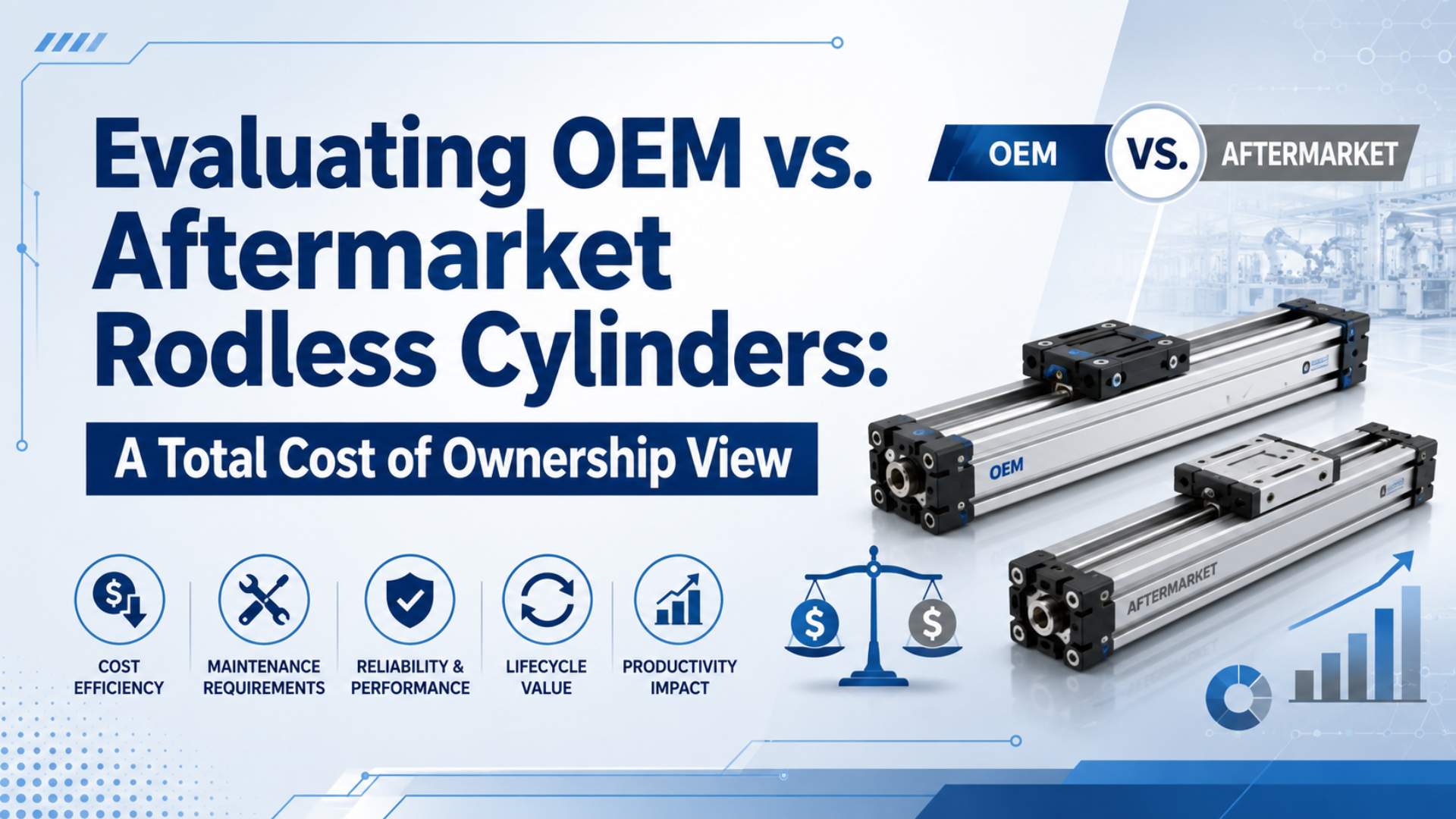
Aftermarket rodless cylinders are not automatically cheaper, and an OEM cylinder is not automatically the lower-cost choice. The defensible decision compares purchase and logistics costs only after the replacement has passed dimensional, performance, safety, documentation, and application-acceptance checks. If those gates fail, the apparent saving is irrelevant. NIST notes that more than half of a manufacturer’s spending is in the supply chain on average. Its supplier guidance therefore treats freight, tariffs, longer lead times, inventory, management overhead, and lost sales as total-cost inputs, not purchasing footnotes (NIST Supply Chain Management, updated 2025; retrieved 2026-07-10).
Key Takeaways
- No universal aftermarket saving exists; calculate both options with the same costs and period.
- Matching dimensions don’t prove equal load. SMC reports up to a 30% improvement with unchanged mounting dimensions (SMC, 2025).
- ISO 19973-1 defines reliability testing, not a universal cycle-life threshold (ISO, 2015).
- Prefer OEM when validation or contract risk dominates; qualify alternatives through a controlled machine trial.
OEM replacement means a service part supplied under the original equipment manufacturer’s product and support system.
Aftermarket replacement means a functionally intended substitute supplied outside that original channel; the label alone says nothing about interchangeability or quality.
Risk-adjusted TCO means all costs over the evaluation period, including the expected financial effect of uncertain lead time, rework, downtime, and failure, after qualification evidence is considered.
Fit isn’t function.
What Does OEM vs. Aftermarket Mean for a Rodless Cylinder Replacement?
The purchasing labels describe the sales channel, not a proven engineering result. One SMC MY1B update kept the same mounting dimensions as its predecessor while increasing maximum load mass and allowable moment by as much as 30%. That is direct evidence that a familiar interface can conceal a different performance envelope (SMC MY1B, updated 2025; retrieved 2026-07-10).
For a buyer, “OEM” normally bundles the original drawing revision, catalog ratings, accessory ecosystem, warranty path, and change-control process. That bundle may reduce engineering work even when its unit price is higher. “Aftermarket” covers a wider field: it can mean a documented drop-in replacement, a configurable equivalent that needs brackets or sensor changes, or merely a product with a similar photograph and nominal stroke. Treat every “direct replacement” label as an evidence claim. The useful question isn’t “Which brand is better?” It is “Which option gives this machine the lowest accepted cost after proving the required function?” That shifts the decision from brand preference to an auditable acceptance record. The distinction matters because the buyer owns the consequences when the claimed equivalence is incomplete. Any hidden difference becomes the buyer’s commissioning problem, downtime exposure, spare-parts burden, or warranty dispute long after the quotation is approved.
The distinction also matters when comparing a rodless layout with other actuator architectures. The existing guide to rodless cylinder advantages explains the space and load-path reasons for selecting the technology; the present article begins after that architecture decision and focuses on replacement sourcing.
What Belongs in the Total Cost of Ownership Comparison?
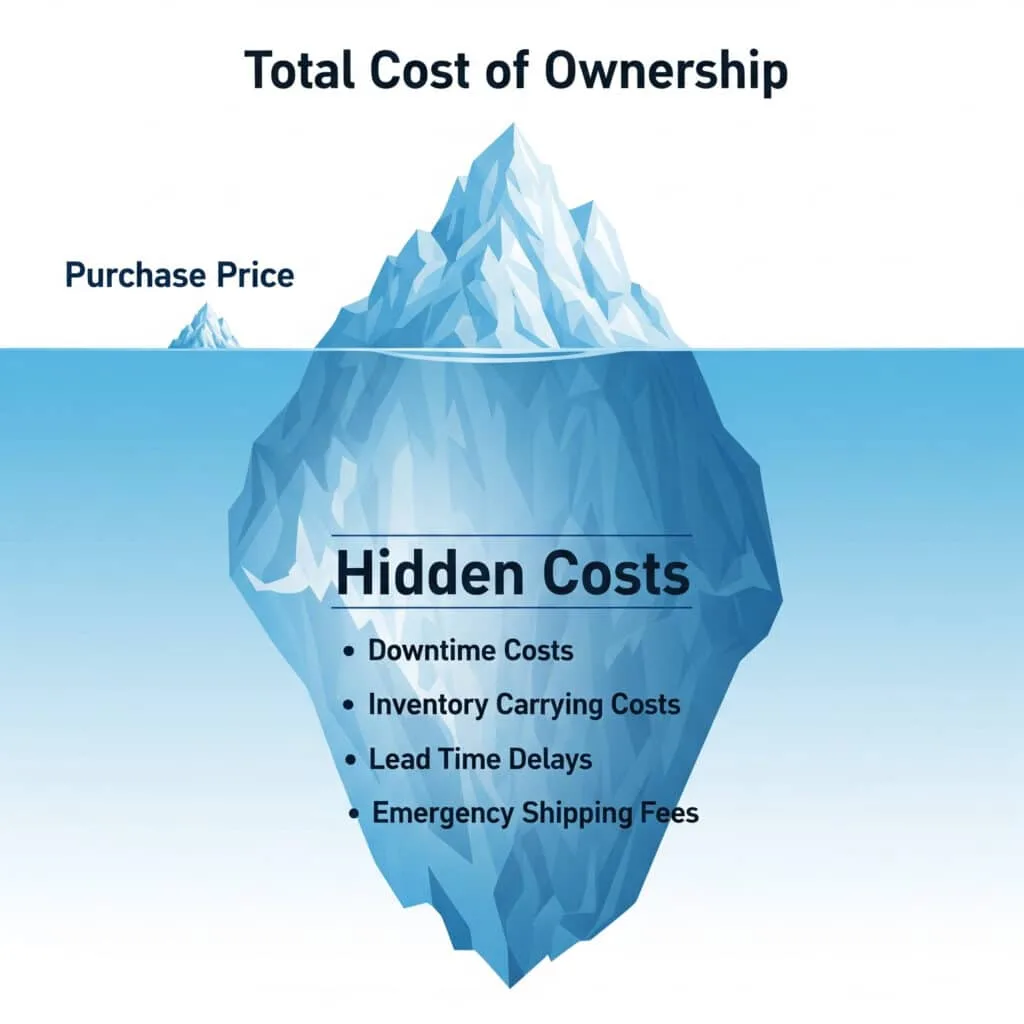
NIST says more than half of a manufacturer’s spending is in the supply chain on average. Therefore, rodless-cylinder TCO should include delivered price, engineering, qualification, inventory, maintenance, and expected downtime, not only two quoted unit prices (NIST Supply Chain Management, updated 2025; retrieved 2026-07-10).
Use one evaluation period and the same assumptions for both candidates:
evaluation-period TCO
= purchase price and normal freight
+ tariffs, taxes, brokerage, and emergency logistics
+ engineering, adapters, sensors, and controls changes
+ supplier qualification and incoming inspection
+ machine trial and production acceptance
+ inventory carrying cost and obsolescence
+ planned maintenance, seal kits, and labor
+ expected downtime and failure consequence
- recoverable warranty credits or residual value
The expected-cost rows should expose uncertainty rather than hide it. For example:
What would reverse the decision?
expected downtime cost
= probability of a qualifying event
x hours of production impact per event
x site-approved cost per affected hour
Do not copy a downtime rate from another factory. Finance, operations, and maintenance should agree on the local rate and whether it includes only lost contribution margin or also scrap, restart labor, missed delivery penalties, and downstream disruption.
| TCO row | OEM evidence to collect | Aftermarket evidence to collect |
|---|---|---|
| Part and logistics | Quote, Incoterm, lead-time commitment, expedite policy | The same four items on the same quantity and destination |
| Engineering change | Original drawing revision and accessory list | Marked-up interchange drawing, adapter and sensor changes |
| Qualification | Existing approval status and service history | Sample cost, inspection plan, documents, trial labor |
| Inventory | Minimum order, safety stock, shelf-life constraints | Minimum order, replenishment variability, dual-source potential |
| Maintenance | Seal kit, wear strip, tool, and labor requirements | Equivalent parts list, repair instructions, local stock |
| Failure exposure | Site history for the exact duty | Test evidence plus a conservative pilot estimate |
| Warranty recovery | Written duration, exclusions, return logistics | Written duration, exclusions, return logistics |
Price isn’t proof.
This framework complements the broader cylinder versus electric actuator cost comparison, which compares technologies while this worksheet compares sources for an already selected pneumatic architecture.
How Do You Verify Dimensional and Functional Compatibility?
Compatibility requires separate fit and function approvals. Parker’s standard OSP-P technical specifications list 10 to 80 mm bores, up to 6,000 mm stroke, and 8 bar maximum pressure. SMC MY1B data lists 25, 32, and 40 mm bores with a 0.1 to 0.8 MPa range (Parker OSP-P; SMC MY1B, retrieved 2026-07-10).
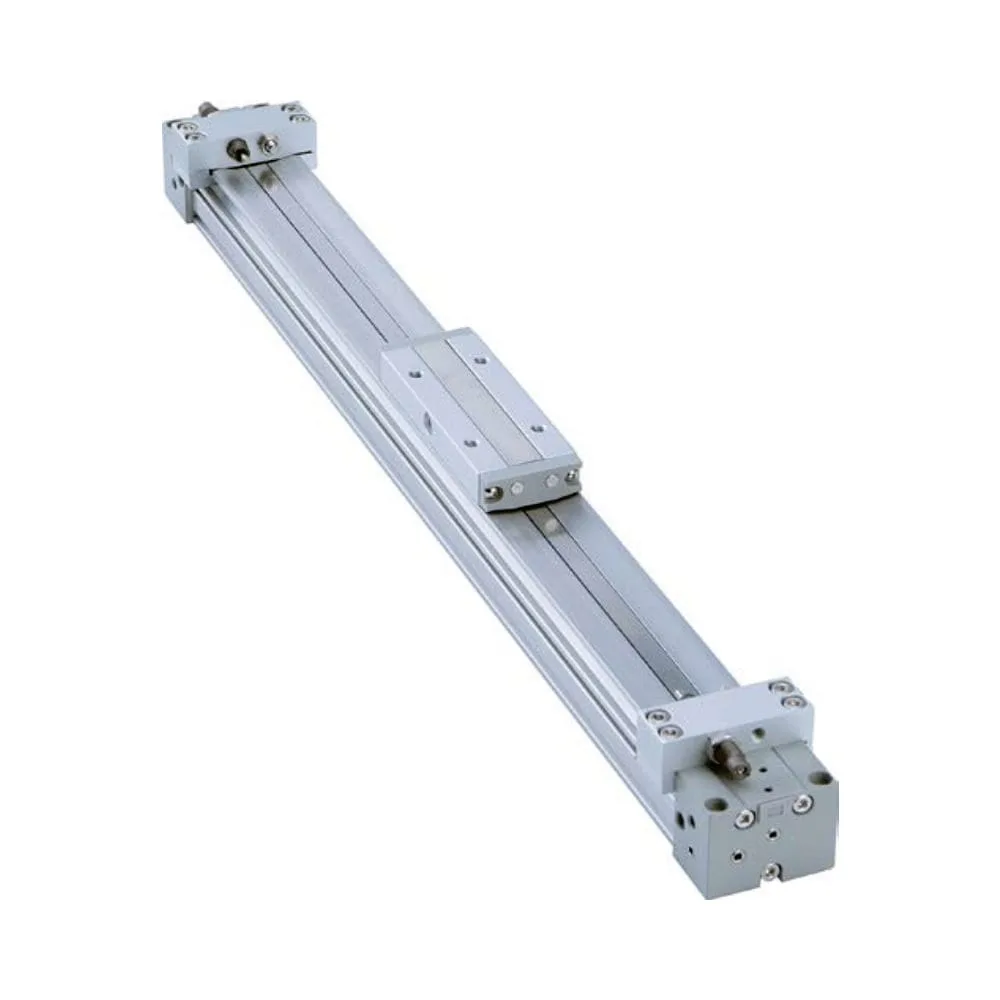
Start with the identification plate and the latest drawing revision. Photograph the installed orientation, ports, sensors, brackets, cable routing, and end clearances before removal. Then record the following:
Would a shifted sensor still clear the machine?
- Core geometry: bore, usable stroke, retracted length, overall length, and permitted overtravel
- Mechanical interface: mounting-hole pattern, locating features, profile dimensions, and carriage interface
- Air path: port thread and location, tube size, valve flow path, exhaust restriction, and working pressure at the actuator during motion. A thread adapter does not prove equal flow.
- Load case: moving mass, center-of-gravity offsets, and pitch, roll, and yaw moments in both directions
- Motion: required speed, cycle rate, cushion or shock-absorber arrangement, and hard-stop location
- Controls: sensor type, voltage, logic, connector, switching position, and controller timing
- Environment: temperature, contamination, washdown, corrosion, cleanroom, lubrication, and material restrictions
- Serviceability: maintenance access, seal-kit contents, special tools, instructions, technician skill, and permitted repair time. Note any task that requires removing the full axis from the machine.
The step-by-step ISO 6432 replacement guide uses the same discipline of measuring the installed interface, although ISO 6432 is a different cylinder family and isn’t the dimensional standard for rodless cylinders. Before purchase approval, ask the supplier for a dimension-by-dimension interchange statement. “Suitable for model X” is weaker than a controlled drawing that identifies every difference and states which performance ratings apply.
Performance Evidence: Compare the Rated Envelope, Not the Logo
The cited standard catalog figures span 5,000 mm for SMC MY1B, 6,000 mm in Parker OSP-P technical specifications, and 8,500 mm for Festo DGC. These are screening limits, not proof of equivalence (SMC; Parker; Festo, retrieved 2026-07-10).
Parker separately promotes engineered OSP-P long-stroke systems up to 41,000 mm. The 6,000 mm value used below is the page’s standard technical-specification entry, not an absolute ceiling for every engineered OSP-P configuration (Parker OSP-P, retrieved 2026-07-10).
The chart uses the three cited documents at their published standard values; it deliberately does not normalize guide variants or engineered extensions.
For the selected model, compare the complete rated envelope:
Can its cushion stop your moving mass at production speed?
For instance, a port adapter can restore thread fit while still restricting flow.
| Parameter | Evidence required | Common false shortcut |
|---|---|---|
| Force | Rated force at actual dynamic pressure, by bore | Bore matches, so force matches |
| Load and moments | Allowable mass plus pitch, roll, and yaw at the required speed | Carriage bolt pattern matches |
| Speed and duty | Permitted speed, cycle rate, thermal limits, and lubrication conditions | Maximum catalog speed is continuous duty |
| Stopping | Cushion or shock-absorber capacity at moving mass and impact speed | Both products have adjustable cushions |
| Guidance | Guide type, preload or play, deflection, and life basis | Both are called “guided” |
| Air interface | Port standard, flow area, pressure range, and exhaust arrangement | Thread adapter solves every difference |
| Environment | Temperature, corrosion, ingress, cleanroom, and materials | Aluminum profiles look alike |
Pressure-area force is only a screening calculation. Use the force tool above to check whether a bore is plausible, then confirm friction allowance, guide moments, dynamic pressure, and the exact manufacturer rating. A high static regulator reading does not prove adequate pressure at the cylinder during motion; the site guide on pneumatic pressure drop explains where those losses arise. From our analysis of the cited catalogs, the most dangerous “drop-in” claim is one that compares only the mounting drawing. The SMC example with unchanged mounting dimensions and a 30% higher load-and-moment rating proves that identical fit can coexist with materially different capability. The reverse can also occur: a part may fit but carry less.
How Should Reliability and Supplier Quality Be Qualified?
ISO 19973-1:2015 defines general procedures for reliability testing, data processing, calculation, and reporting for pneumatic components. It also recognizes that service life can vary with the application. It does not establish “10 million cycles” as a universal acceptance value for rodless cylinders (ISO 19973-1, reviewed and confirmed current in 2021; retrieved 2026-07-10).
A useful reliability claim names the tested configuration and conditions. Ask for:
What exactly counted as a failure?
- Identify the exact model, bore, stroke, guide, seals, sensors, and production revision tested.
- State sample quantity and failure definition.
- Reproduce the operating conditions: pressure, speed, load, moment, cycle profile, temperature, air quality, lubrication, and any allowed adjustment during the test.
- Supply results with the calculation method and report approval.
- Link the supplied batch to the tested design through traceability records.
- Define change-notification rules. They should cover seals, grease, extrusion, machining, critical subcontractors, test methods, and any revision that can alter fit or rated performance.
Supplier quality also includes response after a problem. Review inspection capability, nonconformance handling, root-cause format, corrective-action timing, spare-parts availability, warranty exclusions, return logistics, and who pays removal and reinstallation labor. A certificate is useful evidence of a system; it is not a substitute for application-specific product data.
Use a staged approval:
For recurring inspections, seal work, contamination checks, and baseline records, connect the acceptance plan to the rodless cylinder preventive-maintenance checklist. That keeps sourcing evidence from disappearing after installation.
When Is the OEM Part the Lower-Risk Choice?
OEM is lower-risk when substitution could alter a safety-related or poorly documented machine function, when contract terms restrict changes, or when validation exposure exceeds the credible sourcing benefit. OSHA requires at least annual energy-control inspections, so altered isolation needs formal review (OSHA 1910.147).
Who owns revalidation after a safety-related change?
The OEM option is often the lower-risk choice when one or more of these conditions apply:
- Safety or retained load. The axis protects people, supports a vertical or suspended load, or performs a safety-related function that has not been separately engineered.
- Missing design authority. The installed cylinder is custom, obsolete, or poorly documented, and no controlled interchange drawing exists.
- Certification, customer validation, insurance, lease, or warranty terms restrict substitutions.
- The controller depends on proprietary sensing or braking.
- Expensive qualification window. The machine cannot spare enough guarded trial time, and validation downtime would cost more than the credible sourcing benefit.
- The OEM has unique service data or a proven installed history that another source cannot yet reproduce.
OEM isn’t shorthand for “no review required.” Confirm the current revision and written lead-time or warranty terms because interfaces can stay fixed while capability changes; give both candidates the same evidence burden wherever machine risk is the same.
When Can an Aftermarket Replacement Make Sense?
An aftermarket replacement can make sense when documented interchange, trial access, and a non-safety-critical duty make validation practical. In one non-cylinder NIST case, structured planning cut inventory of key components by 30%; that supports disciplined supply planning, not cylinder equivalence (NIST Tapecon case, created 2026; retrieved 2026-07-10).
Can the site test a sample before it becomes emergency stock?
Good candidate situations include a standardized interface with complete drawings, non-safety-critical duty, accessible trial time, multiple identical axes, high exposure to single-source lead time, or a planned obsolescence project. In these cases, the first unit is a qualification unit, not emergency proof by production outage. The Tapecon result is one manufacturer’s planning outcome, not a rodless-cylinder aftermarket benchmark. Its relevance is narrow: demand, supply, and inventory decisions improve when the assumptions are explicit. It doesn’t prove that any substitute part is interchangeable.
Before approving an alternative supplier, put these items into the purchasing record:
- Exact approved model mapping
- Controlled interchange drawing with revision and exceptions
- Required certificates, inspection report, and traceability
- Sample and production acceptance criteria, including test duration, load, speed, environment, allowable leakage, sensor response, sign-off role, retained records, and the disposition path for every observed deviation
- Warranty, corrective-action, and change-notification terms
- Approved seal kit, accessories, sensor list, and service instructions
- Revalidation triggers after design, material, process, or site-duty changes
Do not launch qualification during an unplanned outage unless the organization accepts the added risk; emergency installation pressure makes skipped measurements and undocumented compromises more likely.
Build a Site-Specific TCO Worksheet and Acceptance Plan
ISO 55001:2024 reduces the decision to three linked dimensions: performance, risk, and expenditure over the asset life cycle; your worksheet should show all three on the same time horizon. A five-year period may suit one site, while a planned machine-retirement date may suit another (ISO 55001, retrieved 2026-07-10).
Which assumption can reverse the result?
Create four workbook tabs or sections:
1. Fixed Commercial Inputs
Record quoted price, quantity, currency, Incoterm, normal and expedited freight, tariff treatment, minimum order, payment terms, lead-time commitment, and quote validity. Convert both options to the same delivered basis.
2. One-Time Qualification Inputs
Enter drawing review hours, sample parts, metrology, fixtures, adapters, controls changes, risk assessment, bench test, machine trial, validation material, and approval labor. Amortize these only across the credible purchased quantity, not an optimistic forecast.
3. Recurring Operating Inputs
Use site records for planned labor, seal kits, lubricants, incoming inspection, safety stock, storage, cycle-related replacement, and expected downtime; the related cylinder and actuator maintenance comparison helps separate preventive work from failure response.
4. Acceptance and Decision Rules
State the pass/fail requirements before the sample arrives. Include dimensions, leakage, full-stroke operation, dynamic pressure, loaded cycle time, sensor repeatability, stop behavior, temperature, noise, sustained-cycle duration, post-test inspection, and required approvals. Record actual results and deviations.
Use scenarios, not a false single-point answer. At minimum, calculate expected, favorable, and adverse cases for lead time, qualification hours, failure probability, and downtime consequence; require the approved choice to remain explainable if one major assumption moves against it.
Conclusion: Treat Interchangeability as an Engineering Claim
Treat interchangeability as a testable claim, not a purchasing label. SMC reports up to a 30% load-and-moment improvement despite unchanged MY1B mounting dimensions, while NIST says more than half of manufacturer spending is in the supply chain on average. Both facts argue for documented qualification plus site-specific TCO (SMC, 2025; NIST, updated 2025).
Keep the evidence with the machine.
From our research, no supplier label can replace a machine acceptance record.
Choose the OEM when its existing approval, unique documentation, certification path, or lower validation risk outweighs price and lead-time differences; choose an independent replacement when its controlled interchange evidence passes the application test and the risk-adjusted TCO remains lower under credible adverse assumptions.
Use the manufacturer, standards, government, and case-study sources below as the evidence boundary for compatibility review. Before ordering, confirm dimensional fit, load path, sealing system, guidance method, maintenance cost, and downtime risk against the actual machine.
FAQs About OEM vs. Aftermarket Rodless Cylinders
No universal savings, warranty, or life rule applies to every machine. SMC reports up to a 30% performance change with unchanged mounting dimensions, while ISO 19973-1 supplies reliability-test procedures rather than a universal cycle threshold. The answers below therefore require exact product data and site acceptance evidence (SMC, 2025; ISO, 2015).
Does an aftermarket rodless cylinder automatically void the machine warranty?
No. Warranty effect depends on the contract, local law, and whether the substituted part caused the claimed failure. SMC reports up to a 30% load-and-moment change despite unchanged MY1B mounting dimensions, so obtain written warranty guidance and complete a separate engineering review (SMC MY1B, updated 2025).
How much can an aftermarket rodless cylinder save?
No universal percentage exists. NIST says more than half of a manufacturer’s spending is in the supply chain on average, so compare delivered price with qualification, inventory, maintenance, and expected downtime over the same period. A lower quote isn’t proof of lower total cost (NIST, updated 2025).
Which dimensions must match for a drop-in replacement?
Check overall length, mounting, ports, sensors, cushions, and clearance. SMC retained MY1B mounting dimensions while increasing maximum load mass and allowable moment by up to 30%, which proves that fit alone isn’t enough (SMC MY1B, updated 2025). Then verify force, moments, speed, stopping, environment, and duty.
How do I verify aftermarket cylinder quality?
Demand model-specific evidence. Parker’s standard OSP-P data lists 8 bar maximum pressure, while SMC lists a 0.1 to 0.8 MPa MY1B operating range; those figures show why generic “OEM-spec” language is insufficient (Parker; SMC). Finish with inspection, a guarded trial, and recorded acceptance.
When should I stay with the OEM cylinder?
Stay with the OEM when a safety-related or certified function hasn’t been re-engineered, the unit is custom, or qualification exposure exceeds the credible benefit. OSHA requires at least annual inspection of each energy-control procedure, reinforcing formal review when a substitution changes pneumatic isolation or restart behavior (OSHA 1910.147). Document the decision.
Source details and retrieval notes
- NIST Manufacturing Extension Partnership, Supply Chain Management. Supplier evaluation, segmentation, scorecards, alternate sourcing, risk mitigation, and total-cost categories beyond purchase price. Page updated 2025. Retrieved 2026-07-10. https://www.nist.gov/mep/supply-chain
- ISO 55001:2024. Asset-management system requirements built around life-cycle performance, risk, and expenditure. Edition 2, published July 2024. Retrieved 2026-07-10. https://www.iso.org/standard/83054.html
- ISO 19973-1:2015. General procedures for pneumatic-component reliability testing, data processing, calculation, and reporting. It does not set a universal rodless-cylinder cycle-life threshold. Retrieved 2026-07-10. https://www.iso.org/standard/62570.html
- OSHA 29 CFR 1910.147. Control of hazardous energy, including pneumatic and stored energy, verification, and periodic inspection requirements. Retrieved 2026-07-10. https://www.osha.gov/laws-regs/regulations/standardnumber/1910/1910.147
- Parker OSP-P Series. Product-family bore, pressure, force, temperature, and modular-option data. The page lists 6,000 mm in standard technical specifications and separately promotes engineered long strokes up to 41,000 mm. Retrieved 2026-07-10. https://discover.parker.com/OSPPSeries
- SMC MY1B-Z catalog. Product-specific bore, pressure, speed, stroke, and dimensional data for the cited MY1B configuration. Retrieved 2026-07-10. https://ca01.smcworld.com/catalog/en/actuator/MY1B-Z-E/6-2-1-p1183-1199-my1b-z_en/data/6-2-1-p1183-1199-my1b-z_en.pdf
- SMC MY1B new-product page. Reports unchanged mounting dimensions with up to a 30% increase in maximum load mass and allowable moment for the cited update. Updated July 2025. Retrieved 2026-07-10. https://www.smcworld.com/newproducts/en-ph/25/my1b/
- Festo DGC technical documentation. Product-family size, stroke, force, guide, cushioning, and configuration data used in the catalog-envelope comparison. Retrieved 2026-07-10. https://www.festo.com/media/catalog/202768_documentation.pdf
- NIST MEP Tapecon case study. Reports a 30% inventory reduction for key components through a planning project. It is cited as a bounded supply-planning case, not as a cylinder-savings benchmark. Created 2026. Retrieved 2026-07-10. https://www.nist.gov/mep/successstories/2025/tapecon-reduces-inventory-investment-through-improved-sales-and-operations
- Parker Hannifin service video. Thirty-minute OSP-P service-pack repair walkthrough showing maintenance access and procedure. Published 2022-07-05. Retrieved 2026-07-10. https://www.youtube.com/watch?v=cYAzFLYK4wc