

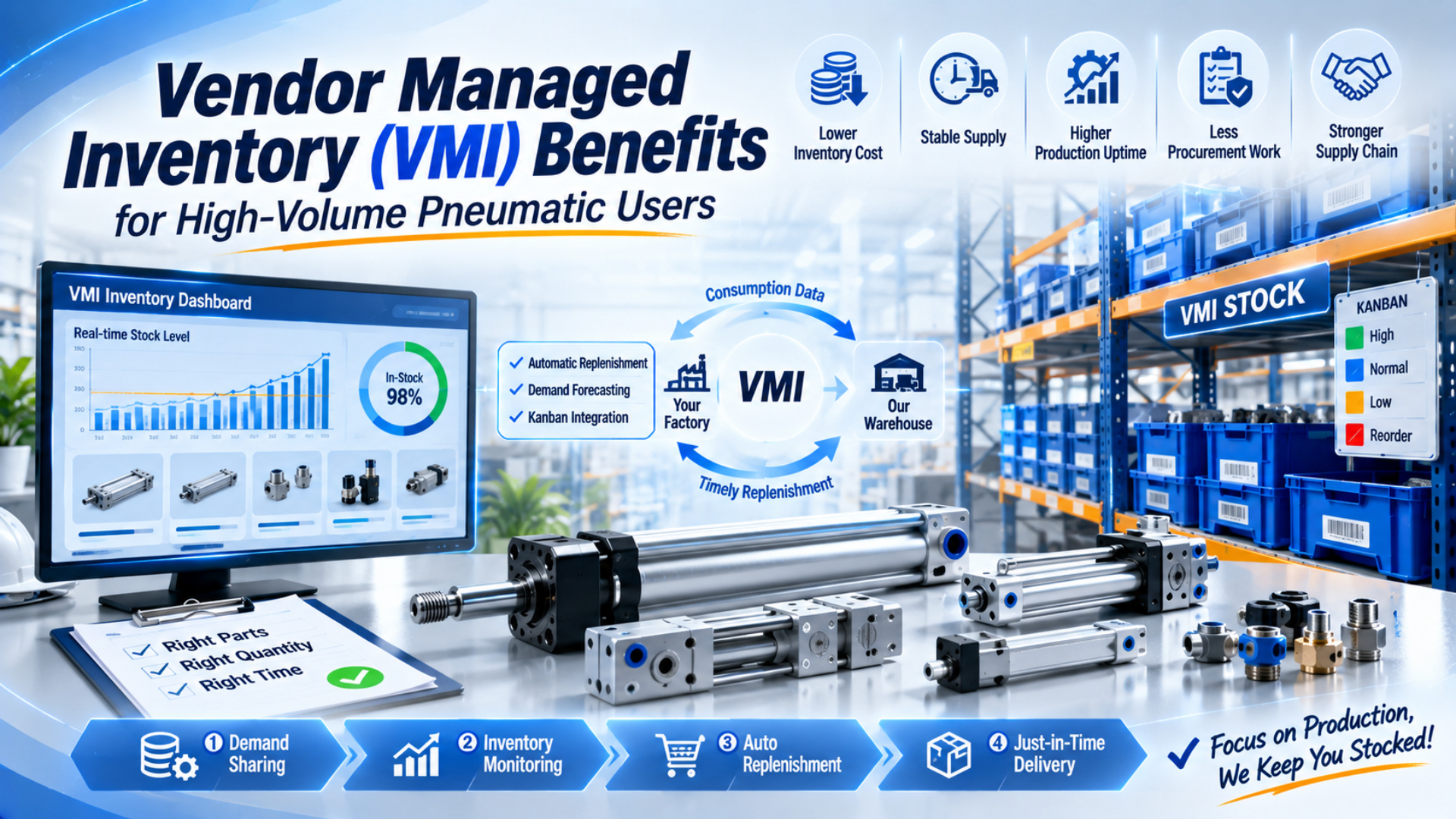
Vendor managed inventory for pneumatic components is a replenishment arrangement in which a supplier uses agreed demand and stock data to plan or initiate supply for a customer location. It can reduce purchasing work and improve part availability. VMI does not automatically transfer ownership, eliminate safety stock, or guarantee a financial return.
For high-volume pneumatic users, the best candidates are repeat-use cylinders, valves, fittings, tubing, repair kits, and accessories with controlled part numbers. Custom actuators, revision-sensitive assemblies, and rarely used emergency spares need different controls. The goal isn’t the smallest inventory balance. It is dependable supply at a measured total cost.
Key Takeaways
- VMI may use consigned or customer-owned stock; ownership depends on the agreement.
- Stable, standardized SKUs are safer pilot candidates than custom or revision-sensitive parts.
- Set min-max ownership, data cadence, exceptions, obsolescence, and exit terms before launch.
- A 10-company field study reported 55% fewer stockouts, but its retail results aren’t a pneumatic guarantee.
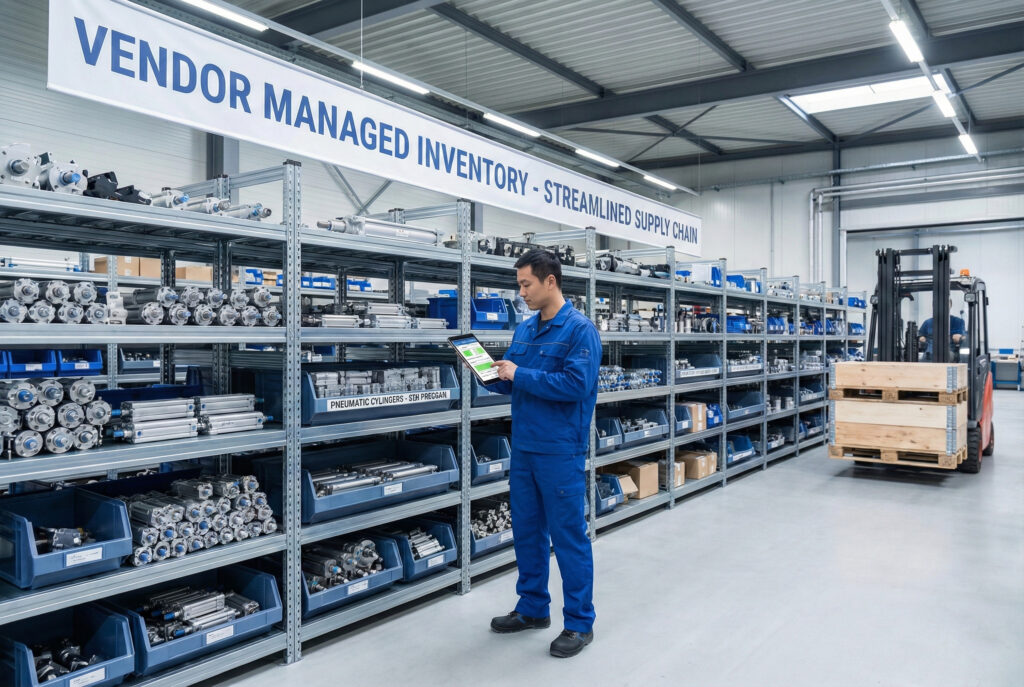
What Does VMI Actually Change in Pneumatic Purchasing?
Oracle documents VMI as a process in which either the supplier or the buying enterprise can own inventory planning and replenishment activity. That distinction matters: the supplier can monitor stock and create replenishment requests while normal purchase orders, receipts, invoices, and buyer approvals remain in place (Oracle, 2026).
In a conventional purchasing loop, the plant notices a shortage, raises a requisition, issues a purchase order, and waits for delivery. Under VMI, the supplier receives agreed inventory and demand signals, compares them with the replenishment policy, and proposes or executes supply before the shortage reaches production.
That is the operational handoff. Commercial ownership is a separate choice.
SAP describes both consigned and non-consigned supplier-managed inventory. With consigned stock, the supplier retains ownership until consumption. With non-consigned stock, the customer takes ownership when the goods are received (SAP). Oracle PeopleSoft makes the same distinction and states that VMI goods can be either consigned or non-consigned (Oracle PeopleSoft).
| Arrangement | Who plans replenishment? | Who owns stock at the plant? | Normal commercial trigger |
|---|---|---|---|
| Standard purchasing | Buyer | Buyer after the agreed receipt or title event | Purchase order |
| Non-consigned VMI | Supplier or shared process | Buyer after the agreed receipt or title event | Replenishment request and purchase order |
| Consigned VMI | Supplier or shared process | Supplier until the agreed consumption or aging event | Consumption advice or ownership change |
| Two-bin or Kanban replenishment | Buyer, supplier, or shared process | Contract-dependent | Empty-bin, card, scan, or quantity signal |
| Supplier hub stock | Supplier usually plans hub inventory | Depends on hub and call-off terms | Release, call-off, or shipment request |
Don’t use “VMI” as shorthand for all five arrangements. The RFQ and contract should identify the planning owner, stock owner, ordering document, invoice event, and party responsible for discrepancies.
Which Pneumatic SKUs Are Good VMI Candidates?
SAP lists four conditions that favor VMI: important customer demand, standardized repeat-use products, stable requirements, and meaningful order-processing costs. Pneumatic programs fit this pattern when part numbers are controlled and consumption repeats; erratic custom builds or frequent engineering changes weaken the signal (SAP, retrieved 2026).
Start with SKU eligibility, not annual spend alone. A low-cost fitting used every shift may deserve VMI before an expensive cylinder that fails once every several years. Conversely, a low-usage safety-critical part may justify protected stock without being suitable for automatic consumption-based replenishment.
Use three separate dimensions:
- Consumption behavior: frequency, variability, seasonality, project spikes, and history quality.
- Supply exposure: replenishment lead time, minimum order quantity, manufacturing constraints, and substitute availability.
- Engineering exposure: drawing revision, seal material, voltage, port thread, mounting interface, and approval status.
| SKU profile | Suggested treatment | Reason |
|---|---|---|
| Standard fittings, tubing, silencers, and common valves with steady use | Strong VMI candidate | Frequent consumption creates a useful replenishment signal |
| Standard cylinders used across several machines | VMI candidate after part-number control | Aggregated demand can be stable, but mounting and sensor variants must remain visible |
| Seal kits and repair items with repeat maintenance demand | Conditional VMI candidate | Shelf life, elastomer compatibility, and kit revision need controls |
| Unique engineered cylinders or machine-specific manifolds | Buyer-planned or separately reviewed | A low stock balance may hide long recovery time and revision risk |
| Safety-related valves or lock units | Protected critical spare with controlled replenishment | Availability matters, but substitution and approval rules must be stricter |
| Obsolete or declining machine-platform parts | Exit or last-buy plan | Automatic replenishment can create stranded inventory |
SKU standardization often has to come first. A plant carrying several equivalent cylinder variants should review its pneumatic cylinder standardization strategy before setting min-max levels. Where interchangeability is claimed, confirm the actual interface through an ISO 15552 supplier interchangeability review or the applicable NFPA dimensional standard.
In our experience, part-number discipline is the strongest early indicator of whether a pneumatic VMI pilot will stay under control. If technicians, purchasing, and the supplier use different numbers for the same component, the inventory signal becomes unreliable before the replenishment rule even runs.
What Data Must the Buyer and Supplier Share?
SAP’s documented supplier-managed inventory workflow has five main steps, beginning with material designation and demand sharing and ending with supplier ship notices. Between them, the parties exchange stock levels, min-max settings, shipment plans, and schedule information. Missing or stale data breaks the replenishment decision even when the commercial agreement is sound (SAP, 2026).
The data contract should be written as carefully as the supply contract. For each field, name the system of record, update frequency, time zone, unit of measure, location, correction method, and exception owner.
At minimum, share:
- approved supplier and customer part numbers;
- site, store, cabinet, or subinventory location;
- usable on-hand quantity;
- quarantined, damaged, reserved, and customer-owned quantity;
- open purchase orders and in-transit shipments;
- consumption or issue history;
- forecast demand and known shutdowns or project spikes;
- agreed minimum, maximum, and order multiple;
- supplier lead time and shipment calendar;
- part revision, lifecycle status, and approved substitutes.
GS1’s EPCIS standard organizes traceability information around business events and can represent product location, movement, and availability across distributed sites. A plant doesn’t need EPCIS to run a small VMI cabinet, but the standard shows why shared identifiers, locations, timestamps, and event meanings matter when several systems exchange inventory data (GS1).
| Data field | System of record | Minimum control question |
|---|---|---|
| On-hand quantity | Warehouse or point-of-use system | Does it exclude quarantine, scrap, and reserved stock? |
| Consumption | Issue, scan, machine, or maintenance record | What event counts as consumption? |
| In-transit quantity | Supplier ASN or carrier record | When does it reduce the replenishment requirement? |
| Forecast | Buyer planning system | Which demand is firm, planned, or informational? |
| Part revision | Engineering or item master | Who blocks replenishment after a design change? |
| Substitute | Approved-parts list | Can the supplier ship it without buyer approval? |
| Min-max policy | Agreed VMI record | Who may change it, and how is the change audited? |
Access should follow least-privilege rules. Share the fields needed to plan and reconcile the program, not unrestricted ERP access. Require named accounts, removal of dormant users, an incident contact, and a fallback method for periods when the integration is unavailable.
We’ve found that teams often debate the min-max quantities too early. First agree on what an issue, reservation, quarantine, return, and ownership change mean in each system. Otherwise, the buyer and supplier can report different available quantities while both datasets appear internally correct.
How Should Min-Max Replenishment Be Governed?
Oracle defines two possible sources for VMI minimum and maximum quantities: the supplier or the enterprise. Its workflow triggers attention when on-hand inventory falls below the minimum, then creates a replenishment request that can become a requisition and purchase order. The party owning the thresholds must therefore be explicit (Oracle, 2026).
A min-max pair is a policy, not a permanent property of the part. It depends on demand, lead time, review cadence, shipment quantity, service objective, and the consequences of shortage. Review it when any of those inputs changes.
For pneumatic components, the stock position must also respect configuration identity. Ten cylinders aren’t interchangeable inventory if they contain different strokes, sensor grooves, rod threads, cushions, seal materials, or mounting kits. Count usable units by approved configuration, not merely by product family.
The agreement should answer these questions:
- Does the trigger use physical on-hand, available stock, or on-hand plus in-transit?
- Are open reservations and quarantine quantities deducted?
- Is replenishment rounded to a pack, pallet, batch, or minimum order quantity?
- Who may override a suggested quantity?
- What happens after an unplanned demand spike?
- When is the policy recalculated?
- How are shutdowns, promotions, new machines, and discontinued equipment handled?
Use exception bands rather than silent automation. A routine replenishment within agreed limits may proceed automatically. An order above the normal maximum, a sudden demand increase, a revision mismatch, or a missing inventory update should stop for review.
Which Contract Terms Prevent VMI Disputes?
Oracle’s consignment lifecycle identifies five linked stages: agreement and order, receipt, costing, consumption and consumption advice, then invoice and payment. That sequence illustrates why physical possession, accounting ownership, replenishment authority, and payment are different events and must be written separately (Oracle, 2025).
At a minimum, the VMI agreement should define:
| Contract area | Questions to settle before launch |
|---|---|
| Scope | Which sites, locations, SKUs, revisions, and approved substitutes are included? |
| Planning authority | Who owns min-max settings, forecasts, overrides, and replenishment approval? |
| Inventory ownership | Is stock consigned or customer-owned, and exactly when does title transfer? |
| Risk of loss | Who bears damage, theft, contamination, and unexplained count differences? |
| Price | Which price applies at shipment, receipt, consumption, or invoice? How are changes approved? |
| Consumption | Which scan, issue, work order, or ownership-change event creates liability? |
| Service | How are availability, fill rate, response time, and escalation measured? |
| Obsolescence | Who owns excess stock after a forecast change, redesign, or machine retirement? |
| Returns | Which unused, aged, superseded, or damaged goods may be returned and at whose cost? |
| Audit | How often are counts reconciled, and how are adjustments approved? |
| Data and security | Which systems, fields, users, retention periods, and incident duties apply? |
| Exit | How can either party end the program, settle stock, retrieve data, and continue supply? |
The supplier should not receive blanket permission to substitute pneumatic components. An apparently equivalent solenoid valve can differ in voltage, connector, duty, manual override, porting, flow, or environmental approval. Use an OEM replacement compatibility checklist and require buyer approval for substitutions outside a pre-approved cross-reference.
How Can Buyers Build a Defensible VMI Business Case?
A field study of 10 Fortune 500 consumer-products manufacturers reported average customer inventory reductions of 32% and stockout reductions of 55% under continuous replenishment. The study concerned retail distribution, not pneumatic MRO, so its figures are evidence that improvement is possible, not a forecast for another plant (Industrial Marketing Management, 1999).
Model the decision with the plant’s own baseline. Don’t begin with a supplier’s savings percentage.
Collect at least one representative operating period for the pilot SKUs:
- average and maximum usable inventory;
- stockout incidents and duration;
- emergency freight and premium-buy events;
- purchase orders, order lines, receipts, and invoices processed;
- cycle-count adjustments and unexplained discrepancies;
- obsolete, expired, or superseded inventory;
- supplier lead-time performance;
- maintenance or production events affected by part unavailability;
- internal labor required to plan, order, receive, reconcile, and expedite.
Then compare like with like. Include the VMI fee, storage fixtures, scanners, software integration, cycle counts, price changes, inbound freight, transition labor, and exit inventory. Treat released working capital separately from recurring operating savings. Capital released from stock is not the same as annual profit.
Research also shows that VMI isn’t automatically cheaper in every demand condition. A 2025 two-echelon model found lower VMI cost when demand decreased, but lower traditional-system cost as demand increased in the modeled scenario (Transportation Research Procedia, 2025). The practical lesson is simple: test the policy against demand variability instead of presenting one universal ROI.
Pneumatic VMI KPI Scorecard
Oracle’s supplier portal exposes seven relevant information groups, including replenishment status, min-max thresholds, on-hand quantity, replenishment measures, refresh status, item details, and historical transactions. A useful scorecard should connect those operational records to service, inventory, data quality, and commercial outcomes (Oracle, 2026).
Define every KPI before setting a target:
| KPI | Recommended definition | Why it matters |
|---|---|---|
| SKU availability | Percentage of scheduled observation points with usable stock above zero | Shows whether the item was physically available |
| Line fill rate | Order lines supplied in full by the required date divided by eligible lines | Prevents partial shipments from looking complete |
| Stockout incidents | Count of eligible SKU-location shortages during the period | Makes repeated small failures visible |
| Expedite rate | Eligible replenishments requiring premium intervention divided by total replenishments | Tests whether the policy is stable |
| Inventory turns | Annualized consumption cost divided by average eligible inventory cost | Shows whether stock is moving |
| Excess and obsolete inventory | Value or units outside the agreed disposition policy | Captures the downside of over-replenishment |
| Count accuracy | System quantity matching verified physical quantity within the agreed tolerance | Tests the input used for replenishment |
| Data latency | Time from physical event to availability in the shared VMI record | Exposes stale signals |
| Supplier response time | Time from a defined exception to acknowledgment and corrective plan | Tests exception handling |
| Total managed cost | Agreed procurement, holding, expedite, program, and discrepancy costs | Keeps savings claims comparable |
“Availability” and “fill rate” aren’t interchangeable. A cabinet may contain one cylinder and therefore appear available while still being unable to fill an order for four. Likewise, a high fill rate can hide excess inventory. Read the service, stock, exception, and cost measures together.
A Controlled Pneumatic VMI Pilot
Oracle allows a VMI relationship to be scoped at either organization or subinventory level, and an item can have only one managing supplier per organization or subinventory. Those two scope choices support a contained pilot: use one location, a controlled SKU list, and explicit ownership before expanding (Oracle, 2025).
Start with a pilot whose boundaries are easy to inspect:
- Freeze scope. List the location, approved part numbers, revisions, ownership model, documents, and users.
- Clean master data. Resolve duplicate part numbers, unit conversions, pack quantities, obsolete revisions, and unapproved substitutes.
- Establish the baseline. Record inventory, service, exceptions, workload, and cost definitions before changing the process.
- Shadow the policy. Let the supplier calculate suggested replenishment while the buyer checks results without automatic release.
- Control go-live. Enable routine replenishment only inside agreed limits and route exceptions to named people.
- Review and decide. Expand, revise, or exit based on the predefined scorecard rather than a single savings claim.
From what we’ve seen, shadow planning catches the mundane errors that create expensive downstream problems: reversed units, wrong pack quantities, stale lead times, duplicate part numbers, and stock assigned to the wrong location. Correct those records before allowing routine replenishment to release automatically.
Keep maintenance involved throughout the pilot. Technicians often know which apparent substitutes fail at the machine, which kits have revision issues, and which “rare” spares protect the longest downtime. Their input should connect with the plant’s pneumatic actuator maintenance checklist and its rodless-cylinder preventive maintenance plan.
The exit test is as important as the launch test. Before go-live, simulate how the plant would recover its item master, open orders, ownership records, consigned stock, and replenishment responsibility if the supplier relationship ended. A program that cannot be unwound safely creates dependency rather than resilience.
Pneumatic VMI FAQs
SAP documents two ownership variants within supplier-managed inventory, consigned and non-consigned, while Oracle permits planning ownership and min-max control to be assigned separately. These options explain why a useful VMI FAQ begins with contract structure and SKU suitability, not a universal spending threshold or guaranteed savings percentage (SAP, 2026).
Does VMI mean the supplier owns every pneumatic component until it is used?
No. Supplier ownership until consumption describes consigned inventory. A VMI program can also use non-consigned stock that becomes customer-owned at receipt. The agreement must identify the title-transfer event, risk of loss, consumption record, invoice trigger, price basis, and treatment of unused or obsolete stock.
How much pneumatic spend is required before VMI makes sense?
There is no universal annual-spend threshold. Evaluate SKU frequency, demand stability, procurement workload, replenishment lead time, shortage consequence, and supplier capability. A frequently consumed low-cost fitting may be a better VMI candidate than an expensive custom cylinder with sporadic demand and frequent revisions.
Should every critical pneumatic spare be placed in VMI?
No. Criticality can justify protected stock, but it does not make demand predictable or automatic replenishment safe. Unique cylinders, safety-related valves, and revision-sensitive assemblies may need buyer-controlled stock, engineering approval for substitutes, or a separate emergency-spares agreement even when common consumables use VMI.
What happens when the supplier misses the agreed service level?
The contract should define the metric, measurement source, review period, exclusions, escalation time, recovery plan, and commercial remedy. It should also preserve an emergency buying route and data access. A target without a shared definition of availability, fill rate, or response time is difficult to enforce.
Can a plant use more than one VMI supplier?
Yes, across different SKU or location scopes. Within each scope, assign one accountable replenishment owner and prevent overlapping orders. Oracle’s cloud workflow permits only one managing supplier for an item within an organization or subinventory, illustrating the need for clear boundaries even when the plant has several VMI partners.
Sources and technical references
- Oracle: Vendor-Managed Inventory Components, planning ownership and replenishment workflow; retrieved 2026-07-26.
- Oracle: Minimum and Maximum Inventory Thresholds, supplier or enterprise threshold ownership; retrieved 2026-07-26.
- Oracle: Consigned Inventory Lifecycle, title transfer and settlement events; retrieved 2026-07-26.
- SAP: Supplier-Managed Inventory, consigned and non-consigned VMI variants; retrieved 2026-07-26.
- GS1: EPCIS and Core Business Vocabulary, shared supply-chain event data; retrieved 2026-07-26.
- Industrial Marketing Management: Continuous Replenishment Field Study, 10-company field study published in 1999; retrieved 2026-07-26.
- Transportation Research Procedia: VMI and Traditional-System Cost Comparison, modeled demand-dependent cost comparison published in 2025; retrieved 2026-07-26.