

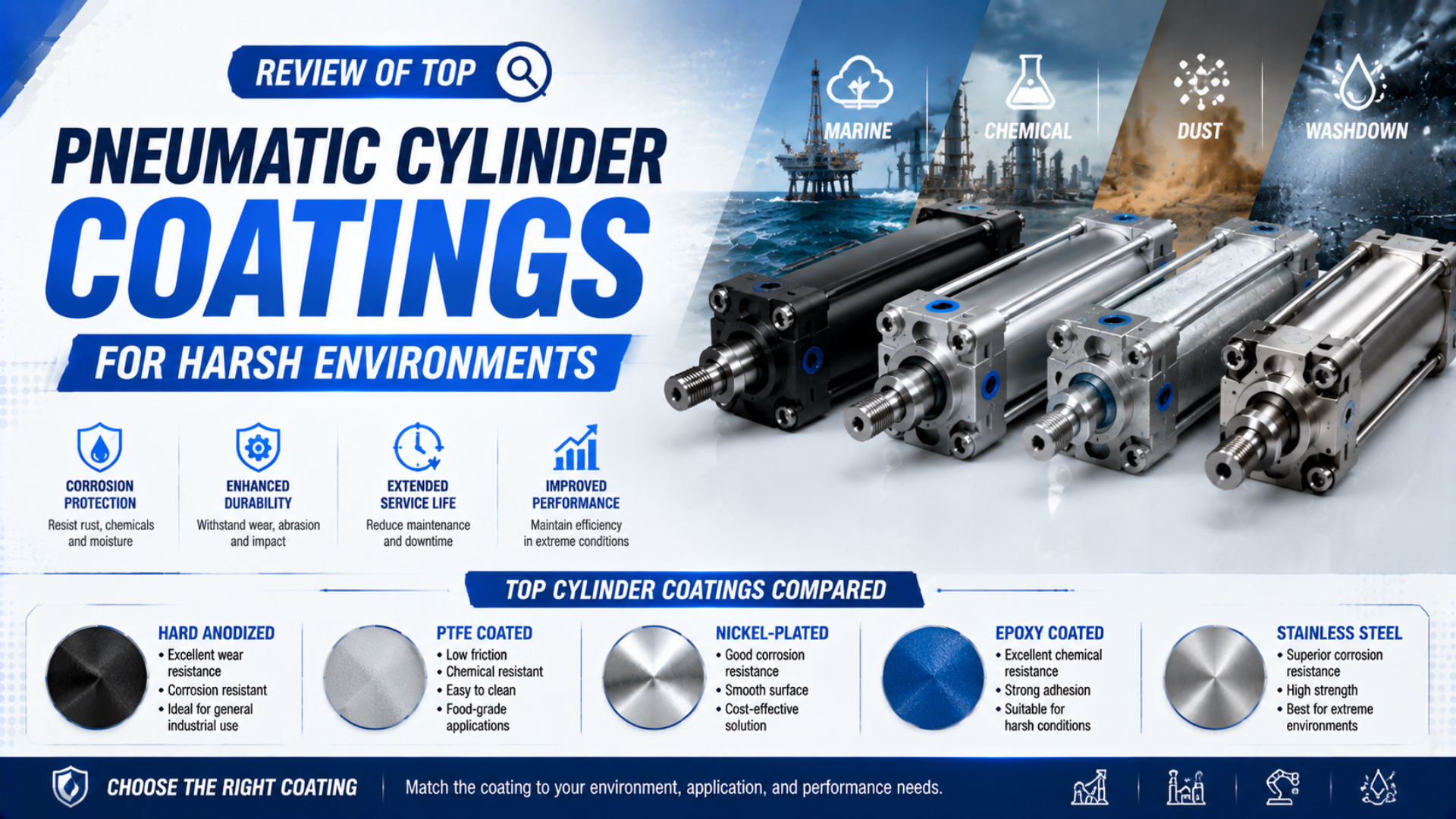
There is no single best pneumatic cylinder coating for every harsh environment. The correct specification starts with the actual exposure, identifies which cylinder components face it, and assigns a compatible material or surface treatment to each one. A hard rod finish, a protected aluminum barrel, and corrosion-resistant fasteners solve different problems.
Salt-spray hours should not be used as a universal league table. ISO 9227:2022 defines three artificial-atmosphere methods, yet explicitly says they are not intended to rank different materials or predict long-term corrosion resistance (ISO 9227, 2022). Treat the result as one controlled quality check tied to a named product specification.
Key Takeaways
- ISO 9227 defines three salt-spray methods but does not convert test hours into field life.
- Specify the barrel bore, barrel exterior, piston rod, end closures, fasteners, seals, and accessories separately.
- Anodizing, plating, polymer coatings, and stainless construction are not interchangeable.
- Acceptance evidence matters more than a generic “corrosion-resistant” label.
A harsh-environment cylinder package is the complete actuator configuration selected for a defined chemical, thermal, mechanical, and moisture exposure. It includes the pressure-retaining parts, moving surfaces, seals, lubricant, fasteners, mounts, sensors, fittings, cables, and any protective surface system.
The selection rule is simple: the least-protected exposed component sets the practical corrosion limit. A stainless barrel with a plated clevis pin, an anodized body with an unsuitable rod finish, or a chemical-resistant coating beside a swollen seal can still produce an early failure.
Why Can’t One Coating Protect Every Cylinder Surface?
ISO 9227:2022 defines three salt-spray methods: neutral salt spray, acetic acid salt spray, and copper-accelerated acetic acid salt spray. That variety is the first clue that “corrosion resistance” is not one property. A cylinder needs separate protection for each surface, exposure mechanism, and functional requirement (ISO 9227, 2022).
The barrel exterior is mostly a barrier-protection problem. The bore is a precision seal-running surface. A piston rod must resist corrosion while retaining the finish, hardness, geometry, and texture required by the rod seal. End caps, threads, tie rods, mounts, pins, switches, and fittings introduce crevices and mixed-metal interfaces.
Coating every visible part with the same system can make the actuator worse. A thick deposit on a fitted diameter changes clearance. A soft polymer layer on an abrasive rod can score or peel. An aggressive post-treatment can alter the base material or final dimensions. A sealed anodic coating may suit an exterior surface while a bore needs a controlled finishing sequence after treatment.
Separate external and internal corrosion paths as well. External washdown liquid can attack joints, scratches, fasteners, and sensor grooves. Internal corrosion more often points toward compressed-air moisture, condensation, incompatible lubricant, assembly damage, or a defect on the pressure side. The washdown corrosion guide covers that diagnostic split in detail.
| Cylinder area | Main job | Typical threat | Specification focus |
|---|---|---|---|
| Barrel exterior | Structural enclosure and mounting interface | Humidity, splash, UV, chemicals, scratches | Base alloy, pretreatment, barrier system, edge and thread coverage |
| Barrel bore | Piston-seal running surface | Moisture, particles, wear, coating defects | Final diameter, form, texture, coating sequence, seal compatibility |
| Piston rod | Moving seal track | Salt, grit, impact, chemical film, wiper damage | Substrate, finish type, thickness, hardness, porosity, final roughness |
| End caps and ports | Pressure closure and connection | Crevices, damaged threads, galvanic couples | Material pairing, coating continuity, plugs, drainage, sealing faces |
| Fasteners and mounts | Load transfer | Dissimilar metals, trapped liquid, damaged paint | Alloy, isolation, drainage, access, replacement parts |
| Seals and accessories | Keep contamination out and motion stable | Swelling, hydrolysis, heat, ingress | Exact compound, grease, media compatibility, enclosure rating |
Coating, Plating, and Stainless Steel Are Different Specification Choices
Two ISO documents establish different anodizing baselines. ISO 7599:2018 covers decorative and protective anodic oxidation, while ISO 10074:2021 covers hard anodic oxidation for engineering use. A drawing should name the applicable process and final requirements instead of treating every dark aluminum surface as the same coating (ISO 7599, 2018; ISO 10074, 2021).
Use the terms accurately:
- Anodizing converts the aluminum surface into an oxide layer. Conventional protective anodizing and hard anodizing have different specification routes and performance priorities.
- Electroless nickel-phosphorus plating deposits a metallic nickel-phosphorus layer by an autocatalytic process. Phosphorus content, thickness, porosity, and heat treatment change the result.
- Engineering chromium plating deposits metallic chromium, usually on a ferrous rod or wear surface. It is a rod-treatment option, not a universal cylinder-body finish.
- PTFE-based coating describes a family of resin systems. The binder, primer, reinforcement, curing cycle, film thickness, adhesion, and finished texture still need definition.
- Stainless steel construction changes the substrate itself. It can remove dependence on a barrier coating at some surfaces, but it does not eliminate pitting, crevice corrosion, galling, mixed-metal attack, or seal incompatibility.
- Organic paint or powder systems can protect external steel brackets and housings. ISO 12944-5:2019 addresses protective paint systems for steel structures, not dynamic seal tracks or finished pneumatic bores (ISO 12944-5, 2019).
This distinction prevents a common procurement error. “316L finish,” “Teflon bore,” and “hard-anodized cylinder” sound specific, but none defines the full actuator. Ask which component receives the treatment, what the substrate is, which surfaces are masked or finished afterward, and which acceptance tests apply.
How Should Exposure Drive the Coating Decision?
Festo separates corrosion resistance into five classes, CRC0 through CRC4, and reserves CRC4 for extreme corrosion stress such as aggressive food or chemical media and severe outdoor exposure. Its guidance still calls for testing with the actual medium when appropriate, which is more useful than choosing from a generic coating ranking (Festo CRC, accessed 2026).
Write an exposure record before selecting a surface system. At minimum, record the chemical name, concentration, temperature, contact mode, exposure time, frequency, rinse, drying, abrasive contamination, UV, mechanical impact, and expected damage to the coating. “Outdoor,” “food grade,” and “chemical resistant” are not test conditions.
| Exposure | First screening question | Reasonable starting direction | Evidence still needed |
|---|---|---|---|
| Indoor humidity and light industrial dust | Does condensation reach the bore or only the exterior? | Protective anodizing or standard catalog construction may be adequate | Air quality, coating specification, seal and lubricant limits |
| Outdoor weather and UV | Are edges, ports, switches, and mounts equally protected? | Hard anodized or protected body with weather-compatible accessories | UV, cyclic wetting, coating damage, drainage, temperature range |
| Food or beverage washdown | What cleaner, concentration, temperature, spray, and hygiene zone apply? | Washdown-specific stainless or validated coated configuration | Cleanability, food-contact status, seal chemistry, grease, ingress evidence |
| Chemical splash or fumes | Is exposure intermittent splash, vapor, or immersion? | Material and coating selected from exact media data | Concentration, temperature, wet time, permeation, adhesion, repair plan |
| Coastal or marine salt | Is the actuator in humid air, salt spray, splash, or submersion? | 316L, duplex, or a documented coating package according to zone | Crevices, deposits, galvanic pairs, drainage, rod and accessory package |
| Mining and abrasive dust | Does grit reach the rod, wiper, bore, or rodless sealing band? | Wear-resistant rod finish, effective scraper, guarded or guided layout | Particle size, impact, cleaning method, final surface texture |
| Elevated temperature | Will heat alter the coating, substrate, seal, or lubricant first? | Temperature-rated material system | Continuous and peak temperature, thermal cycling, chemical combination |
Food processing illustrates why material labels are insufficient. US food-manufacturing rules require equipment to be adequately cleanable and food-contact surfaces to withstand the intended environment, food, cleaning compounds, sanitizers, and cleaning procedures (21 CFR 117.40, accessed 2026). A coating name alone cannot establish that complete requirement.
Marine selection needs the same discipline. A salt-spray cabinet does not reproduce deposits behind a bracket, intermittent seawater immersion, UV, cable ingress, or galvanic contact. Use the separate marine cylinder selection guide when chloride exposure is the primary load case.
Which Surface Treatment Fits Each Cylinder Component?
ASTM B650-23 lists six engineering uses for chromium coatings, including wear, fretting, friction, galling, corrosion, and dimensional restoration. That range explains why hard chrome remains associated with rods, but it also shows why “chrome plated” is incomplete without substrate, thickness, treatments, finish, and acceptance evidence (ASTM B650, 2023).
Start from the component, then choose the treatment:
Aluminum barrel exterior
Protective anodizing can suit normal industrial service. Hard anodizing becomes more attractive when abrasion or handling damage matters, but the exact alloy, pretreatment, thickness, sealing condition, color, masked regions, and post-machining sequence must be named. The hard-anodized versus standard barrel comparison explains why hardness alone cannot predict seal or barrel life.
Aluminum bore
The bore needs final dimensional and tribological control. Specify whether it is anodized, plated, lined, or finished after treatment. Then define diameter, roundness, straightness, texture, cleanliness, coating thickness at relevant locations, and compatibility with the piston seal and lubricant. The hard-anodizing depth guide covers coating growth and dimensional allowance.
Ferrous piston rod
Engineering chromium is one established option. ISO 6158:2018 provides a designation route for electrodeposited chromium thickness on engineering components, while ASTM B650-23 adds requirements for thickness, adhesion, porosity, and hydrogen-embrittlement controls (ISO 6158, 2018; ASTM B650, 2023).
Nitriding, stainless rods, nickel-based systems, PVD layers, and ceramic coatings may fit other duties. Each changes the substrate-coating system and the finish seen by the wiper and rod seal. Use the hard chrome versus nitriding comparison for process trade-offs and the ceramic rod coating guide for abrasive mining exposure.
End caps, fasteners, mounts, and accessories
These parts often decide field performance. Match alloys where practical, isolate dissimilar metals where the design allows, drain liquid instead of trapping it, and keep coated edges inspectable. A 316L body assembled with vulnerable pins, washers, switch hardware, or fittings is not a 316L environmental package. Review galvanic corrosion between cylinder components when mixed metals share a wet interface.
The most useful comparison is not “Which coating ranks first?” It is “Which failure path remains after this component receives this treatment?” That question exposes gaps at rod seals, edges, threads, mounting pockets, sensors, and replacement hardware before the machine reaches service.
What Do the Main Coating Families Actually Provide?
ASTM B733 groups electroless nickel-phosphorus coatings along three specification axes: phosphorus type, exposure-based service condition, and post-plating heat-treatment class. The same coating name can therefore represent different corrosion, wear, hardness, and dimensional behavior. Procurement needs the complete designation and acceptance plan, not an ENP label alone (ASTM B733, 2022).
| Surface system | What it can provide | Where it commonly fits | Main specification traps |
|---|---|---|---|
| Protective anodizing | Corrosion barrier and harder aluminum surface than bare alloy | Aluminum exterior in controlled industrial duty | Unnamed alloy, missing thickness/seal condition, damaged edges, assumed bore treatment |
| Hard anodizing | Greater abrasion reserve and thicker engineering oxide | Aluminum bores or exteriors where wear matters | Dimensional growth, roughness, cracking, post-finishing, seal compatibility |
| Electroless nickel-phosphorus | Metallic barrier with relatively uniform deposition on freely wetted geometry | Complex aluminum or steel parts, selected bores and housings | Phosphorus content, porosity, pretreatment, heat treatment, tolerance buildup |
| Engineering chromium | Hard, wear-resistant engineering deposit | Ferrous piston rods and selected wear surfaces | Microcracks or porosity, substrate condition, thickness, grinding, hydrogen controls |
| PTFE-based system | Low surface energy and chemical resistance from a defined resin system | Selected non-stick or chemically exposed surfaces | Generic “Teflon” wording, soft film, abrasion, adhesion, curing, final texture |
| Organic paint or powder | External barrier and color system | Steel brackets, guards, housings, non-sliding exterior parts | Surface preparation, edge coverage, scratches, repair, unsuitable dynamic interfaces |
| Stainless construction | Corrosion-resistant substrate without relying on an external barrier at every surface | Washdown, marine, hygienic, or chemical configurations | Grade, finish, crevices, galling, mixed metals, rod and accessory differences |
Electroless nickel illustrates why chemistry matters. ASTM B733 states that low-phosphorus deposits favor high as-plated hardness, medium-phosphorus deposits serve general wear and corrosion needs, and high-phosphorus deposits provide stronger salt-spray and acid resistance. That is a selection boundary, not a universal promise for every coated cylinder.
PTFE needs equal care. A PTFE resin dispersion can be applied through spray, roll, or curtain processes, but the final coating system depends on formulation and processing (Chemours Teflon PTFE DISP 40, accessed 2026). For a sliding pneumatic surface, specify the complete system and verify adhesion, texture, wear, seal behavior, and chemical exposure together.
Stainless steel belongs in the same decision table because it can replace a coated substrate, but it should not be marketed as a coating. Product details still govern suitability. SMC’s CG5-S catalog, for example, identifies 304 stainless external parts, selectable NBR or FKM seals, a water-resistant scraper, and a restriction against use in the food zone for the cited product (SMC CG5-S, accessed 2026).
Qualification Evidence Matters More Than a Salt-Spray Ranking
ASTM B117-26 leaves three decisions to the applicable product specification: the specimen, the exposure period, and the interpretation of results. It also warns that natural-environment performance seldom correlates with standalone salt-spray data. Require a named method, specimen configuration, acceptance criterion, and corroborating product evidence (ASTM B117, 2026).
A defensible evidence package has several layers:
- Drawing and process definition: substrate alloy and condition, treated surfaces, masking, pretreatment, coating designation, thickness, sealing or heat treatment, post-machining, and repair rules.
- Process-control inspection: certificate traceability, appearance, thickness map, adhesion or porosity checks where applicable, hardness method and load when required, and records for each lot.
- Functional-surface inspection: final diameter, roundness, straightness, texture, defects, cleanliness, and fit at seals, bearings, threads, and ports.
- Material compatibility: exact cleaner, process chemical, lubricant, seal compound, temperature, concentration, and exposure time.
- Cylinder-level validation: leakage, breakaway behavior, running friction, motion, corrosion damage, and seal condition before, during, and after the stated exposure.
- Installed-assembly review: mounts, pins, fasteners, switches, cables, fittings, drainage, guards, and maintenance access.
Use the correct thickness method for the coating/substrate pair. ISO 2360:2017 covers amplitude-sensitive eddy-current measurement for non-conductive coatings on non-magnetic conductive substrates and is particularly applicable to many anodic oxides. ISO 21968:2019 covers phase-sensitive eddy-current measurement for non-magnetic metallic coatings on suitable substrates (ISO 2360, 2017; ISO 21968, 2019).
Salt spray is most useful for finding process discontinuities and checking that a defined protection system remains controlled. It cannot establish seal life, abrasion life, chemical compatibility, or installed service years. If lifetime is a purchasing requirement, use a cylinder-level program with declared duty and failure thresholds. ISO 19973-3:2015 provides procedures for assessing piston-rod cylinder reliability and reports life in cycles or kilometres (ISO 19973-3, 2015).
Do not let one passing coupon overrule a failing assembly. The coating supplier can control a flat test panel while the cylinder manufacturer controls edges, bores, threads, grinding, seals, cleaning, and assembly damage. Both records matter, but the installed actuator is the final test object.
How Should Procurement Write the RFQ and Acceptance Plan?
ASTM B650-23 requires evidence across at least five technical areas for engineering chromium: pre/post treatments, thickness, adhesion, porosity, and appearance. A useful cylinder RFQ applies the same discipline to every specified surface system and adds final dimensions, seal compatibility, assembly testing, and documentation requirements (ASTM B650, 2023).
Send the supplier an exposure table rather than the phrase “harsh environment.” Include:
| RFQ field | What to state | Why it matters |
|---|---|---|
| Environment | Indoor, outdoor, washdown, marine, mining, chemical, high temperature | Establishes the dominant damage paths |
| Media | Product name, chemistry, concentration, contaminants | Screens metals, coatings, seals, grease, labels, and plastics |
| Contact | Vapor, splash, direct spray, wet/dry cycling, immersion | Changes crevice, permeation, and ingress risk |
| Temperature | Continuous, peak, fluid, surface, and ambient values | Changes corrosion, curing limits, seals, and lubrication |
| Mechanical duty | Bore, stroke, speed, cycle rate, side load, impact, particles | Connects the surface system to actual wear |
| Component scope | Bore, exterior, rod, end caps, fasteners, mounts, accessories | Prevents an incomplete “stainless” or “coated” package |
| Surface specification | Standard, designation, thickness, finish, post-treatment | Makes the supplied process auditable |
| Acceptance | Sampling, locations, methods, limits, report format | Defines what passing means before shipment |
| Functional test | Leakage, friction, motion, exposure, endurance, failure limit | Connects coupon evidence to cylinder performance |
| Maintenance | Cleaning, rinse, inspection, touch-up, spare seals and hardware | Keeps the selected protection intact in service |
Request the exact part number and configuration behind every catalog claim. Ask whether the quoted corrosion result covers a flat coupon, a component, or the assembled cylinder. Identify the location of measurements, the number of samples, the acceptance criterion, and what happens when coating repair changes a critical dimension.
For food applications, request declarations tied to the actual hygiene zone and component configuration. For marine work, include the exposure zone and mixed-metal mounting drawing. For mining, include particle size, impact, scraper arrangement, and rod protection. A good RFQ gives the supplier enough information to reject an unsuitable catalog option before it becomes a field failure.
Pneumatic Cylinder Coating FAQs
ISO 19973-3:2015 expresses pneumatic-cylinder life in two practical units: cycles or kilometres. These five answers keep coating claims tied to defined components, tests, and operating boundaries, so a supplier certificate supports the application without being mistaken for a universal field-life guarantee (ISO 19973-3, 2015).
What is the best pneumatic cylinder coating for a harsh environment?
There is no universal winner. ISO 9227:2022 contains three different salt-spray methods and warns against ranking materials from those results. Define the media, temperature, contact, abrasion, and component first. Then select separate systems for the barrel exterior, bore, rod, closures, hardware, seals, and accessories.
Is 316L stainless steel a pneumatic cylinder coating?
No. 316L is a stainless steel grade and therefore a substrate or construction material, not a coating. It can reduce dependence on barrier finishes, but it still needs suitable surface condition, seals, fasteners, drainage, and accessories. Even SMC’s water-resistant CG5-S uses 304 external parts in its stated configuration.
Can salt-spray hours predict how many years a cylinder will last?
No. ASTM B117-26 states that standalone salt-spray results seldom correlate with natural-environment performance. ISO 9227:2022 also rejects long-term prediction. Test hours are meaningful only with a named method, specimen, preparation, exposure, acceptance criterion, and product specification, supported by relevant assembly or field evidence.
Should the piston rod and cylinder body use the same coating?
Usually not. ISO 6158:2018 addresses engineering chromium coatings that commonly fit wear surfaces such as rods, while ISO 7599 and ISO 10074 address different anodic systems for aluminum. The rod, bore, exterior, and hardware face different motion, corrosion, dimensional, and seal-interface requirements.
What coating evidence should a pneumatic cylinder supplier provide?
Request at least five evidence groups: substrate and process traceability, coating thickness and condition, final geometry and texture, seal and media compatibility, and cylinder-level functional results. Add sampling locations, methods, acceptance limits, exposure conditions, repairs, and all sample results. A generic salt-spray certificate is not enough.
Sources and technical references
- ISO 9227:2022, Corrosion tests in artificial atmospheres - Salt spray tests, retrieved 2026-07-27.
- ASTM B117-26, Standard Practice for Operating Salt Spray (Fog) Apparatus, retrieved 2026-07-27.
- ISO 7599:2018, Decorative and protective anodic oxidation coatings on aluminium, retrieved 2026-07-27.
- ISO 10074:2021, Hard anodic oxidation coatings on aluminium and its alloys, retrieved 2026-07-27.
- ASTM B733-22, Autocatalytic nickel-phosphorus coatings on metal, retrieved 2026-07-27.
- ISO 6158:2018, Electrodeposited chromium coatings for engineering purposes, retrieved 2026-07-27.
- ASTM B650-23, Electrodeposited engineering chromium coatings on ferrous substrates, retrieved 2026-07-27.
- ISO 2360:2017, Amplitude-sensitive eddy-current coating-thickness measurement, retrieved 2026-07-27.
- ISO 21968:2019, Phase-sensitive eddy-current coating-thickness measurement, retrieved 2026-07-27.
- ISO 19973-3:2015, Reliability testing for pneumatic cylinders with piston rods, retrieved 2026-07-27.
- ISO 12944-5:2019, Protective paint systems for steel structures, retrieved 2026-07-27.
- Festo corrosion resistance classes CRC0 to CRC4, retrieved 2026-07-27.
- SMC CG5-S stainless steel cylinder catalog, retrieved 2026-07-27.
- 21 CFR 117.40, Equipment and utensils, retrieved 2026-07-27.
- Chemours Teflon PTFE DISP 40 product information, retrieved 2026-07-27.