

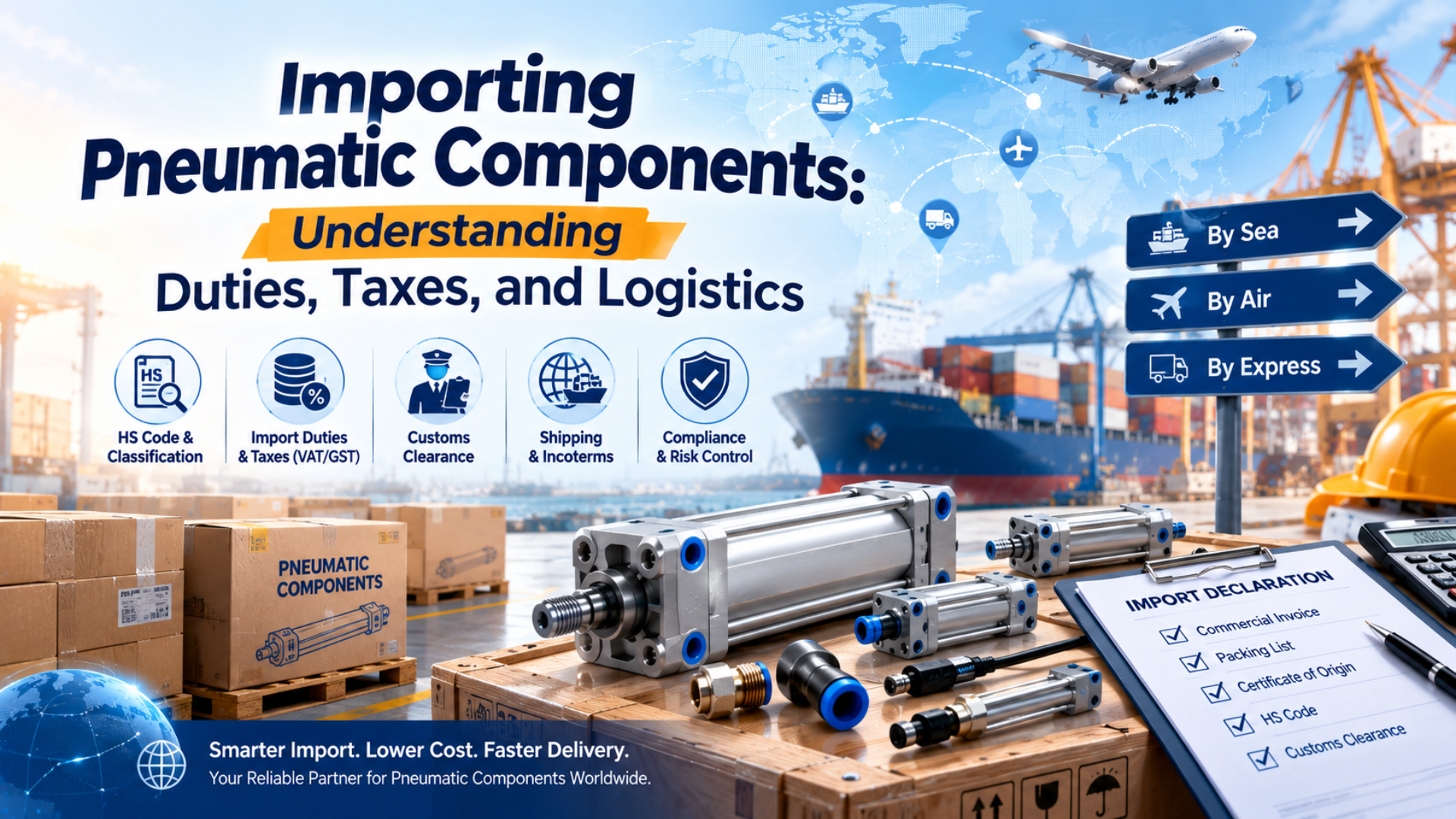
Importing pneumatic components starts with five facts: the exact product, destination-country classification, customs value, country of origin, and entry date. A product name or six-digit HS code alone cannot determine the final duty. Build the quote around current official tariff data, a named Incoterm, documented responsibilities, and an auditable landed-cost worksheet.
The Harmonized System standardizes the first 6 digits, while the United States expands import classifications to 10 digits (International Trade Administration HS guide, accessed 2026). That difference explains why a supplier’s HS suggestion is useful but cannot replace the importer’s destination-country classification review.
Key Takeaways
- Start with the 6-digit HS code, then verify the destination-country extension.
- U.S. FY2026 formal-entry MPF is 0.3464%, subject to official minimum and maximum amounts.
- FOB and CIF are maritime rules; FCA and CIP suit multimodal shipments.
- Record tariff sources, dates, assumptions, and responsible parties before dispatch.
This guide is a procurement-control framework, not a customs ruling or legal opinion. Confirm product-specific treatment with the importer of record, a licensed customs broker, or the destination customs authority before shipment.
Why Can’t You Quote One Duty Rate for Pneumatic Components?
The HS is standardized to 6 digits, but countries add further digits and apply their own tariff measures. A defensible duty quote therefore needs the product classification, customs value, origin, destination, and expected entry date. Missing any one of those inputs can change the payable amount (International Trade Administration, accessed 2026).
For example, 8412.31 is the international starting point for linear-acting pneumatic power engines and motors, commonly described as pneumatic cylinders. It does not automatically settle every product:
- a rotary pneumatic actuator may fall under another subheading;
- a valve-cylinder assembly may need analysis as an assembly rather than two isolated names;
- a replacement part may classify differently from the complete actuator;
- a pneumatic fitting can depend on material, construction, and function;
- an electrically operated valve may trigger product requirements that do not apply to a mechanical cylinder.
The U.S. International Trade Commission currently lists 8412.31.00 for linear-acting pneumatic cylinders in the HTSUS (USITC Harmonized Tariff Schedule, accessed 2026). However, the base classification line is only one layer. Country-of-origin measures, Chapter 99 provisions, exclusions, antidumping or countervailing orders, and other entry requirements may still apply.
Use this five-part classification record:
| Required field | What to record | Why it matters |
|---|---|---|
| Product identity | Complete cylinder, valve, fitting, seal kit, sensor, or assembly | Customs classifies the imported article, not the purchasing department’s generic category |
| Technical function | Linear motion, rotary motion, flow control, pressure control, connection, or repair | Function often separates headings or subheadings |
| Construction | Materials, ports, actuation method, electrical content, and included accessories | Material and assembly state can change classification |
| Origin | Country where the applicable origin rule is satisfied | Trade remedies and preferences usually follow origin, not shipping port |
| Entry facts | Destination, mode, value, and expected entry date | National codes, fees, and temporary measures change over time |
The most useful duty figure in a sourcing comparison is not a percentage copied into a quotation. It is a versioned assumption: classification, origin rule, Chapter 99 result, exclusion reference, retrieval date, and reviewer. That record lets purchasing update one variable without rebuilding the entire comparison.
How Should You Classify a Cylinder, Valve, Fitting, or Repair Part?
CBP’s Binding Ruling Program can issue a pre-entry classification decision, but CBP expressly notes that classification rulings are binding while quoted duty rates are not. For a recurring or high-value pneumatic import, prepare a product dossier detailed enough for a broker, customs specialist, or ruling authority to reproduce the analysis (CBP Binding Ruling Program, accessed 2026).
Start with the article in the condition imported. Do not classify a kit as if every part arrived separately, or classify a bare cylinder as if the shipment included sensors, cables, valves, and mounting hardware.
For a pneumatic cylinder, document:
- linear or rotary output;
- pneumatic operating principle;
- bore, stroke, rod arrangement, and mounting;
- complete actuator versus replacement part;
- included cushioning, guide, sensor, valve, or controller;
- primary materials and country of manufacture;
- drawings, photographs, catalog sheet, and operating description.
For a pneumatic valve, add:
- directional, pressure, flow, isolation, or process function;
- number of ports and positions;
- solenoid, pilot, manual, or mechanical actuation;
- body material, nominal size, and pressure range;
- coil voltage and whether electrical parts arrive installed;
- standalone valve or part of a manifold or machine assembly.
For fittings and tubing, material matters, but function and construction still need documentation. Record whether the article is a tube or pipe fitting, quick coupling, threaded adapter, push-in fitting, silencer, manifold, or another device with a distinct function.
What if two reasonable codes remain? Keep the competing classifications and the reason each was accepted or rejected. For U.S. entries, search CBP’s CROSS rulings for comparable merchandise, then request a binding ruling when the remaining uncertainty is commercially material. A ruling request should describe the actual transaction and product, not an abstract family name.
Supplier documentation can support the process, but the importer of record retains responsibility for using reasonable care. CBP’s importer guidance states that this responsibility remains even when a licensed broker files the entry (CBP Tips for New Importers, accessed 2026).
Building a Defensible Landed-Cost Model
For U.S. FY2026 formal entries, CBP sets MPF at 0.3464% of imported-goods value, with a USD 33.58 minimum and USD 651.50 maximum. The MPF base excludes duty, freight, and insurance. A useful landed-cost model therefore calculates each charge from its own legal or commercial base instead of applying one percentage to CIF (CBP MPF, accessed 2026).
Use a modular formula:
Landed cost is the total cost of acquiring and delivering the goods to the selected receiving point under a declared scope. It should identify included, excluded, estimated, and unresolved charges rather than imply that one commercial term covers every customs, tax, and delivery cost.
Here, is the cost delivered to the chosen receiving point. is the ordinary customs duty, covers applicable trade-remedy or Chapter 99 duties, covers government processing or port fees, and covers destination taxes such as import VAT or GST when applicable.
Do not assume every term is calculated from . In the United States, CBP says the declared value is generally the price paid for the goods, excluding freight and insurance, subject to valuation adjustments and other valuation methods where necessary (CBP Commercial Invoice Value, accessed 2026).
Consider an illustrative U.S. ocean entry with an entered merchandise value of USD 35,000:
The result falls between the FY2026 minimum and maximum. For qualifying commercial cargo unloaded at a covered U.S. port, CBP lists the Harbor Maintenance Fee at 0.125% of cargo value:
HMF does not apply to air or mail shipments, and preference programs can affect MPF treatment. Confirm the current fee rules for the entry rather than copying this example into a future quote (CBP Duties, Taxes and Fees, accessed 2026).
The duty lines remain unresolved until classification, origin, and additional measures are confirmed. That is intentional.
A strong landed-cost sheet shows unresolved variables instead of hiding them inside a single “all-in” figure. Mark duty, trade remedies, freight, exam, demurrage, exchange rate, and inland delivery as confirmed, quoted, estimated, or excluded. Procurement can then compare offers without mistaking a supplier estimate for a customs determination.
For replacement sourcing, compare both offers on the same delivered basis. The OEM versus aftermarket cylinder total-cost guide shows which commercial and technical fields should be normalized before a price decision.
Which Incoterm Fits the Shipment and Transport Mode?
Incoterms 2020 contains 11 rules: 7 for any transport mode and 4 reserved for sea or inland waterway transport. Pneumatic components moving in containers or by combined truck, ocean, rail, and air routes often need FCA or CIP analysis rather than automatic use of FOB or CIF (ICC Incoterms 2020, accessed 2026).
Incoterms allocate delivery, risk, selected costs, carriage obligations, and export or import formalities. They do not determine title transfer, payment terms, product conformity, tariff classification, or remedies for breach unless the sales contract addresses those issues separately.
| Rule | Transport mode | Delivery and risk point | Import clearance |
|---|---|---|---|
| FCA | Any mode | Seller delivers to the buyer’s carrier at the named place | Buyer |
| CIP | Any mode | Risk transfers when seller delivers to the first carrier; seller pays carriage and specified insurance to destination | Buyer |
| FOB | Sea or inland waterway | Goods are placed on board the buyer-nominated vessel at the named port of shipment | Buyer |
| CIF | Sea or inland waterway | Risk transfers on board at origin; seller pays freight and minimum specified insurance to destination port | Buyer |
| DAP | Any mode | Seller places goods at buyer’s disposal at the named destination, ready for unloading | Buyer |
| DDP | Any mode | Seller delivers at the named destination and handles import clearance and duties | Seller |
ICC confirms that CIF is reserved for maritime trade and uses a different default insurance level from CIP. Under CIF, paying freight to the destination does not move the risk-transfer point to the destination (ICC CIF and CIP explanation, accessed 2026).
Name the place precisely:
FCA Seller Factory, Ningbo, China, Incoterms 2020CIP Buyer Warehouse, Lyon, France, Incoterms 2020FOB Shanghai Port, China, Incoterms 2020DAP Buyer Dock, Chicago, Illinois, USA, Incoterms 2020
Avoid FOB China or DDP USA. Those descriptions leave the delivery point, terminal, inland leg, and cost boundary unclear.
In our experience reviewing export quotations, the most common Incoterm problem is not choosing the wrong three-letter rule. It is omitting the named place and edition. Two suppliers can both quote FCA while pricing delivery to different terminals, which makes the totals look comparable when they are not.
DDP deserves special review. The seller must be legally and operationally able to complete import formalities in the destination country. If local rules prevent the seller from acting as importer of record, registering for tax, or recovering import VAT, DAP or another structure may be more workable. Confirm the arrangement before accepting a turnkey price.
What Documents Should Be Locked Before Shipment?
For U.S.-bound ocean cargo, the Importer Security Filing commonly requires 10 data elements. Eight are due no later than 24 hours before cargo is laden, while container-stuffing location and consolidator data are due as early as possible and no later than 24 hours before arrival (CBP ISF timing, accessed 2026).
Build one controlled shipment pack:
| Document or record | Minimum control | Cross-check |
|---|---|---|
| Commercial invoice | Seller, buyer, detailed descriptions, quantities, values, currency, origin, classification, and named Incoterm | Purchase order, payment record, classification file |
| Packing list | Package count, line contents, net and gross weight, dimensions, and marks | Invoice quantities and carrier booking |
| Transport document | Shipper, consignee, notify party, ports or airports, package details, and freight status | Booking confirmation and packing list |
| Origin evidence | Non-preferential origin and preference support when a claim is made | Manufacturing facts and destination origin rule |
| Product dossier | Datasheet, drawing, photographs, materials, function, and model structure | Classification and product-compliance review |
| Import filing instructions | Importer number, broker, bond, entry type, code, value, origin, and additional tariff treatment | Approved tariff worksheet |
| Product-compliance file | Only the declarations, tests, labels, and records actually required for the product and market | Applicable legislation and end use |
Use specific descriptions. “Pneumatic parts” does not distinguish a rodless cylinder from a valve manifold, seal kit, or stainless fitting. A better line reads: “Double-acting rodless pneumatic cylinder, aluminum body, 40 mm bore, 500 mm stroke, without electrical controller,” followed by the verified destination-country code.
The supplier should not substitute its own product name, value, origin, or code after document approval without notifying the importer. Likewise, the packing list and invoice must use the same units, quantities, model numbers, and package references.
Who owns the final entry data? CBP says the importer of record remains ultimately responsible for correctness and applicable duties, taxes, and fees even when a broker is used (CBP Tips for New Importers, accessed 2026). Put approval ownership in the shipment checklist rather than assuming the forwarder has accepted it.
For a replacement valve, the document pack must identify function and electrical configuration, not only the original brand. The OEM solenoid-valve compatibility guide shows the technical fields needed to prevent a commercially correct but functionally wrong shipment.
U.S. Current-Duty Verification Workflow
The U.S. tariff schedule uses a 10-digit import classification, while China-origin Section 301 duties follow country of origin rather than country of export. CBP directs importers to verify exclusions with USTR or seek advisory guidance or a binding ruling when product scope is uncertain (CBP Section 301 FAQ, accessed 2026).
Use this sequence immediately before approving the shipment:
- Freeze the product description. Confirm what arrives together and whether accessories are installed.
- Confirm the HTSUS classification. Use the current USITC schedule, explanatory material, and relevant CBP rulings.
- Determine customs value. Record transaction value and every required addition or alternative method.
- Determine country of origin. Do not substitute the port of loading or seller address.
- Read the HTSUS footnotes and Chapter 99 instructions. Identify every additional reporting number and rate.
- Check Section 301 or other exclusion scope. Match the exact product description, code, origin, and effective dates.
- Screen other measures. Check antidumping or countervailing cases, quotas, licenses, forced-labor controls, and agency requirements where applicable.
- Calculate fees separately. Apply current MPF, HMF, and entry-specific charges to their correct bases.
- Save evidence. Record source URLs, retrieval date, effective date, reviewer, and broker confirmation.
USTR extended 178 specified China Section 301 exclusions through November 9, 2026 (USTR exclusion extension, accessed 2026). This is not a blanket exclusion for pneumatic cylinders. Qualification depends on the precise annex description and entry facts.
If an exclusion or classification drives a major sourcing decision, preserve the cited text and seek a product-specific review. A current web result is evidence of what was checked, but it is not a substitute for the entry record or a binding decision.
What Changes for EU and Other Destination Markets?
The European Union classifies goods under an 8-digit Combined Nomenclature, while TARIC adds two more digits and integrates tariff and trade-policy measures. Importers must therefore replace U.S. HTSUS and Chapter 99 checks with the destination’s own nomenclature, origin rules, tax treatment, and product legislation (European Commission tariff classification, accessed 2026).
Use a jurisdiction matrix:
| Decision | United States | European Union | Other destinations |
|---|---|---|---|
| Classification | 10-digit HTSUS | 8-digit CN plus TARIC measures | National tariff based on the HS |
| Duty modifiers | Chapter 99, preferences, trade remedies | TARIC preferences, suspensions, quotas, trade-defense measures | Country-specific measures |
| Import tax | Entry-specific federal treatment; state or local taxes reviewed separately | Import VAT and local recovery rules | VAT, GST, sales tax, or other local system |
| Product compliance | Product and agency specific | Applicable harmonized product legislation | Local safety, electrical, pressure, environmental, or sector rules |
| Advance certainty | CBP binding ruling | Binding Tariff Information | Destination authority’s ruling process where available |
Do not treat CE marking as a generic import document for every pneumatic component. The European Commission states that CE marking is mandatory only for products covered by harmonized EU rules that specifically require it; otherwise the mark must not be used (EU CE marking guidance, accessed 2026).
The correct question is: which legislation applies to this exact product as placed on the market? A bare mechanical cylinder, an electrically actuated valve, a pressure assembly, and a machine incorporating those parts can have different obligations. RoHS, EMC, low-voltage, machinery, pressure-equipment, and REACH checks must follow scope and product facts.
Food applications require the same discipline. FDA food-facility registration applies to facilities manufacturing, processing, packing, or holding food, not automatically to a pneumatic-cylinder manufacturer. If an imported material is intended to contact food, review the actual food-contact substances and authorized conditions of use (FDA food-contact material guidance, accessed 2026).
Cleanroom, food, and special-environment imports also need technical evidence beyond customs documents. The critical cleanroom cylinder specification guide illustrates how construction, lubricants, materials, and installed qualification differ from a broad compliance label.
What Should a Pneumatic Import RFQ Contain?
A six-digit HS code is only the internationally harmonized starting point, so the RFQ must carry enough technical and commercial detail for destination-country classification and quote comparison. One line per SKU should connect the product specification, origin, quantity, Incoterm, destination, transport mode, document package, and tariff assumptions (International Trade Administration, accessed 2026).
Include these fields:
- product type and complete model;
- drawing, bore, stroke, ports, mounting, materials, and accessories;
- valve function, actuation, voltage, connector, and manifold configuration where applicable;
- quantity per SKU and forecasted repeat volume;
- country of manufacture and requested origin evidence;
- proposed six-digit HS code with a clear statement that destination verification remains required;
- named Incoterm place and
Incoterms 2020edition; - air, courier, LCL, FCL, rail, or multimodal shipping assumption;
- export packing, package dimensions, net weight, and gross weight;
- requested invoice, packing list, origin, test, material, conformity, and inspection documents;
- importer of record and broker responsibilities;
- normal lead time, dispatch window, quote validity, and excluded charges.
Compare quotations using a normalization sheet:
| Comparison field | Supplier A | Supplier B | Accepted basis |
|---|---|---|---|
| Technical scope | Same function, dimensions, materials, and accessories | ||
| Quantity and currency | Same order quantity and conversion date | ||
| Incoterm | Same rule, named place, and 2020 edition | ||
| Transport | Same mode, service level, and destination | ||
| Duty assumptions | Same classification, origin, measures, and entry date | ||
| Documents | Same certificates, reports, and shipment pack | ||
| Warranty and replacement | Same response, exclusions, and return method |
If dimensional interchangeability is part of the purchase, attach interface requirements rather than relying on a standard number alone. See the ISO 15552 cylinder interchangeability guide and the NFPA interchangeable-cylinder guide for the mounting and interface checks that belong in the RFQ.
For supplier documentation or a product-specific export quotation, send the destination, application, SKU list, drawings, expected volume, and requested Incoterm through the contact form. Company manufacturing and quality-control context is available on the About Bepto page.
Pneumatic Component Import FAQs
CBP requires 10 ISF data elements for common U.S.-bound ocean shipments, with 8 due no later than 24 hours before lading. These FAQs address the classification, broker, Incoterm, landed-cost, and DDP decisions that must be settled early enough to keep commercial and filing data consistent (CBP ISF, accessed 2026).
Is HS 8412.31 always correct for a pneumatic cylinder?
No. 8412.31 is the 6-digit HS starting point for linear-acting pneumatic cylinders, but the imported article’s function, assembly state, accessories, and destination-country nomenclature still need review. The United States requires a 10-digit HTSUS number, and a rotary actuator, part, or combined assembly may classify differently.
Does a freight forwarder determine the final duty rate?
No. A forwarder or broker can prepare filings and advise on classification, but the importer of record retains responsibility for entry accuracy. CBP can provide a binding pre-entry classification ruling; CBP also states that classification rulings are binding while the duty rates quoted in them remain subject to change.
Are FOB and CIF suitable for air freight?
No. ICC divides Incoterms 2020 into 7 rules for any transport mode and 4 maritime rules. FOB and CIF are reserved for sea or inland waterway transport. For air or multimodal container traffic, review FCA, CPT, or CIP based on the intended delivery, carriage, and insurance responsibilities.
What costs belong in pneumatic-component landed cost?
Include goods, freight, insurance, base and additional duties, government fees, broker, terminal, inland transport, and applicable import tax. Calculate each from its correct base. For U.S. FY2026 formal entries, MPF is 0.3464%, subject to the current USD 33.58 minimum and USD 651.50 maximum.
Does DDP remove every obligation from the buyer?
No. DDP assigns import clearance and duty responsibility to the seller under Incoterms 2020, but it does not settle product conformity, payment, title, tax recovery, or the seller’s legal ability to act as importer. The buyer should verify the named place, importer-of-record structure, included taxes, and excluded destination charges.