

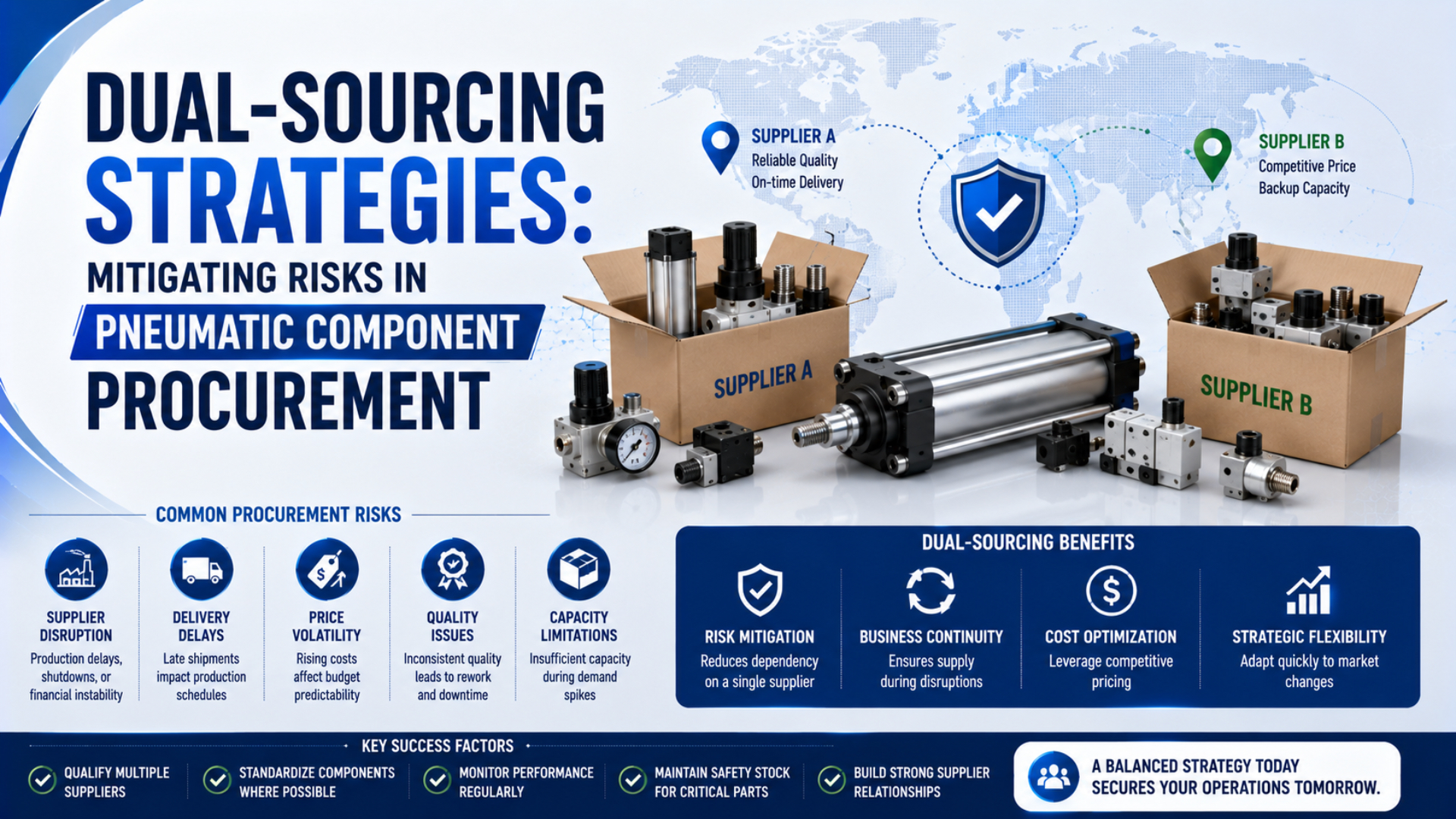
Dual sourcing is the controlled use of two suppliers for the same approved requirement. A second quotation is not enough. However, the alternate must reproduce an approved configuration and retain validated production evidence, usable capacity, current commercial terms, and a documented route for taking over demand.
No allocation is universally correct. A 70/30 or 60/40 split is not a rule. Therefore, the appropriate share depends on demand, capacity, lead time, minimum order quantity, qualification status, landed cost, and the recurring business needed to keep the alternate ready. Research on severe disruption risk describes supplier consolidation as a trade-off between scale economies and diversification, not as a problem with one fixed answer (Goldschmidt et al., 2021).
Key Takeaways
- Qualify the product, process, production site, and current drawing revision—not only the supplier’s company name.
- Map shared raw materials, sub-tier suppliers, tooling, geography, ports, and logistics before treating two sources as independent.
- Determine allocation from capacity and activation needs instead of copying a universal ratio.
- For ISO 15552 cylinders, the standard covers a 32-320 mm bore dimensional series at up to 1,000 kPa; it does not guarantee complete functional interchangeability.
Where Dual Sourcing Reduces Exposure
Dual sourcing can provide another route when an approved supplier experiences a site outage, capacity constraint, quality containment, transport interruption, or commercial failure. In addition, it can provide comparison data for lead time and quality. Responsiveness and total delivered cost also become visible. The benefit comes from a usable alternative, not from supplier count alone.
The strategy is most relevant to a component whose unavailability can interrupt production, delay a machine build, or prevent maintenance recovery. Specifically, start by classifying the purchased item:
| Item characteristic | Why it affects the sourcing decision | Typical control |
|---|---|---|
| Standard, widely available component | Substitution may be relatively fast, but interfaces and ratings still require confirmation | Approved cross-reference and receiving inspection |
| Configured catalog component | Options such as stroke, seal, sensor, connector, or port orientation can block substitution | Controlled configuration record and sample validation |
| Customer-specific component | Drawings, tooling, materials, tests, and intellectual property may prevent rapid transfer | Dual qualification, tooling plan, change control, and capacity evidence |
| Safety- or regulation-relevant component | A change may require additional engineering, compliance, or customer approval | Formal approval authority and documented validation |
| Long-lead or capacity-constrained component | A supplier may be technically capable but unable to respond during a surge | Reserved capacity, release rules, or protected inventory |
Dual sourcing does not eliminate demand uncertainty, poor specifications, weak inventory control, or correlated upstream failures. In fact, it can add complexity. Two suppliers create separate change-notification channels and performance records. They also add validation work and opportunities for configuration drift, so those costs belong in the business case. In contrast, the pneumatic VMI guide addresses replenishment ownership, while the pneumatic stock-planning guide covers asset criticality and inventory buffers. This article owns a different decision: qualifying and activating two production routes.
Why Can Two Suppliers Still Fail at the Same Time?
Common-cause risk is the exposure created when nominally separate sources depend on the same critical node. For example, two tier-one suppliers may use the same extrusion mill, seal compound, magnet supplier, casting source, port, logistics corridor, energy network, or production region. They may also use the same customer-owned tooling or subcontract the same special process. A disruption at that shared node can disable both nominal sources.
Accordingly, NIST recommends mapping supplier locations, sub-tier relationships, transportation routes, and geographic concentrations. Hidden tier-two and tier-three dependencies can reveal bottlenecks that are not visible in a tier-one supplier list (NIST MEP, 2024).
For every critical pneumatic component, ask both suppliers:
- Production route: name the approved site.
- Shared inputs: disclose whether raw materials, proprietary profiles, seals, electronics, or magnets have one upstream source.
- Transport: record the normal port, carrier, border route, and practical alternative.
- Control assets: confirm access to customer-owned drawings, gauges, tooling, test programs, work instructions, and the method for reporting sub-tier or site changes.
Supplier confidentiality may limit the names disclosed. That said, the buyer can still request structured evidence: country or region, single-source status, alternate-site status, recovery lead time, ownership, last review date, and the person responsible for escalation.
A useful dual-source record has two separate statuses: technically qualified and operationally activated. Technical qualification confirms that the part and process meet defined requirements. Supplier activation is the confirmation that the source can still access the current revision, material, tooling, people, production route, and capacity when an order is released. In other words, approval records the evidence; activation tests whether that evidence remains usable.
How Should One Specification Control Both Sources?
Supplier comparisons fail when each source quotes a different interpretation of the requirement. Therefore, create one buyer-controlled specification baseline and require every quotation, sample, approval, and production release to reference it.
For a pneumatic cylinder, that baseline can include:
- Geometry: define the installation envelope.
- Duty: working and rated pressure; speed range; load, moment, and side-load limits; cushioning; expected cycling.
- Environment and controls: seal and lubricant restrictions, air quality, temperature, chemicals, washdown, corrosion, sensors, connectors, and control interfaces.
- Release evidence: define acceptance tests and inspection characteristics, then control traceability, packaging, approved deviations, drawing revision, change-notification rules, effective dates, and approval authority.
ISO 15552 establishes basic, mounting, and accessory dimensions for a detachable-mount cylinder series from 32 mm to 320 mm bore with a maximum rated pressure of 1,000 kPa. Its purpose is dimensional interchangeability within that scope (ISO 15552:2018, confirmed 2025). However, it does not standardize every seal, sensor, cushioning characteristic, port choice, material, performance limit, or accessory configuration. Small configuration details can still block substitution: thread form; sensor pinout; magnet polarity; grease chemistry; cushion-adjuster access; anodizing requirement; connector keying. Record them before samples are ordered. Check serial-number traceability and calibration lineage. Where applicable, verify firmware revision, plating chemistry, and lubricant-batch continuity. For configured assemblies, also review lot genealogy and gauge repeatability. Include torque tooling, crimp profile, adhesive cure, desiccant packaging, label template, and customs classification.
Use the ISO 15552 procurement checklist to build a complete RFQ, then apply the separate ISO 15552 interchangeability checklist when comparing a proposed alternate with an installed unit.
Other products need different interface sets. Similarly, do not use the existence of an ISO 9001 certificate as product approval. ISO and IAF guidance treats procurement control as a broader process involving correct purchasing requirements, defined provider criteria, verification, monitoring, and risk-based controls (ISO 9001 Auditing Practices Group).
What Evidence Qualifies the Second Supplier?
Qualification should follow the consequence of failure and the novelty of the component; for instance, a standard fitting may need documented specification review and sample inspection. A custom rodless cylinder on a constrained machine axis may require drawing approval and material evidence. It may also need dimensional inspection, functional tests, load verification, endurance evidence, and installation validation.
Therefore, use gates instead of a universal calendar:
| Qualification gate | Decision question | Minimum evidence |
|---|---|---|
| Requirement review | Does the supplier understand the controlled configuration and application duty? | Signed specification review, deviations, assumptions, and responsible contacts |
| Capability review | Can the named production site make and test the component? | Process route, equipment, subcontractors, capacity basis, quality controls, and change process |
| Sample or first article | Does a representative unit conform to the approved requirements? | Identified sample, drawing revision, inspection and test results, deviation disposition |
| Machine validation | Does the alternate operate safely and acceptably in the real system? | Installation record, interface check, functional results, controls compatibility, approval |
| Production release | Can repeat production preserve the approved configuration? | Released part number, control plan or equivalent controls, records, packaging, lead time |
| Activation review | Can the supplier accept and execute the failover order now? | Current revision acknowledgement, material/tooling availability, confirmed capacity, commercial release path |
The supplier’s management-system certificate is one input. Importantly, verify the organization name, certified site, standard, scope, status, certification body, and accreditation relationship. IAF CertSearch provides certificate status, scope, certified locations, certification body, and accreditation body for participating accredited certificates (IAF CertSearch). A valid certificate still does not prove that the particular pneumatic component has passed the buyer’s technical approval.
NIST similarly separates supplier discovery from buyer vetting: a capability match only starts qualification (NIST MEP Supplier Scouting).
In our experience reviewing quotations, the fastest way to expose a false backup is to ask for the exact drawing revision, production site, validation record, and achievable quantity for a dated release. A supplier may recognize the part number but no longer have current material, tooling access, or approved production instructions.
Volume Allocation Without a Fixed Ratio
Treat volume allocation as an output of constraints and objectives. In particular, do not begin with a percentage copied from another company.
Build a scenario table using:
- Demand: forecast volume and recovery tolerance.
- Supply: approved site capacity, normal lead time, recovery lead time, MOQ, release quantity, and material commitments.
- Economics: total landed cost under common currency and delivery assumptions, plus inventory and obsolescence exposure.
- Readiness: use quality, delivery, responsiveness, and change-control evidence to determine the recurring work needed to keep the alternate’s real production route current.
For example, concentrating volume with the stronger source may improve price and process learning but leave the alternate dormant. Conversely, a more even split can preserve active capability while duplicating administrative work and weakening volume discounts; a small allocation has value only if it is large and frequent enough to exercise the real production route.
Review the allocation after a documented trigger rather than shifting business informally. Specifically, relevant triggers include a drawing change, site move, new sub-tier source, quality containment, sustained delivery deterioration, capacity change, demand step, freight-route change, certificate-status change, or unsuccessful failover exercise. Define who can approve a temporary or permanent reallocation.
No public calculator resolves allocation because the inputs are buyer-specific. However, international offers still need one landed-cost assumption set.
Keeping the Alternate Source Ready
An approved source can decay. Drawings change and tooling deteriorates; materials become obsolete; capacity moves elsewhere. Therefore, the original approval date says little about today’s material availability, tooling condition, trained labor, or committed capacity.
Operational readiness is perishable.
Maintain one source-control record:
| Control block | Information to keep current |
|---|---|
| Identity | Approved company, production site, subcontracted special processes, and buyer/supplier part numbers |
| Configuration | Drawing and specification revisions, materials, deviations, approved samples, and validation reports |
| Assets | Tooling and gauge ownership, location, condition, access, and transfer restrictions |
| Supply | Normal capacity, surge assumptions, lead times, last confirmation, and certificate scope where required |
| Readiness | Last production exercise, open changes, corrective actions, commercial restrictions, and escalation contacts |
The exercise does not have to imitate a crisis. Instead, a controlled production release can confirm that the supplier retrieves current data, buys the correct material, runs the approved process, generates required records, and ships an accepted unit. Set the interval from component criticality and the rate of design or supply-route change. ISO and IAF procurement guidance calls for current approved-provider information, purchasing against defined criteria, verification, and effective performance monitoring. Those controls support dual sourcing only when applied to each approved production route, not merely recorded at corporate level.
Supplier scorecards should define their denominators. Specifically, “on-time delivery” is ambiguous unless the record states the promised date, allowed window, order-line treatment, partial-shipment rule, buyer-caused exclusions, and data source. Defect rate should distinguish incoming rejection from production escape or field failure. Response time should separate acknowledgement, containment, and permanent corrective action.
Writing an Executable Failover Playbook
A failover plan should be executable without inventing approvals during the disruption. Therefore, write it before the alternate source is needed.
Define:
- Trigger: name the initiating condition.
- Decision authority: who releases alternate-source orders and approves technical deviations.
- Demand and priority: which machines, customers, or service orders receive constrained supply first—and who can change that sequence.
- Configuration and capacity: record the permitted revision and deviations, then obtain a dated statement of available quantity, start date, production route, material constraint, and ramp assumption.
- Inspection and release: whether source inspection, incoming checks, functional testing, or temporary containment changes during failover.
- Data and tooling access: how drawings, programs, gauges, tooling, and test equipment can be used or transferred.
- Communication and recovery: contacts, reporting cadence, customer-notification responsibility, and criteria for restoring the original allocation.
Meanwhile, commercial agreements should address forecast status, cancellation, capacity commitments, change notification, confidentiality, intellectual property, tooling, audit access, records, and termination. A generic force-majeure phrase is not a complete continuity plan. The ICC model clause, for example, defines conditions, notification, mitigation, and consequences. It also allows parties to adapt events and terms to their circumstances (ICC Force Majeure and Hardship Clauses, 2020).
Contract language and remedies depend on governing law and the negotiated agreement. Have qualified legal counsel review the final terms while engineering and procurement separately confirm that the technical failover can be executed.
Dual-Sourcing Pneumatic Components FAQs
Is dual sourcing always safer than single sourcing?
No. Dual sourcing helps only when the alternate is qualified and avoids the same critical failure mode. Shared material, tooling, production region, or logistics can defeat the strategy; compare the remaining exposure with inventory, redesign, or capacity reservation. One source may still be preferable.
How should two suppliers be qualified for the same pneumatic part?
Give both suppliers one controlled requirement, then review the named site’s capability, sample evidence, machine compatibility, repeat-production controls, change process, and current capacity. Approval must identify the exact part, revision, site, and permitted deviations; a certificate or quotation does not approve the component.
Must pneumatic parts from both suppliers be dimensionally identical?
Required machine interfaces must match the approved specification, but dimensional similarity is insufficient; check pressure rating, materials, seals, cushioning, sensors, ports, flow behavior, environment, records, and controls compatibility. ISO 15552 defines selected cylinder dimensions; it does not standardize every functional characteristic.
What is the best volume split between primary and secondary suppliers?
There is no universal percentage. Model demand, approved capacity, lead time, MOQ, landed cost, quality, inventory, and the work needed to keep the alternate active. Record the reason and review triggers; a nominal share that never exercises production may not preserve readiness.
How often should the backup supplier be tested?
Match the interval to component criticality. Recheck after changes to the drawing, site, process, sub-tier source, tooling, or capacity. A controlled order gives stronger evidence than an email because it runs the whole chain from data retrieval through accepted delivery.
Sources and Technical References
- OECD Supply Chain Resilience Review, OECD, 2025.
- Mapping Your Supply Chains Helps Prioritize Risks, Actions, NIST Manufacturing Extension Partnership, 2024.
- Supplier Scouting, NIST Manufacturing Extension Partnership.
- Guidance on External Providers, ISO 9001 Auditing Practices Group and IAF.
- ISO 15552:2018, Pneumatic fluid power cylinders with detachable mountings.
- IAF CertSearch, International Accreditation Forum certificate-verification database.
- Strategic Sourcing Under Severe Disruption Risk, Goldschmidt, Kremer, Thomas, and Craighead, 2021.
- ICC Force Majeure and Hardship Clauses, International Chamber of Commerce, 2020.