
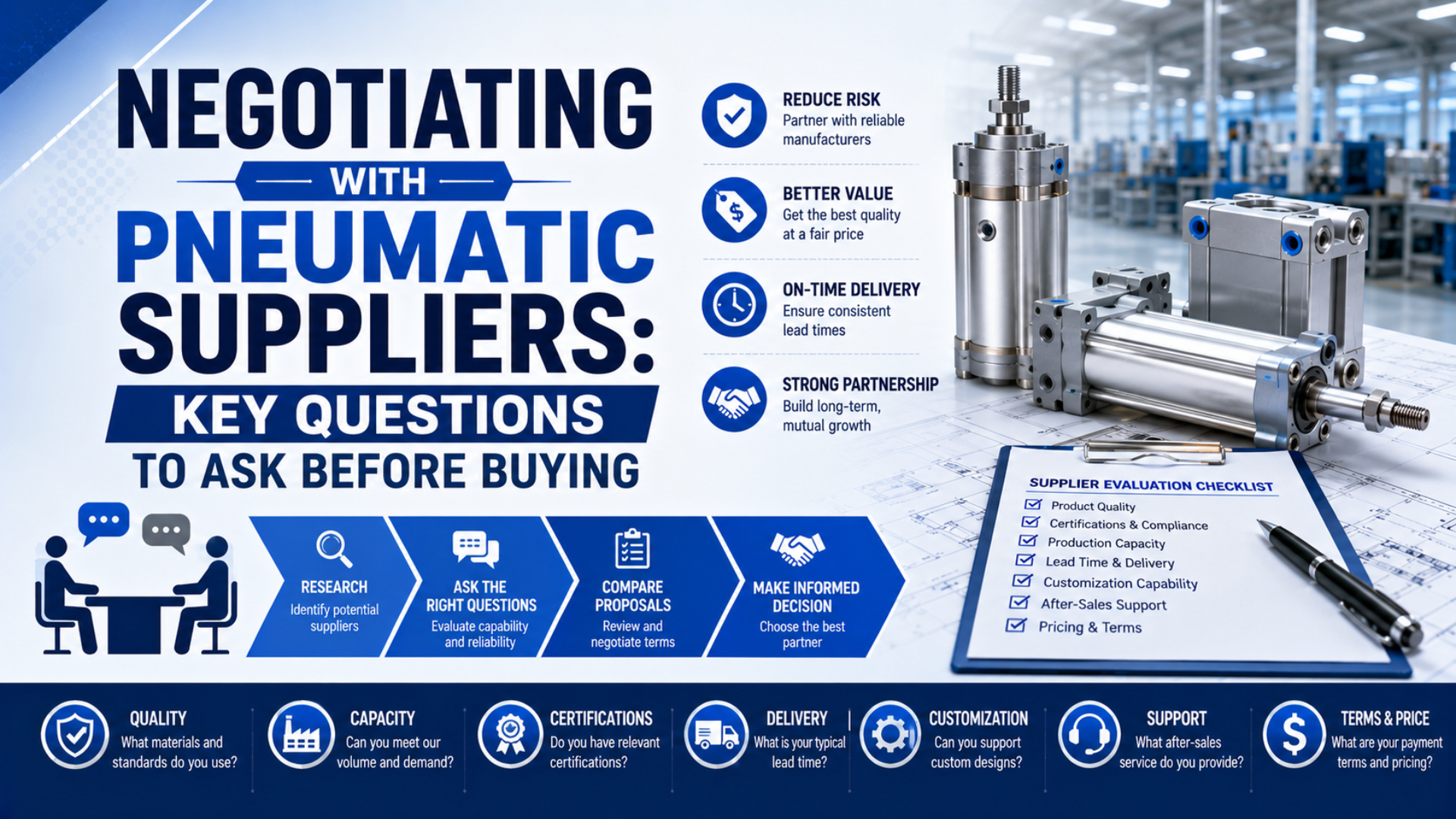
Negotiating with pneumatic suppliers works best when every promise becomes a comparable field, a named document, or a measurable acceptance test. Price matters, but it should be negotiated only after the buyer has controlled technical compliance, delivery definitions, inspection evidence, change notification, warranty remedies, and the exact commercial scope.
The practical goal isn’t to extract the lowest unit price. It is to approve a supplier and an offered configuration that purchasing, engineering, quality, maintenance, and logistics can all understand. That requires a requirement sheet, a compliance matrix, a normalized quote, and a controlled trial order.
Key Takeaways
- ISO 9001 certification covers a management system, not the conformity of an individual pneumatic component.
- Incoterms 2020 contains 11 rules, so every international quote needs the selected rule and an exact named place.
- Negotiate evidence, definitions, exceptions, and remedies before discussing the final price.
In this guide
- What Should You Define Before Negotiating?
- How Can You Verify a Pneumatic Supplier’s Quality Claims?
- Which Delivery Questions Expose Real Capacity?
- Normalizing Price and Commercial Terms
- What Technical Support and Change Control Should You Require?
- Testing a New Pneumatic Supplier
- How Should You Score the Supplier and Close the Negotiation?
- Pneumatic Supplier Negotiation FAQs
What Should You Define Before Negotiating?
ISO 15552:2018 covers detachable-mount pneumatic cylinders from 32 to 320 mm bore at a maximum rated pressure of 1,000 kPa, or 10 bar. That defined scope is useful, but it doesn’t specify every port, rod end, seal, sensor, cushion, material, or application duty (ISO 15552).
Start with the application requirement, not a supplier’s catalog code. For each line item, record the installed function, operating conditions, interfaces, quantity, evidence, and acceptance criteria. If the team cannot describe what must be accepted, it isn’t ready to negotiate an alternative.
For an ISO-profile cylinder, use the ISO 15552 cylinder procurement checklist to control bore, stroke, mounting, ports, rod end, cushioning, sensing, materials, environment, and required documents. For an installed replacement, the separate ISO 15552 interchangeability workflow covers drawing comparison and first-article release.
Build a requirement-to-offer matrix
Technical compliance is a documented match between the buyer’s controlled requirement and the supplier’s exact offer. Send the same matrix to every bidder. Require one of four responses for every row: complies, deviates, supplier proposes, or not applicable. Silence shouldn’t be interpreted as compliance.
| Requirement field | Buyer entry | Supplier response | Evidence required |
|---|---|---|---|
| Product identity | Manufacturer, family, complete part number, revision | Exact offered identity | Part-code decoder and current data sheet |
| Mechanical interface | Bore, stroke, mounting, rod end, installed envelope | Complies or marked deviation | Configured drawing |
| Pneumatic interface | Port thread, size, location, pressure, air quality | Complies or marked deviation | Option-specific technical data |
| Motion duty | Load, orientation, speed, cycle rate, cushioning demand | Accepted limits | Application review |
| Environment | Temperature, contaminants, washdown, chemicals, corrosion | Accepted limits | Material and environmental evidence |
| Electrical options | Sensor type, voltage, output, connector, cable | Exact configuration | Wiring data and sensor part number |
| Acceptance | Dimensions, leakage, function, documentation | Proposed inspection method | Inspection and test plan |
| Commercial scope | Quantity, delivery location, packaging, warranty | Complete quotation | Quote and terms |
What happens when two suppliers interpret a requirement differently? The matrix exposes the difference before it becomes a purchase-order dispute. It also keeps a low price from masking a missing sensor, different port thread, unquoted mounting, or unaccepted operating condition.
Treat exceptions as part of the offer, not as notes hidden under the quotation. The accepted compliance matrix, drawing, and deviation list should share a revision with the purchase order. This creates a traceable baseline for the sample, production lot, and future reorder.
How Can You Verify a Pneumatic Supplier’s Quality Claims?
ISO states that certification to ISO 9001 is voluntary, that ISO does not certify organizations, and that certification is performed by independent certification bodies. A certificate can support supplier qualification, but it doesn’t certify the offered cylinder, valve, fitting, or assembly (ISO certification; ISO 9001 explained).
Ask for the certificate before the negotiation meeting, then check:
- legal organization name and production-site address
- standard and edition
- activities and product scope covered
- certificate number, issue date, expiry date, and current status
- certification body and any stated accreditation
- whether the quoted product is made at the certified site
A logo on a quotation isn’t enough. Nor is a certificate issued to a trading office if the buyer needs control of the manufacturing site. When the supply chain contains a manufacturer, exporter, distributor, and service company, map each party’s role.
Where accredited certificate data are available, cross-check the organization and certificate status through IAF CertSearch. Resolve any mismatch with the certification or accreditation body instead of treating a PDF copy as final proof.
Private-label programs add brand ownership, tooling, artwork, and production-release responsibilities. Use the dedicated private-label pneumatic cylinder manufacturer qualification guide when those obligations are part of the purchase.
Ask for product evidence, not a universal defect-rate promise
ISO 2859-1:2026 provides sampling plans indexed by acceptance quality limit, or AQL, for inspection by attributes. The standard uses lot size, inspection level, sample size, acceptance criteria, and switching rules; it does not turn AQL into the supplier’s actual process defect rate (ISO 2859-1:2026).
The buyer should define inspection according to characteristic risk:
| Characteristic | Useful evidence | Buyer decision |
|---|---|---|
| Safety or regulatory feature | Applicable declaration, controlled test, and traceability | Define required conformity and escalation |
| Critical interface | Drawing characteristic and measurement record | Define first-article and lot controls |
| Functional performance | Pressure, leakage, stroke, sensor, or switching test | Define method, conditions, and pass limit |
| Material or seal | Material declaration, certificate, or supplier-controlled specification | Define lot linkage and substitution rules |
| Cosmetic feature | Approved visual standard and examples | Define acceptable and rejectable conditions |
Don’t ask, “What is your defect rate?” and stop there. Ask for the numerator, denominator, period, product scope, detection point, exclusions, and treatment of rework. Supplier PPM, incoming rejects, warranty returns, and line stoppages measure different events.
Verify inspection and measurement control
ISO 10012:2026 is the second edition of the measurement-management standard and was published in February 2026. It addresses confidence in the validity and reliability of measurement results used for design, production, testing, monitoring, and service delivery (ISO 10012:2026).
For critical measurements, request the instrument type, identification, status, method, environmental conditions, operator competence, result, and acceptance limit. “Calibrated” doesn’t prove the instrument was suitable for the tolerance, in date when used, or applied with the correct method.
NIST explains that metrological traceability belongs to a measurement result and requires a documented, unbroken calibration chain in which each link contributes measurement uncertainty. An instrument label alone cannot establish that chain for a specific acceptance result (NIST).
For double-acting single-rod pneumatic cylinders, ISO 10099:2001 defines final functional examination and acceptance criteria. Its four-page scope remains current after confirmation in 2023, but application-specific checks still belong in the buyer’s plan (ISO 10099).
Which Delivery Questions Expose Real Capacity?
ISO 19011:2026 is the fourth edition of the management-system auditing guideline. It covers audit principles, audit-program management, conducting audits, and auditor competence, making it a useful framework when delivery risk justifies a structured second-party supplier audit at the relevant production site (ISO 19011:2026).
Begin by defining the delivery metric. “On time” can mean the requested date, the supplier-confirmed date, the original promise, the latest accepted reschedule, departure from the factory, arrival at the buyer, or receipt after inspection. Those definitions produce different results.
On-time delivery is the share of eligible orders, lines, units, or shipments meeting a stated delivery condition and reference date. Define that denominator, event, and date before accepting a percentage.
For instance, a supplier may quote lead time from approved drawing release while the buyer assumes it starts when the purchase order is sent. Both parties can repeat the same number and still commit to different dates.
Ask the supplier to return:
- measurement period and eligible orders
- unit of measure: order, line, unit, or shipment
- reference date and treatment of approved reschedules
- definition of complete delivery
- exclusions, cancellations, and partial shipments
- monthly results for the relevant product family or production site
- causes of misses and corrective actions
A percentage without that denominator is just a sales statement. For a new supplier, raw line-level evidence or a limited pilot is more useful than a company-wide presentation covering unrelated products.
Separate quoted lead time from capacity evidence
Use direct questions:
- When does quoted lead time start: purchase-order receipt, drawing approval, deposit, or material availability?
- Does it include inspection, documentation, packing, export clearance, and transport?
- Which materials or bought-out items control the schedule?
- What capacity is committed to this product family?
- How are shortages, machine failures, holidays, and rejected lots handled?
- Which date triggers escalation, and who owns the recovery plan?
- Can the supplier split a shipment without written approval?
If demand can change, provide a baseline, forecast horizon, firm window, maximum release, and expected surge scenario. Don’t ask whether the supplier “can double volume.” Ask what notice, material commitment, tooling, labor, qualification, and recovery steps the stated surge requires.
When a capacity claim requires an on-site audit, use the cylinder factory capability evaluation guide to trace one real order through machining, measurement, assembly, testing, packing, and shipment.
The contract should distinguish a forecast from a purchase commitment. It should also state whether a late-delivery remedy is a service credit, premium freight, cancellation right, recovery plan, or another agreed action. Local law and the negotiated contract determine enforceability, so legal review may be appropriate.
Normalizing Price and Commercial Terms
Incoterms 2020 contains 11 rules. ICC explains that delivery and risk transfer are tied together under those rules, while the C-rules can separate the risk-transfer point from the destination to which the seller pays transport. Fix that distinction in every competing quotation (ICC, 2025).
Compare quotations only after every supplier prices the same technical configuration and commercial boundary. A lower unit price may exclude mounting hardware, sensors, inspection documents, special packaging, freight, insurance, duty, or bank charges included elsewhere.
| Quote field | Required entry | Comparison risk if blank |
|---|---|---|
| Product | Exact manufacturer, part number, revision, and included accessories | Unlike configurations appear equivalent |
| Quantity | MOQ, price break, release quantity, and annual assumption | Volume price can’t be reproduced |
| One-time charges | Tooling, engineering, qualification, samples, and documentation | First order looks artificially cheap |
| Packaging | Unit protection, labels, pallet, moisture control, and returnable items | Damage and handling costs move to buyer |
| Freight term | Incoterms 2020 rule and exact named place or point | Cost and risk boundaries remain unclear |
| Timing | Production lead time, shipment method, transit estimate, and validity | Arrival date is inferred from incomplete data |
| Payment | Currency, deposit, milestone, due date, and bank charges | Cash cost and exposure differ |
| Warranty | Start point, duration, remedy, exclusions, and freight responsibility | Nominal periods hide different coverage |
| Price change | Effective date, notice, index or cause, open-order treatment | Future releases have unknown exposure |
Total evaluated cost is the sum of comparable quoted charges plus clearly labeled buyer-specific cost scenarios. It isn’t a universal total-cost percentage. For example, a spare-kit price is a supplier quote, while expected downtime exposure is the buyer’s scenario. Combining them without labels creates false precision.
Negotiate volume without inventing discount tiers
Ask each bidder for the same quantity breaks, forecast basis, firm release window, MOQ, order multiple, and price-validity period. If an annual agreement is proposed, state whether the commitment is a forecast, minimum annual purchase, blanket order, or scheduled release.
Payment terms depend on credit review, jurisdiction, order risk, tooling, and supplier policy. Request the offered terms in writing. Don’t publish Net 30, Net 60, or Net 90 as universal expectations, and don’t assume a longer payment period is free if it changes the price or security requirement.
What Technical Support and Change Control Should You Require?
ISO’s supply-chain guidance for ISO 9001 states that the standard does not define requirements for the goods or services being purchased. Buyers must communicate their needs through product specifications, drawings, standards, catalog references, or other suitable information (ISO supply-chain guide).
Technical support should be negotiated as an operating process. Ask who receives application questions, what information is required, how severity is classified, who can approve deviations, and what output closes the request. A vague promise of “24/7 support” doesn’t establish engineering competence or response ownership.
For a pneumatic application, request the support package that fits the risk:
- configured 2D drawing and neutral 3D model
- current data sheet and option-code explanation
- material, seal, lubricant, sensor, and accessory identification
- application review inputs and written limits
- installation, commissioning, maintenance, and troubleshooting instructions
- first-article or sample review support
- nonconformance response and corrective-action ownership
Ask for a response target by severity, but define the event. An acknowledgment isn’t a technical answer, and a technical answer isn’t a corrective action. Track time to acknowledgment, containment, root-cause response, and accepted closure separately where those stages matter.
Freeze product changes
The purchase agreement should identify which changes require notice or approval:
- manufacturing site
- drawing or part-number revision
- dimensions, tolerances, materials, seals, lubricant, coating, or process
- sub-supplier for a critical characteristic
- test method or acceptance criteria
- packaging, labeling, traceability, or documentation
- discontinuation or end-of-life status
Specify the notice recipient, minimum information, affected lots, proposed effective date, qualification evidence, and buyer disposition. “Equivalent material may be used” is not a change-control system.
For a cross-supplier replacement, connect this clause to the approved drawing, first-article record, and golden sample. The pneumatic cylinder standardization guide can then control approved alternatives across multiple machine positions.
The same logic applies to replacement valves. The solenoid valve compatibility checklist separates coil, connector, port, flow, pressure, manual override, and circuit-function evidence before a substitute is released.
Testing a New Pneumatic Supplier
ISO 2859-1:2026 is an 82-page standard for acceptance sampling by attributes, while ISO 10099:2001 is a four-page pneumatic-cylinder final-examination standard. Their different scopes show why a trial order needs both a lot decision and product-specific acceptance criteria (ISO 2859-1; ISO 10099).
Use a staged release:
- Document review: approve the compliance matrix, drawing, part code, inspection plan, traceability, and commercial boundary.
- Sample or first article: inspect critical interfaces, materials or declarations, function, markings, documentation, and packaging.
- Machine trial: confirm installation, leakage, motion, sensing, cushioning, environment, and maintenance access under the real duty.
- Controlled production lot: apply the agreed lot-inspection plan and monitor delivery, defects, response, and document accuracy.
- Approved release: freeze the accepted identity, revision, site, evidence, and reorder rules.
Each stage should have an exposure limit and a named release authority. A sample can prove that one item passed defined checks; it cannot prove stable capacity or future lot conformity. A controlled lot adds process evidence without turning the entire installed base into a supplier experiment.
Keep a qualified backup where business risk requires it, but verify that the backup’s exact configuration and documents remain current. If recurring demand justifies supplier-managed stock, move the replenishment rules into the separate pneumatic VMI guide.
How Should You Score the Supplier and Close the Negotiation?
ISO 19011:2026 contains 46 pages of guidance on audit programs, audit conduct, and auditor competence. It doesn’t prescribe a pneumatic supplier score, so the buyer must weight technical, quality, delivery, commercial, and support criteria according to application risk (ISO 19011:2026).
A 100-point scorecard can make the decision visible, provided the weights are buyer-defined and the evidence rules are fixed before bids are opened:
| Evaluation area | Example weight | Required evidence |
|---|---|---|
| Technical compliance | 30 | Completed matrix, configured drawing, deviations, application acceptance |
| Quality and traceability | 25 | Certificate scope, inspection plan, measurement records, lot traceability |
| Delivery and continuity | 20 | Metric definition, relevant history, lead-time basis, capacity and recovery plan |
| Commercial terms | 15 | Normalized quote, Incoterms boundary, validity, payment, warranty, price change |
| Support and change control | 10 | Named contacts, response stages, technical documents, notification process |
These weights are a template, not an industry benchmark. Increase technical and quality weight for safety-related or regulated applications. Increase continuity weight where one missing cylinder can stop a line. Record every score against evidence, not presentation quality.
Close the negotiation with a written action list:
- accepted technical and commercial baseline
- unresolved deviations, owner, and due date
- sample or trial quantity
- inspection and machine-test criteria
- delivery date definition and escalation contact
- Incoterms 2020 rule and exact named place
- warranty and nonconformance remedies
- change-notification requirements
- conditions for production approval
The final question is simple: can another buyer reconstruct the decision from the record six months later? If not, the negotiation is still relying on memory and verbal assurances.
Pneumatic Supplier Negotiation FAQs
Incoterms 2020 has 11 rules, ISO 2859-1:2026 governs attribute sampling plans, and ISO 9001 certification applies to a management system rather than an individual component. Those three boundaries explain why supplier selection must combine commercial definitions, product evidence, and controlled acceptance (ICC; ISO 2859-1).
What is the most important question to ask a pneumatic supplier?
Ask the supplier to identify every deviation from the controlled requirement and provide evidence for each claimed compliance. This question is more useful than asking only for price or an on-time percentage because it exposes technical scope, missing documentation, assumptions, and exceptions before they enter the purchase order.
Does ISO 9001 certification prove a pneumatic component is high quality?
No. ISO 9001 certification concerns the organization’s quality management system, and ISO does not certify organizations itself. Verify the certificate’s organization, site, scope, dates, and certification body, then separately approve the offered component through drawings, specifications, inspection evidence, samples, and application tests.
What delivery metric should buyers request?
Request a defined metric, not just “on-time delivery.” State the measurement period, order or line denominator, requested or confirmed reference date, treatment of accepted reschedules, definition of complete delivery, exclusions, and relevant product scope. Then inspect the underlying results and corrective actions for missed commitments.
How should buyers compare pneumatic supplier prices?
First confirm that every quote covers the same accepted technical configuration. Then normalize accessories, one-time charges, packaging, freight, duty, currency, payment, warranty, and price-change terms. For international trade, record the Incoterms 2020 rule and exact named place so cost and risk boundaries aren’t inferred.
Should a buyer switch the full order volume after one sample passes?
Usually not. A passing sample verifies one item against defined checks; it doesn’t establish stable lot conformity, capacity, delivery performance, or change control. Use document approval, first article, machine trial, controlled production lot, and formal release stages, with an exposure limit and release owner at every gate.
Sources and technical references
- ISO 9001 explained
- ISO certification and conformity assessment
- ISO 9001 guidance for the supply chain
- ISO 15552:2018 pneumatic cylinder dimensions
- ISO 2859-1:2026 acceptance sampling
- ISO 10012:2026 measurement management
- ISO 10099:2001 pneumatic cylinder final examination
- ISO 19011:2026 management-system auditing
- ICC: Place of delivery and risk transfer under Incoterms 2020